Why Saw Cut Concrete Joints Fail Before the Blade Even Touches the Slab
Most joint failures in flatwork aren’t caused by bad timing or poor mix design alone — they’re caused by crews running the wrong equipment, mismatched diamond tooling, and blade segments that were never built for the aggregate they’re cutting through. Saw cut concrete joints are the primary method for controlling random cracking in slabs-on-grade, pavements, warehouse floors, and highway decks. But treating this process as a simple walk-behind task is where the damage starts. The moment you match your equipment class, blade bond hardness, and segment geometry to the actual slab conditions, your joint quality goes from acceptable to surgical.
Equipment Classification for Concrete Joint Sawing Operations
Concrete joint sawing equipment falls into three primary operational classes, and selecting the wrong class for your slab thickness or project scale is one of the most common and costly errors made in the field. Understanding the mechanical differences between these classes directly determines your blade performance, cut quality, and joint consistency.
Early Entry Saws — Specifications and Limitations
Early entry saws, often called soft-cut machines, are lightweight walk-behind units typically weighing between 65 and 185 pounds. These saws are engineered specifically for cutting green concrete — typically within 1 to 4 hours after finishing, depending on ambient temperature, humidity, and mix water content. The blade guard systems on early entry machines use a skid plate design that prevents raveling on plastic concrete by distributing blade pressure across a wider contact surface.
Engine output on professional-grade early entry units ranges from 5 to 13 horsepower, with blade arbor speeds typically running between 4,500 and 6,000 RPM. Blade diameters in this class are generally limited to 6-inch and 10-inch configurations. The critical specification here is joint depth — early entry saws are designed to achieve a minimum cut depth of one-quarter of the slab thickness, which is the ACI 360R standard for effective crack control. On a 6-inch slab, that means a minimum 1.5-inch cut depth. Attempting to achieve greater depth with early entry equipment risks blade deflection, spalling, and premature bearing wear.
Walk-Behind Flat Saws — Power Ratings and Blade Capacity
For standard joint cutting on cured concrete slabs, walk-behind flat saws are the industry workhorse. These machines are available in horsepower ranges from 18 HP to 65 HP, with the most common production-grade units operating at 25 to 35 HP. Blade diameters scale accordingly — 12-inch blades are standard on 18–25 HP units, while 14-inch to 18-inch blades require machines delivering at least 30 HP to maintain adequate blade peripheral speed.
Peripheral speed — the speed at which the diamond segment passes through the concrete — is the most critical mechanical variable in flat saw performance. The optimal peripheral speed for most concrete joint cutting applications falls between 16,000 and 20,000 surface feet per minute (SFPM). Running below this range causes glazing on soft bond segments; running above it on hard bond blades causes premature diamond loss. Most professional contractors check this specification before every blade change, yet it’s routinely ignored on smaller crews.
Hydraulic depth control systems on mid-range walk-behind saws allow for repeatable joint depths within ±1/16 inch — a specification that matters enormously on doweled joint systems where load transfer is engineered to a specific depth tolerance. If your crew is still setting depth by feel or eyeballing a gauge, you’re introducing variance that undermines the entire joint design. For a deeper look at equipment selection decisions before you mobilize to a job site, the technical breakdown at what every contractor needs to know about concrete cutting equipment and diamond blade selection covers the full decision matrix.
Diamond Blade Segment Geometry and Bond Hardness for Joint Cutting
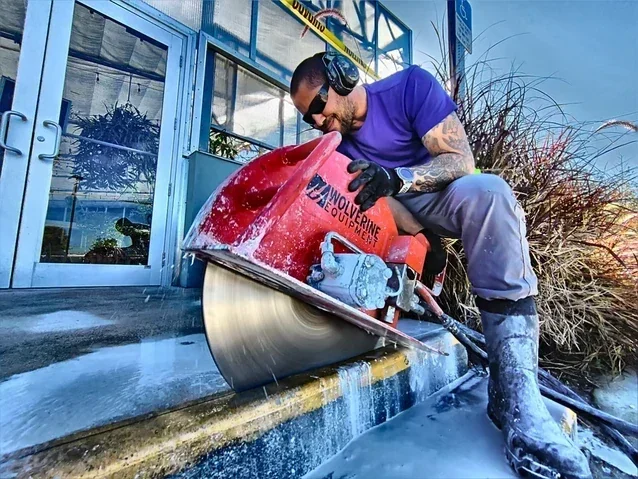
Diamond tooling for saw cut concrete joints is not a commodity purchase. The segment geometry, diamond concentration, grit size, and bond matrix hardness must be matched to the concrete’s compressive strength, aggregate type, and curing age. Getting this wrong costs you diamonds, time, and joint quality.
Segment Height, Width, and Kerf Specifications
Standard joint-cutting blades for flatwork applications use segment heights between 10mm and 15mm for most walk-behind applications. Taller segments — 15mm to 20mm — are reserved for deep-cut applications exceeding 4 inches of cut depth, where extended segment life justifies the higher tooling cost. Segment width (kerf) typically ranges from 0.125 inches to 0.165 inches on 14-inch blades, with narrower kerfs preferred for decorative or tight-tolerance control joint work.
The gullet design between segments controls slurry evacuation and blade cooling. Narrow gullets trap slurry in high-production cutting, causing heat buildup that accelerates bond degradation. For continuous joint cutting in hot Miami conditions, blades with wider gullets and segmented or turbo rim profiles outperform standard segmented blades by a measurable margin in both cut rate and segment life.
Bond Hardness Matching to Aggregate and Compressive Strength
Bond hardness is the single most misunderstood specification in diamond tooling selection. The bond matrix must wear at a rate that exposes fresh diamond crystals as cutting progresses. If the bond is too hard for the aggregate, the diamonds polish over without releasing — a condition called glazing. If the bond is too soft, diamonds release before they’ve done useful work — a condition called undercutting.
- Soft bond blades (hardness grade 6–8): Designed for hard, abrasive aggregates — granite, trap rock, silica quartzite. The soft matrix wears quickly enough to continuously expose fresh diamonds against hard material.
- Medium bond blades (hardness grade 9–11): The most versatile specification for South Florida flatwork. Works well in limestone aggregate mixes, standard 4,000–5,000 PSI slabs, and general DOT pavement work.
- Hard bond blades (hardness grade 12–14): Specified for soft, non-abrasive aggregates like river gravel and soft limestone. The hard matrix holds diamonds in place longer against low-abrasion material.
Concrete compressive strength at time of cutting also shifts your bond selection. Green concrete cut at 12–24 hours behaves very differently from a 28-day cured 6,000 PSI industrial floor. Early entry blades are purpose-built for green cutting and use extremely soft bond systems with small diamond grit (typically 40–60 US mesh) to prevent raveling while still achieving clean joint edges.
Blade RPM, Arbor Size, and Machine Compatibility Checks
Before mounting any blade, the arbor bore diameter must match the saw spindle exactly. Standard arbor sizes for walk-behind flat saws run at 1-inch, 20mm, and 25.4mm. Running a blade on an incorrect arbor size — even with adapter flanges — introduces lateral runout that destroys segment welds and produces a wavy, inconsistent joint. This is one of the most common mistakes to avoid when concrete cutting and one of the most dangerous.
Maximum RPM ratings on diamond blades are not suggestions — they are engineering limits based on the tensile strength of the steel core and the centrifugal forces acting on the segments at speed. A 14-inch blade rated at 4,400 RPM should never be mounted on a machine capable of spinning it at 5,500 RPM. Steel core failure at operating speed is catastrophic. Always verify the blade’s maximum RPM against the saw’s no-load spindle speed before operation.
Water Flow Rates and Slurry Management in Joint Cutting
Wet cutting joint saws require a minimum water flow rate of 0.5 to 1.5 gallons per minute delivered directly to both sides of the blade. Inadequate water flow is the leading cause of blade core overheating, segment delamination, and stress cracking in the steel core. On long joint runs in direct Miami sun, water demand increases — ambient temperatures above 90°F accelerate heat transfer into the blade core, requiring water flow rates at the upper end of this range.
Slurry management on joint cutting operations is also a regulatory and quality issue. Diamond slurry contains fine silica particles that cannot be allowed to enter storm drains under EPA and local NPDES permit requirements. Vacuum-assisted slurry recovery systems are now standard equipment on compliant job sites. This same discipline applies in pipe cutting operations, where cutting concrete pipe without fines or floods requires integrated slurry containment from the start of the cut.
Specialty Applications — Fiber-Reinforced Slabs and Post-Tensioned Decks
Fiber-reinforced concrete (FRC) slabs present a unique blade wear challenge. Synthetic macro-fibers and steel fibers both increase the abrasion load on diamond segments, accelerating bond wear and reducing effective blade life by 20–40% compared to plain concrete of equivalent strength. Specify medium-hard bond blades with higher diamond concentration (40–50% concentration by volume) for FRC joint cutting to compensate for the accelerated wear rate.
Post-tensioned slabs require pre-cut tendon surveys using ground-penetrating radar (GPR) before any joint cut is initiated. The cut depth on PT slabs must be controlled to remain above the tendon plane — typically limiting joint depth to 1 inch or less on 8-inch PT decks. This is a non-negotiable specification with structural consequences. The same careful pre-cut planning applies to masonry and block structures, as detailed in the technical guide on what every contractor must know before cutting a cinder block wall for a window opening — the principle of knowing what’s inside the material before you cut is universal across all concrete cutting disciplines.
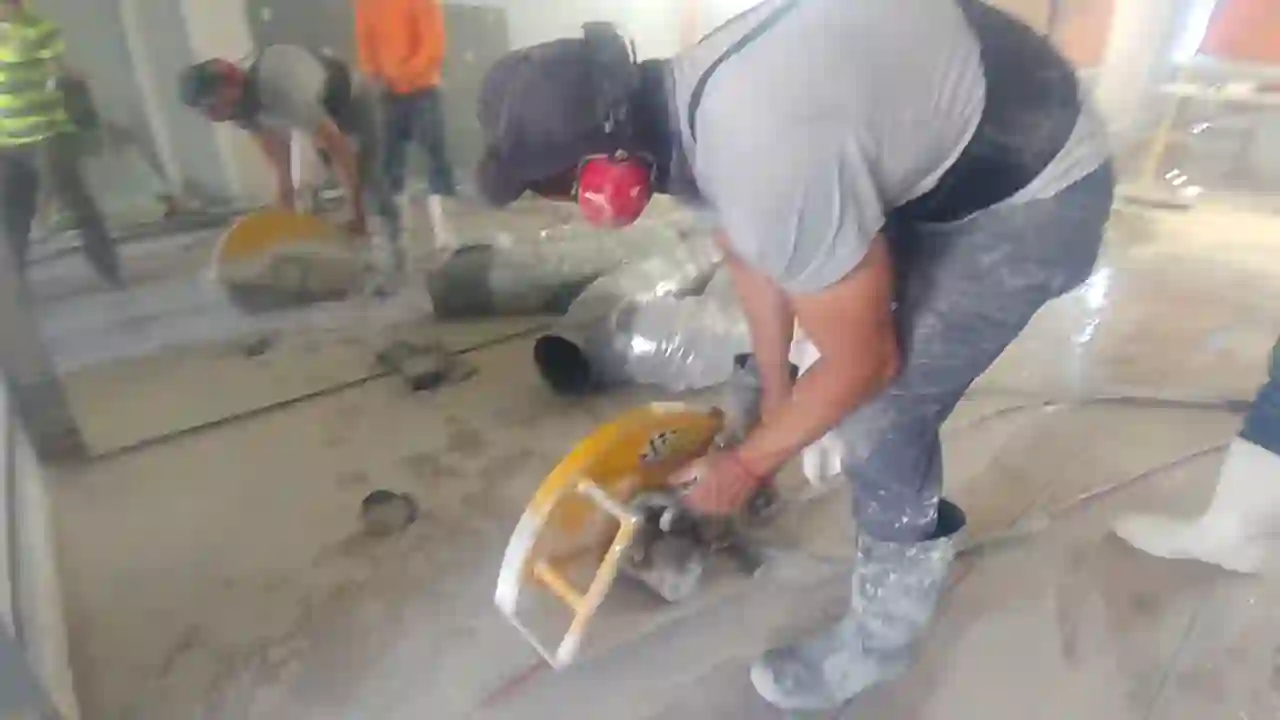
Production Rate Benchmarks and Blade Life Expectations
A properly spec’d 14-inch medium-bond blade on a 30 HP flat saw cutting 4-inch-deep joints in 4,000 PSI limestone aggregate concrete should yield production rates between 150 and 300 linear feet per hour, depending on operator pace, joint spacing, and site conditions. Blade life on this specification should reach 400 to 600 linear feet per blade before segment height drops below the minimum effective cutting threshold of 3mm above the core.
Tracking blade life per linear foot — not per hour — is the professional standard. Cost-per-linear-foot analysis on diamond tooling is the only metric that allows you to accurately compare blade performance across different machines, operators, and concrete conditions. If your crew isn’t logging this data, you’re making tooling decisions based on gut feeling rather than engineering.
Saw cut concrete joints done at the right depth, with the right equipment class, and the right diamond tooling are one of the most reliable crack control systems in flatwork construction. The specifications outlined here are not theoretical — they reflect the production realities of professional concrete cutting operations running daily in South Florida’s demanding mix of high-strength industrial floors, DOT pavement work, and specialty structural applications. Match your equipment to your conditions, and your joints will perform exactly as designed.