Why Orlando’s Aggregate and Concrete Mix Profiles Force Specific Blade Choices
Concrete cutting in Orlando, FL isn’t a generic operation you can approach with a one-size-fits-all blade inventory. Central Florida’s construction market pulls aggregate from local limestone quarries and river sources, producing concrete with a hardness profile that sits in the medium-to-hard range on the Mohs scale — typically between 4.5 and 6.5 depending on the mix design and pour date. That range matters enormously when you’re specifying diamond tooling, because a blade engineered for soft aggregate in coastal South Florida will glaze over and lose its cutting edge within minutes on a properly cured Orlando slab. The bond matrix holding your diamond segments has to match the abrasiveness of the material being cut. Harder aggregate demands a softer bond so the matrix wears away fast enough to continuously expose fresh diamond crystals. Get that wrong and you’re burning segments, overheating the core, and producing cuts that wander off line.
Flat Saw Horsepower Ratings and Blade Diameter Matching for Orlando Slab Work
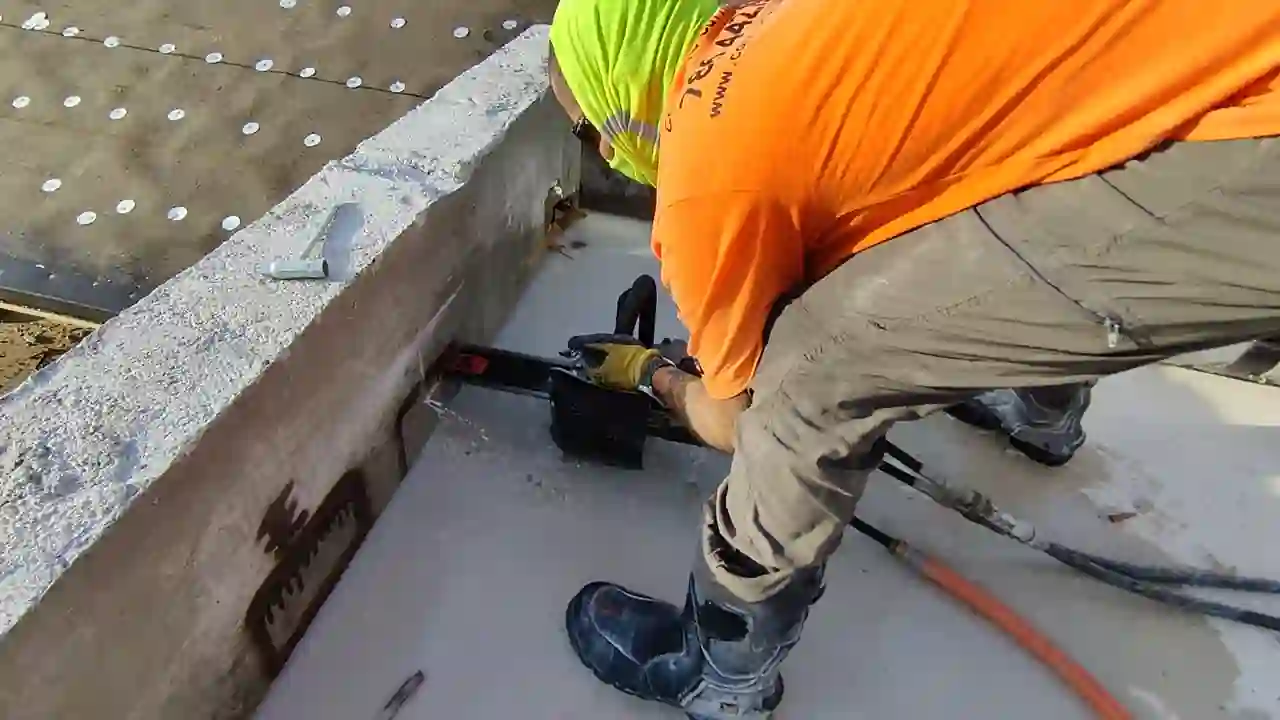
Flat sawing — also called slab sawing — is the dominant method for cutting horizontal concrete surfaces in Orlando’s commercial and residential construction sectors. The equipment specification starts with the relationship between engine horsepower and blade diameter. Industry standard practice calls for approximately 3 to 5 horsepower per inch of blade diameter when operating under load in reinforced concrete. That means a 20-inch blade requires a flat saw producing at least 60 HP at the arbor, not at the engine flywheel. Many contractors confuse rated engine HP with actual arbor output, which loses 15–25% through drive systems. Running undersized power on an oversized blade produces blade flutter, segment stress fractures, and dangerous lateral deflection.
For standard 4-inch to 6-inch slab depths common in Orlando residential construction, a 14-inch to 18-inch blade on a mid-frame saw in the 35–65 HP class handles most residential and light commercial applications. Step up to industrial slabs — parking decks, warehouse floors, highway work — and you’re looking at 24-inch to 36-inch blades on 65–130 HP walk-behind or ride-on flat saws. Blade arbor bore must match the saw spindle exactly; common sizes run 1-inch, 20mm, and 1-inch with a key. Any mismatch in bore tolerance introduces vibration that destroys segment bonding at the weld line. For deeper context on residential applications in Central Florida, the work covered under residential concrete cutting services illustrates how equipment scaling changes dramatically between a 4-inch driveway cut and a 12-inch foundation wall penetration.
Diamond Segment Geometry — Height, Width, and Kerf Specification for Reinforced Pours
Segment geometry is where most operators stop reading the spec sheet too early. Diamond segments are characterized by three primary dimensions: segment height (how tall the cutting face is, typically 8mm to 15mm), segment width (which determines kerf width and must exceed core thickness by at least 0.040 inches per side), and segment length (contact arc, usually 24mm to 40mm). For heavily reinforced concrete — the kind found in Orlando’s commercial tilt-up construction and post-tensioned parking structures — you need segments with a minimum height of 10mm to ensure adequate service life before the segment wears flush with the core. Segments below 8mm on rebar-dense pours will reach the wear limit in a single shift.
Rebar encounter is where blade specification gets genuinely technical. Steel reinforcement is significantly softer than concrete aggregate, which means a blade optimized purely for hard aggregate will actually cut through rebar aggressively — but the heat generated at the steel-diamond interface accelerates segment bond degradation. Blades designed for reinforced concrete use a segmented or turbo-segmented rim with gullet spacing wide enough to evacuate steel swarf and concrete slurry simultaneously. Gullet depth should be no less than 14mm on blades used in rebar-dense environments. For a detailed breakdown of safe rebar cutting protocols that complement proper blade selection, this guide on rebar cutting safety covers the procedural side that equipment specs alone don’t address.

Wall Saw Track Systems and Blade Flange Specifications for Vertical Penetrations
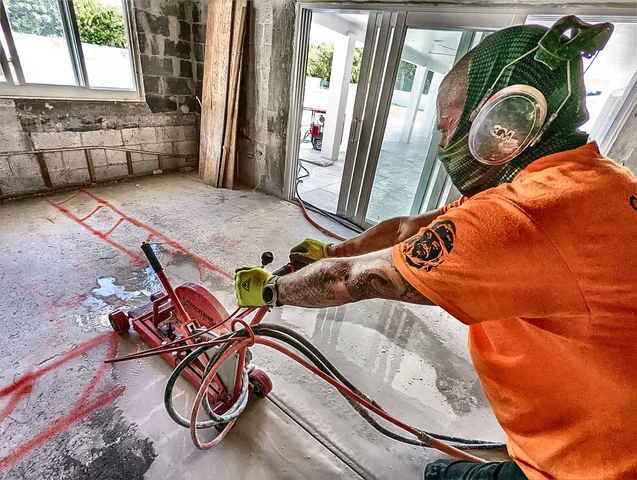
Wall sawing in Orlando’s concrete structures — whether cutting door openings in tilt-up panels or penetrations through cast-in-place shear walls — requires a different equipment conversation entirely. Wall saws operate on a track-and-carriage system mounted directly to the concrete face. The track must be anchored with a minimum pull-out resistance of 2,000 lbs per anchor point, using drop-in anchors or through-bolt systems rated for the concrete’s compressive strength. Most Orlando commercial concrete runs between 3,500 PSI and 5,000 PSI, which supports standard anchor ratings without issue. Problems arise when cutting post-tensioned walls where anchor placement must avoid tendon paths — a pre-cut slab depth analysis using ground-penetrating radar is non-negotiable before any anchor is set.
Wall saw blades run in diameters from 18 inches up to 60 inches depending on penetration depth. The maximum cutting depth per pass is roughly 40% of blade diameter, so a 48-inch blade achieves approximately 19 inches of cut depth — enough for most tilt-up panel thicknesses. Blade flanges on wall saws must be matched to the machine’s spindle specification; common configurations include 60mm, 75mm, and 90mm flange diameters. Flange diameter affects blade stiffness and lateral stability during the cut — undersized flanges on large-diameter blades produce lateral deflection that ruins cut tolerances and risks blade pinching in the kerf. Wall saw blades also require a higher diamond concentration (typically 40–50 concentration on the standard scale) because the blade enters and exits the cut repeatedly as the carriage traverses, creating more impact stress per segment than continuous flat sawing.
Wire Saw Specifications for Cutting Post-Tensioned Slabs and Structural Members
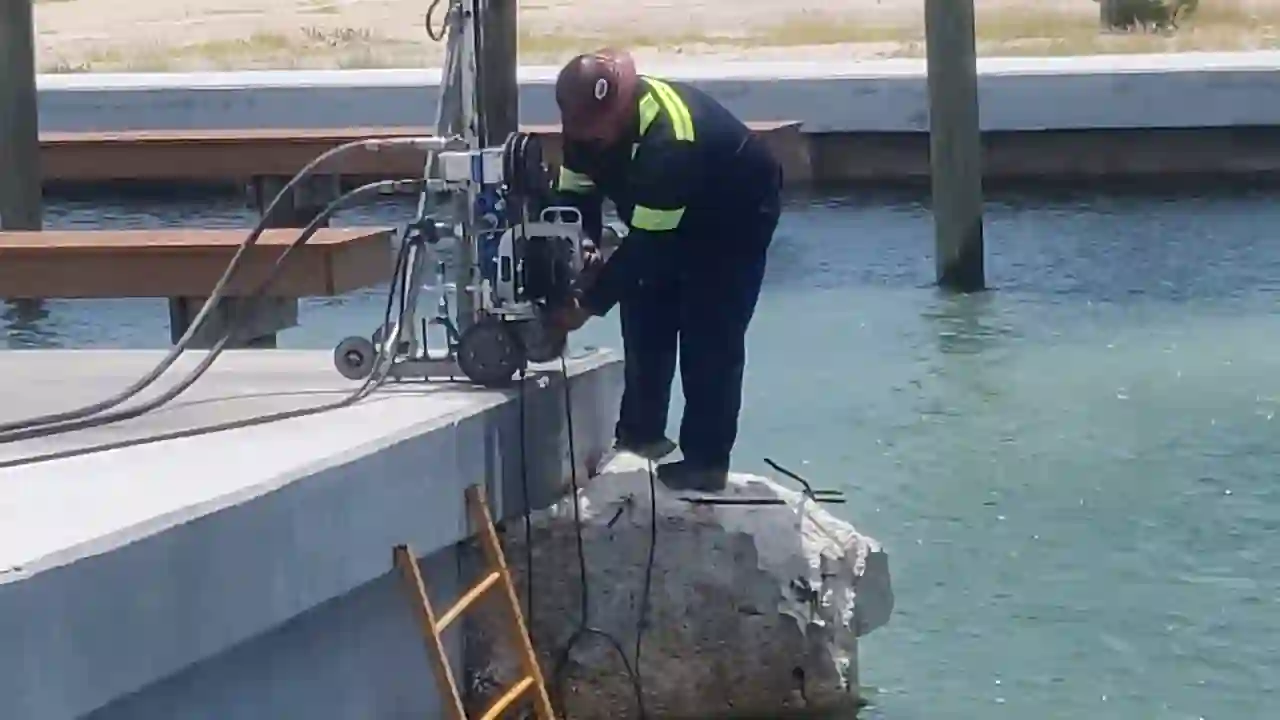
Wire sawing is the method of choice when blade access is geometrically impossible or when the structural member being cut is too thick for any practical blade diameter. In Orlando’s high-rise and bridge infrastructure work, wire saws handle cuts that no other method can. The wire itself is a continuous loop of steel cable with diamond beads crimped at regular intervals — typically 30 to 40 beads per meter for concrete applications. Bead diameter runs from 10.5mm to 11.5mm, with the bead geometry (sintered vs. electroplated) selected based on the concrete’s abrasiveness profile.
Wire saw machines operate on a pulley and tensioning system that maintains wire tension between 200 and 400 Newtons depending on cut geometry. Tension that’s too low allows wire oscillation that causes irregular bead wear and potential wire breakage. Too much tension accelerates fatigue failure at the crimp joints. Wire speed — the linear velocity of the wire through the cut — is the primary cutting parameter, ranging from 18 to 30 meters per second for concrete applications. Slower speeds are used on extremely hard aggregate or heavily reinforced sections; faster speeds increase cut rate but reduce bead life. The reinforced concrete sawing tag aggregates detailed case studies where wire saw parameters were adjusted for specific structural conditions.
Wet vs. Dry Cutting Specifications and Cooling Flow Rates
The wet-versus-dry cutting decision is driven by blade specification, not operator preference. Dry-cutting blades use a segmented rim with wide gullets to allow air cooling and dust evacuation. They are rated for intermittent cutting only — typically no more than 10 seconds of continuous blade-to-concrete contact before a 5-second cooling pause. Continuous dry cutting overheats the core steel, which loses tensile strength above 400°F, leading to core warping and catastrophic segment loss. Dry blades are appropriate for shallow cuts in non-reinforced concrete under 2 inches depth.
Wet cutting is the standard for any serious concrete cutting in Orlando. Cooling water flow rate must be adequate: a minimum of 1.5 gallons per minute for blades up to 14 inches, scaling to 3–5 GPM for blades in the 24-inch to 36-inch range. Water is introduced at both sides of the blade through the arbor flanges or via external nozzles angled to direct flow into the kerf. Insufficient water flow produces thermal shock cracking in diamond segments — a failure mode that looks like random segment chipping but is actually heat stress fracturing at the diamond-metal bond interface. If you’re evaluating whether to handle complex cuts in-house or bring in specialists, the breakdown at this resource on outsourcing concrete cutting covers the equipment investment and liability factors that make the decision straightforward for most GCs.
Core Drill Specifications for Utility Penetrations in Orlando Commercial Construction
Core drilling rounds out the primary equipment categories. Core bits are hollow cylindrical tools with diamond segments on the cutting face, available in diameters from 1 inch up to 60 inches. For standard utility penetrations — conduit sleeves, plumbing rough-ins, HVAC duct openings — diameters of 2 inches to 8 inches cover the majority of Orlando commercial work. Core drill motors are rated by amperage (electric) or hydraulic flow (hydraulic), with 15-amp single-phase motors handling bits up to 4 inches in 3,000 PSI concrete, and 3-phase or hydraulic units required above that threshold.
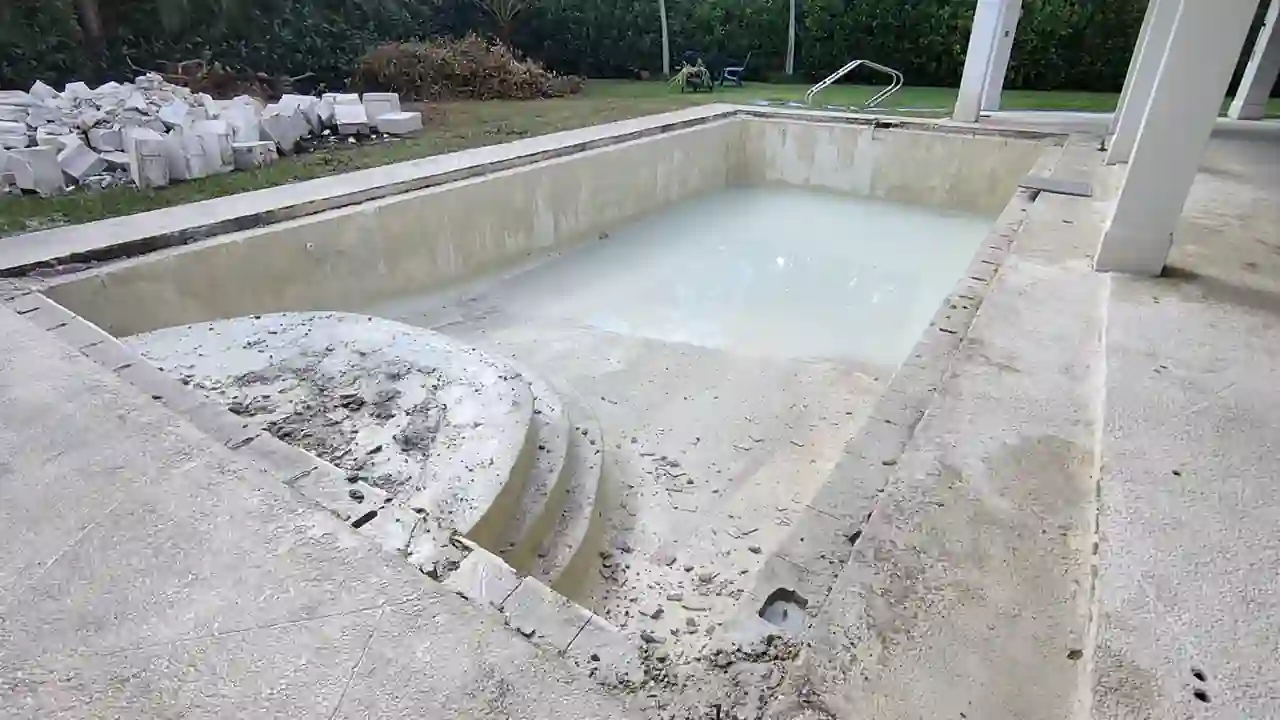
Bit wall thickness — the difference between outer and inner diameter — determines both segment contact area and slurry evacuation efficiency. Thicker walls provide more segment surface area and longer service life but generate more heat. Standard wall thickness runs from 3mm to 5mm for most commercial bits. For post-tensioned slabs or any situation where the penetration location isn’t fully confirmed clear of tendons or conduit, the same GPR scanning protocol used for wall saw anchor placement applies here. It’s also worth noting that pool demolition projects — which involve significant concrete cutting and removal — require a completely different equipment approach; the discussion at this pool demolition resource explains why cutting and removal sequencing matters before any fill operation begins.
Blade RPM Limits and Arbor Speed Matching — The Number That Gets People Hurt
Every diamond blade carries a maximum operating speed stamped on the core in surface feet per minute (SFPM) or RPM. These are not suggestions. The ANSI B7.1 standard and OSHA 29 CFR 1926.303 both require that blade speed never exceed the manufacturer’s rating. The formula connecting RPM to SFPM is straightforward: SFPM equals blade diameter in inches multiplied by RPM multiplied by 0.2618. A 14-inch blade rated at 5,500 SFPM must not exceed approximately 3,000 RPM. Running a blade over its rated speed generates centrifugal stress in the core steel that exceeds the material’s tensile strength — the result is core fracture and segment ejection at velocities that cause fatal injuries. Always verify the saw’s no-load arbor speed with a tachometer before mounting any blade, and confirm the blade’s rated speed matches or exceeds that measurement. This single verification step eliminates one of the most preventable equipment failures in the concrete cutting trade.