
One of the most common questions we hear on the job is whether a concrete saw can actually cut through steel rebar. The short answer is yes — but doing it well, safely, and without destroying your blade takes real know-how. Here in Miami, nearly every concrete structure we cut into is reinforced, so encountering rebar isn’t a matter of if but when.
This guide breaks down exactly how concrete saws handle rebar, what blades and techniques to use, and the mistakes that chew through equipment and budgets.
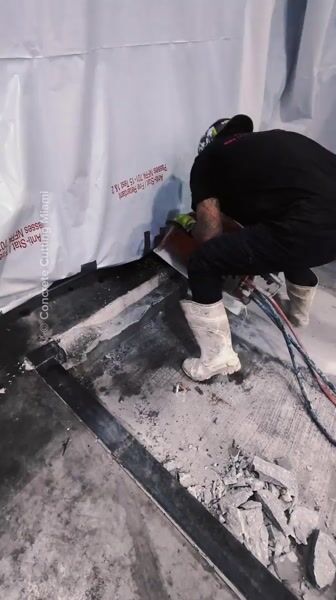
Why Rebar Is in Almost Every Cut
Rebar (short for reinforcing bar) is embedded in concrete to compensate for concrete’s natural weakness: tensile strength. Concrete handles compression extremely well, but it cracks under tension and bending forces. Steel rebar bridges that gap, giving structures the flexibility and load-bearing capacity they need to last decades.
If you want a deeper look at how reinforcement shapes structural performance, our post on the hidden power of rebar in concrete structures covers it in detail.
The takeaway for cutting? You should always assume rebar is present. In Miami-Dade especially, building codes require heavy reinforcement in slabs, walls, and foundations to withstand hurricane-force loads. Walking into a cut blind is one of the most common mistakes in concrete cutting — and one of the most expensive.
Why Rebar Changes Everything About Concrete Cutting
Concrete is strong in compression and weak in tension. Rebar — the steel bar cast inside it — supplies the tensile strength that lets slabs, walls, and foundations carry load and flex without cracking. That steel is, by design, stronger than the concrete around it, and that single fact makes cutting reinforced concrete a different discipline from cutting plain concrete.
In South Florida, assume every structural cut will meet steel: hurricane codes demand heavy reinforcement, and coastal salt air corrodes rebar over decades, weakening the bond between steel and concrete. There are really two kinds of concrete here — the kind with rebar in it, and the kind where you simply haven't found the rebar yet. Cutting reinforced concrete is a two-material job: concrete and steel, severed in a single pass.
Blade Selection for Reinforced Concrete
The blade is the single most important variable. On plain concrete, a diamond blade grinds through cement paste and aggregate — both softer than the diamond — so it cuts efficiently and wears predictably. Add steel and the physics change: a blade made only for concrete skates across rebar, generates heat, wears unevenly, and glazes. A reinforced-concrete blade uses a different diamond matrix, segment geometry, and bond hardness to cut both materials at once.
Diamond Bond Hardness: The Biggest Single Factor
Diamonds sit in a metal bond matrix. As the blade cuts, the bond wears away and exposes fresh diamonds — the blade stays sharp by wearing. Match the bond to the material and it works; mismatch it and you get one of two failures.
| Bond | How it behaves | Where it fits |
|---|---|---|
| Soft bond | Wears quickly, exposes diamonds fast | Hard, cured concrete — but wears out too fast on rebar-heavy cuts |
| Medium / combination bond | Balances diamond retention and release | General-purpose when rebar is present; cuts concrete and steel together |
| Hard bond | Holds diamonds longer | Abrasive steel and wire mesh — but can glaze on very hard concrete |
Reinforced concrete sits in a narrower window than plain concrete: a medium-hard bond that holds its diamonds long enough to survive the steel, yet still wears enough to keep exposing fresh cutting points.
Segment Design: What Separates a Rebar Blade
- Higher diamond concentration than plain-concrete blades — more cutting points for the dual-material cut.
- Layered or "sandwich" segments that alternate layers tuned for concrete and steel, keeping the blade efficient as it moves between the two.
- Undercut protection segments that shield the steel core where it meets the segments — the spot that wears fastest in prolonged steel cutting — and laser-welded segments for deep cuts, which survive the abrasive slurry of aggregate and steel better than sintered ones.
Segmented vs. Turbo vs. Continuous Rim
The rim style controls how aggressively the blade cuts and how it handles steel.
- Segmented — gaps between the segments clear slurry and cool the blade; the aggressive, general-purpose choice for reinforced work.
- Turbo — a serrated rim that cuts fast but smoother; strong on hard concrete, less forgiving in heavy steel.
- Continuous rim — the cleanest edges for finishes, but it glazes quickly once it meets rebar.
Wet Cutting Is Effectively Mandatory
Cutting steel against concrete generates far more heat than concrete alone, and rebar makes it worse in a counterintuitive way: the steel conducts heat away from the cut zone, so the rebar network acts as a heat sink and radiates it back into the blade. Continuous water at the blade is not optional — it cools the blade, flushes grit from the kerf, and suppresses the silica dust that makes cutting a respiratory hazard. Dry cutting reinforced concrete destroys blades and throws dangerous dust — in professional work, and in Miami's air-quality climate, wet cutting is the standard. On our own reinforced-slab work we run a 12 GPM hydraulic power pack; that continuous flow, not a trickle, is what keeps a blade alive through a dense rebar mat and keeps dust suppressed at the source.
Matching the Saw to the Steel Inside
Blade and machine must match, because an undersized saw sabotages even a good blade.
- Enough horsepower. The motor must hold its speed under the load of cutting two materials; a weak saw bogs down the moment it hits rebar, slowing the cut and wearing the blade unevenly.
- Hydraulic power for sustained cuts. Hydraulic saws and power units deliver constant torque across a wide range, so the blade keeps moving instead of stalling on a heavy bar the way an electric saw can. For wall sawing, large slab work, and dense rebar mats, hydraulic is the standard.
- Wire sawing for what a round blade can't reach. On massive walls, columns wrapped in spiral reinforcement, or sections too thick for a circular blade, a diamond-impregnated wire is looped around the concrete and pulled through, severing concrete and steel together. Tension must be held steady so the beads press into the rebar rather than bouncing off it, and coolant fed into the cut so the beads don't overheat.
- Core drilling for penetrations. Where the opening is round — pipe, conduit, drainage — diamond-tipped core bits drill clean holes through reinforced concrete.
Detecting Rebar Before the First Cut
You cannot cut well what you cannot see inside. Ground-penetrating radar (GPR) scanning before any cut on a reinforced structure maps the layout, spacing, and depth of the steel, letting you plan a path that minimizes how much steel the blade must grind through — and revealing what you are not looking at.
Typical South Florida reinforcement, from lighter to heavier:
| Structure | Typical reinforcement |
|---|---|
| Residential slab | #3–#4 bars at 12–18 inch centers, single mat, a few inches below the surface |
| Commercial slab | #4–#5 bars at 12 inch centers, often a double mat |
| Structural wall | #4–#5 bars at 6–12 inch centers, double mat, tied at every intersection |
| Post-tension slab | Unbonded tendons in sheathing rather than ordinary rebar — must not be cut |
The heavier and tighter the reinforcement, the slower the cut and the more it costs in blade life, so scan results should feed directly into the cutting plan and the quote.
Techniques That Protect the Blade and the Cut
Rebar eats blades — that's unavoidable. Technique is what separates a blade that lasts from one ruined in a single pass.
Control Your Feed Rate — Never Force the Cut
The most damaging habit is leaning on the saw. When the blade meets steel it should do the work at its own pace. Forcing it generates excess heat, warps the blade core, and tears segments loose before they're worn out. A steady, controlled pass cuts faster overall than an aggressive one that glazes the blade and has to be backed off.
Step-Cut Deep Slabs
On deep cuts — thick slabs, foundations, walls — don't take full depth in one pass. Step down in stages, letting the blade clear slurry between passes. Step-cutting keeps the blade cooler, stops the saw bogging down in a rebar mat, and produces straighter edges. On especially thick sections, a wire saw may be the better tool entirely.
Avoid Glazing
Glazing is the failure to watch for. Heat and pressure polish the bond matrix so it stops releasing diamonds, and the blade becomes a smooth disc that only spins and smokes. Avoid it by keeping the feed rate right, water flowing, and the bond matched to the material. Once glazed, a blade won't recover on its own — it must be dressed or replaced.
Read the Blade Between Cuts
The blade tells you what it just cut. An even, concave wear profile points to uniform, predictable reinforcement; a jagged edge suggests scattered or randomly placed bars, common in Miami's older structures. Expect markedly faster segment wear after heavy cuts through thick, tightly reinforced sections. Inspect for damage too: missing or cracked segments (a loose segment becomes a projectile), uneven wear that signals the blade isn't tracking straight, and a heat-warped core. A damaged blade is a safety hazard — pull it off the saw.
Post-Tension Cables: A Separate and Serious Hazard
Not every kind of steel in concrete is rebar, and the difference can be lethal. Post-tensioned slabs contain tendons — steel strands held under enormous tensile stress inside plastic sheathing — instead of, or alongside, conventional bars. Post-tension cables must never be cut. Severing one releases stored energy violently: the cable can whip out of the slab and the concrete around it can fail without warning. A post-tension slab can look like an ordinary reinforced slab until the blade touches a tendon, which is why GPR scanning is essential here. Work on a post-tensioned structure belongs to a professional who can find the tendons first — not a rental saw.
Protecting the Structure After the Cut
Cutting reinforced concrete is not only removal; the concrete that stays has to keep carrying its load. A partially cut bar is worse than a cleanly cut one — it concentrates stress and can crack under the repeated loading of a Miami hurricane season. Good practice after a cut includes:
- Confirming with a follow-up magnetic scan that no rebar was left half-embedded in the cut face.
- Keeping adequate clear cover of concrete over any cut rebar ends, so newly exposed steel is shielded from corrosive coastal air.
- Sealing and epoxy-injecting cut faces where structural bond and corrosion protection matter, especially on load-bearing elements.
- Verifying — for structural work — that the remaining section still meets the engineer's requirements before the opening is used.
- Where rebar runs continuously across a joint, cutting to full depth matters — a partial-depth cut can let a crack propagate across the whole slab, so every rebar crossing must be genuinely severed, often with overlapping stitch-drilled core holes.
Slurry, Silica, and South Florida Compliance
Wet cutting solves one problem and creates another: the water that cools the blade and controls dust comes out as slurry loaded with fine silica and metal grit. In Miami, where the water table is high, letting that slurry reach storm drains is a regulatory matter. Professional crews contain it with vacuum recovery and closed-loop systems that capture the great majority of the water and solids. Silica control across the job — wet methods, containment, and proper respirators rather than a paper mask — is non-negotiable under workplace and local air-quality rules.
Why Reinforced Concrete Costs More to Cut
Reinforced concrete is harder on everything: blade wear is faster, cutting speed is slower, and the job takes more power, water, and time than plain concrete of the same thickness. That is the honest reason reinforced cutting runs materially higher than unreinforced work — not padding, but the physics of cutting steel. Section thickness, steel density, and how well the cut was planned around GPR all move the effort up or down.
Abrasive corundum blades are the cheap alternative, and they show why cheap isn't cheap: they will cut rebar, but they burn down fast enough to vanish in a single heavily reinforced cut, driving constant blade changes, downtime, and ragged, mismatched edges.
When to Stop and Call a Professional
Some of this work is within reach of a capable operator with the right saw and blade. Some of it is not. Stop before you cut and bring in a professional when the job involves:
- Post-tensioned concrete. The tendons are under extreme tension; cutting one can be fatal.
- Load-bearing walls or structural slabs, where a wrong cut can compromise the entire building.
- Thick or heavily reinforced sections beyond the power and blade depth of a consumer-grade saw.
- Precision openings — doors, windows, HVAC penetrations — in reinforced walls, where overcuts and ragged edges are unacceptable.
- Any structure where you don't know what is inside and can't scan it.
Questions to Ask Before You Hire a Concrete Cutting Contractor
- "Are your blades rated for cutting through rebar?" The answer should be an immediate yes, with a specific blade type or manufacturer named.
- "What do you do when you hit a bar larger than expected?" They should describe adjusting cutting speed, keeping water on the blade, and switching to a properly specified blade — not reaching for a Sawzall.
- "Do you scan for post-tension cables before cutting?" This separates crews who know conventional rebar can be cut from those who know post-tension tendons must never be touched.
- "How does rebar density affect your quote?" A serious contractor will say the scan results factor into pricing. One who says it doesn't matter is either inexperienced or planning to figure it out on site, at your expense.
The right crew shows up with the right blade, cuts continuously through concrete and steel without stopping, and produces clean openings in the time they estimated. Everyone else learns about the rebar when the blade stops turning.
Concrete Control Joints Why They Matter and Where to Cut Them in Miami
Concrete shrinks as it cures, and control joints are the planned weak points that keep that shrinkage from turning into
Concrete Patio Work in Broward From Cutting to Removal Done Right
A concrete patio in Broward is rarely a simple slab in an open yard. Between tight side yards, HOA requirements,

How to Get Rid of a Pool in Miami the Right Way Without a Mess
Removing a pool is not a weekend project, and doing it wrong in South Florida can leave you with a