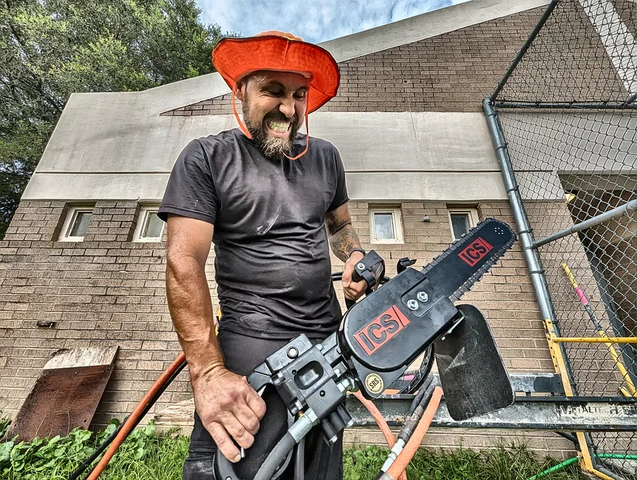
Why the demolition hammer matters more than most people think
In professional concrete work, the demolition hammer is the tool that follows the saw. The sequence is always the same: saw-cut first to separate the concrete from everything around it, then break the separated section with a demolition hammer for removal. The saw defines the boundaries. The hammer does the removal. And choosing the wrong hammer for the job — too small and it takes all day, too large and it damages what you are trying to preserve — is one of the most common and most expensive mistakes in concrete demolition.
The term demolition hammer covers a broad range of concrete breaking tools, from handheld electric breakers weighing 20 pounds to excavator-mounted hydraulic hammers weighing over 10,000 pounds. What they share is a fundamental operating principle: a piston driven by electric, pneumatic, or hydraulic power strikes a chisel or moil point at high frequency, transferring impact energy into the concrete to fracture it. The differences between them — power source, impact energy, weight, operating orientation, and application — determine which hammer is correct for a given task. In professional concrete cutting and demolition in Miami, the hammer selection is as important as the blade selection. The wrong tool turns a straightforward job into an ordeal.
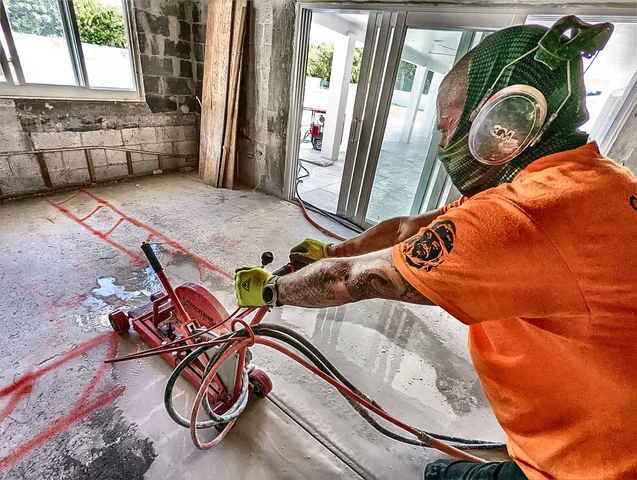
We use demolition hammers across the size spectrum in our Miami operation. A small electric breaker for chipping tile off a concrete wall. A mid-size pneumatic breaker for breaking a sectioned patio slab into manageable pieces. A large hydraulic hammer on a skid steer for breaking a driveway after it has been saw-cut. The tool changes; the principle does not: saw-cut first, then break. The hammer only touches concrete that is already physically separated from what needs to stay.
Types of demolition hammers and their applications
Electric demolition hammers
Electric breakers are the most common demolition hammers for residential and light commercial concrete work. They range from 20-pound handheld units delivering 5-15 foot-pounds of impact energy to 70-pound units delivering 35-50 foot-pounds. The power source is a standard 120V outlet (or 240V for the largest units), so they can operate anywhere with electrical service.
Electric breakers are the right choice for:
- Thin slab breaking: 4-inch residential slabs that have been saw-cut into sections. A 35-50 pound electric breaker handles these pieces efficiently.
- Interior demolition: Electric breakers produce no exhaust emissions, making them safe for indoor use (with proper ventilation for dust control). This is essential for Miami interior renovations where the work area is part of an occupied building.
- Precision chipping: Removing concrete from around embedded items — rebar, conduit, anchor bolts — where the impact must be precisely controlled. Smaller electric breakers with chisel bits provide this precision.
- Tile and thin-set removal: Removing ceramic tile and the thin-set mortar bed from concrete slabs, a common task in Miami bathroom and kitchen renovations.
The limitations of electric breakers: they are limited by available electrical power — a 70-pound breaker needs a dedicated 20-amp circuit. They cannot match the impact energy of pneumatic or hydraulic hammers. They generate heat during extended operation and require cooling periods. And the vibration transmitted to the operator is significant, limiting continuous operation time.
Pneumatic demolition hammers
Pneumatic breakers are powered by compressed air from a tow-behind or truck-mounted air compressor. They range from 40-pound handheld units delivering 30-50 foot-pounds of impact energy to 90-pound units delivering 60-80 foot-pounds. Pneumatic breakers provide higher impact energy than electric breakers of comparable weight, and they can operate continuously without overheating because the compressed air provides cooling.
Pneumatic breakers are the right choice for:
- Medium-thickness slab breaking: 6-inch driveway slabs, commercial floor slabs, and other medium-thickness concrete where the impact energy of an electric breaker is insufficient for efficient breaking.
- High-volume breaking: When the volume of concrete to break justifies the setup cost of bringing a compressor to the site. The continuous-duty capability of pneumatic breakers makes them more productive over a full day of breaking.
- Exterior demolition where noise is less constrained: Pneumatic breakers are loud — 100+ decibels — and the compressor adds additional noise. They are best suited to exterior work where noise is less regulated and hearing protection is mandatory.
The limitations: pneumatic breakers require a compressor — a significant piece of support equipment that must be transported, fueled, and maintained. The compressor and breaker together are louder than electric alternatives. The air hose creates a trip hazard and limits mobility. And like all handheld breakers, vibration exposure to the operator is a concern requiring job rotation and anti-vibration measures.
Hydraulic demolition hammers (machine-mounted)
Hydraulic breakers are mounted on excavators, skid steers, or backhoes and powered by the carrier machine’s hydraulic system. They range from small units delivering 150-500 foot-pounds for skid steers to large units delivering 5,000-15,000 foot-pounds for full-size excavators. Hydraulic breakers remove the operator from direct contact with the tool, eliminating vibration exposure and dramatically increasing breaking productivity.
Machine-mounted hydraulic hammers are the right choice for:
- Thick concrete breaking: 8-inch and thicker commercial slabs, foundation walls, bridge decks, and other heavy concrete that is beyond the practical capability of handheld breakers.
- High-volume demolition: When the volume of concrete to break is measured in hundreds or thousands of square feet, machine-mounted hammers are the only productive option. A skid steer with a hydraulic hammer can break more concrete in an hour than a crew with handheld breakers can break in a day.
- Reinforced concrete: The higher impact energy of hydraulic hammers fractures the concrete matrix and breaks the bond to the rebar, making rebar separation and concrete removal more efficient than with handheld breakers.
Critical note for Miami: machine-mounted hammers must only be used on concrete that has been saw-cut and separated from surrounding structures. The impact force of even a small skid-steer hammer travels far through concrete and can damage foundations, pools, and underground utilities if the concrete is still physically connected. Saw-cut first, break second — this rule is absolute when machine-mounted hammers are in use.

How to choose the right demolition hammer for the job
The hammer selection decision matrix:
- Concrete thickness: Match the impact energy to the thickness. A 4-inch slab needs 15-25 foot-pounds for efficient breaking. A 6-inch slab needs 25-50 foot-pounds. An 8-inch slab needs 50+ foot-pounds or machine-mounted breaking. Using a hammer that is undersized for the thickness means the breaker bounces on the surface without fracturing the concrete — all noise, no progress.
- Rebar content: Heavily reinforced concrete requires more impact energy to fracture the concrete and break the bond to the steel. Lightly reinforced or unreinforced concrete breaks with less energy.
- Access and space: Interior work with standard doorways and finished surfaces demands smaller, electric breakers. Exterior work with open access allows larger breakers and machine-mounted hammers.
- Production volume: A few square feet of concrete to break is a handheld job. A few hundred square feet is machine-mounted territory. The setup and mobilization cost of larger equipment must be justified by the volume of work.
- Vibration sensitivity: If the concrete being broken is near vibration-sensitive structures — medical equipment, precision manufacturing, historic masonry — smaller breakers or alternative methods (expansive grout, wire sawing) may be required regardless of thickness or volume.
Demolition hammer safety essentials
- Personal protective equipment: Hard hat, face shield or safety glasses, hearing protection (double protection — earplugs plus earmuffs — for extended breaking), steel-toe boots, and vibration-dampening gloves. The operator and anyone within 50 feet of a demolition hammer in use must have hearing and eye protection.
- Dust control: Concrete breaking generates dust even when wet methods are used for cutting. Water spray at the breaker point reduces airborne dust. Respiratory protection (N95 minimum) is required for the operator and anyone in the immediate work area.
- Utility awareness: Breaking concrete over or near underground utilities — even after saw-cutting — requires extreme caution. The breaker point can penetrate below the slab into soil and strike buried lines. Utility marking and GPR scanning before breaking are essential.
- Vibration management: Handheld breaker operators should rotate off the tool every 30-60 minutes to reduce cumulative vibration exposure. Anti-vibration gloves and breaker designs with vibration-dampening handles reduce but do not eliminate HAVS risk.
The demolition hammer in the professional workflow
In professional concrete work, the demolition hammer is never the first tool that touches the concrete. The sequence is:
- GPR scan to identify hazards
- Saw cut to separate concrete from surrounding structure
- Sectioning cuts to divide the concrete into manageable pieces
- Demolition hammer to break the separated sections
- Debris removal and site cleanup
The hammer is step four, not step one. Any contractor who arrives with a demolition hammer and no saw is not planning to cut first — and the vibration damage that follows is predictable and preventable. The hammer is an essential tool in professional concrete demolition. Used in the correct sequence, it breaks efficiently and safely. Used out of sequence, it breaks things you did not intend to break.