Why Cutting a Cinder Block Wall for a Window Opening Is One of the Highest-Risk Masonry Operations on Any Job Site
Let’s be direct: cutting a cinder block wall to create a window opening is not a weekend project, and it is not a task that tolerates improvisation. From a senior trade perspective, this operation sits at the intersection of structural engineering, respiratory health hazards, electrical risk, and OSHA-regulated silica exposure. Every year, contractors underestimate the complexity of this cut and workers pay the price — sometimes with their lungs, sometimes with their lives. Whether you’re working on a commercial construction project or a residential retrofit, the protocols outlined here are non-negotiable.
Pre-Cut Structural Assessment and Load Path Identification
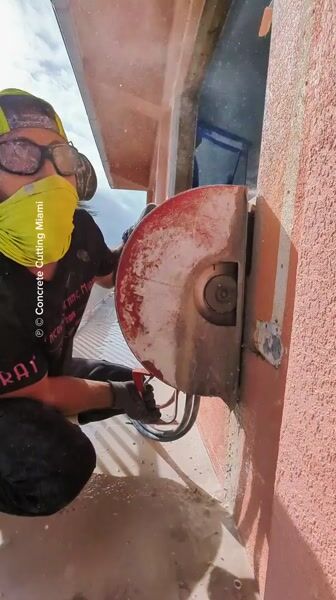
Before any diamond blade contacts a cinder block wall, a structural load path analysis must be completed. Cinder block — technically called concrete masonry unit (CMU) construction — frequently carries vertical loads from floor joists, roof trusses, or upper-story walls. Removing a section of this wall without understanding the load distribution above it can trigger partial or full wall collapse.
The pre-cut assessment should include the following steps:
- Obtain original architectural drawings or commission an as-built survey if drawings are unavailable.
- Identify rebar and bond beam locations using a rebar locator (cover meter) rated for masonry applications.
- Determine whether the wall is load-bearing by tracing the structural system from roof to foundation.
- Verify lintel requirements — any opening wider than 32 inches in a load-bearing CMU wall typically demands a precast or steel lintel installed before cutting begins.
- Check for embedded conduit and plumbing using thermal imaging or ground-penetrating radar (GPR) where budgets allow.
Skipping this phase is not a time-saving measure. It is a liability-generating gamble. Proper structural assessment is also a key driver of construction efficiency — knowing what you’re cutting into eliminates costly mid-job corrections and emergency shoring scenarios.
OSHA Silica Dust Regulations That Directly Govern CMU Cutting Operations
OSHA’s Respirable Crystalline Silica Standard (29 CFR 1926.1153) is the single most critical regulatory framework governing this type of work. Cinder block is a silica-containing material. When cut dry — or even when cut wet without proper containment — it generates respirable crystalline silica particles that penetrate deep into lung tissue and cause silicosis, an irreversible and potentially fatal disease.
Under Table 1 of the OSHA silica standard, handheld angle grinders and walk-behind saws used on masonry are specifically listed. Compliance requirements include:
- Wet cutting with integrated water delivery systems that continuously suppress dust at the point of generation.
- Local exhaust ventilation (LEV) using HEPA-filtered vacuums rated at a minimum of 99.97% efficiency at 0.3 microns, attached directly to the cutting tool.
- Respiratory protection — at minimum, a NIOSH-approved N95 respirator, though a P100 half-face respirator is the professional standard for extended CMU cutting tasks.
- Exposure assessment — if wet cutting and LEV are not both in use simultaneously, air monitoring may be required to document worker exposure below the 50 µg/m³ action level.
- Designated competent person on site who is trained to identify silica hazards and implement corrective measures in real time.
Dry cutting CMU with an abrasive blade and no dust control is not just a health hazard — it is a direct OSHA violation subject to citations up to $15,625 per serious violation and $156,259 for willful or repeated violations.
Selecting the Right Blade and Equipment for CMU Window Openings
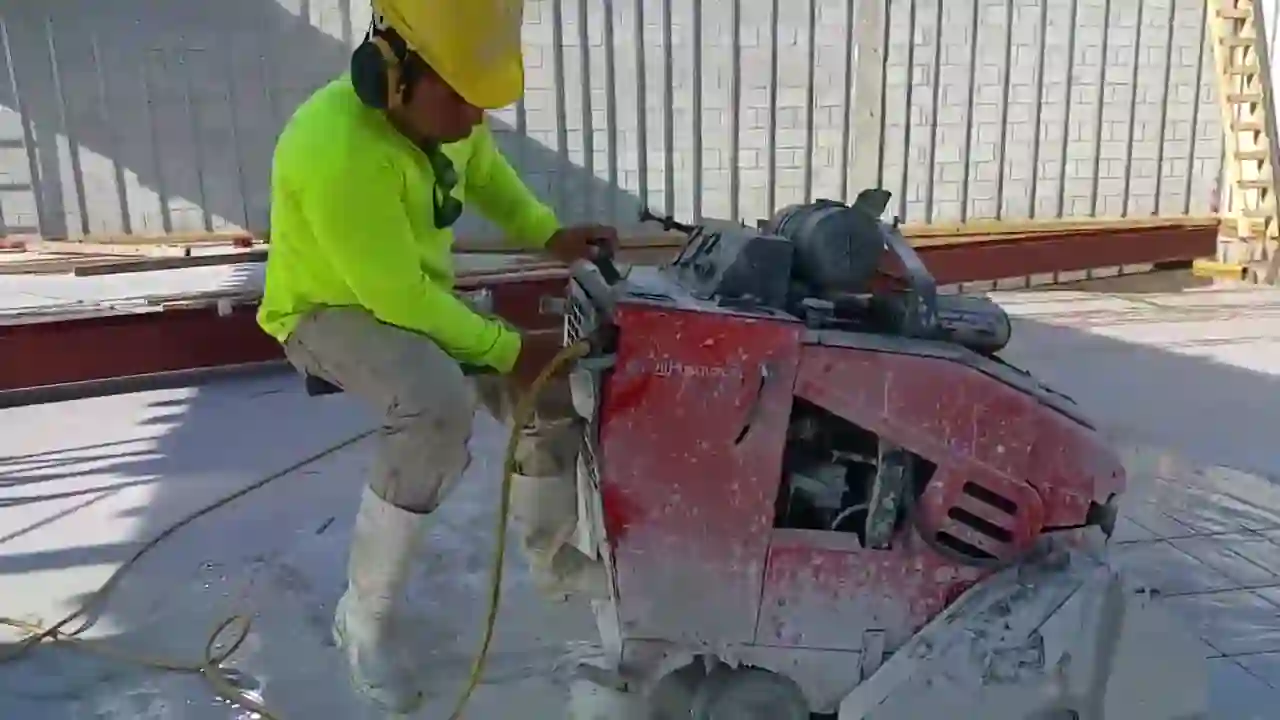
The choice of cutting equipment is both a safety decision and a precision decision. For cutting cinder block walls to create window openings, the industry standard tools fall into two categories depending on wall thickness and access conditions.
Diamond Blade Wall Saws for Through-Wall Cuts
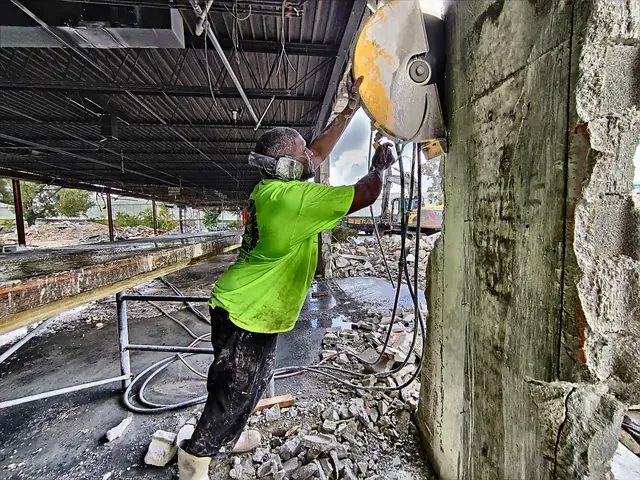
For walls 6 inches to 12 inches thick — the most common CMU wall dimensions in South Florida construction — a track-mounted diamond blade wall saw is the preferred tool. These systems allow the operator to stand clear of the cutting plane, reducing exposure to vibration, kickback, and dust. The blade should be a segmented diamond blade rated for masonry and reinforced concrete, with a bond hardness matched to the aggregate in the block. Using a blade with too soft a bond on abrasive CMU causes premature diamond loss and blade wobble, which is a serious safety event.
Handheld Angle Grinders with Diamond Cup Wheels for Detail Work
Corner relief cuts and edge detailing around window jambs often require handheld tools. When using angle grinders on CMU, operators must use two-handed grip, maintain proper blade guard position, and never exceed the maximum RPM rating stamped on the blade. Anti-vibration gloves rated for masonry work reduce hand-arm vibration syndrome (HAVS) risk on extended operations.
Understanding the right construction materials and their interaction with cutting equipment is what separates a controlled, professional cut from a dangerous, unpredictable one.
Job-Site Hazard Zones and Physical Barricading Requirements
A CMU window cut generates two distinct hazard zones that must be physically controlled before work begins.
The Falling Debris Zone
When the cut block section is freed from the wall, it becomes a falling mass. A standard 8x8x16-inch CMU block weighs approximately 35 to 50 pounds. A window opening requires the removal of multiple blocks simultaneously. The debris zone must be barricaded at a minimum horizontal distance equal to 1.5 times the wall height, on both the interior and exterior faces of the wall. Hard barricades — not just caution tape — are required when the work is performed above grade or adjacent to pedestrian pathways.
The Dust and Slurry Zone
Wet cutting generates silica-laden slurry that spreads across the work surface and becomes airborne again as it dries. Containment sheeting must be placed on floors within 10 feet of the cut on both sides of the wall. Slurry must be collected and disposed of as a construction waste material — not washed into storm drains, which violates EPA stormwater regulations.
Temporary Shoring Protocols Before the First Cut Is Made
If the wall is confirmed to be load-bearing, temporary shoring must be installed before any cutting begins. This is not optional — it is an OSHA requirement under 29 CFR 1926 Subpart Q (Concrete and Masonry Construction). Temporary shoring for CMU window cuts typically involves:
- Adjustable steel shores or timber shoring installed on both sides of the proposed opening, spanning from floor to the structural element above.
- Shoring load capacity verified by a qualified person against the calculated tributary load from above.
- Shoring inspection before each work shift and after any event (seismic activity, adjacent heavy equipment operation) that could have disturbed the shoring system.
In the South Florida market, where CMU construction dominates residential and light commercial building stock — particularly in projects involving structural retrofits and exterior modifications — improper shoring is one of the most frequently cited deficiencies during OSHA inspections.
Post-Cut Inspection and Lintel Seating Verification
Once the cut is complete and debris is cleared, the work is not finished from a safety standpoint. The lintel — whether precast concrete, steel angle, or reinforced bond beam — must achieve a minimum bearing length of 8 inches on each side of the opening in standard CMU construction. This bearing length ensures the lintel transfers load back into the intact wall mass rather than bearing on the cut edge of the block.
A post-cut inspection should document:
- Lintel bearing length on both jambs, measured and recorded.
- Condition of remaining CMU at the cut edges — no cracking, spalling, or block displacement.
- Grouting of any hollow CMU cells adjacent to the opening that were exposed by the cut.
- Temporary shoring removal sequence — shoring should not be removed until the lintel is fully seated and any mortar or grout has achieved minimum design strength (typically 75% of 28-day strength, or approximately 3 days at 70°F ambient temperature).
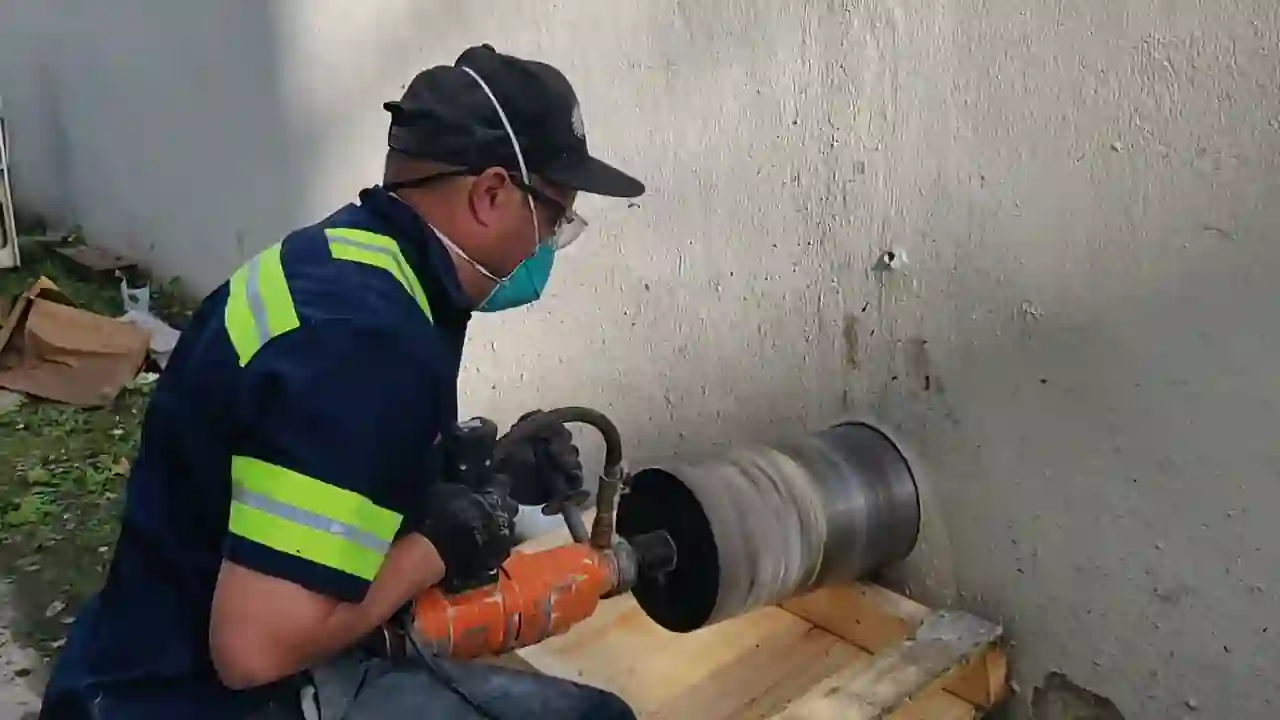
Personal Protective Equipment Standards Specific to CMU Cutting
General PPE requirements for construction sites apply, but CMU cutting demands an elevated PPE specification. The minimum required PPE ensemble for this task includes:
- Head protection — ANSI Z89.1 Type I or Type II hard hat, Class E rated.
- Eye and face protection — ANSI Z87.1 safety glasses plus a full face shield when cutting; the face shield does not replace safety glasses.
- Hearing protection — diamond blade wall saws and angle grinders routinely exceed 95 dB at the operator position; dual hearing protection (plugs plus muffs) is recommended for extended operations.
- Respiratory protection — as detailed under the OSHA silica section above.
- Hand protection — cut-resistant gloves rated ANSI/ISEA 105 Level A4 or higher for handling cut CMU edges, which are razor-sharp.
- Foot protection — ASTM F2413 safety boots with metatarsal guards when working in the debris zone.
Professional CMU cutting is a technically demanding, highly regulated operation. The contractors who execute it safely and efficiently are those who treat every cut as a planned engineering event — not a field improvisation. When the structural integrity of a building and the respiratory health of a crew are both on the line, there is no margin for shortcuts.