Why Blade Specification for Concrete Saw Joints Is a Structural Decision, Not a Supply Room Grab
Walk into any equipment yard in Miami and you’ll find crews grabbing whatever blade is on the shelf before heading out to cut contraction joints in fresh slabs. That habit is costing contractors money, producing ragged joint edges, and — in the worst cases — creating stress concentrations that accelerate cracking rather than controlling it. Concrete saw joints exist for one reason: to predetermine where the slab will crack as it shrinks. If the blade, the saw, and the cutting schedule aren’t dialed in together, that entire engineering purpose collapses. This post breaks down the equipment specifications, diamond tooling characteristics, and blade selection logic that separates competent joint cutting from guesswork.
Saw Type and Engine Class Matched to Joint Depth Requirements
The first equipment decision happens before a blade is even selected. Contraction joints in standard 4-inch residential slabs need to be cut to a minimum depth of one-quarter the slab thickness — that’s 1 inch minimum. Industrial slabs running 6 to 8 inches thick push that requirement to 1.5 to 2 inches. Fiber-reinforced slabs add another variable because the fibers resist blade travel and generate significantly more heat at the cutting interface.
For residential and light commercial joint work, a walk-behind flat saw with a 14- to 18-inch blade capacity and a minimum 13-horsepower engine handles the depth range comfortably. For anything involving post-tensioned slabs, heavy industrial pours, or the kind of thick-deck work common in Miami’s high-rise construction sector, you need a machine in the 25- to 35-horsepower class with hydraulic depth control and a 20-inch or larger blade arbor. Underpowered saws cause blade deflection mid-cut — which produces a wandering joint line and uneven depth, both of which defeat the purpose of the joint entirely.
Spindle speed is equally critical. Most professional flat saws for joint cutting operate between 1,800 and 3,600 RPM at the blade. The blade diameter and the concrete aggregate hardness determine where in that range you want to run. Larger blades at lower RPM maintain surface speed while reducing centrifugal stress on the segment bond. Smaller blades at higher RPM cut faster but wear segments more aggressively in hard aggregate mixes.
Water Flow Rates and Their Effect on Blade Life During Joint Cutting
Dry cutting blades exist for joint work, but they are the exception, not the rule. Wet cutting with controlled water flow — typically 1 to 3 gallons per minute depending on blade diameter — serves two functions simultaneously. It cools the diamond segment bond matrix, preventing thermal glazing, and it flushes slurry out of the kerf so the diamonds can re-engage fresh concrete rather than grinding their own waste. Insufficient water flow is one of the top causes of premature blade wear on joint cuts. If you’re seeing blue discoloration on the blade core near the segments, the water supply is inadequate for the cutting conditions.
Diamond Segment Geometry and Bond Matrix Selection for Joint Cutting Applications
This is where most blade selection decisions go wrong. Diamond blades are not interchangeable across concrete types, and the segment specifications that work on cured 28-day concrete are not the same ones you want for early-entry joint cutting on green concrete.
Diamond segments consist of two components that must be matched to the application. The diamond grit size determines how aggressively the blade cuts and how smooth the joint wall surface is. For standard joint cutting in cured concrete, a grit size in the 30/40 to 40/50 mesh range provides an efficient balance of cut speed and segment longevity. Finer grits (50/60 mesh) produce cleaner joint walls but cut more slowly and are better suited to decorative applications where edge quality matters aesthetically.
The bond matrix hardness is the more technically demanding selection. The bond — typically a sintered metal powder matrix — must wear at a rate that continuously exposes fresh diamond crystals. If the bond is too hard for the concrete being cut, the diamonds polish over without releasing, and the blade stops cutting efficiently. If the bond is too soft, diamonds release before they’ve done their full work, and segment wear accelerates dramatically.
- Soft bond (Grade 6–8): Use on hard, dense aggregate concrete — silica, granite, or quartzite aggregate mixes. The hard aggregate wears the bond at the correct rate to keep diamonds exposed.
- Medium bond (Grade 9–11): The workhorse specification for general-purpose joint cutting on standard Miami-area concrete mixes using limestone aggregate.
- Hard bond (Grade 12–14): Reserved for soft, abrasive aggregate concrete — cinder block, lightweight aggregate, or highly porous mixes — where the bond needs to resist rapid wear from the abrasive material.
Mismatching bond hardness to aggregate type is a project planning error that shows up immediately in blade performance and adds significant cost to what should be a straightforward joint cutting operation. Always request the concrete mix design from the GC before specifying blades on a large joint cutting contract.
Early-Entry Joint Cutting and the Specialized Blade Requirements That Come With It
Early-entry sawing — cutting joints within 1 to 4 hours of concrete placement, before the surface has fully hardened — requires a completely different equipment and blade configuration than conventional joint cutting. The goal is to cut before random cracking initiates, which in hot, dry Miami conditions can happen within 2 to 3 hours of finishing on exposed slabs.
Early-entry saws are purpose-built machines with skid plates that prevent surface tearing and blade guards designed to minimize aggregate disturbance. The blades used in early-entry applications use a dry-cut, turbo segment design with a hard bond matrix specifically calibrated for green concrete. Green concrete is soft and abrasive simultaneously — the cement paste hasn’t fully hydrated, so it’s sticky and pulls at the blade, while the aggregate sits loosely in the matrix and can be dislodged if blade pressure is too high.
Blade width matters here too. Early-entry blades typically run 0.100 to 0.125 inches in kerf width, narrower than conventional joint blades, to minimize the disturbance zone around the cut. The cutting depth for early-entry joints is often limited to 1 inch or slightly less on standard slabs, with the understanding that a conventional saw will return to deepen the joint once the concrete reaches sufficient strength.
Segment Height, Core Thickness, and Blade Tensioning for Long Joint Runs
On large slab pours — warehouse floors, airport aprons, or the kind of expansive flatwork common in Miami’s industrial and logistics corridor — joint runs can extend hundreds of linear feet without interruption. Blade specifications for long runs need to account for cumulative heat buildup and segment fatigue in ways that short residential cuts don’t demand.
Segment height on blades intended for extended joint cutting should be a minimum of 12mm, with 15mm preferred for runs exceeding 500 linear feet. Taller segments provide more diamond-bearing material and allow the blade to run longer before reaching the core. Core thickness — the steel plate the segments are bonded to — should be matched to the arbor size and the saw’s spindle rigidity. Undersized cores flex under lateral load, producing joint walls that aren’t plumb and kerf widths that vary along the cut length.
Blade tensioning is a specification that many contractors overlook entirely. Quality blades for joint cutting are tension-rolled at the factory to compensate for the thermal expansion that occurs during cutting. A blade that runs flat at room temperature will dish or wobble at operating temperature if it hasn’t been properly tensioned. When sourcing blades, confirm with the supplier that tension rolling is part of the manufacturing spec — it’s a non-negotiable requirement for straight, consistent joint cuts. You can find additional tooling guidance in our tools resource library.
Matching Diamond Concentration and Blade Diameter to Specific Concrete Mix Designs
Diamond concentration — expressed as a percentage of diamond volume within the segment — directly affects how aggressively a blade cuts and how long it lasts. Higher concentration blades (40–50 concentration) are slower cutting but last longer, making them appropriate for large joint cutting contracts where blade changes are costly in both time and material. Lower concentration blades (25–30 concentration) cut faster and are better suited to shorter runs or situations where cutting speed is the priority.
For specific material selections involving fiber-reinforced concrete — increasingly common in Miami commercial construction — a medium-high diamond concentration with a medium bond is the starting specification. The fibers create a secondary wear mechanism on the segment face that accelerates bond consumption, so you need the additional diamond reserve that higher concentration provides.
Blade diameter selection should always be driven by required joint depth plus the mechanical clearance needed for the blade guard and water delivery system. A common error is selecting a blade that provides exactly the required cutting depth with no margin — any blade wear reduces effective cutting depth, and a blade that starts at the minimum depth requirement will be cutting undersized joints before the pour is fully jointed. Build in at least 20% depth margin above the minimum joint depth requirement when specifying blade diameter.
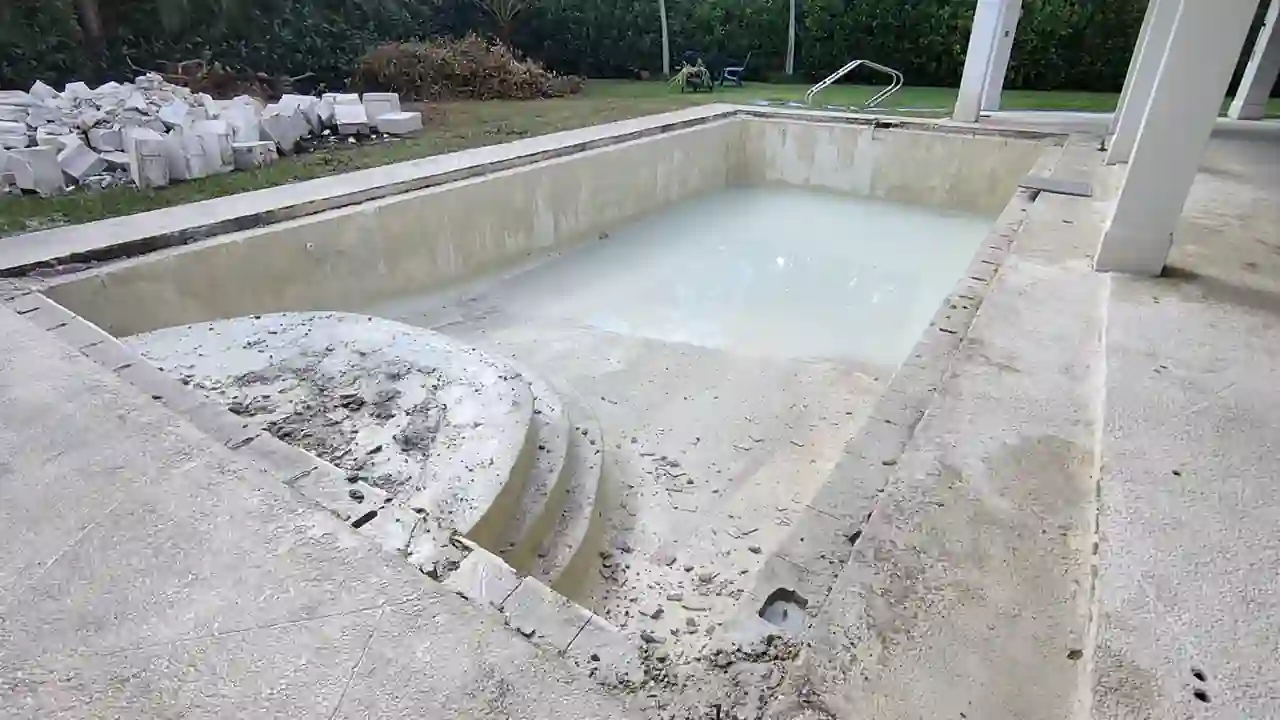
The same precision that goes into blade selection for joint cutting applies to full-depth removal work. Our team handles everything from precision joint cutting to complete concrete driveway removal in Miami with the same level of equipment specification discipline. And for projects involving complex structural considerations — like pool fill-ins where slab continuity and joint placement interact with subsurface conditions — the blade and equipment decisions are just as consequential.
Pre-Cut Checklist That Senior Crews Run Before Every Joint Cutting Operation
Equipment specification doesn’t end at the supply house. Before the first pass on any joint cutting operation, a disciplined crew runs through a physical verification sequence that catches specification mismatches before they become expensive problems in the slab.
- Verify blade arbor compatibility — confirm the blade bore diameter matches the saw spindle exactly, with no adapter bushings that could introduce runout.
- Check blade tension visually — a properly tensioned blade will ring clearly when tapped; a loose or improperly tensioned blade produces a dull thud.
- Confirm water flow rate — measure actual flow at the blade guard outlet before cutting begins, not just at the pump.
- Verify concrete strength or age — confirm the slab has reached the target strength for conventional cutting, or is within the early-entry window for green cutting.
- Inspect segment bond integrity — examine all segments for cracks, missing tips, or signs of previous overheating before mounting the blade.
- Set cutting depth with a test pass — make a 6-inch test cut and measure actual depth before committing to the full joint layout.
Concrete saw joints are a structural element of every slab on grade, and the equipment decisions behind them deserve the same rigor as any other structural specification. Get the blade selection, the saw class, the bond hardness, and the cutting schedule right — and the joints do exactly what they’re engineered to do for the life of the structure.