Why Plumbing Cuts Are the Most Cost-Sensitive Scope in Any Slab Job
When a general contractor or plumbing subcontractor calls us about concrete cutting for plumbing, the first question is almost always about price. That’s the right instinct, but price without context is just a number. What actually matters is understanding the full cost structure — blade wear, cut depth, reinforcement type, slab thickness, and post-cut debris management — because every one of those variables can swing a project budget by 30% or more. In Miami’s climate and construction environment, where post-tension slabs dominate new builds and older structures carry unpredictable rebar layouts, the margin for error on a plumbing cut bid is razor thin.
The Core Variables That Drive Every Plumbing Cut Bid
Bidding concrete cutting for plumbing isn’t a linear exercise. It’s a matrix of overlapping technical factors that a seasoned estimator has to weigh simultaneously. Miss one, and you’re eating margin on the back end. Here’s how experienced contractors break it down.
Slab Thickness and Its Direct Impact on Blade Cost
Standard residential slabs in Miami typically run 4 to 6 inches. Commercial slabs can hit 8 to 12 inches, and elevated structural decks go deeper still. Every additional inch of cut depth means more blade exposure time, faster segment wear, and in many cases, multiple passes. A 4-inch unreinforced slab cut might consume $8–$12 in diamond blade wear per linear foot. A 10-inch post-tension slab with hard aggregate can push that number to $22–$35 per linear foot before you account for labor. Understanding minimum concrete thickness requirements is essential before any cut plan is finalized, because cutting too close to structural minimums creates both safety and liability exposure.
Reinforcement Type — Rebar vs. Post-Tension vs. Wire Mesh
This is the single biggest wildcard in plumbing cut pricing. Wire mesh in a residential slab adds minimal cutting resistance and marginal blade cost. Standard rebar (#4 or #5 bar on 12-inch centers) is predictable — you can factor it into your per-foot rate with confidence. Post-tension cables are a completely different animal. Cutting an active post-tension tendon is catastrophic. It releases stored energy violently, creates serious injury risk, and can cause structural failure. Every post-tension slab requires GPR scanning prior to any saw work, which adds $400–$900 to the project cost upfront. That scan is non-negotiable, and any contractor who skips it is exposing everyone on site to unacceptable risk.
Linear Footage and Cut Geometry
Straight runs are efficient. A plumber who needs a clean 20-foot trench from a floor drain to an exterior wall gives a cutting crew a straightforward scope. But plumbing rarely runs in straight lines. Offsets, cleanout boxes, trap locations, and vent stack penetrations all create short cuts, directional changes, and tight corners — and each transition point costs time. Short cuts (under 3 feet) are disproportionately expensive on a per-foot basis because setup, repositioning, and blade cooling time don’t scale down the way linear footage does. When building a bid, we price short cuts at 1.5x to 2x the standard linear rate.
Realistic Timeline Estimates by Project Type
Timeline is where a lot of plumbing contractors get burned when they don’t coordinate properly with their concrete cutting sub. Here’s a realistic breakdown of what to expect in the field.
Residential Slab Plumbing Rough-In Cuts
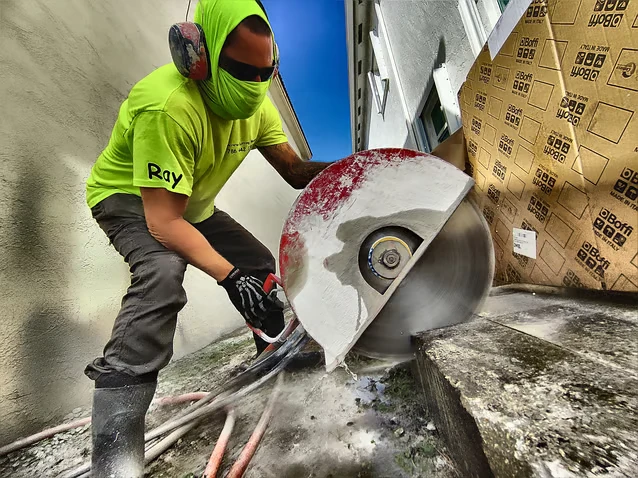
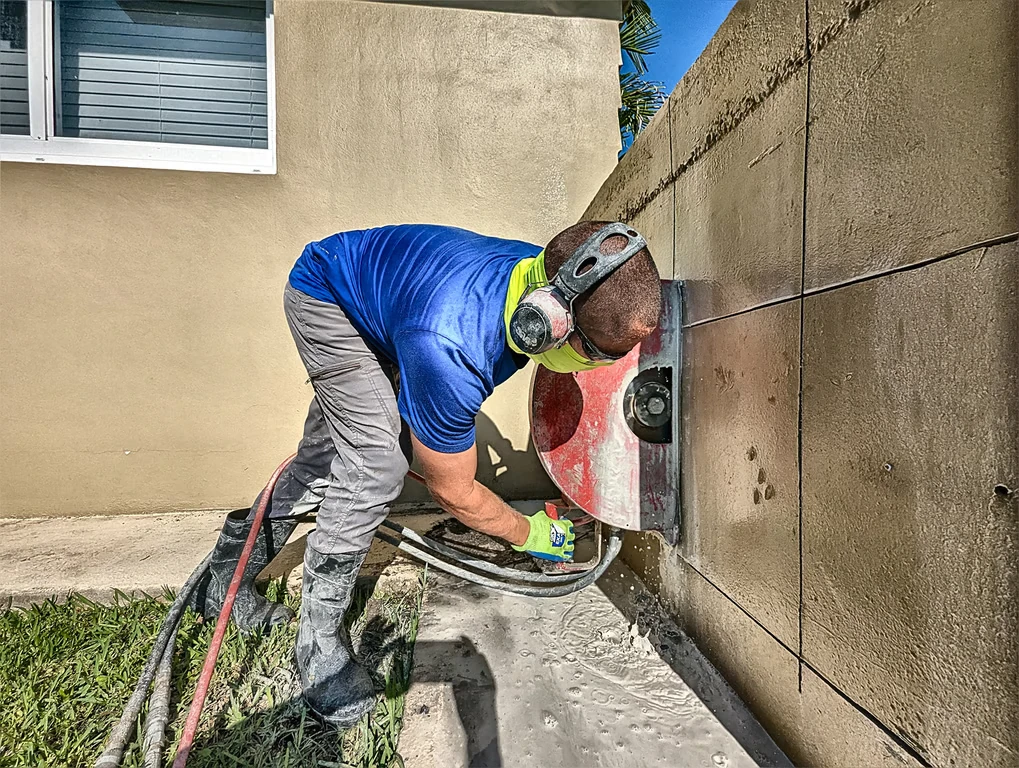
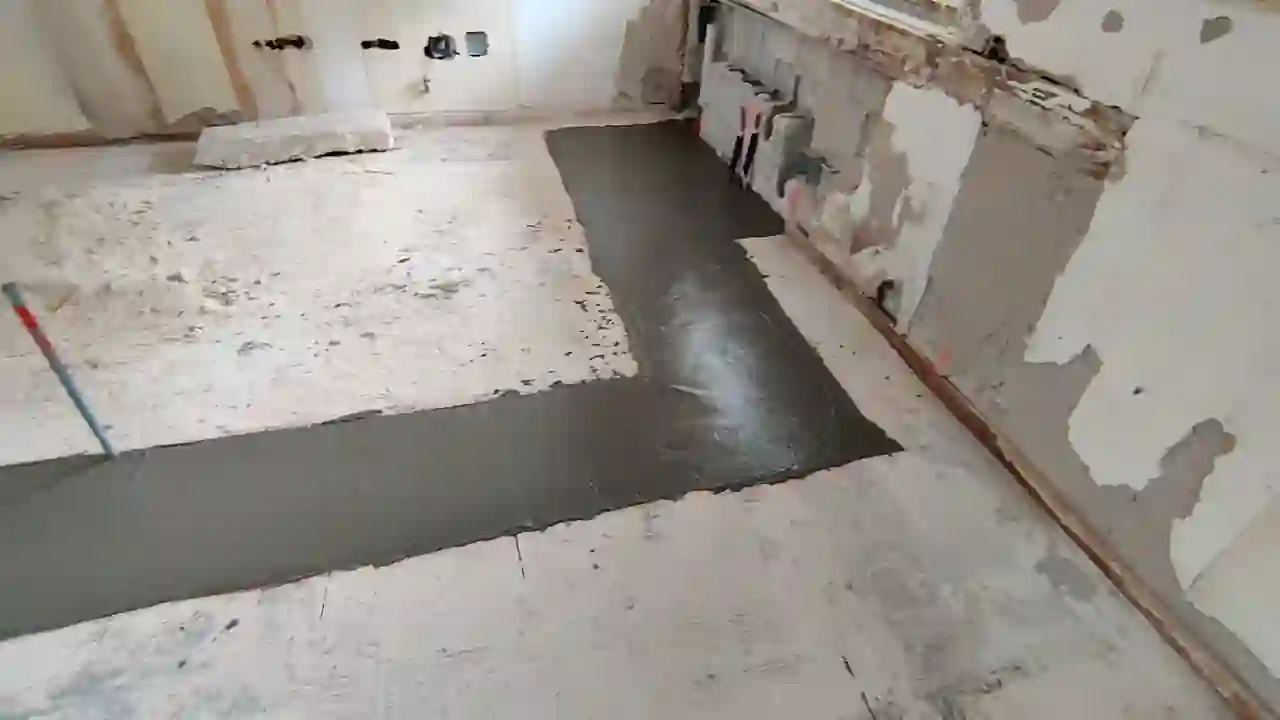
A typical single-family home plumbing rough-in involves 40–120 linear feet of cutting, usually in a 4-inch unreinforced or lightly reinforced slab. With a properly staged crew using a 14-inch or 18-inch flat saw, the actual cutting time runs 2–4 hours. Add 1–2 hours for GPR scanning if required, 1 hour for debris removal and slurry management, and you’re looking at a half-day mobilization. Total on-site time for a standard residential scope is typically 4–6 hours. If the slab contains post-tension cables, add a full day for scanning, layout marking, and careful cut sequencing around the tendon grid.
Commercial Tenant Improvement Plumbing Cuts
Commercial TI work is where timelines get complicated fast. A restaurant buildout or medical office retrofit might require 200–500 linear feet of cutting across multiple areas, with varying slab thicknesses, existing utility conflicts, and occupied adjacent spaces that limit working hours. These projects typically run 2–4 days of cutting, with debris removal staged daily. Miami’s construction environment adds another layer — as explored in depth in why Miami construction projects demand a completely different playbook for site logistics, humidity, heat load on equipment, and permitting timelines all factor into realistic scheduling.
Multi-Family and High-Rise Plumbing Penetrations
Elevated deck penetrations for plumbing in multi-family or high-rise construction are priced and scheduled differently than slab-on-grade work. Core drilling dominates this scope — typically 4-inch to 6-inch cores for drain lines, 2-inch to 3-inch cores for supply and vent. A crew can average 8–15 cores per day depending on deck thickness and reinforcement density. Scheduling must account for access, floor protection, and water management since core drilling generates significant slurry that must be contained and removed. This is a scope where waste management planning directly affects how fast a crew can work and how clean the handoff to the plumber is.
What Separates a Tight Bid from a Losing One
Experienced estimators know that the difference between a profitable plumbing cut job and a money-loser usually comes down to three things that get underestimated in the field.
Slurry and Debris Removal as a Billable Line Item
Wet cutting generates slurry. Dry cutting generates silica dust. Both require active management, and neither is free. Slurry vacuuming, containment, and disposal should always appear as a separate line item in any concrete cutting bid — not buried in a flat per-foot rate. On a 100-linear-foot residential plumbing cut, slurry management alone can represent $150–$300 in labor and disposal cost. On a commercial project, that number scales quickly. Contractors who absorb this cost into their per-foot rate end up underpriced on large jobs and overpriced on small ones.
Mobilization Fees and Minimum Job Charges
Any professional concrete cutting operation carries real overhead per mobilization — equipment transport, crew staging, insurance, and setup time. A minimum job charge of $350–$600 is standard in the Miami market. This is a legitimate cost that protects the contractor and should be disclosed clearly in every bid. Projects that look like small scopes on paper (a single cleanout cut, one drain penetration) often don’t justify the mobilization unless they’re bundled with adjacent work. Smart plumbing contractors batch their cutting scopes to maximize efficiency and avoid paying minimum charges on multiple small mobilizations. This kind of project coordination is exactly the type of opportunity that experienced subs identify early in the scheduling process.
Permit and Inspection Requirements That Affect Scheduling
In Miami-Dade County, any slab cutting that affects structural elements — particularly in post-tension construction — may require a structural engineer’s review and a permit. This isn’t a bureaucratic nuisance; it’s a real scheduling factor that can add 1–3 weeks to project timelines if not anticipated. Plumbing contractors who are newer to slab work sometimes treat concrete cutting as a same-week task. On regulated scopes, it’s a 2–4 week lead-time item. Build that into your project schedule from day one.
DIY Considerations and When Professional Cutting Is Non-Negotiable
Some property owners and small contractors explore DIY approaches for minor plumbing cuts in simple, unreinforced slabs. In very limited scenarios — a small cleanout access cut in a residential garage with a confirmed unreinforced 4-inch slab — this can be feasible with a rented walk-behind saw and proper silica dust controls. But the moment post-tension cables, structural slabs, or multi-unit buildings enter the picture, professional cutting with GPR scanning is the only responsible path. The liability exposure from a severed tendon or an undersized cut that damages a drain line far exceeds any savings from self-performing the work.

Building a Realistic Budget for Your Plumbing Cut Scope
Here’s a practical framework for budgeting concrete cutting for plumbing in the Miami market. Residential slab-on-grade, standard reinforcement, straight runs: $8–$18 per linear foot all-in including slurry management. Post-tension residential with GPR scanning: $20–$40 per linear foot. Commercial slab, heavy reinforcement, complex geometry: $25–$55 per linear foot. Core drilling for penetrations: $75–$200 per core depending on diameter and deck thickness. Always add a 10–15% contingency for unknown reinforcement conditions — in Miami’s older building stock, you will find surprises.
The contractors who consistently win profitable plumbing cut work in this market are the ones who invest in accurate pre-bid scanning, communicate clearly with the plumbing sub about cut geometry before mobilizing, and price debris management as a visible line item rather than hiding it in overhead. Precision cutting done right is not the cheapest line on the bid — but it’s the one that keeps the plumber on schedule and the GC out of rework conversations.