What Makes Concrete Construction Miami Sites So Operationally Demanding
Walk any active concrete construction site in Miami — Brickell, Edgewater, Doral, or Little Havana — and you’ll immediately recognize something that out-of-town contractors often miss until it’s too late: the site itself is the problem. Not the concrete, not the mix design, not the structural drawings. The site. Miami’s urban density, its aging infrastructure corridors, its waterfront setbacks, and its relentless humidity all converge to create access and logistics challenges that require a fundamentally different operational approach than anything you’d encounter on a flat, open suburban build. This post breaks down the real-world technical realities of managing concrete construction in Miami, with a specific focus on confined space operations, equipment access limitations, and the pre-pour and post-pour cutting sequences that keep complex projects moving on schedule.
Urban Site Logistics in Miami’s High-Density Corridors
In most U.S. markets, a concrete construction crew can stage equipment freely, run multiple saw setups simultaneously, and rely on wide staging lanes for material movement. Miami doesn’t work that way. In Brickell and Downtown, you’re often working within a 10-foot sidewalk easement, a shared alley access point, and a city permit window that restricts lane closures to off-peak hours. The logistical math gets brutal fast.
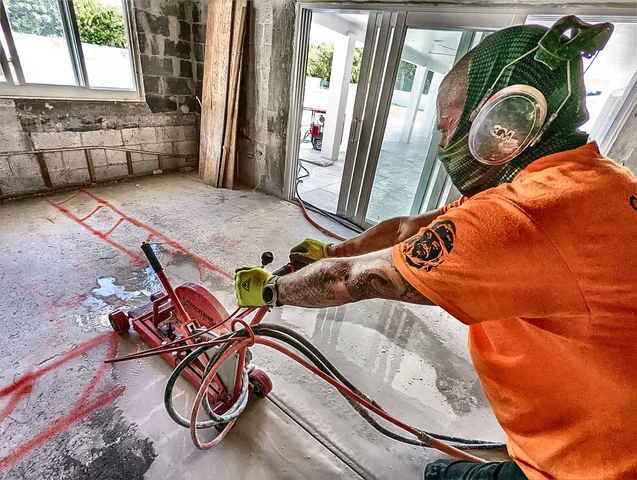
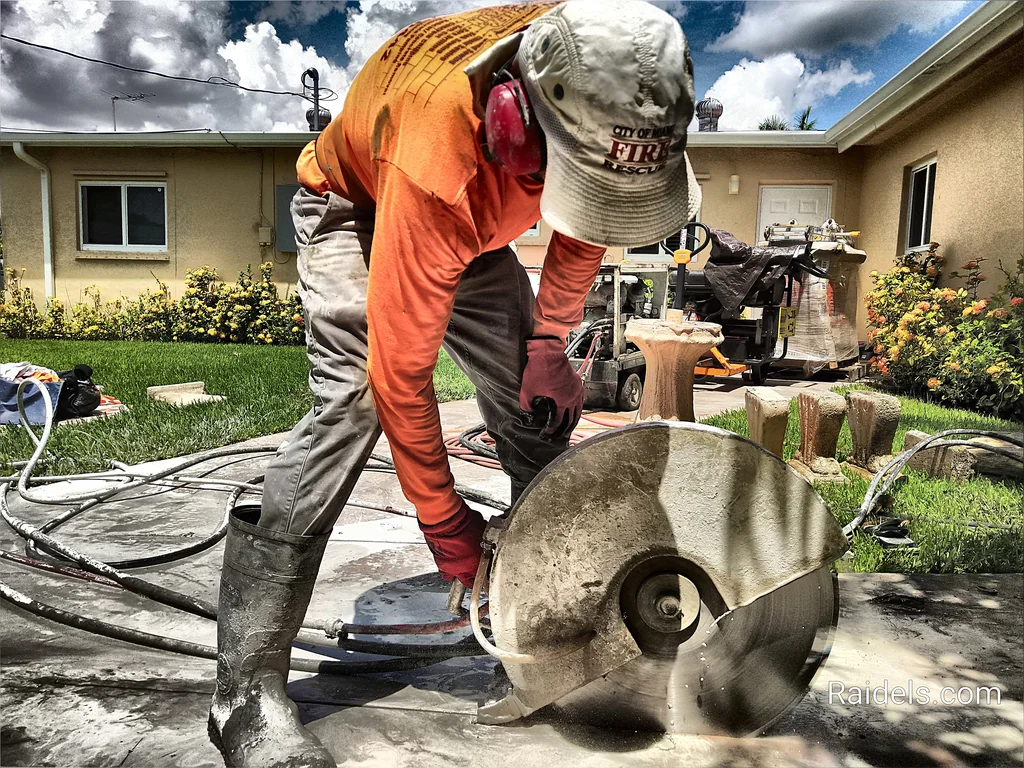
For concrete cutting crews supporting new construction — whether that’s core drilling for MEP penetrations, slab sawing for post-tension relief cuts, or wall sawing for structural openings — the equipment selection process starts with the access audit, not the cut spec. A 65-horsepower hydraulic flat saw that performs beautifully on an open pour deck becomes a liability when the only access to the basement level is a single 8-foot-wide ramp shared with rebar delivery trucks and concrete pump hose runs.
This is why experienced Miami concrete contractors default to electric hydraulic power packs and compact track-mounted saws for interior and below-grade work. The reduced footprint, the elimination of gas exhaust in enclosed spaces, and the ability to reposition equipment through standard door openings are operational necessities, not luxury upgrades. Projects near the waterfront carry additional permitting complexity — if you’re working adjacent to Biscayne Bay or any tidal canal, equipment staging and slurry containment protocols are governed by both city and FDEP requirements simultaneously. Learn more about the specific demands of Miami waterfront construction projects and how they shape cutting and demolition scope.
Confined Space Concrete Cutting Protocols for Below-Grade Miami Construction
Below-grade concrete work in Miami presents a specific category of challenge that sits at the intersection of OSHA confined space regulations, structural engineering requirements, and pure physical logistics. Miami’s water table is notoriously high — in many parts of the city, you hit groundwater within 4 to 6 feet of grade. That reality shapes how below-grade concrete structures are designed and, critically, how cutting and penetration work gets executed after the pour.
When a structural engineer specifies a post-pour opening in a basement retaining wall — for a utility corridor, a pedestrian tunnel connection, or a mechanical access point — the cutting crew is operating in a space that may have active dewatering systems running, limited ventilation, restricted overhead clearance, and load-bearing conditions that require temporary shoring before the first cut begins. The sequence matters enormously:
- Shoring installation and verification before any structural wall penetration begins, coordinated with the project’s structural engineer of record
- Ventilation assessment using CFM calculations appropriate for the saw type — electric hydraulic systems dramatically reduce the ventilation burden compared to gas-powered equipment
- Slurry management planning in advance, since below-grade cuts generate water and concrete slurry that cannot be allowed to migrate toward dewatering sumps or active waterproofing membranes
- Dust suppression protocols coordinated with adjacent trades, particularly critical in Miami’s enclosed parking structures and mixed-use podium builds
- Emergency egress mapping for all personnel inside the confined work zone, per OSHA 29 CFR 1926.1201 confined space standards applicable to construction
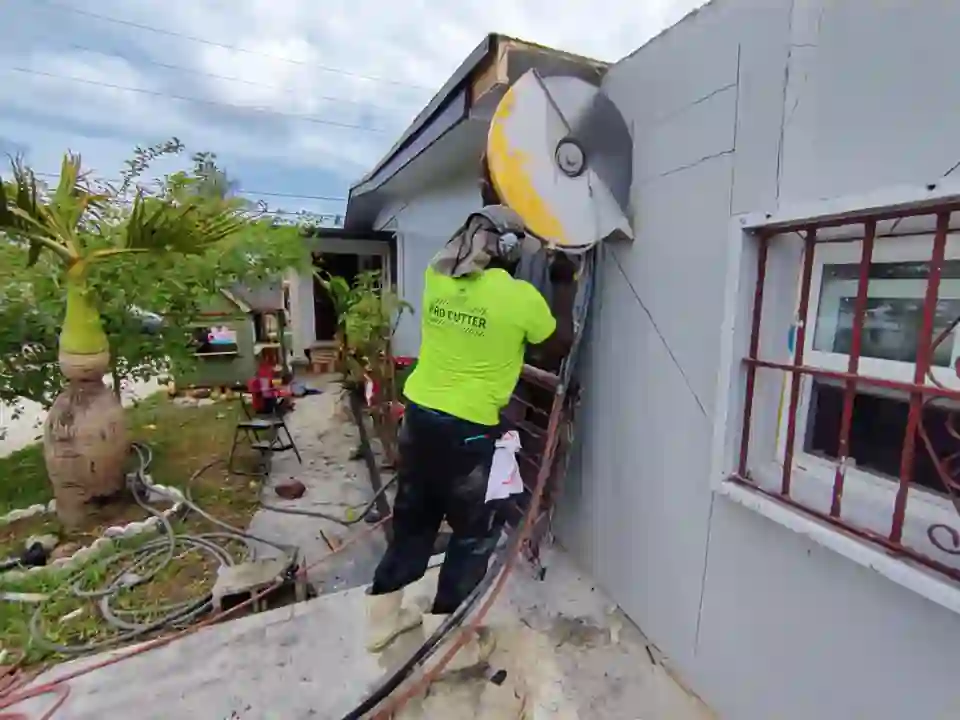
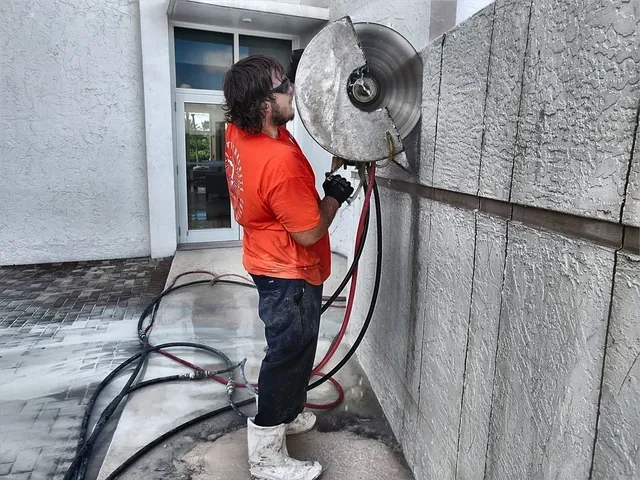
The wall saw is typically the tool of choice for these structural openings, and for good reason. A track-mounted wall saw allows the operator to maintain standoff distance from the cut plane, reduces vibration transfer to adjacent structural elements, and can be configured for plunge cuts that minimize overbreak at corners. For deeper cuts in reinforced walls — anything over 18 inches of effective concrete thickness — diamond wire sawing becomes the technically superior option, though the rigging requirements in confined spaces add their own complexity layer. Explore the full technical case for diamond cutting systems and their advantages on complex Miami projects.
Equipment Access Limitations on Miami High-Rise Tower Pours
Miami’s residential high-rise boom — concentrated in Edgewater, Brickell, and Sunny Isles — creates a recurring access problem for concrete cutting crews: how do you get heavy, vibration-sensitive cutting equipment to the 18th floor of an active construction site where the hoist schedule is controlled by the general contractor and every minute of hoist time is allocated weeks in advance?
The answer is modular equipment design and pre-planned logistics. Hydraulic power packs can be broken into components that move on a standard construction hoist. Diamond blades, core bits, and ancillary tooling stage in rolling carts sized to hoist platform dimensions. The wall saw track sections are designed for disassembly and reassembly on-floor. None of this happens by accident — it requires a pre-mobilization site walk, a hoist schedule negotiation with the GC’s superintendent, and a crew that has executed this sequence enough times to do it efficiently under time pressure.
For residential concrete construction specifically — whether it’s a mid-rise condo in Coconut Grove or a single-family pour in Coral Gables — the access constraints shift from vertical logistics to horizontal clearance. Tight lot lines, mature tree canopies, and neighborhood restrictions on equipment noise levels all factor into the operational plan. Miami residential concrete projects require the same level of logistical discipline as commercial high-rise work, just applied to a completely different physical context.
Wall Saw Track Mounting in Structurally Sensitive Environments
One of the most technically demanding aspects of concrete construction support work in Miami is the proper setup of wall saw track systems on surfaces that may be post-tensioned, may have embedded conduit or rebar in non-standard locations, or may be adjacent to occupied spaces where vibration transmission is a legitimate concern. Track mounting requires anchor bolt placement that accounts for the anticipated cutting loads — and in post-tensioned concrete, every anchor location must be GPR-scanned and cleared before drilling begins, without exception.
Ground-penetrating radar scanning prior to any wall saw anchor installation isn’t a precaution in Miami construction — it’s a baseline operational requirement. PT cables in a Brickell tower slab run at 2,000 to 3,000 psi of prestress force. Severing one is a structural event, not a repair item. The scan data drives the anchor grid layout, which in turn drives the track position, which determines the cut line. That chain of dependencies means the cutting crew needs to be in coordination with the structural engineer before mobilization, not after something goes wrong. For a deeper look at the equipment involved in these operations, the wall saw equipment category covers the technical specifications relevant to Miami construction applications.
Slurry Containment and Environmental Compliance on Miami Job Sites
Concrete slurry — the byproduct of wet diamond cutting — is classified as a high-pH waste stream and cannot be discharged to storm drains, surface water, or the ground without treatment. In Miami, where storm drains connect directly to Biscayne Bay and its tributaries, slurry management is both an environmental compliance issue and a practical site cleanliness issue that affects your relationship with the GC and the neighboring trades.
Best practice on Miami concrete construction sites involves a three-stage slurry management approach: collection at the cut point using vacuum extraction or bermed containment, neutralization using CO2 injection or pH-buffering agents to bring the slurry to an acceptable discharge pH, and disposal through a licensed waste hauler or on-site reclamation if the project volume justifies the equipment investment. For waterfront projects or sites with proximity to protected wetlands, the FDEP may require documented slurry management plans as a condition of the construction permit.
The operational discipline required to execute concrete construction support work in Miami — from the confined space protocols to the equipment logistics to the environmental compliance requirements — is exactly why this market rewards contractors who have invested in both the technical training and the right tool inventory. Miami’s concrete construction volume is substantial and growing, and the sites are only getting more complex as density increases and the projects push closer to the bay, closer to the property lines, and higher into the sky.
If your project involves access constraints, post-tensioned structures, below-grade cutting, or any configuration where standard equipment setups simply won’t fit the physical reality of the site, the conversation needs to start with a crew that has solved these problems before — not one that’s working through them for the first time on your schedule and your budget.