Why Lauderdale Lakes Construction and Demolition Sites Demand a Higher Safety Standard
Lauderdale Lakes sits in a dense urban corridor within Broward County, where construction and demolition projects unfold in close proximity to residential neighborhoods, active roadways, and aging infrastructure. That combination creates a layered hazard environment that generic jobsite safety plans simply cannot address. Whether you’re cutting a reinforced slab for a commercial retrofit, removing a load-bearing wall in a mixed-use structure, or executing a full structural demolition, the margin for error in this municipality is razor-thin. OSHA 29 CFR 1926 Subpart T — the federal demolition standard — applies to every phase of work, and local Broward County ordinances add additional notification and inspection requirements on top of that federal baseline. Contractors who treat safety as a checklist item rather than an engineered system are the ones who end up with stop-work orders, citations, and worse.
Pre-Demolition Engineering Surveys and Structural Assessment Requirements
Before any cutting blade touches concrete in Lauderdale Lakes, OSHA 1926.850(a) mandates a competent person conduct a thorough engineering survey of the structure. This isn’t a visual walkthrough — it’s a documented assessment of structural integrity, load paths, and potential collapse zones. In older Broward County commercial buildings, you’ll frequently encounter post-tensioned slabs, which fundamentally change how a demolition sequence must be staged. Cutting into a post-tensioned tendon without proper survey data can release thousands of pounds of stored energy in a fraction of a second, sending concrete fragments across a wide radius.
The engineering survey must identify all utility lines — gas, electrical, water, telecommunications — and confirm disconnection before work begins. In Lauderdale Lakes, underground utility mapping is particularly critical because many older parcels have undocumented lateral lines that don’t appear on municipal drawings. Ground-penetrating radar (GPR) scanning should be treated as non-negotiable on any slab or foundation work. For crews dealing with foundation access challenges, a pre-cut GPR pass can mean the difference between a clean penetration and a catastrophic utility strike.
OSHA-Compliant Silica Dust Control During Concrete Cutting Operations
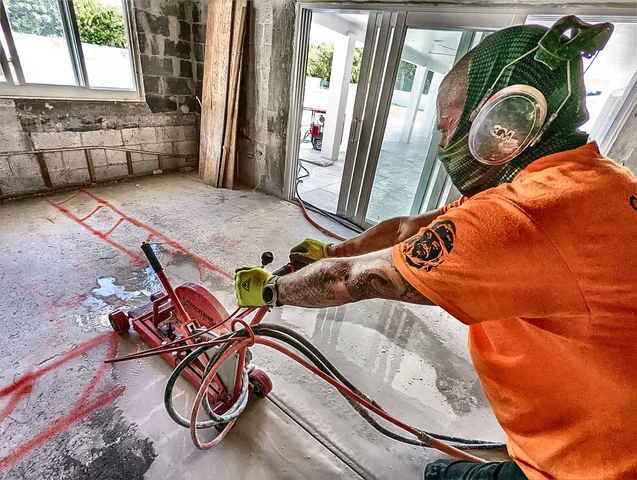
OSHA’s Respirable Crystalline Silica Standard (29 CFR 1926.1153) is one of the most frequently cited violations in South Florida construction. The permissible exposure limit (PEL) is 50 micrograms per cubic meter of air averaged over an eight-hour shift, with an action level of 25 µg/m³. Dry cutting concrete in an enclosed or semi-enclosed Lauderdale Lakes jobsite will blow past those numbers within minutes. Wet cutting with continuous water suppression is the primary engineering control, and it must deliver water directly to the blade-material interface — not sprayed from a distance.
For projects where wet cutting isn’t feasible, such as certain interior slab cuts or electrical proximity situations, crews must deploy a HEPA-filtered vacuum shroud system rated for Table 1 compliance. Operators must wear a minimum of a NIOSH-approved N95 respirator, though a half-face APF-10 respirator is strongly preferred for extended cuts. Air monitoring logs must be maintained on-site and made available to OSHA upon request. Supervisors who rely on industry-standard tools and techniques designed specifically for silica mitigation will find compliance far more manageable than retrofitting controls after work has started.
Structural Sequencing and Collapse Prevention on Active Demolition Floors
Partial demolition — the most common type of work in Lauderdale Lakes renovation and adaptive reuse projects — creates a uniquely dangerous structural condition. When you remove one element of a concrete frame, you alter the load distribution across the remaining structure. OSHA 1926.855 requires that walls, floors, and structural members be shored, braced, or otherwise supported before adjacent elements are removed. In practice, this means developing a demolition sequence drawing that a licensed structural engineer has reviewed and stamped.
For projects involving door and opening widening in load-bearing concrete walls, temporary shoring must be installed before any cutting begins. The shoring system must be designed to carry the full dead load of the structure above, plus a minimum 25% safety factor for dynamic loading during the cut. Teams working on door opening widening in Fort Lauderdale-area projects understand that this step cannot be skipped or abbreviated regardless of schedule pressure. A premature header failure in a multi-story building doesn’t just injure the cutting crew — it can trigger progressive collapse of the floors above.
Floor Loading Limits During Debris Accumulation
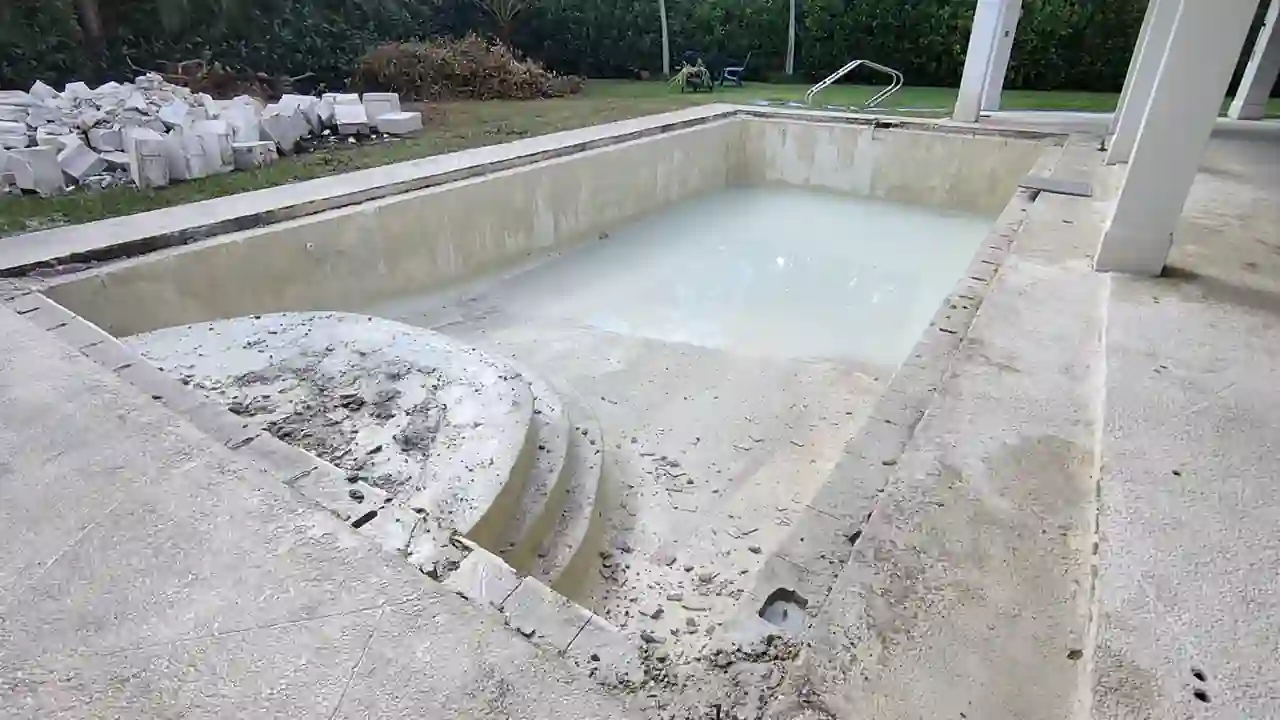
Concrete rubble is extraordinarily heavy. A single cubic yard of broken concrete weighs approximately 2,000 to 2,700 pounds. Allowing debris to accumulate on a floor slab that is simultaneously being cut weakens the very surface your crew is standing on. OSHA requires that floors be cleared of debris in a manner that doesn’t overload the remaining structural capacity. On Lauderdale Lakes projects involving multi-story structures, debris chutes or crane-assisted removal should be engineered into the logistics plan from day one, not improvised mid-project.
Personal Protective Equipment Hierarchy for Concrete Demolition Crews
PPE is the last line of defense, not the first — but it must be correct, properly fitted, and consistently worn. For concrete cutting and demolition in Lauderdale Lakes, the minimum PPE matrix includes:
- Head protection: ANSI Z89.1 Class E hard hat for all personnel within the demolition zone
- Eye and face protection: ANSI Z87.1 safety glasses plus a full-face shield when operating cutting equipment
- Hearing protection: Rated NRR 25 or higher for diamond blade saw operation, which typically generates 95–105 dB at the operator position
- Hand protection: Cut-resistant gloves rated ANSI A4 or higher when handling broken concrete edges
- Foot protection: ASTM F2413 steel-toed boots with metatarsal guards on active demolition floors
- Respiratory protection: As specified under the silica standard above — no exceptions for short-duration cuts
- High-visibility vests: Required whenever mobile equipment operates within the exclusion zone
Maintaining structural safety on demolition sites isn’t just about the building — it’s about the crew working inside it. PPE audits should happen at the start of every shift, and supervisors must have authority to remove personnel from the site for non-compliance without exception.
Exclusion Zones, Signage, and Public Safety Barriers in Urban Lauderdale Lakes Sites
Urban demolition in Lauderdale Lakes means working near pedestrian corridors, adjacent occupied buildings, and active traffic lanes. OSHA 1926.850(e) requires that all hazardous areas be barricaded and posted with warning signs. But in a dense urban environment, the standard orange construction fence is rarely sufficient. Engineered debris containment systems — including overhead catch platforms and solid hoarding panels — are required when work occurs above grade in proximity to public access areas.
Broward County building officials may require a right-of-way permit and traffic control plan for any demolition that affects sidewalk access or requires crane or equipment staging in a public roadway. These permits must be obtained before work begins, and failure to do so can result in immediate stop-work orders that delay projects far longer than the permit process would have. For projects involving stair removal or vertical access work, see how specialized techniques apply to concrete stair removal in Miami-area projects — many of the same containment principles translate directly to Lauderdale Lakes conditions.
Hazardous Materials Identification Before Cutting Begins
Pre-1980 structures in Lauderdale Lakes present a significant asbestos-containing materials (ACM) risk. Transite pipe, floor tile mastic, pipe insulation, and certain fireproofing compounds may all contain asbestos. OSHA 1926.1101 requires that all suspect ACM be sampled and analyzed by an accredited laboratory before any demolition activity that would disturb those materials. A positive ACM result triggers a full Class I or Class II abatement protocol, including negative-pressure enclosures, air monitoring, and waste disposal through a licensed hazardous materials hauler.
Lead paint is equally common in older Lauderdale Lakes commercial and residential structures. Any cutting, grinding, or demolition of painted concrete surfaces may generate lead dust, triggering OSHA 1926.62 compliance requirements including baseline blood lead testing for workers, engineering controls, and specific decontamination procedures. These aren’t optional compliance items — they are enforceable federal standards with significant per-violation penalties.

Building a Jobsite Safety Culture That Outlasts Any Single Project
The most technically sound safety plan fails without crew buy-in and consistent enforcement. On Lauderdale Lakes demolition sites, daily toolbox talks should address the specific hazards present that day — not generic reminders. If the crew is cutting a post-tensioned slab on Tuesday, Tuesday’s toolbox talk covers tendon identification, emergency stop procedures, and exclusion zone enforcement. If Wednesday brings a partial wall removal, the talk shifts to shoring verification and load path awareness.
Competent persons — as defined by OSHA — must be on-site whenever cutting or demolition is active. A competent person isn’t just someone with experience; it’s someone with the specific training to identify hazards and the authority to take immediate corrective action, including stopping work. Concrete Cutting Miami, LLC builds that authority into every project structure, because the fastest way to lose a contract in Broward County is to earn a serious injury citation on a high-visibility urban jobsite.
Lauderdale Lakes construction and demolition work rewards contractors who invest in pre-project planning, engineered controls, and genuine safety leadership. The hazards are real, the regulations are enforceable, and the consequences of cutting corners — in every sense of that phrase — are severe. Crews that treat OSHA compliance as a competitive advantage rather than a burden consistently deliver faster, safer, and more profitable projects than those who don’t.