The core misunderstanding about how a concrete saw works — it does not cut, it grinds
Most people who ask how a concrete saw works picture the same thing: sharp teeth on a spinning blade, like a circular saw for wood, biting into concrete and removing chips of material with each tooth. That image is completely wrong — and understanding why it is wrong is the key to understanding how concrete saws actually work. A concrete saw does not have teeth. It has a smooth rim with rectangular blocks called segments welded around the circumference. Those segments are made of a metal powder mixed with synthetic diamond crystals, pressed under heat and pressure into a solid matrix. When the blade spins at 2,000 to 4,000 RPM and contacts the concrete, the exposed diamond crystals — the hardest known material on Earth — grind against the concrete surface. Each diamond crystal acts as a microscopic cutting point, abrading a tiny amount of concrete with each pass. The blade is not cutting. It is grinding through the concrete at the microscopic level, with thousands of diamond points each removing an infinitesimal amount of material per revolution.

This grinding action is why how a concrete saw works depends on more than just the diamonds. The metal matrix that holds the diamonds is just as important. As the blade spins and the diamonds grind against concrete, friction heats the metal matrix. The heat and abrasion cause the matrix to wear away slowly, exposing fresh, sharp diamonds that were buried beneath the surface. This self-sharpening behavior is the fundamental mechanism that allows a single diamond blade to cut hundreds or thousands of linear feet of concrete. If the matrix wears too fast — because the bond is too soft for the aggregate type — the diamonds fall out before they have been fully used, and blade life is short. If the matrix wears too slowly — because the bond is too hard — the diamonds wear down and become dull, the blade surface glazes over, and the blade stops cutting effectively. Matching the bond hardness to the aggregate type is the essential knowledge that separates professional concrete saw operators from amateurs.

The power source — what spins the blade and why it matters
The second part of understanding how a concrete saw works is the power source that spins the blade. Diamond crystals grinding through concrete encounter enormous resistance, and the power unit must deliver consistent torque at the blade arbor despite that resistance. If the blade slows down under load, the diamonds skip across the surface rather than grinding into it, generating heat without cutting depth. There are three primary power systems used in concrete sawing, and each has different characteristics that suit different applications.
Gas-powered saws
Gas-powered concrete saws use a two-stroke or four-stroke internal combustion engine to spin the blade through a belt or direct drive system. The engine produces its rated horsepower at a specific RPM range, and the drive system converts that to the correct blade RPM. Gas saws are self-contained — no cords, no hoses, no external power unit — which makes them highly portable. The engine runs on a gasoline-oil mixture (for two-stroke engines) or straight gasoline (for four-stroke). The trade-offs are exhaust emissions, noise, and vibration. In Miami, gas-powered saws are used primarily for outdoor work and in well-ventilated ground-floor spaces. They are not suitable for enclosed interior work without forced ventilation — two-stroke exhaust contains carbon monoxide at concentrations that become dangerous rapidly in confined spaces.
Electric-powered saws
Electric concrete saws use an electric motor — typically 120V single-phase for smaller handheld saws or 480V three-phase for large industrial saws — to spin the blade. Electric motors produce full torque from zero RPM, which provides excellent cutting feel and control. They produce no exhaust emissions, making them the preferred choice for indoor cutting in occupied buildings, healthcare facilities, and any space where air quality matters. The limitation is power availability. A 120V circuit limits the motor to about 15 amps, which may not be sufficient for cutting thick or heavily reinforced concrete at production speed. Three-phase 480V power provides all the power a large saw needs but requires a compatible power supply, which is typically available in industrial facilities but not in residential settings.
Hydraulic-powered saws
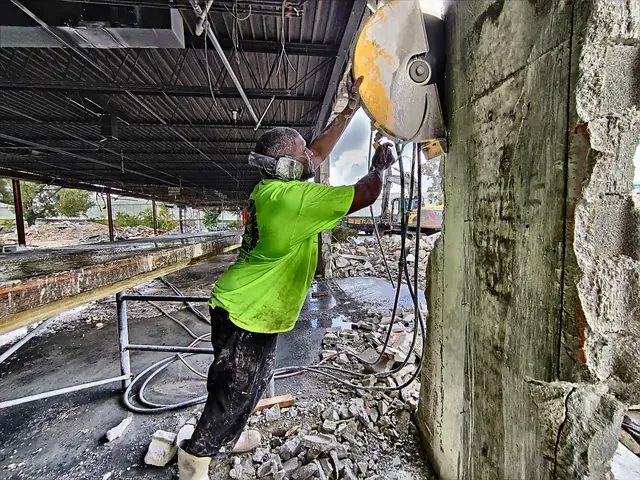
Hydraulic concrete saws use a remote hydraulic power unit — typically powered by a diesel, gas, or large electric motor — to pump hydraulic fluid through high-pressure hoses to a hydraulic motor mounted on the saw head. The hydraulic motor spins the blade. This configuration separates the power generation from the cutting tool, which provides significant advantages. The saw head can be lighter and more compact because it does not carry an engine or large electric motor. The power unit can be located outside the work area, connected by hydraulic hoses that can be run considerable distances. Hydraulic power delivers consistent torque regardless of load — the saw maintains blade speed through rebar and hard aggregate in ways that gas and electric saws cannot match. In Miami, hydraulic wall saws are the standard for cutting heavily reinforced structural walls and thick slabs where gas and electric power sources would struggle.
Blade cooling — why concrete saws use water
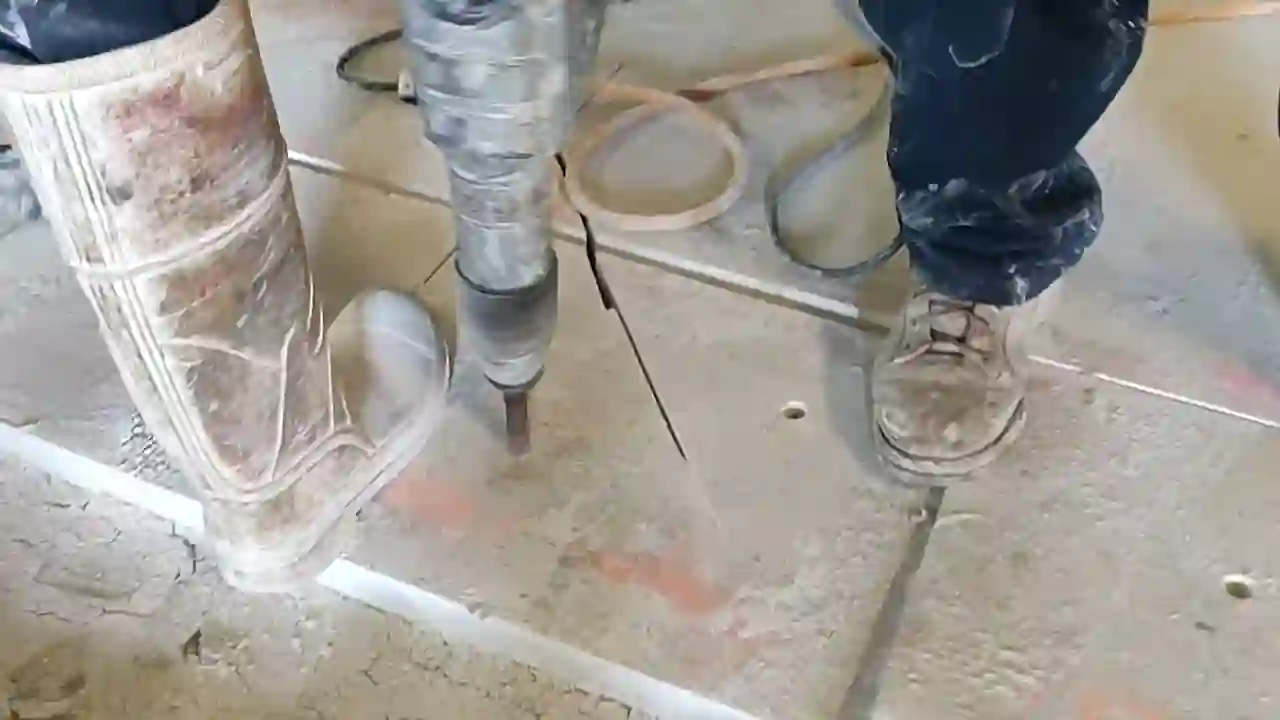
Diamond grinding through concrete generates intense heat at the contact point between diamond crystals and concrete surface. Without cooling, that heat builds rapidly — the diamond-metal matrix interface can reach temperatures where the metal softens, the diamonds lose their grip, and the blade core can warp from thermal stress. A dry-cut diamond blade can be destroyed in minutes on a demanding cut. This is the third critical element of how a concrete saw works: water cooling.
Water is delivered to the blade through a hose or integral water tank, flowing onto the blade surface or into the blade guard where it is directed to the cutting edge. The water serves three purposes simultaneously: it cools the blade by absorbing and carrying away heat, it suppresses airborne silica dust by binding the fine concrete particles into slurry, and it lubricates the cut slightly, reducing friction between the blade and the concrete sidewalls. The water does not need to be high volume — a steady stream directed at the leading edge of the blade where it contacts the concrete is sufficient. The resulting slurry — water mixed with concrete dust — must be contained and disposed of properly. In Miami-Dade County, slurry cannot be washed into storm drains, and professional concrete cutting operations include vacuum slurry collection systems or containment berms as standard equipment.
Dry cutting — operating a concrete saw without water — is possible on small jobs with blades specifically designed for dry operation. Dry-cutting blades typically have a softer bond that wears faster, exposing diamonds more aggressively to compensate for the lack of water cooling. But dry cutting produces significant airborne silica dust, which is regulated by OSHA standard 1926.1153. In practice, any concrete cutting job in Miami beyond a quick single cut should be performed wet, with proper slurry containment. The blade lasts longer, the air stays cleaner, and the job stays compliant with federal and county regulations.
The saw operator — the variable that makes everything else work
Understanding how a concrete saw works includes understanding that the saw is a tool, and the operator is what makes the tool produce professional results. The operator controls feed rate — how fast the blade advances into the concrete. Feed too fast and the blade binds, overheats, or deflects, producing a curved cut instead of a straight line. Feed too slowly and the diamonds glaze over, the blade stops cutting effectively, and productivity drops. The correct feed rate varies continuously throughout a cut — faster through unreinforced concrete, slower through rebar, faster through areas where the aggregate is loosely packed, slower where it is dense. The operator adjusts based on sound, vibration, and visual feedback from the cut. An experienced operator hears when the saw is working efficiently and feels when the blade needs to slow down.
On wall sawing operations in Miami, where cuts through structural concrete walls must be straight and plumb to meet engineering tolerances, the track system provides mechanical guidance — but the operator still manages feed rate, water flow, and blade condition. On slab sawing jobs where hundreds of linear feet of control joints or trench cuts must be made in a day, the operator’s ability to maintain consistent feed rate directly determines whether the job finishes on schedule. The saw is the tool. The operator is the skill. Miami concrete cutting depends on both. Contact us for saw cutting services from operators who know how to get the most from every blade on every cut.