Why the Method You Choose Determines the Hazard You Inherit
Every demolition job starts with a choice, and that choice has consequences that ripple through your entire safety plan. Whether you’re pulling permits for a high-rise retrofit in Brickell or clearing a slab in Hialeah, the demolition technique you select doesn’t just affect production speed — it directly determines your exposure to silica dust, structural instability, falling debris, and OSHA 29 CFR 1926 Subpart T violations. As a senior concrete consultant who has worked across South Florida’s coastal and urban environments for over two decades, I can tell you that the gap between a compliant demolition and a recordable incident often comes down to whether the crew understood the hazard profile of the method they were using before the first cut was made.
Mechanical Demolition with Hydraulic Breakers — High-Impact, High-Hazard
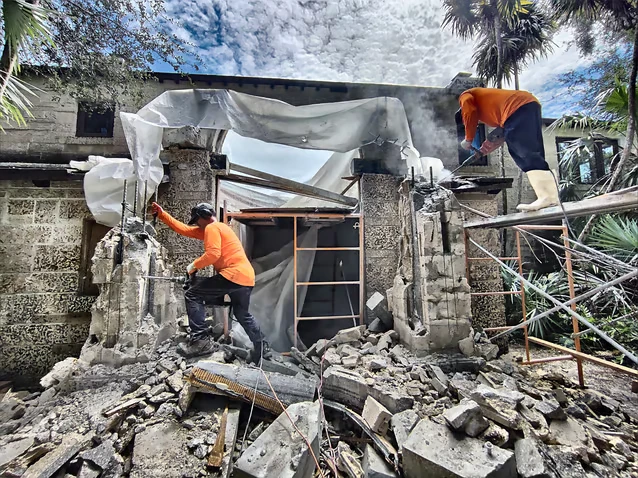
Hydraulic breaker attachments mounted to excavators remain one of the most widely used mechanical demolition techniques on commercial and residential job sites throughout Miami-Dade County. They’re effective for breaking up mass concrete, thick slabs, and reinforced footings. However, the vibration, noise, and airborne particulate generated by this method create a multi-layered hazard environment that demands a rigorous safety protocol before the machine ever swings into position.
OSHA’s silica standard under 29 CFR 1926.1153 Table 1 requires wet methods or HEPA-equipped vacuum systems whenever hydraulic breakers are used on concrete. In Miami’s humid climate, water suppression is often the go-to, but crews must monitor water flow rates continuously — a dry pass even for 90 seconds can spike respirable silica concentrations well above the OSHA action level of 25 µg/m³. Additionally, the exclusion zone for hydraulic breaking must be established based on projectile throw distance, which OSHA recommends calculating at a minimum of 1.5 times the height of the structure being demolished. Structural pre-surveys under 29 CFR 1926.850(a) are non-negotiable before any mechanical impact work begins.
Vibration-Induced Structural Fatigue in Adjacent Structures
One underappreciated hazard specific to dense South Florida neighborhoods is the transmission of ground vibration from hydraulic breakers into adjacent foundations. Older CBS (concrete block structure) homes near demolition zones can experience micro-cracking in mortar joints when peak particle velocity (PPV) exceeds 0.5 inches per second. If your site is within 50 feet of an occupied structure, vibration monitoring with a seismograph is not optional — it’s a liability shield and, increasingly, a permit condition in Miami-Dade. For projects where vibration thresholds are a concern, precision concrete cutting services offer a dramatically lower-vibration alternative that keeps adjacent structures intact and your compliance record clean.
Diamond Wire Sawing for Controlled Structural Demolition
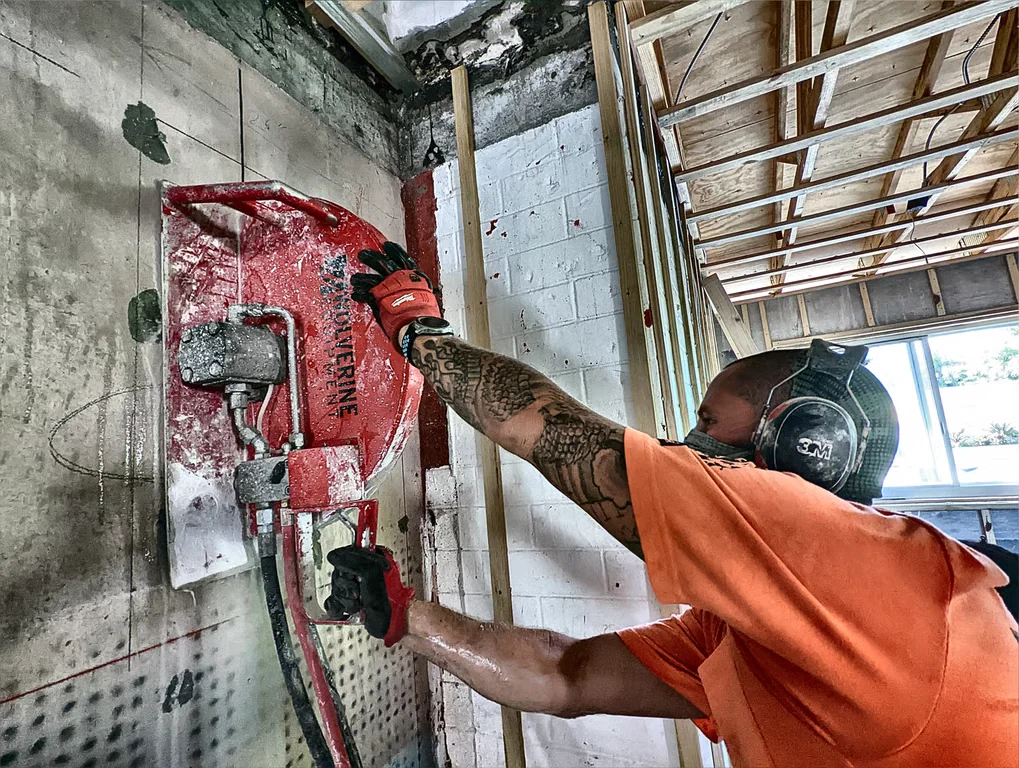
Diamond wire sawing is the technique of choice when precision and minimal collateral damage are the primary objectives — think bridge deck sections, marine piling caps, or post-tensioned parking garage beams. A diamond-impregnated wire loop is threaded through pre-drilled anchor points and driven by a hydraulic or electric flywheel, cutting through virtually any concrete cross-section without impact shock.
From a safety standpoint, diamond wire sawing requires a dedicated wire tension monitoring protocol. A wire failure under tension can result in a high-velocity snap that travels the full loop length — a lethal hazard if personnel are within the wire plane. OSHA 29 CFR 1926.302 requires that all power-actuated tools and cutting equipment be operated only by trained, authorized personnel, and diamond wire systems fall squarely into that category. Exclusion zones must be established perpendicular to and along the wire plane, with physical barriers — not just cones — installed before any tension is applied. For coastal infrastructure projects where structural tolerances are tight, our team has documented the full protocol in this breakdown of precision demolition for Florida coastal infrastructure.
Flat Sawing and Core Drilling — Lower Hazard Profile, But Not Zero Risk
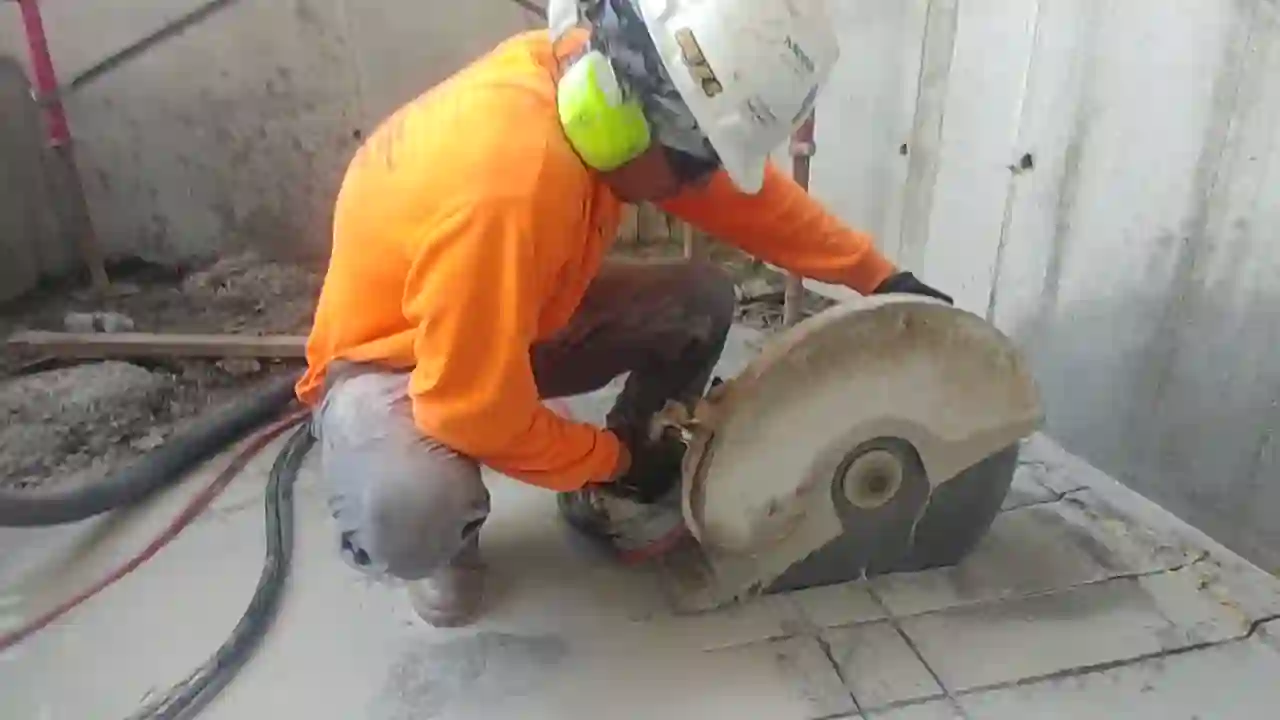
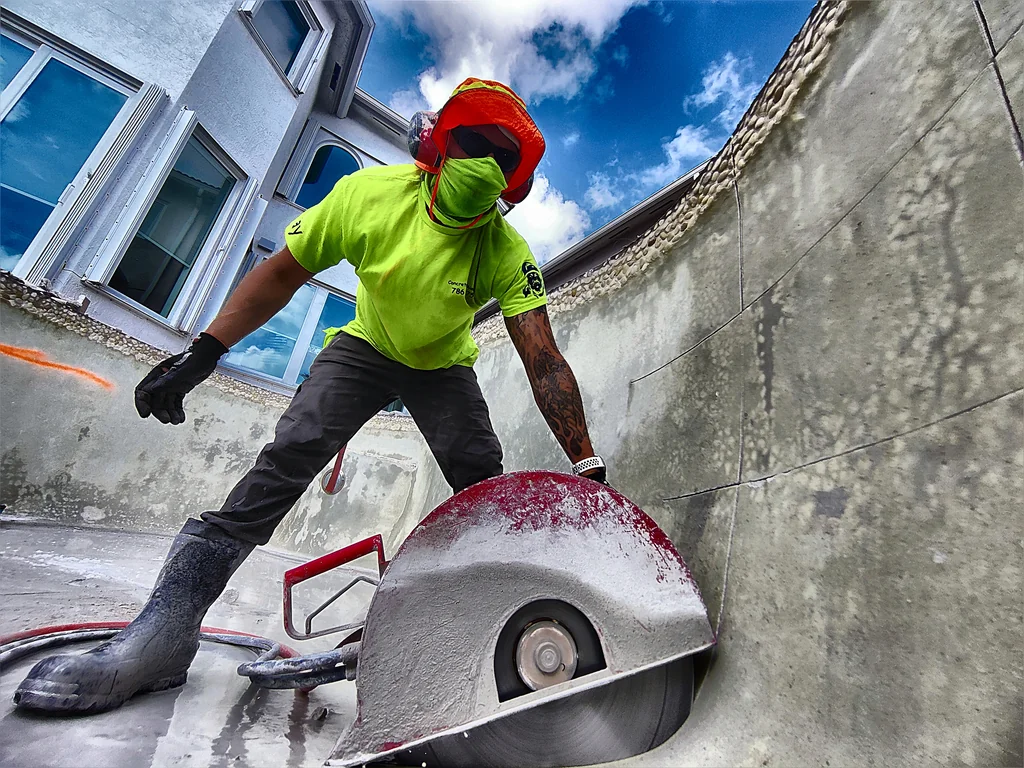
Flat sawing (walk-behind or ride-on slab saws) and core drilling are the workhorses of interior demolition and utility access work. These methods are significantly lower in structural risk compared to impact demolition, but they carry their own OSHA compliance requirements that Miami contractors routinely underestimate.
Silica Exposure During Flat Sawing Operations
OSHA Table 1 for flat sawing specifies that wet cutting must be used at all times, or alternatively, a vacuum system with a HEPA filter rated at 25 cfm or greater must be integrated directly into the saw’s blade guard. The engineering control must be active — administrative controls like “work quickly and leave the area” do not satisfy the standard. Employees exposed to flat sawing operations for more than four hours per shift must be enrolled in a medical surveillance program if silica exposure exceeds the action level, regardless of whether controls are in place. For contractors managing plumbing access cuts and utility trenches, understanding both the cost and the compliance burden upfront is critical — this resource on what concrete cutting for plumbing actually costs addresses both dimensions directly.
Electrical Hazard Identification Before Any Core Drill Touches a Slab
Ground-penetrating radar (GPR) scanning is now considered industry standard before core drilling in any slab with embedded conduit, post-tension cables, or rebar at unknown depths. OSHA 29 CFR 1926.416 requires that all electrical hazards be identified and controlled before work begins — and “I didn’t know it was there” is not a defensible answer after a drill bit contacts a live 480V conduit. GPR scanning adds a predictable line-item cost but eliminates one of the most catastrophic hazard categories in slab demolition work.
Selective Interior Demolition and Hazardous Material Protocols
Selective demolition — removing specific structural or non-structural elements while leaving the surrounding structure intact — is common in Miami’s commercial renovation market. It requires the most rigorous pre-demolition survey of any technique category. Under 29 CFR 1926.850, a competent person must inspect the structure for hazardous materials including asbestos-containing materials (ACM), lead-based paint, and in older South Florida buildings, potential friable fireproofing materials before any selective demolition begins.
In Miami-Dade County, the Florida Department of Environmental Protection (FDEP) and EPA NESHAP regulations require that any renovation or demolition of a structure with ACM above threshold quantities (260 linear feet or 160 square feet) be preceded by a licensed asbestos survey and proper notification to FDEP at least 10 working days before work begins. Failing to comply triggers fines that start at $10,000 per day per violation. For contractors managing site clearance and selective demo simultaneously, the compliance framework outlined in this guide on safe site clearance services in Miami provides a practical starting checklist.
Controlled Demolition with Expansive Demolition Agents
Expansive demolition agents (EDAs) — sometimes called non-explosive demolition agents or soundless cracking agents — are poured into pre-drilled holes and generate expansive pressure over 12 to 24 hours, fracturing concrete without noise, vibration, or flyrock. This technique is increasingly used in Miami for projects near occupied buildings, hospitals, and noise-sensitive zones where mechanical impact or blasting would be prohibited.
The primary hazard with EDAs is blowout — if the agent is mixed too rich or if the drill hole geometry is incorrect, the expanding material can eject from the hole at high velocity. OSHA requires full face protection and chemical-resistant gloves during mixing and pouring operations, and personnel must maintain a clear zone around drill holes for the first two hours after pouring. For backyard renovation projects and residential slab removal where noise and vibration limits are strict, EDAs combined with diamond sawing represent the safest compliant approach — a combination relevant to many of the projects we see tagged under backyard renovation in Miami.
Post-Demolition Crack Control and Structural Integrity Verification
Demolition doesn’t end when the last piece of concrete hits the ground. Post-demolition crack monitoring and structural verification of remaining elements is a compliance requirement under 29 CFR 1926.850(k), which mandates that walls, floors, and structural members be inspected for stability after each phase of demolition. In reinforced concrete structures, partial demolition can redistribute load paths in ways that create delayed failures — sometimes hours after the crew has left the site.
Crack monitoring using tell-tales or digital crack gauges on remaining structural elements should be part of every phased demolition plan. For projects where crack propagation in remaining slabs or walls is a documented concern, the engineering controls and monitoring strategies covered under crack control protocols provide the technical framework your safety plan needs to satisfy both OSHA and your structural engineer of record.
Building Your Demolition Safety Plan Around the Technique, Not After It
The single most common compliance failure I see on Miami demolition sites is a safety plan written generically and then applied to a specific technique without modification. OSHA’s Subpart T is explicit — the hazard analysis must reflect the actual methods being used, the actual materials being demolished, and the actual site conditions present. A safety plan written for hydraulic breaking does not satisfy the requirements for a selective interior demo with silica and ACM exposure. Each technique demands its own Job Hazard Analysis (JHA), its own engineering controls, and its own competent person verification before work begins.
Choosing a contractor who understands the full technical and regulatory weight of each demolition method is the first risk control measure any project owner can implement. The difference between a compliant, incident-free project and a recordable event often has nothing to do with luck — it has everything to do with whether the right technique was matched to the right safety protocol before the first tool hit the concrete.