Why Commercial Concrete Drilling in Clearwater Demands a Safety-First Mobilization Plan
Commercial concrete drilling in Clearwater operates in a uniquely demanding environment. Between the coastal humidity that accelerates tool corrosion, the dense mix designs common in Florida’s commercial construction stock, and the proximity of active occupancies in retrofit and renovation scenarios, the hazard profile here is substantially different from a standard inland drill job. Before a single diamond core bit touches a slab, a comprehensive safety mobilization plan must be in place — one that addresses OSHA 29 CFR 1926 Subpart Q requirements, silica dust exposure under the revised Table 1 enforcement standards, and the structural unknowns buried inside post-tensioned and rebar-heavy commercial decks.
Clearwater’s commercial building inventory includes mid-rise office complexes, healthcare facilities, hospitality structures, and retail centers — many of which were built across multiple decades with inconsistent structural documentation. That means drill operators are frequently working without complete as-built drawings, raising the stakes for every core penetration. A senior concrete contractor doesn’t just show up with a rig and a bit. They show up with a pre-task analysis, a confined space assessment if applicable, a GPR scan protocol, and a silica exposure control plan that satisfies OSHA’s 2017 silica rule for construction. Anything less is a liability waiting to materialize.
Ground Penetrating Radar Scanning as a Non-Negotiable Pre-Drill Safety Step
One of the most preventable hazards in commercial concrete drilling is hitting an embedded utility, post-tension tendon, or structural rebar cluster without prior knowledge of its location. Ground Penetrating Radar (GPR) scanning is not optional on commercial Clearwater job sites — it is the baseline standard for responsible drill operations. A 1.6 GHz antenna paired with a dual-channel system can resolve rebar spacing, tendon paths, conduit runs, and voids at depths up to 18 inches in typical commercial slab configurations.
The GPR scan must be performed by a qualified technician, and the results must be reviewed by the drill crew lead before layout is finalized. Every proposed core location should be marked with a minimum 3-inch clearance buffer from any identified anomaly. When post-tension tendons are identified — and in Clearwater’s commercial building stock, they frequently are — the drill supervisor must consult with the structural engineer of record before proceeding. Severing a post-tension tendon during a core drill is not just a structural event; it is a catastrophic safety incident that can result in explosive tendon release, slab collapse risk, and OSHA recordable injuries.
Mapping Tendon Paths in Banded and Distributed PT Systems
In banded post-tension systems common in Florida commercial construction, tendons run in concentrated bands in one direction and are distributed uniformly in the perpendicular direction. GPR can identify the banded tendons reliably, but distributed tendons at 24- to 36-inch spacing require careful scan grid spacing — typically no more than 6-inch line intervals — to avoid missed detections. Drill crews operating in Clearwater commercial facilities should request the original PT shop drawings from the building owner or structural engineer of record whenever available, using GPR as a confirmation tool rather than the sole detection method.
OSHA Table 1 Compliance for Silica Dust Control During Core Drilling Operations
The Occupational Safety and Health Administration’s revised crystalline silica standard (29 CFR 1926.1153) has fundamentally changed how commercial concrete drilling crews must manage airborne dust. For rotary drilling operations on concrete, OSHA’s Table 1 specifies that wet drilling methods with a vacuum system achieving at least 25 CFM airflow at the bit must be employed, or the operator must use a commercially available shroud and vacuum system with a HEPA-filtered unit rated at 99.97% efficiency at 0.3 microns.
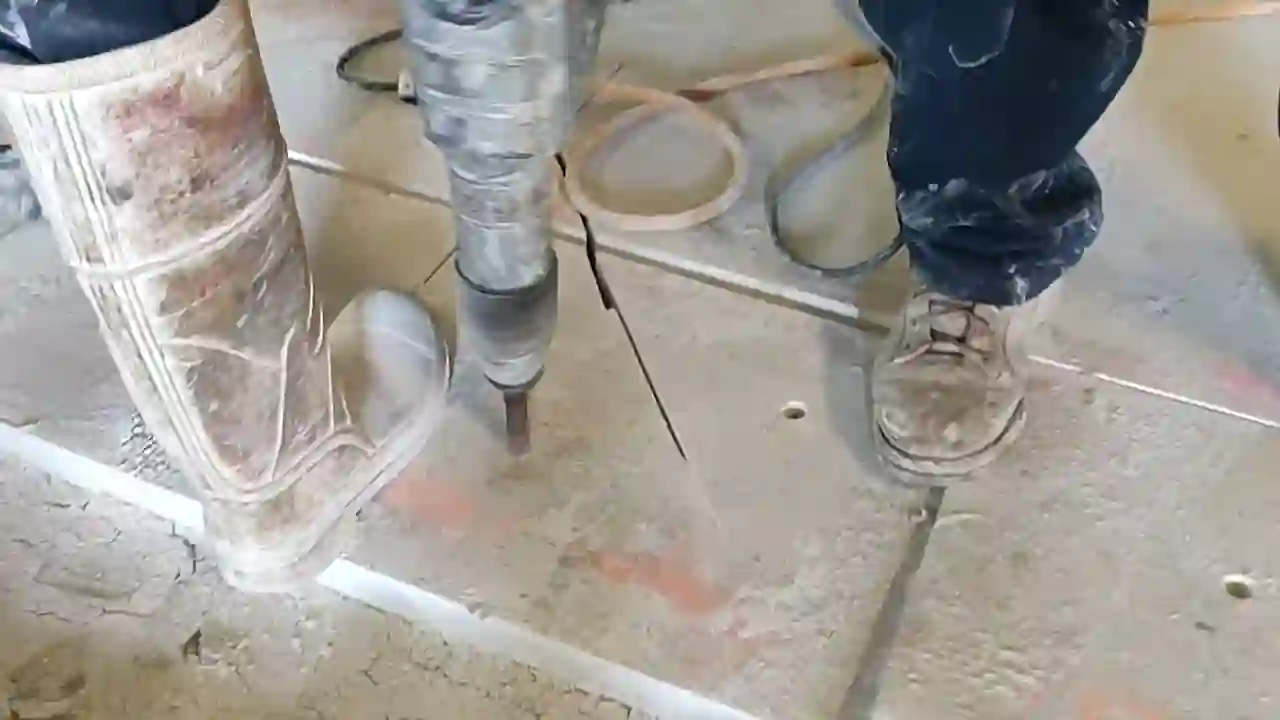
On Clearwater commercial sites, wet drilling is the preferred method for slabs and walls where water intrusion to occupied or sensitive spaces below is controlled. When wet methods are impractical — such as drilling above electrical rooms or occupied tenant spaces — dry vacuum systems with HEPA filtration become mandatory, not optional. Operators must wear a minimum NIOSH-approved N95 respirator during all drilling operations, and a P100 half-face respirator is strongly recommended when working in confined or poorly ventilated areas. Atmospheric monitoring using a real-time aerosol monitor should be conducted on jobs exceeding four hours of continuous drilling to verify that the 8-hour time-weighted average (TWA) remains below the OSHA permissible exposure limit of 50 micrograms per cubic meter.
Housekeeping Protocols That Prevent Secondary Silica Exposure
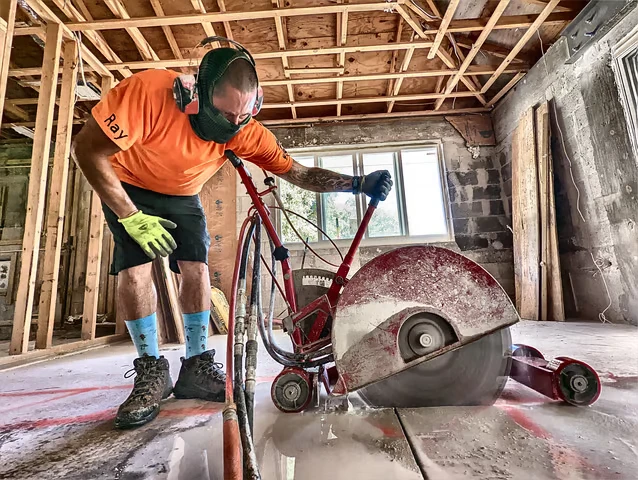
Post-drill housekeeping is a frequently overlooked silica exposure vector. Dry sweeping of concrete dust is prohibited under OSHA’s silica rule. All residual slurry and dust must be collected using a HEPA-filtered vacuum or wet methods, and disposal must comply with local Clearwater stormwater ordinances, which prohibit concrete slurry discharge into storm drains. Contain slurry on-site using portable berms, allow it to dry, and dispose of it as solid waste. This is not just environmental compliance — it protects the next trade crew that enters the space from secondary inhalation exposure.
Electrical Hazard Identification and Lockout Tagout Requirements for Drill Zones
Commercial concrete drilling in occupied or partially energized buildings introduces serious electrical hazard exposure. Before any drilling begins in wall or ceiling assemblies, the electrical systems in the immediate work zone must be de-energized and locked out per OSHA 29 CFR 1910.147. This is not a courtesy — it is a legal requirement. The drill supervisor must coordinate with the building’s facilities manager or electrical contractor to identify all circuits, conduits, and junction boxes within the projected drill path and a minimum 24-inch buffer zone around it.
In Clearwater’s older commercial inventory, particularly buildings constructed prior to 1990, conduit routing often deviates significantly from original drawings due to renovation layering. GPR scanning helps, but it does not replace electrical verification. A non-contact voltage tester must be used on all exposed conduit within the drill zone prior to mobilization. For projects involving core drilling through fire-rated assemblies, fire stopping restoration must be scheduled immediately after penetration completion — leaving open penetrations in fire-rated walls or floors is a code violation and a life safety hazard.
Structural Load Considerations When Drilling Commercial Decks Under Live Load Conditions
One of the more technically complex safety scenarios in commercial concrete drilling is working on occupied floors where the deck above or below remains under live load. Diamond core drilling removes material from a structural member, and when multiple cores are drilled in proximity, the cumulative section loss can compromise local load capacity. OSHA does not prescribe specific core spacing limits, but ACI 318 and the structural engineer of record must be consulted for any core pattern that involves more than three penetrations within a 10-square-foot area in a structural slab.
This is particularly relevant in Clearwater’s healthcare and hospitality sectors, where MEP retrofit projects frequently require dense core patterns for new riser installations. A shoring plan may be required beneath the drill zone if the slab is operating near its design load capacity. The drill contractor must never assume that a slab can absorb arbitrary section loss without structural review. For context on how structural complexity drives technical decision-making in coastal Florida projects, the analysis of what makes concrete removal in Surfside so technically demanding provides an instructive parallel for Clearwater commercial operators.
Fall Protection and Elevated Platform Safety for Overhead and Elevated Drill Work
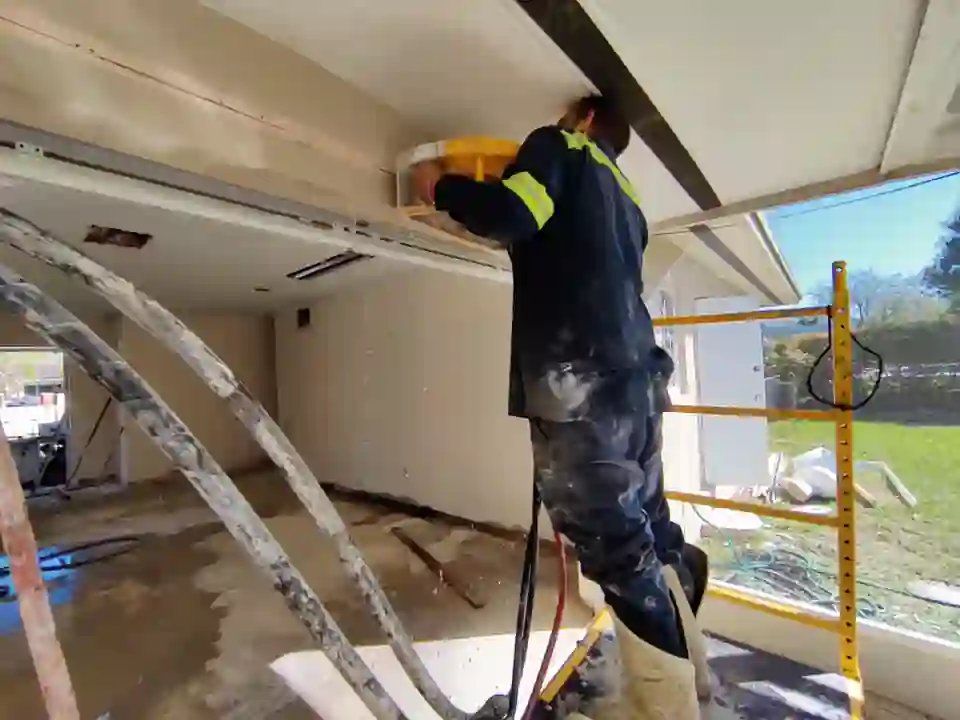
Commercial concrete drilling frequently requires working from elevated platforms — whether coring through elevated decks from below using overhead rigs, or drilling from scaffolding into structural walls. OSHA 29 CFR 1926 Subpart M mandates fall protection for any work surface at or above 6 feet. For overhead drilling operations, operators must use a drill rig with a positive locking feed mechanism to prevent uncontrolled bit drop, and all personnel in the immediate area must wear hard hats rated to ANSI Z89.1 Type I or Type II.
Scaffold platforms used for concrete drilling must be capable of supporting four times the intended load, including the weight of the drill rig, water supply equipment, vacuum system, and operator. Wet drilling on elevated platforms creates slip hazards — anti-slip matting and drainage channels must be incorporated into the platform design. These aren’t bureaucratic checkboxes; they are the operational standards that separate professional commercial concrete drilling contractors from crews that generate incident reports. Projects across Clearwater’s evolving commercial cityscape demand nothing less than full compliance.
Rig Anchoring Standards for Overhead Core Drilling
Overhead core drilling rigs must be anchored to the substrate using manufacturer-specified anchor bolts with verified pull-out strength for the concrete compressive strength present. Never anchor an overhead rig into concrete with a compressive strength below 2,500 PSI without engineering review. Anchor torque must be verified with a calibrated torque wrench, and the rig must be tested with a trial load before the operator commits to a full-depth core. This applies equally to specialized equipment configurations adapted for non-standard drilling geometries.
Building a Site-Specific Safety Plan That Satisfies Clearwater Commercial Project Requirements
Every commercial concrete drilling project in Clearwater should be supported by a written, site-specific safety plan that addresses the hazards identified in the pre-task analysis. This document must include the silica exposure control plan, the GPR scan protocol, the electrical lockout procedure, the fall protection plan, emergency contact information, and the location of the nearest trauma center — Clearwater’s commercial zones are served by multiple Level II and Level III trauma facilities, and that information should be posted at the job site entrance.
The safety plan must be reviewed with the entire drill crew before mobilization, not distributed and filed. Verbal confirmation of understanding should be documented with crew signatures. OSHA compliance inspections on commercial construction sites in the Tampa Bay area have intensified in recent years, and documentation is the difference between a citation and a clean inspection. Whether you’re managing a single core penetration for a new MEP riser or a multi-phase drilling program for a full building retrofit, the safety infrastructure must match the scale of the work. Projects tied to commercial building improvement programs carry the same OSHA obligations as ground-up construction — there are no exemptions for retrofit scope.
Commercial concrete drilling in Clearwater is skilled, high-stakes trade work. The contractors who execute it safely, consistently, and in full OSHA compliance are the ones who build long-term relationships with general contractors, facility managers, and building owners across Pinellas County. Safety isn’t overhead — it’s the foundation of a sustainable commercial drilling operation.