Why Concrete Removal in Doral Carries Higher Risk Than Most Crews Anticipate
Doral is one of Miami-Dade County’s most active commercial corridors. Between the warehouse expansions along NW 107th Avenue, the industrial park retrofits near the airport, and the residential infill projects pushing deeper into formerly undeveloped lots, concrete removal work here is constant — and it’s rarely simple. What looks like a straightforward slab demo from the street often involves post-tensioned reinforcement, proximity to active utilities, and site conditions that demand more than a jackhammer and a dumpster. At Concrete Cutting Miami, LLC, we’ve worked enough Doral sites to know that the margin for error is thin, and the cost of ignoring safety protocols is measured in injuries, OSHA citations, and project shutdowns. This post breaks down the specific hazards, compliance requirements, and field-tested protocols that govern every concrete removal job we run in this area.
OSHA 29 CFR 1926 Subpart Q and What It Actually Means on a Doral Demo Site
OSHA’s Subpart Q governs demolition operations in construction, and it’s not optional reading — it’s the legal baseline every concrete removal crew must operate within. The standard requires a written engineering survey before any demolition begins. On Doral commercial sites, this means documenting slab thickness, rebar layout, post-tension cable locations, load-bearing elements, and the condition of any adjacent structures. Skipping this step isn’t just a regulatory violation; it’s how crews end up with unexpected slab collapses or severed tension cables that snap back with lethal force.
The engineering survey must be conducted by a competent person — someone with the training, authority, and field knowledge to identify hazards and halt work when conditions change. On larger Doral projects, we bring in a licensed structural engineer to sign off on the survey before a single blade touches the concrete. For smaller residential or driveway removals, our lead operator performs a documented site assessment covering utility locations, slab condition, and proximity hazards. You can see how we approach excavation and site prep planning for projects that involve both removal and ground disturbance.
Silica Dust Exposure Controls Required Under OSHA’s Table 1
Respirable crystalline silica is the most underestimated hazard in concrete cutting and removal work. OSHA’s Silica Standard for Construction (29 CFR 1926.1153) sets a permissible exposure limit of 50 micrograms per cubic meter of air, averaged over an eight-hour shift. Grinding, cutting, and breaking concrete — all standard operations in any removal project — generate silica dust at levels that can exceed that limit within minutes without proper controls.
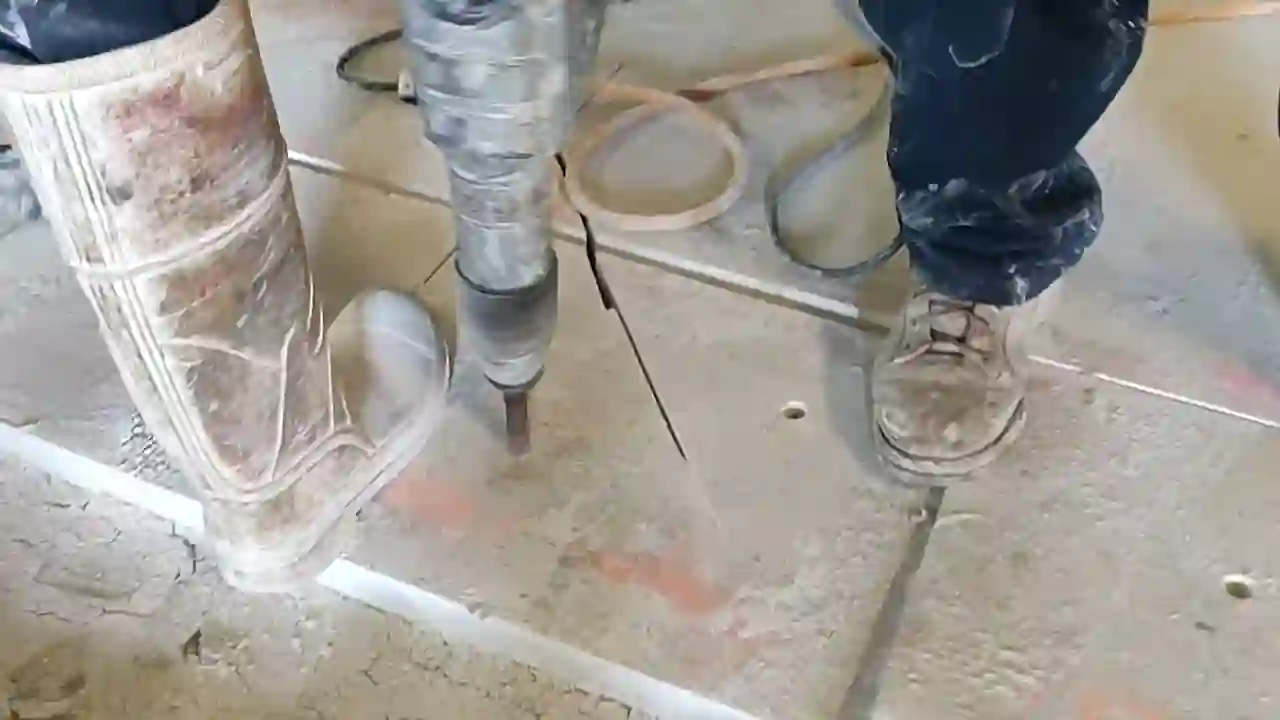
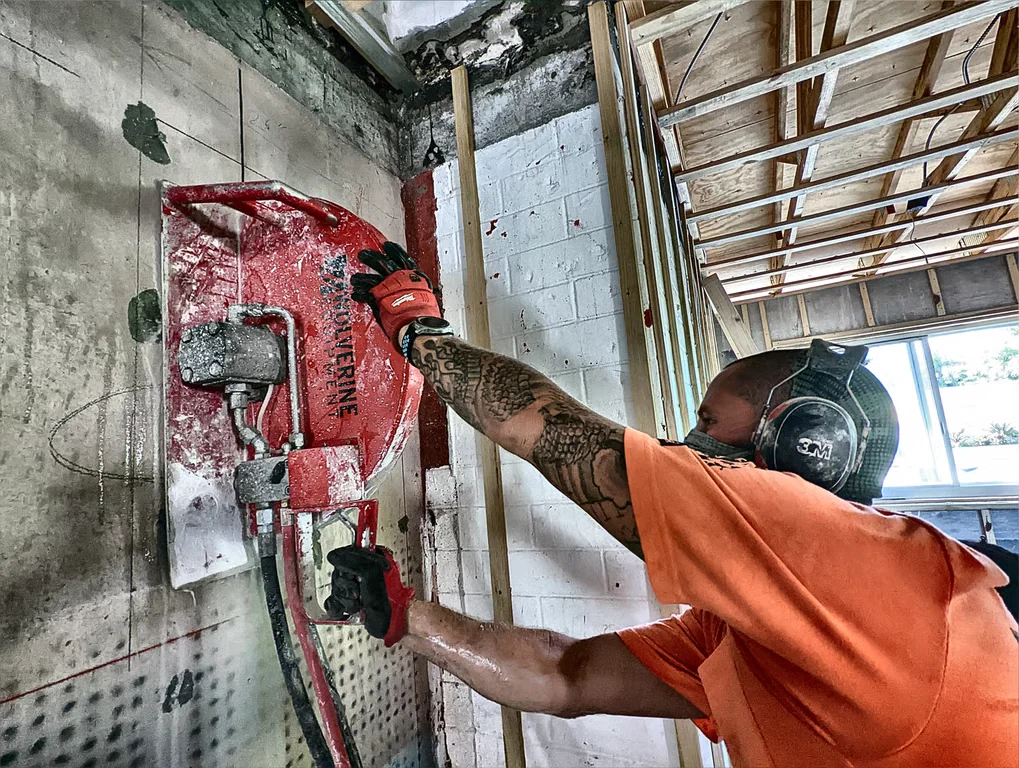
OSHA’s Table 1 provides specific engineering controls based on the task and equipment type. For handheld grinders used in concrete removal, wet methods or local exhaust ventilation (LEV) with a HEPA-filtered vacuum system are required. For jackhammers and chipping hammers, water delivery systems that keep the work area wet are the baseline control. Sawing operations require either wet cutting or a vacuum shroud attached directly to the blade guard housing. Every piece of cutting equipment we deploy on Doral removal jobs is either wet-equipped or fitted with an integrated dust collection system rated for silica capture.
Respiratory protection is a supplemental control, not a substitute for engineering controls. When Table 1 controls are fully implemented, a half-face respirator with P100 filters is the minimum PPE. When controls are only partially implemented — which happens in confined spaces or awkward access situations common in Doral’s tighter commercial lots — a powered air-purifying respirator (PAPR) with an assigned protection factor of 1000 becomes necessary. Our crews are fit-tested annually and trained on donning/doffing procedures per the OSHA respiratory protection standard (29 CFR 1926.103).
Post-Tension Slab Identification and the Catastrophic Risk of Cutting Blind
Doral’s commercial construction boom from the 1990s through the 2010s produced a significant inventory of post-tensioned concrete slabs. These slabs contain high-strength steel tendons — typically 270-ksi strands — tensioned to forces ranging from 25,000 to 33,000 pounds per tendon. When an unbonded tendon is severed by a saw blade, the released energy is explosive. The tendon retracts violently into the concrete, and the surrounding slab can crack or shift in seconds. Fatalities from unintentional post-tension cable cuts are documented in OSHA’s fatality inspection database.
Before any concrete removal begins on a Doral site, we use ground-penetrating radar (GPR) to scan the slab and identify tendon locations, rebar patterns, and embedded conduit. GPR delivers real-time subsurface imaging that allows us to mark cut lines that avoid tensioned elements entirely. When removal requires cutting through post-tensioned zones — which happens in selective demolition scenarios — we follow a strict destressing protocol: identify the tendon anchor locations at the slab edge, cut the slab in a controlled sequence that releases tension progressively, and brace adjacent sections before any tendon is severed. This is highly specialized work, and it’s one reason why blade selection and machine configuration matter as much as operator technique. For a deeper look at how equipment choices affect both safety and cut quality, see our guide on cutting a cement slab the right way.
Utility Strike Prevention Protocols for Doral’s Dense Underground Infrastructure
Miami-Dade County’s 811 call-before-you-dig requirement is the legal minimum, but it’s not sufficient for concrete removal work in Doral’s commercial zones. Utility locates provided by 811 mark approximate centerlines within a tolerance zone — typically 18 to 24 inches on either side of the marked line. When you’re operating a slab saw with a 14-inch blade or a hydraulic breaker with a 3-inch chisel, working within that tolerance zone without additional verification is unacceptable.
Our protocol requires vacuum excavation (hydrovac or air lance) to expose and visually confirm utility depth and exact position before any mechanical removal begins within 36 inches of a marked utility. For high-voltage electrical conduit — common in Doral’s industrial corridors — we maintain a minimum 5-foot standoff for all power tools and require a spotter dedicated exclusively to utility monitoring during the removal operation. Gas line exposures require immediate work stoppage and coordination with FPL or TECO depending on the service provider for the specific parcel.
Equipment Stability and Overhead Hazard Management During Mechanical Demolition
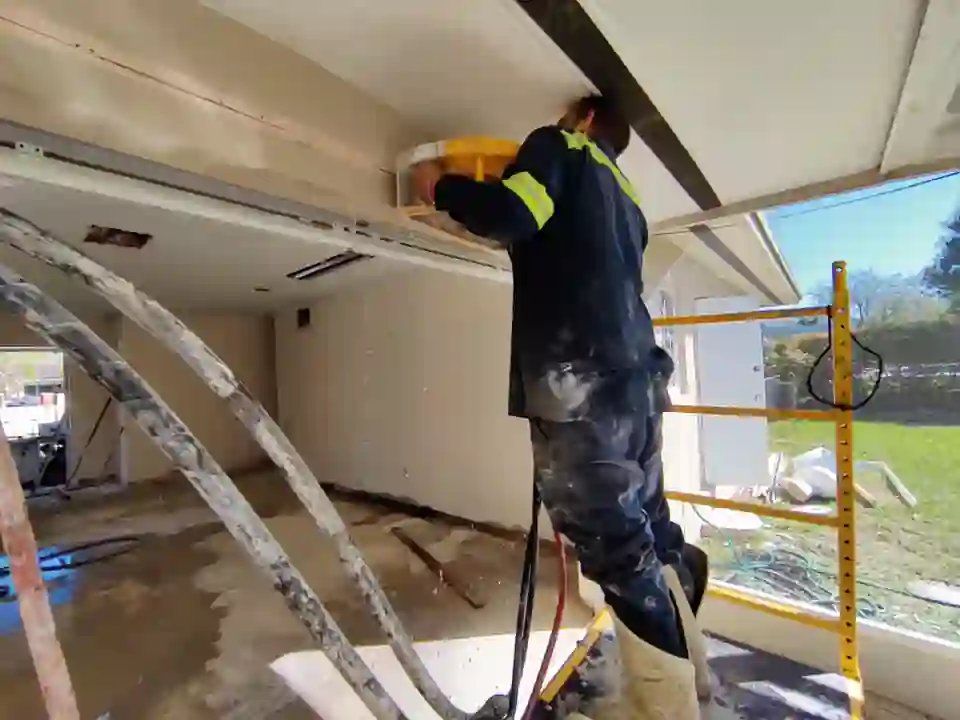
Excavator-mounted hydraulic breakers and concrete processors are the workhorses of large-scale removal in Doral, but they introduce stability and overhead hazard risks that hand-tool operations don’t. Excavator positioning on partially demolished slabs requires a soil bearing capacity assessment — a freshly broken slab edge can shear under machine weight, causing a tip-over event. We calculate machine weight against the slab’s remaining structural capacity before repositioning, and we never allow the machine’s center of gravity to extend beyond a confirmed stable surface.
Overhead power lines are a constant concern on Doral sites. OSHA 1926.1408 requires a minimum 20-foot clearance for lines up to 350 kV when operating equipment with a boom or arm. Before any mechanical demolition begins, we survey overhead lines, calculate the maximum reach of the equipment at full extension, and establish a spotter-controlled approach zone if work must occur near the clearance boundary. On sites where clearance cannot be maintained, we coordinate with FPL for temporary de-energization or insulated line covers through their construction services department.
For projects involving large-volume removal where wire sawing is the preferred method over impact demolition, our wire saw operations page covers the specific rigging and tension management protocols we use to control the cut path and prevent wire failure events.
Debris Management, Load Calculations, and Haul Route Compliance
Concrete debris from a Doral removal project generates substantial weight. A 6-inch unreinforced slab weighs approximately 75 pounds per square foot. A 2,000-square-foot commercial slab produces roughly 75 tons of material — and that’s before accounting for rebar weight or thickened edge conditions. Overloading haul trucks is both an OSHA violation and a Florida DOT violation, and it’s a common shortcut that increases rollover risk and road damage liability.
We calculate debris volume and weight before scheduling haul trucks, and we specify load limits per truck based on the material density of the specific concrete being removed. Core samples taken during the GPR survey give us density data. Trucks are loaded to 80% of their rated capacity to account for uneven loading distribution. For projects where cost planning around debris volume and haul logistics is a priority, our project planning and cost resources provide detailed breakdowns of how removal scope affects total project budget.
Worker Training Requirements and Competent Person Designation
Every crew member on a Doral concrete removal site must be trained on the specific hazards present — silica exposure, utility strike risk, post-tension hazards, and equipment operation. OSHA requires that workers exposed to silica at or above the action level (25 µg/m³) receive training on the health effects of silica, the specific tasks that generate exposure, and the controls in place to limit it. This training must be documented and refreshed annually.
The competent person designation is not ceremonial. This individual must have the authority to stop work — and must exercise that authority when conditions change. On our Doral removal crews, the competent person conducts a documented pre-task safety briefing every morning, reviews the day’s scope against the engineering survey, and performs a post-shift site inspection to identify any new hazards introduced during the day’s work. You can review footage of our field operations and safety setups through our project video library.
For residential projects — driveway removals, pool deck demolitions, patio slabs — the hazard profile is different but not absent. Silica exposure is still a primary concern, and utility strikes remain a real risk even on smaller lots. Our approach to driveway removal in Miami follows the same documented protocol framework as commercial work, scaled appropriately for the site conditions.
The Non-Negotiable Standard for Every Doral Removal Project We Take
Concrete removal in Doral is not a commodity service. The site conditions, regulatory environment, and technical hazards involved demand a crew that treats compliance as a baseline, not a differentiator. Every project we take in Doral begins with a documented engineering survey, a silica exposure control plan, a utility verification protocol, and a competent person designation on paper before equipment is ever loaded on the truck. That standard doesn’t change based on project size, timeline pressure, or budget constraints. The work either gets done safely or it doesn’t get done — and in our experience, clients who understand that distinction are the ones whose projects finish on time, on budget, and without incident.