Why concrete sawing and drilling are always mentioned together — they are different tools for different cuts on the same project
Concrete sawing and drilling appear together in company names, service descriptions, and search queries because on a real construction project, they are almost never performed in isolation. Concrete sawing — whether flat sawing a slab, wall sawing an opening, or wire sawing a thick wall section — creates linear cuts: straight lines that separate concrete or define edges. Concrete drilling — primarily core drilling — creates circular penetrations: round holes through slabs and walls for pipes, conduits, ducts, and structural connections. The two methods use different cutting tools, different setup procedures, and produce different results. But they are deployed together on virtually every project because most projects require both linear cuts and circular penetrations.
 Concrete Cutting Miami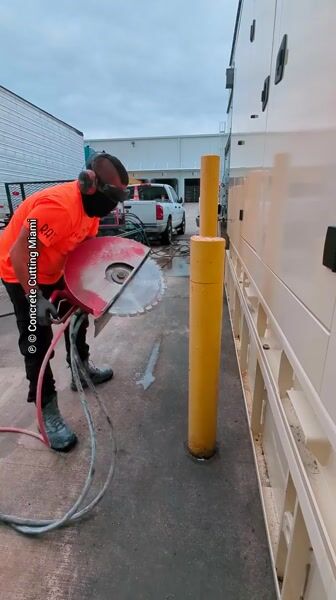
A commercial building renovation in Miami needs a new door opening cut through a concrete wall (sawing) and core-drilled holes through the floor slab for the plumbing risers and electrical conduits that will serve the new space (drilling). A residential pool demolition needs the pool deck saw-cut along the separation line from the coping (sawing) and core-drilled drainage holes through the pool floor before backfilling (drilling). An industrial facility upgrade needs trenches saw-cut through the floor slab for new equipment power feeds (sawing) and core-drilled anchor bolt holes for the new machinery (drilling). When concrete sawing and drilling are provided by the same contractor as coordinated services, the equipment is mobilized once, the schedule is managed as a single operation, and the sawing and drilling are sequenced to avoid conflicts. When they are provided by two separate contractors, each operates on their own schedule with their own equipment delivery, and each has someone else to blame when delays or conflicts arise.
Concrete sawing methods — the linear cutting services
The sawing half of concrete sawing and drilling includes several distinct methods, each designed for specific applications and concrete conditions.
Flat sawing
Flat sawing uses a diamond blade on a walk-behind or ride-on saw to cut horizontal concrete surfaces — floors, slabs, pavements, and any concrete that lies flat. The saw traverses the cut line, with blade depth adjustable from surface scoring to full slab thickness. Slab sawing is the primary method for cutting control joints, creating trenches for plumbing and electrical, sectioning slabs for demolition, and cutting expansion joints in pavement. In Miami, flat sawing is the most frequently performed concrete sawing service because residential and commercial slabs are the most common concrete elements modified during renovation.
Wall sawing
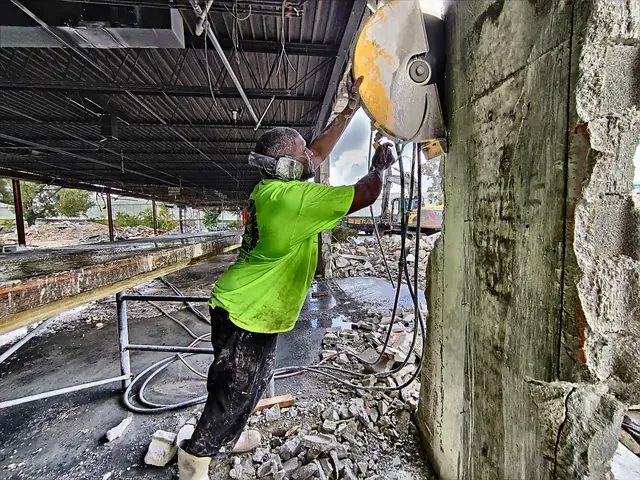
Wall sawing mounts a diamond blade on a track system fastened to a vertical or overhead surface. The saw head travels along the track under power, with incremental-depth passes for concrete thicker than the blade can cut in a single pass. Wall sawing produces straight, plumb cuts essential for door and window openings, mechanical penetrations, and structural wall modifications. The track system ensures the cut is straight and the face is plumb — critical when the opening will receive a door or window frame with tight installation tolerances.
Wire sawing
Wire sawing uses a continuous loop of diamond-impregnated steel cable to cut through concrete sections too thick for circular blades. The wire is threaded through a small cored access hole and wrapped around the section to be cut. The drive unit tensions the wire and pulls it through the concrete, cutting the full thickness regardless of how thick it is. Wire sawing handles bridge piers, dam structures, thick foundation walls, and massive concrete sections where circular saw blades cannot reach across the full thickness.
Concrete drilling methods — the circular penetration services
Core drilling
Core drilling uses a diamond-tipped hollow cylindrical bit rotating at controlled speed to cut a circular path through concrete. The bit removes a solid core of concrete that is extracted when the bit is retracted. Core drilling produces precise round holes from small diameters — half-inch holes for chemical anchors and anchor bolts — to large diameters — 12 inches or more for plumbing stacks, HVAC risers, and major utility penetrations. The drill rig is mounted to the floor or wall with a vacuum base, expansion anchors, or bracing, and the bit is fed into the concrete at a controlled rate with water cooling delivered to the cutting surface. Core drilling through rebar is routine — the diamond bit cuts through the steel as part of the drilling operation.
Stitch drilling
When a square or rectangular opening is required but wall sawing is impractical due to access, concrete conditions, or opening geometry, stitch drilling creates the opening by drilling a series of overlapping core holes around the perimeter. The individual cores remove most of the material, and the remaining narrow webs of concrete between holes are broken out. Stitch drilling is slower and more labor-intensive than wall sawing for large openings but works in situations where a track-mounted saw cannot be set up — confined spaces, overhead locations, and irregularly shaped openings.
How concrete sawing and drilling work together on real Miami projects
Understanding concrete sawing and drilling as complementary services is easiest when you see how they are deployed together on actual projects.
- Retail tenant improvement: A Miami retail space in a concrete building is being renovated for a new tenant. Wall sawing cuts a new accessible entrance opening through the exterior concrete wall. Core drilling creates holes through the floor slab for plumbing connections to the new restroom. Flat sawing cuts trenches for electrical conduit runs from the panel to the point-of-sale counter. All three methods are deployed on the same project, by the same contractor, in a coordinated sequence that minimizes disruption to neighboring tenants.
- Residential bathroom addition: A Miami homeowner is adding a bathroom in a space that previously had no plumbing. Flat sawing cuts a trench through the slab for the new drain line. Core drilling creates a hole through the exterior wall for the plumbing vent penetration. The sawing and drilling are sequenced so the core-drilled hole aligns with the trench path — coordination that is simpler when one contractor performs both.
- Industrial equipment installation: A manufacturing facility is installing a new production machine. Flat sawing cuts the outline of the new equipment pad depression in the existing floor. Core drilling creates the anchor bolt holes that will secure the machine to the new pad. The core hole locations must be precisely positioned relative to the saw-cut pad edges — a coordination task that is straightforward when the same contractor handles both operations.
- Concrete wall modification for HVAC: A building is being retrofitted with a new HVAC system that requires larger ductwork. Wall sawing cuts the new duct opening through the concrete wall. Core drilling creates smaller penetrations for refrigerant lines and condensate drains. The openings must be correctly sized and correctly located relative to each other — sawing and drilling coordinated as a single scope of work.
Why hiring one contractor for concrete sawing and drilling makes a difference
When concrete sawing and drilling are performed by two separate contractors, the property owner or general contractor becomes the project coordinator between them. The sawing contractor cuts on Tuesday. The drilling contractor drills on Thursday. On Thursday, the drilling contractor discovers that the saw cut is in a slightly different location than expected, and the core hole they need to drill would intersect the saw cut line. Now both contractors need to come back, and someone needs to pay for the extra mobilization. When sawing and drilling are performed by the same contractor, these coordination conflicts are resolved during planning — the saw cut and the core hole are laid out together, sequenced together, and executed as a single operation. Concrete cutting services that include both sawing and drilling eliminate the coordination gap that costs time and money when separate contractors work the same area on different schedules.
In Miami-Dade County, where concrete construction is the dominant building type and renovation projects routinely require both sawing and drilling, the efficiency advantage of a single-source contractor is significant. One mobilization. One set of equipment. One crew that understands how the saw cuts and the core holes relate to each other. One point of contact for scheduling and problem resolution. Contact us to discuss your project and receive a scope of work that integrates concrete sawing and drilling from initial scanning through final cleanup.