The Naples FL Job Site Environment Changes Everything About How You Cut
Concrete cutting in Naples FL is not a straightforward operation you can template from a South Florida warehouse district job. The geography, the build density, the clientele, and the coastal soil profile combine to create some of the most technically demanding site conditions a cutting crew will encounter anywhere in the state. We’re talking about gated communities with weight-restricted access roads, high-end residential renovations where vibration tolerances are essentially zero, and commercial retrofit projects wedged between active hospitality operations that cannot tolerate dust, noise windows longer than two hours, or any equipment that doesn’t fit through a standard doorway. Before a single diamond blade spins, the site logistics conversation has to happen — and it has to be detailed.
This is exactly why site logistics planning is the single biggest differentiator between a successful concrete cutting project and a costly failure. Naples amplifies every one of those variables. The luxury residential corridor from Port Royal to Pelican Bay presents access constraints that would make a seasoned Miami contractor pause. Narrow service entries, underground parking structures with 7-foot clearance decks, and beachfront properties with no staging area to speak of — these are standard Tuesday conditions in Collier County.
Equipment Selection Driven Entirely by Access Restrictions
When you’re cutting concrete in a confined Naples job site, the equipment conversation starts with what you cannot bring, not what you want to bring. A 65-horsepower flat saw on a trailer is irrelevant if the access gate is 8 feet wide and the pathway to the pour is a 42-inch landscaped corridor. The equipment selection matrix has to be built backward from the site constraints.
Handheld and Hand-Guided Tools as Primary Cutting Systems
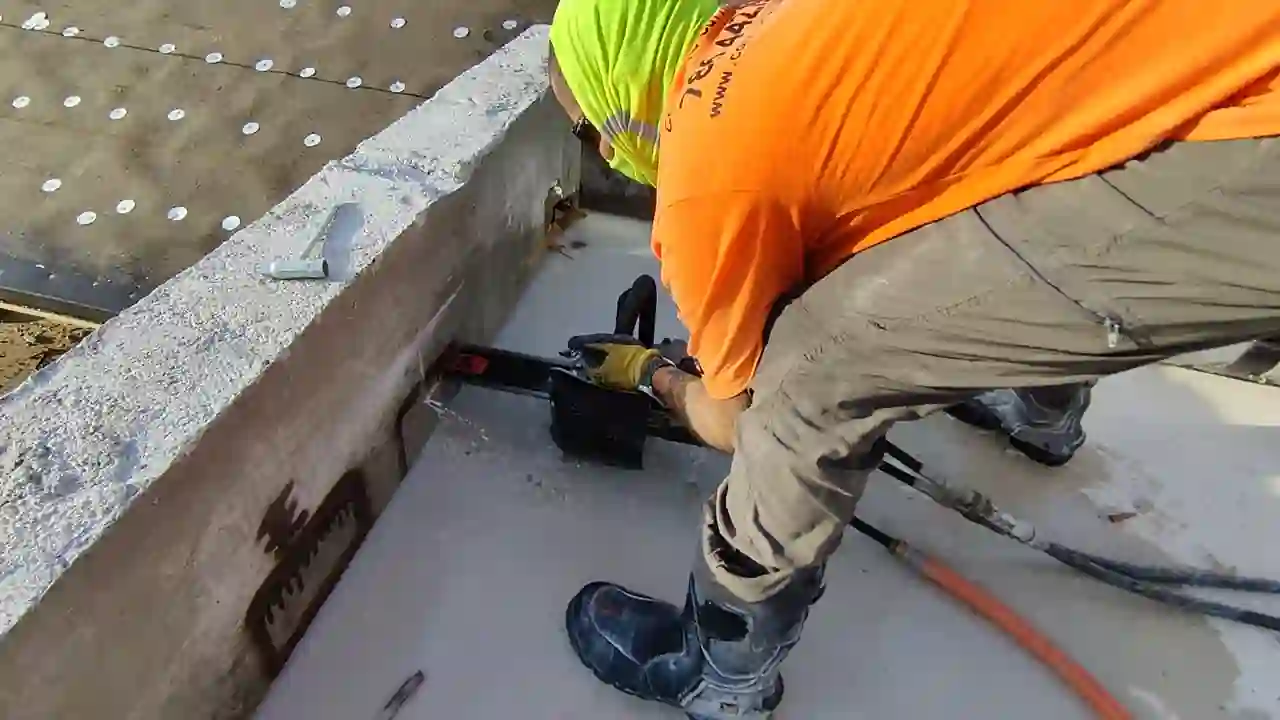
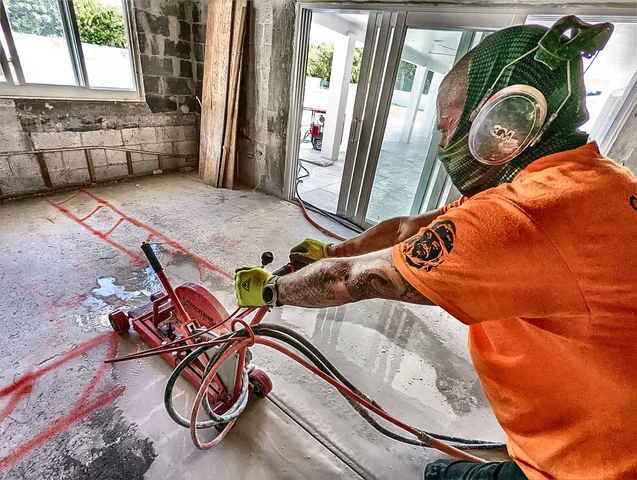
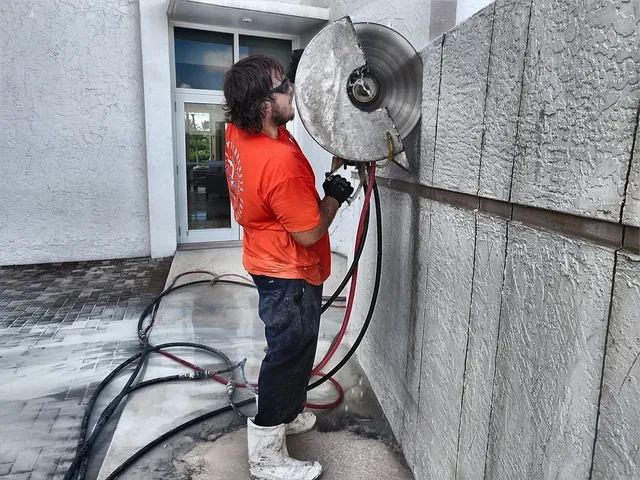
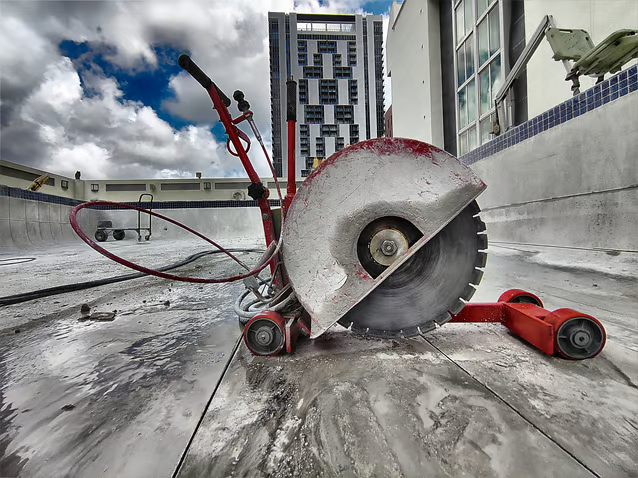
In confined residential and commercial spaces across Naples, hand tools frequently become the primary cutting system, not a fallback option. Handheld cut-off saws with 14-inch diamond blades, electric angle grinders with segmented rim blades for flush cuts near walls, and hand-guided walk-behind saws in the 13 to 20 horsepower range are often the only viable tools for interior slab work in occupied structures. This requires operators with genuine skill — not just the ability to run equipment, but the ability to maintain line accuracy, manage slurry, and control depth on a tool that doesn’t have the mechanical guidance of a large floor saw.
Core drilling in tight spaces compounds the challenge. When you’re drilling a 6-inch core through a post-tension slab in a Naples high-rise mechanical room with 36 inches of working clearance on each side, the rig setup, anchor placement, and water management all have to be executed in a space that wasn’t designed for any of it. Operators need to work with low-profile rigs, angled feed assemblies, and vacuum extraction systems that fit the geometry of the room — not the geometry of a textbook diagram.
Confined Space Protocol for Underground and Below-Grade Cutting
Naples has a significant inventory of below-grade parking structures, mechanical vaults, and utility tunnels — particularly in the older downtown corridor and in mixed-use developments near Fifth Avenue South. Concrete cutting in these environments triggers OSHA confined space entry protocols that add a layer of operational complexity most residential-focused contractors are completely unprepared for.
Ventilation Engineering for Slurry Vapor and Exhaust Management
Gasoline and propane-powered equipment is typically prohibited in true confined spaces without forced-air ventilation systems that meet specific air change requirements. That means electric-drive saws, battery-operated core rigs, and hydraulic power units with remote motors become the standard toolkit for below-grade Naples work. The slurry generated by wet cutting in a confined vault doesn’t just create a slip hazard — in a sealed space, the silica-laden mist becomes an immediate respiratory threat without proper negative-pressure containment and HEPA filtration.
Crews operating in these conditions need to understand the full scope of access limitation planning that goes into a below-grade project — from the permit documentation required for confined space entry to the atmospheric monitoring equipment that has to be on-site before any worker descends. Carbon monoxide from any combustion source, oxygen displacement from hydraulic fluid vapor, and silica dust concentration are all live hazards that have to be continuously monitored, not assumed to be acceptable.
Rebar Density and Post-Tension Cables in Naples High-Rise Construction
The structural concrete in Naples’ coastal high-rises and luxury condominiums is not the same animal as a standard commercial slab. Many of these structures were built with post-tension cable systems running in both directions at 24 to 36-inch spacing, combined with conventional rebar grids that add further complexity to any cutting operation. Hitting an active post-tension cable during a slab penetration is a catastrophic event — both in terms of immediate structural risk and project liability.
Ground-penetrating radar (GPR) scanning is not optional on these jobs. It’s the first line of defense before any blade or drill bit touches the surface. Understanding how rebar density affects blade selection and feed rate is critical knowledge for any operator working in high-reinforcement slabs — but in a post-tension environment, that knowledge has to be paired with precise scan interpretation and conservative cut-line planning that keeps a minimum 3-inch clearance from any identified tendon.
Blade Specification for High-PSI Coastal Concrete
Concrete mix designs in coastal Naples construction frequently run at 5,000 to 6,000 PSI compressive strength, with some structural elements exceeding 8,000 PSI in newer high-rise cores. Standard general-purpose diamond blades are not the right tool. Hard-bond diamond segments with higher diamond concentration and finer grit sizing are required to maintain cutting speed without glazing in these dense, low-abrasion mixes. Feed rate discipline matters enormously — forcing a blade through hard concrete in a confined space where you can’t see the cut line clearly is a fast path to blade failure, kickback, and injury.
Staging, Slurry Containment, and Debris Management on Zero-Lot-Line Sites
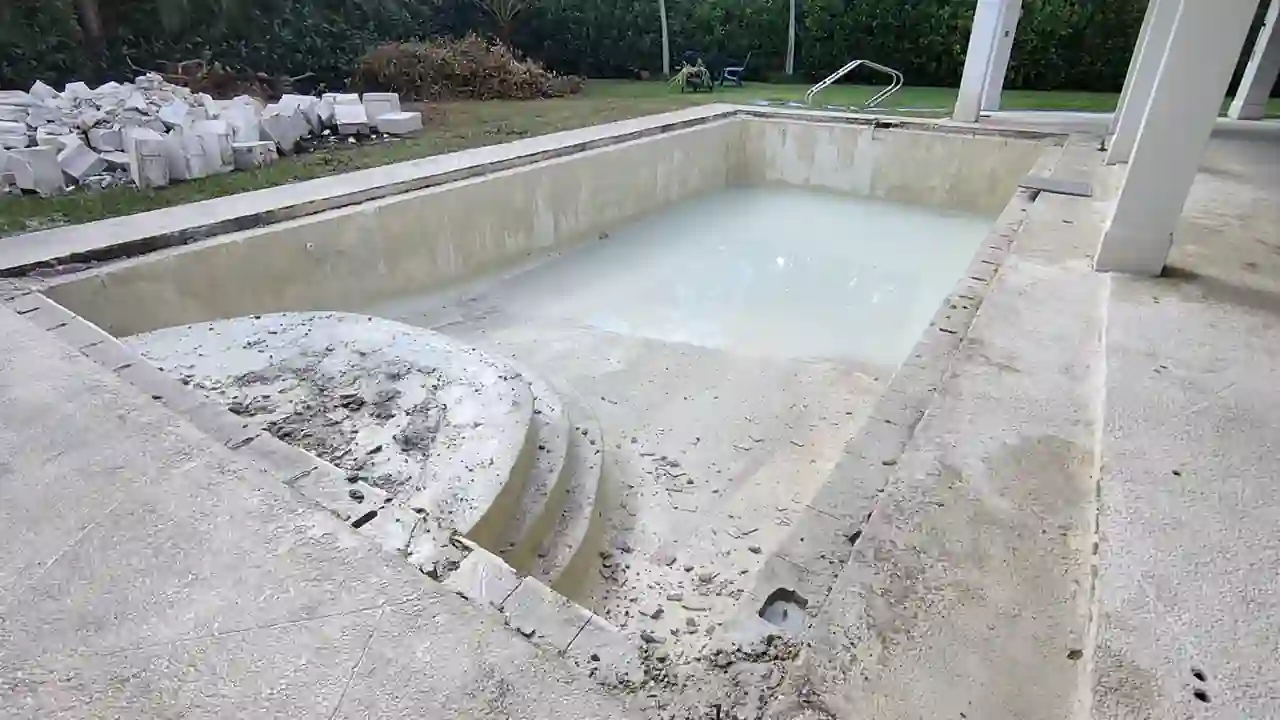
One of the most underestimated logistical challenges in Naples concrete cutting is slurry and debris management on sites where there is literally no staging area. Zero-lot-line properties, interior commercial renovations, and covered parking structures all share the same problem — the waste generated by wet cutting has no natural place to go, and the site conditions don’t allow for a standard vacuum truck setup at the curb.
Portable slurry containment systems with submersible pumps, wet/dry vacuums with high-capacity tanks, and bermed containment mats become essential equipment on these jobs. The slurry cannot be allowed to migrate into storm drains — both because of local environmental regulations and because concrete slurry will harden in drainage infrastructure and create expensive remediation problems. On jobs adjacent to active South Florida coastal construction corridors, the environmental compliance expectations are consistent and strictly enforced.
Dust suppression in dry-cut scenarios — which sometimes become necessary when water access is restricted in finished interior spaces — requires wet-ring vacuum shrouds on all cutting equipment and continuous negative-air pressure in the work zone. Summer construction safety in Southwest Florida adds a heat stress dimension to this equation — operators in full PPE running electric saws in a sealed, negative-pressure work area need scheduled hydration breaks and thermal monitoring built into the job plan.
Pre-Mobilization Site Assessment as a Non-Negotiable Deliverable
Every concrete cutting project in Naples FL should begin with a documented site assessment that covers access route dimensions and load ratings, staging area availability, power source locations and amperage capacity, water supply access and drainage routing, structural scan requirements, confined space classification, and noise and vibration tolerance windows for adjacent occupants. This is not a checklist you run through in your head on the morning of mobilization. It’s a formal document that drives equipment selection, crew sizing, scheduling, and subcontractor coordination.
Contractors who skip this step in Naples don’t just create problems for themselves — they create problems for the owner, the GC, and every other trade on the project. A concrete cutting crew that shows up with the wrong equipment for a confined access site, or that hasn’t planned for slurry containment in a finished-floor environment, will cause delays that ripple through the entire project schedule. In a market where luxury clients and high-end GCs have zero tolerance for disruption, that’s a reputation-ending mistake.
The technical demands of concrete cutting in Naples FL reward contractors who treat site logistics as a core competency — not an afterthought. Equipment selection, confined space protocol, rebar and post-tension awareness, slurry management, and pre-mobilization planning are all parts of the same operational system. Execute them with discipline, and the cutting work itself becomes the straightforward part of the job.