What Site Logistics Actually Mean When You’re Cutting Concrete in Miami FL
Walk onto any concrete cutting job in Miami and the first thing a seasoned operator does isn’t pick up a blade — it’s read the site. Access points, overhead clearances, utility conflicts, drainage slopes, structural load paths, and the proximity of occupied spaces all get mentally catalogued before a single piece of equipment rolls off the truck. In Miami FL, where concrete cutting projects span everything from aging coral-rock foundations in Coral Gables to post-tension slabs in high-rise towers in Brickell, the logistical complexity isn’t a footnote — it’s the whole story. Getting the cut right means solving the site puzzle first.
Confined Space Cutting — Where Standard Protocol Breaks Down Fast
OSHA defines a permit-required confined space as any space large enough for a worker to enter, with limited means of entry or exit, and not designed for continuous occupancy. In Miami’s dense urban core, concrete cutting crews encounter these conditions constantly — mechanical rooms beneath hotels, elevator pits in residential towers, underground cisterns, and utility vaults buried under commercial slabs. The moment a cutting operation moves into one of these environments, the entire workflow changes.
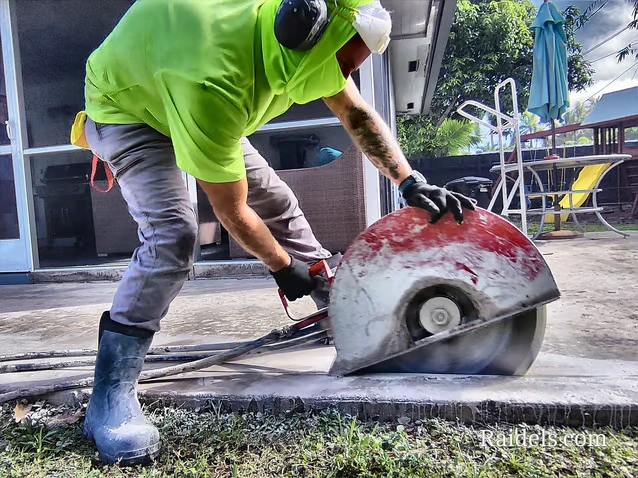
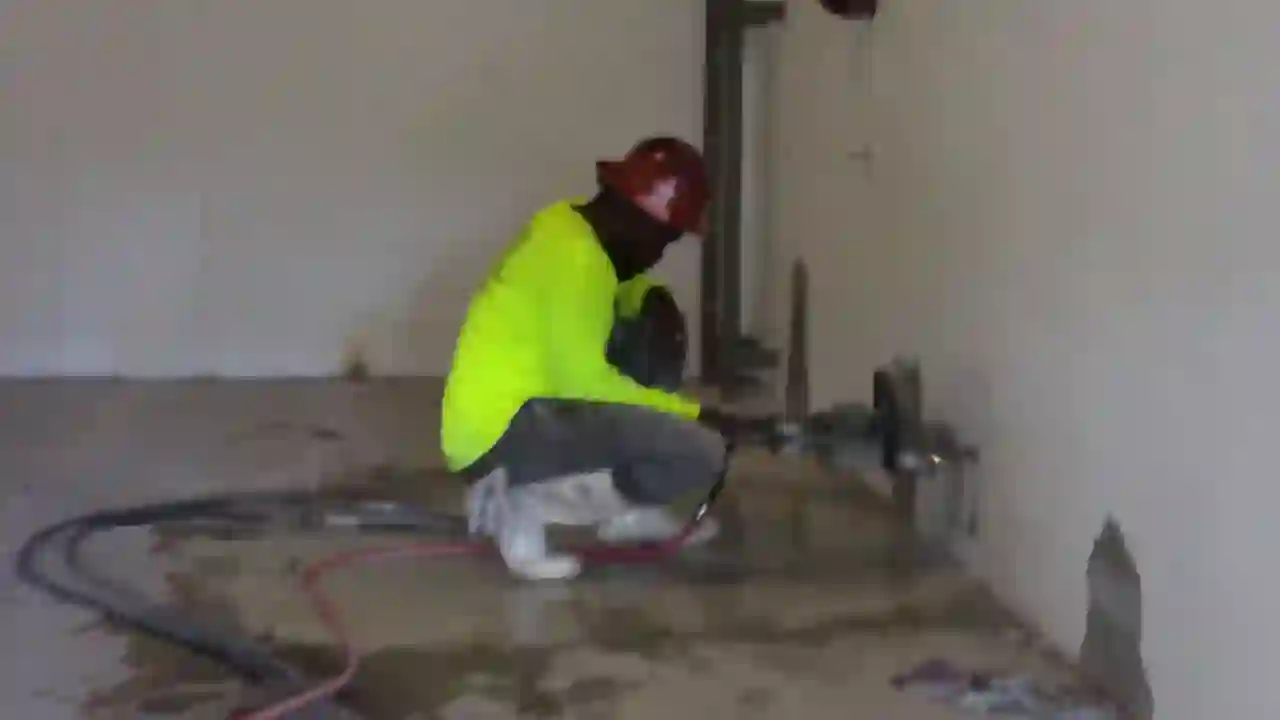
Ventilation becomes the first engineering problem. Diamond blade wall saws and core drills generate slurry, silica dust, and in some cases combustion exhaust from hydraulic power packs. In a confined space with no natural airflow, particulate concentrations spike within minutes. Crews working confined space concrete cutting in Miami FL must deploy forced-air ventilation systems — typically axial fans with flexible ducting — rated for the cubic footage of the space, with continuous air monitoring for silica, CO, and oxygen displacement. This isn’t optional. It’s the difference between a productive cut and a medical emergency.
Equipment selection gets radically constrained. A standard 20-horsepower electric wall saw on a track system may be physically impossible to maneuver into a space with a 28-inch access hatch. That forces operators toward smaller-format tools — hand-held diamond chainsaws, compact hydraulic core drills, or ring saws with reduced guard profiles. Each of these substitutions carries trade-offs in cut depth, speed, and operator fatigue. For a deeper look at how hand tools factor into confined-space and repair scenarios, the breakdown of concrete repair hand tools is worth reviewing before spec’ing any restricted-access job.
Atmospheric Testing and Entry Permitting on Miami Job Sites
Before any worker enters a permit-required confined space on a Miami concrete cutting project, atmospheric testing must be conducted and documented. Oxygen levels must read between 19.5% and 23.5%. Combustible gas levels must be below 10% of the lower explosive limit. And in spaces where prior chemical storage, decomposition, or fuel contamination is suspected, additional compound-specific testing is mandatory. In Miami’s older building stock — structures built in the 1950s through 1970s — underground spaces frequently contain legacy contaminants that modern sensors will flag immediately.
Entry permits must identify the authorized entrants, the attendant stationed outside, the entry supervisor, the hazards present, the means of isolation, and the rescue procedure. On active commercial sites in Miami FL, this paperwork trail isn’t bureaucratic overhead — it’s the legal and operational backbone that keeps the job running if something goes wrong.
Access Limitations That Dictate Equipment Strategy Before the Job Starts
Miami’s built environment creates access challenges that crews in less dense markets rarely encounter. Narrow alleyways between mixed-use buildings in Wynwood, interior courtyard pools surrounded by structural walls in Coconut Grove, and parking garage slabs with 7-foot clearances in Downtown Miami all demand that equipment selection happen during the estimating phase — not on the morning of the cut.
Consider a core drilling operation targeting a 12-inch diameter penetration through a post-tension slab on the fourth floor of a parking structure. The elevator is freight-rated to 2,500 lbs. A standard electric core drill rig with a 5-horsepower motor, vacuum base, and associated water supply weighs approximately 180 lbs assembled. That’s manageable. But if the job requires a hydraulic power pack to drive a larger-diameter core barrel, that pack alone may weigh 600 to 800 lbs. Now the logistics problem is a rigging problem. How does that equipment reach the fourth level? Can it be broken down and reassembled in the field? Does the stairwell width accommodate it? These questions get answered before the truck is loaded, or they become expensive surprises mid-project.
Slurry Management in Sites With Zero Drainage Access
Wet cutting is the industry standard for diamond blade work — water suppresses silica dust, cools the blade, and extends blade life significantly. But in confined spaces or elevated interior locations, water management becomes a serious secondary engineering challenge. On a Miami FL concrete cutting job inside a finished building — say, a condo renovation in Edgewater — slurry cannot be allowed to migrate into adjacent units, drain into unprotected floor penetrations, or contact electrical systems below the cut plane.
Experienced crews deploy vacuum slurry systems that capture water and concrete particulate simultaneously at the cutting point. These systems use industrial wet-vacs plumbed directly to the blade guard or core barrel shroud, maintaining negative pressure at the cut zone. The collected slurry — a mixture of water and concrete fines — must then be treated as a waste stream. In Miami-Dade County, concrete slurry cannot be discharged to storm drains. It requires pH adjustment (typically to between 6.0 and 9.0) before disposal, or transport to an approved facility. Projects that skip this step face environmental enforcement actions that make the original job look cheap.
Post-Tension Slab Scanning and Structural Coordination in Tight Sites
Post-tension construction dominates Miami’s mid-rise and high-rise residential market. Before any penetration or saw cut through a PT slab, ground-penetrating radar scanning is non-negotiable. In a wide-open environment, GPR scanning is straightforward. In a confined space — an equipment room, a stairwell, or a mechanical chase — the scanning geometry gets complicated. The antenna must maintain consistent contact with the slab surface, and the scan grid must be tight enough to identify tendon spacing accurately.
When GPR identifies tendons running through a proposed cut line, the structural engineer of record must be engaged to evaluate re-routing options or assess whether a tendon can be de-stressed and cut with proper end-anchoring. In Miami’s high-density residential towers, this coordination loop — contractor, GPR technician, structural engineer, building official — can add days to a project timeline. Crews who understand this dynamic build it into their schedules. Those who don’t get caught waiting for approvals while the project clock runs.
The full complexity of what happens when site access and disposal logistics collide on a real Miami job is documented in detail at what nobody tells you about concrete cutting and disposal when site access is a nightmare — required reading for any GC managing a complex interior demo scope.
Residential Projects in Miami Where Logistics Rival Commercial Complexity
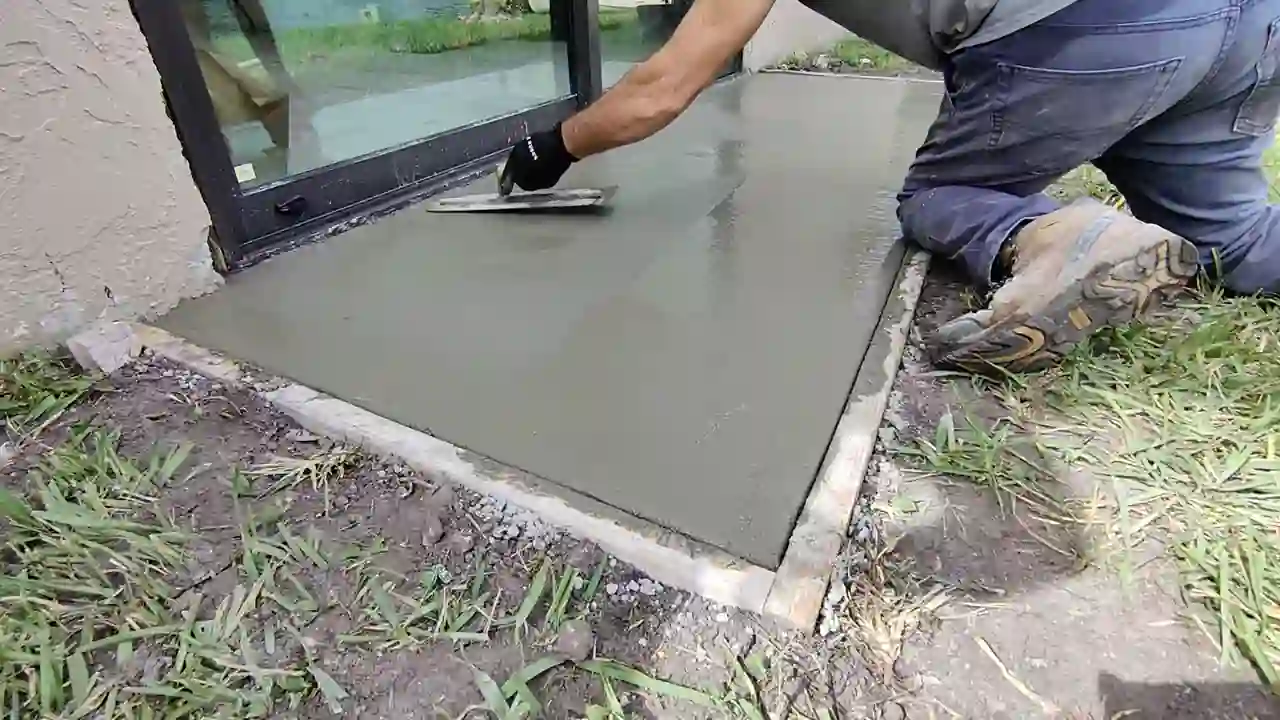
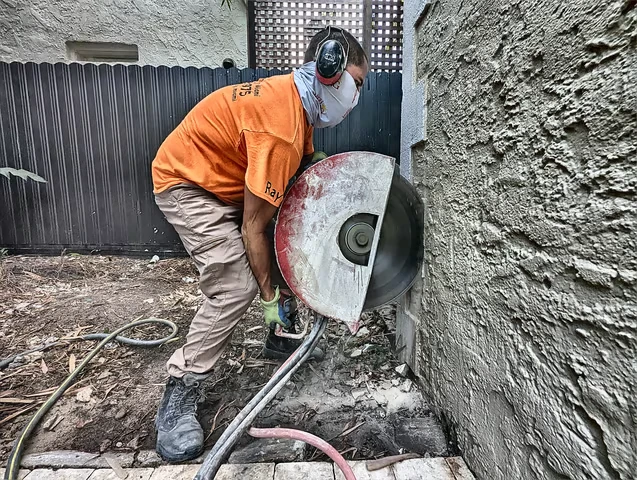
It’s tempting to assume that residential concrete cutting in Miami is simpler than commercial work. It frequently isn’t. A pool deck removal in Pinecrest with a 36-inch side-yard gate access means all equipment must fit through that opening. A garage floor saw cut in a Doral home with a finished laundry room directly below requires the same slurry containment discipline as a commercial high-rise. And a fence post removal in a coral-rock yard — common in older Miami neighborhoods — presents blade wear rates that would surprise operators used to standard limestone aggregate mixes.
Residential clients in Miami also tend to have less tolerance for extended noise, vibration, and disruption than commercial property managers. Managing the human logistics — scheduling cuts during permitted hours, communicating with neighbors, coordinating with HOAs — is as much a part of the job as the technical execution. Projects involving fence and boundary structures carry their own site-specific challenges, as explored in the work documented under North Lauderdale concrete fence applications.
For homeowners and contractors managing renovation scopes in Miami, the full range of cutting and demolition services applicable to residential work is covered under home improvements in Miami, where project-specific logistics are addressed in practical terms.
Building the Right Crew Configuration for Access-Restricted Miami Cuts
A confined space or access-limited concrete cutting job in Miami FL is not a one-operator task. The minimum safe crew configuration for a permit-required confined space includes an authorized entrant performing the cut, a trained attendant stationed at the entry point with communication capability and rescue equipment, and an entry supervisor responsible for permit integrity and atmospheric monitoring continuity. On larger jobs with multiple entry points or extended durations, that crew grows accordingly.
Tool redundancy also matters more in restricted-access environments. If a blade binds or a hydraulic fitting fails inside a confined space, the operator cannot simply walk to the truck for a replacement without triggering a full exit and re-entry protocol. Experienced Miami concrete cutting crews pre-stage backup blades, fittings, and consumables inside the work zone before the permit is opened. It adds setup time. It also prevents the kind of mid-job delays that compound into significant cost overruns on fixed-price contracts.
Miami’s concrete cutting market rewards operators who treat logistics as a technical discipline equal to the cutting itself. The blade makes the cut. The planning makes the job.