Why Site Logistics Are the Real Engineering Problem in Concrete Cutting and Disposal
Most conversations about concrete cutting and disposal focus on the blade, the saw, or the wire. That’s understandable — the cutting equipment is what makes the work possible. But any senior contractor who’s spent real time on complex demolition jobs will tell you the same thing: the cut itself is rarely where projects fall apart. It’s everything around the cut. Access restrictions, vertical material movement, debris staging, slurry containment, and confined space ventilation — these are the variables that separate a clean, on-schedule job from a costly, dangerous mess. If you’re managing a concrete cutting and disposal scope in a constrained environment, your logistics plan needs to be built before your equipment list.
Pre-Cut Site Assessment — The Steps Most Crews Skip
Before a single blade touches concrete, a thorough site assessment must account for three primary logistical categories: material egress routes, equipment staging zones, and utility conflict mapping. In Miami’s dense urban core and aging commercial inventory, these three factors routinely collide. You’ll find mechanical rooms with 36-inch doorways, parking garages with 6-foot 8-inch clearance, and basement slabs that haven’t been touched since the 1960s — often with no current as-built drawings available.
The egress route assessment is non-negotiable. Every concrete panel, core slug, or slab section cut during demolition becomes a material handling problem the moment it separates from the parent structure. A 4-inch-thick slab section cut at 24 inches by 24 inches weighs approximately 200 pounds. Multiply that across a 500-square-foot removal scope and you’re moving over 25,000 pounds of concrete debris through whatever access point exists. If that access point is a single stairwell or a freight elevator with a 2,000-pound capacity, your sequencing plan needs to account for that bottleneck before the first cut is made.
Utility Conflict Mapping Below Grade
Below-grade concrete cutting introduces a specific hazard set that above-grade work doesn’t always trigger: pressurized utility proximity. In older Miami-Dade construction, post-tension conduit, embedded electrical, and hydronic piping are frequently undocumented. Ground-penetrating radar (GPR) scanning should be treated as a mandatory pre-cut step, not an optional upgrade. A 14-inch wall saw cutting through an undetected post-tension tendon doesn’t just damage the structure — it releases stored energy capable of causing serious injury. For technical context on working through rebar-laden sections, the concrete sawing with rebar resource library covers blade selection and feed rate management in reinforced conditions.

Confined Space Concrete Cutting — Ventilation, Slurry, and Equipment Scaling
Confined space work changes every variable in a concrete cutting and disposal operation. OSHA defines a permit-required confined space as any space large enough for a worker to enter, with limited means of entry or exit, and not designed for continuous occupancy. Mechanical rooms, crawlspaces, utility tunnels, and below-grade pump rooms all qualify. In these environments, the cutting equipment itself becomes a hazard source beyond the blade — internal combustion saws are completely off the table, and even electric equipment generates heat and particulate that demand active ventilation management.
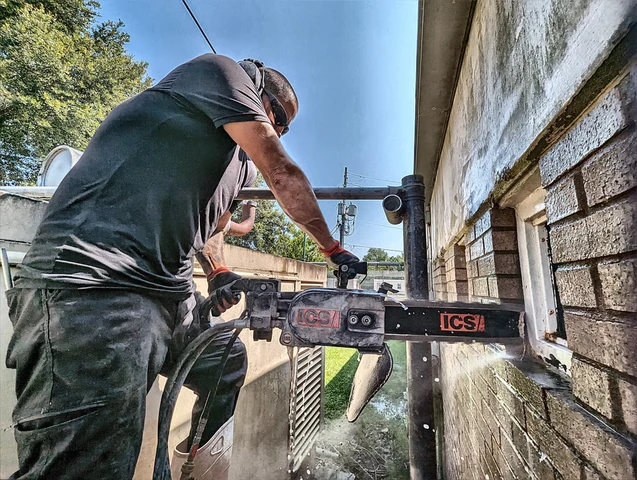
Electric wall saws, hydraulically-driven ring saws, and battery-assisted core drilling rigs are the primary tool categories suited for confined space concrete cutting. Hydraulic power packs can be positioned outside the confined space with hydraulic lines run to the cutting head inside, keeping the combustion source and heat generation outside the work envelope. This equipment configuration requires careful hose management to prevent trip hazards in already-restricted movement corridors. For crews specializing in this environment, the confined space drilling tag archive documents specific equipment configurations and entry protocols used in South Florida projects.
Slurry Management in Enclosed Environments
Wet cutting is standard practice for dust suppression and blade cooling, but in confined spaces, the resulting slurry creates a secondary problem that’s often underestimated. A single core drill through a 12-inch concrete wall can generate 3 to 5 gallons of slurry. Scale that across a multi-penetration scope in a basement mechanical room with no floor drain, and you’re managing a standing water and silica-laden slurry situation that violates both environmental disposal protocols and creates immediate slip hazards for the crew. Portable slurry vacuums, containment berms, and pre-planned slurry disposal staging areas must be part of the confined space work plan before tools are staged.
Silica exposure controls under OSHA’s 1926.1153 standard apply regardless of space configuration. In confined spaces, the engineering controls become more complex because dilution ventilation — the standard approach in open environments — is less effective. Local exhaust ventilation (LEV) positioned directly at the cutting interface, combined with continuous air monitoring, is the compliant and safe approach. Cutting crews should never rely on respiratory protection alone as the primary silica control method in enclosed cutting environments.
Slab Cutting Sequencing for Structural Integrity During Phased Removal
When concrete cutting and disposal is executed in phases — as is common in occupied buildings, active parking structures, or staged renovation scopes — the cutting sequence directly affects structural behavior. Flat slab systems with two-way reinforcement distribute loads across multiple bays. Removing a slab section without accounting for the redistribution of that load to adjacent bays can trigger punching shear failures at column connections that weren’t part of the demolition scope. This is not a theoretical concern — it’s a documented failure mode in phased demolition projects.
The sequencing protocol for phased slab cutting should be developed in coordination with the engineer of record. Temporary shoring beneath cut sections, sequenced removal that moves away from column lines rather than toward them, and maximum panel size limits based on structural analysis are all standard controls. For large-format slab removal where crane or forklift access is available, pre-cutting panels to a manageable lift weight before breaking the final perimeter connection is the preferred method — it eliminates uncontrolled slab drop and allows precise placement into debris containers.
Vertical Material Handling in Multi-Story Confined Scopes
Getting cut concrete from the work level to the disposal container is one of the most physically demanding and equipment-intensive aspects of any confined or access-restricted project. In stairwell-only access scenarios, debris chutes, bucket conveyors, or manual relay chains are the available options — none of which are fast. Electric material hoists rated for construction debris can be rigged to window openings or shaft penetrations to create a vertical egress path that bypasses stairwell bottlenecks. The weight-per-lift capacity of the hoist must be matched to the maximum panel weight established during the cutting sequencing phase.
For projects where the disposal container must be positioned at street level while work occurs multiple floors below grade, the time-per-cycle for material movement will often exceed the time-per-cycle for the cutting operation itself. This inversion — where logistics drive production pace, not cutting speed — must be reflected in the project schedule and crew sizing. Sending a four-person cutting crew into a job with a two-person debris handling capacity creates a productivity bottleneck that no blade upgrade will solve. The best concrete cutting companies understand this balance intuitively. If you’re evaluating contractors for a complex scope, this breakdown of what separates top-tier core drilling companies from the rest covers the operational questions worth asking before you award the work.
Concrete Disposal Compliance — What the Debris Weighs Against What the Regulations Allow
Concrete cutting and disposal in Miami-Dade County falls under Florida DEP Chapter 62-701 for construction and demolition debris management. Clean concrete rubble — free of hazardous materials, asbestos-containing materials (ACM), and lead-based paint — qualifies for disposal at permitted C&D debris facilities, which carry lower tipping fees than municipal solid waste facilities. The qualification matters financially on large scopes: a 20-ton concrete removal job routed to the wrong facility can cost two to three times more in disposal fees than the same material handled correctly.
Pre-1978 construction requires ACM survey and, where applicable, abatement before any mechanical demolition activity. This is a hard regulatory requirement, not a precautionary suggestion. Concrete cutting through ACM-containing fireproofing, floor leveling compounds, or tile adhesives without prior abatement creates a regulatory liability that extends beyond the cutting contractor to the building owner and general contractor. Confirm ACM clearance documentation is in hand before mobilizing cutting equipment on any pre-1978 structure.
Load tickets, material manifests, and facility receipts should be retained for every disposal run on permitted projects. In Miami-Dade, building department inspectors and environmental compliance officers have requested disposal documentation during inspections on renovation projects — particularly those involving below-grade work near Biscayne Bay or other protected water bodies. The documentation burden is light compared to the cost of a stop-work order triggered by an undocumented disposal chain.
Building the Right Crew Configuration for Access-Restricted Concrete Cutting and Disposal
Access-restricted concrete cutting and disposal is a specialty discipline within an already specialized trade. The crew configuration for a confined space, multi-floor, or access-limited scope looks different from a standard open-site demolition job. You need operators certified in confined space entry and rescue, equipment scaled to fit through the access points that actually exist on the job, a logistics coordinator whose sole job is managing material flow from cut point to disposal container, and a project lead with GPR interpretation skills and the authority to stop work if utility conflicts are identified mid-operation.
That crew configuration costs more per day than a standard flat-rate cutting crew. It should. The complexity of the work demands it, and the liability exposure of getting it wrong — structurally, regulatorily, or from a worker safety standpoint — dwarfs any short-term savings from understaffing the logistics side of the operation. Concrete cutting and disposal done right in a constrained environment is a precision logistics exercise that happens to involve diamond blades. Plan it that way from the first site walk, and the cut itself becomes the easy part.