What Every Contractor Should Know Before Picking Up a Rental Jackhammer
Jackhammer rental looks straightforward on the surface — walk into a tool rental shop, hand over a credit card, drive to the job site, and start swinging. But anyone who has spent real time in the field knows that selecting the wrong breaker class, the wrong chisel geometry, or the wrong operating technique can turn a half-day demo job into a two-day nightmare with cracked footings, blown compressors, and a crew that’s done by lunch from sheer fatigue. Before you sign that rental agreement, you need a technical framework for making the right call every single time.
Understanding Breaker Classes and Matching Them to Your Concrete
Rental jackhammers fall into three broad classes based on impact energy, measured in foot-pounds (ft-lbs) or joules. Getting this classification right is the single most important decision you’ll make on a demolition job.
Light-Duty Electric Demolition Hammers (6–15 ft-lbs)
These units — typically 10 to 15 lbs in weight — are designed for tile removal, thin topping slabs (under 2 inches), and surface scarification. They run on standard 120V circuits and generate enough impact energy to break up lightweight concrete but will stall and overheat on anything with structural rebar or a compressive strength above 3,000 PSI. If you’re pulling up a bathroom floor or chipping a thin overlay, a light-duty electric hammer is your most cost-effective rental option, usually running $45–$75 per day in the Miami market.
Mid-Range Electric and Pneumatic Breakers (15–40 ft-lbs)
This is the workhorse category for most residential and light commercial demolition. A 35 ft-lb electric demolition hammer — think Bosch 11335K class — can handle 4-inch slabs with light rebar (#3 and #4 bar) efficiently. Pneumatic equivalents in this range require a compressor delivering a minimum of 90 PSI at 25 CFM. Undersizing your compressor here is the most common rental mistake on jobsites. The hammer sounds like it’s working, but it’s operating at 60% efficiency, burning through your rental hours and your crew’s energy simultaneously.
Heavy-Duty Pneumatic Breakers (40–90+ ft-lbs)
These are the tools that serious concrete demolition demands. A 65 ft-lb pneumatic breaker paired with a 185 CFM towable air compressor can demolish 8-inch reinforced slabs, break through grade beams, and chunk out foundation walls. Rental rates in Miami typically run $120–$180 per day for the breaker alone, with compressor rentals adding another $200–$350 per day for towable units. For jobs where you’re hitting anything thicker than 6 inches or encountering high-PSI concrete (4,500 PSI and above), this is non-negotiable equipment. For projects of this scale, it’s also worth reviewing professional bid strategies for concrete demolition to ensure your labor and equipment costs are accurately captured.
Chisel Geometry and Steel Selection for Different Demolition Scenarios
The bit you attach to your rental jackhammer matters as much as the machine itself. Most rental shops hand you a moil point by default — that tapered, conical chisel — and it’s genuinely the wrong tool for about half the applications contractors encounter.
Moil Points vs. Flat Chisels vs. Spade Bits
Moil points concentrate impact energy at a single tip, making them ideal for fracturing thick, unreinforced concrete and starting break lines. However, on reinforced slabs, a moil point tends to deflect off rebar rather than cutting through the matrix around it. In those scenarios, a flat chisel (also called a scaling chisel) distributes force across a wider face, allowing you to work the concrete away from the steel systematically. Spade bits are your go-to for soil excavation, clay breaking, and frost-heaved asphalt — not concrete. Using a spade bit on a structural slab is a waste of impact energy and accelerates bit wear dramatically.
Steel Grade and Shank Compatibility
Always verify shank compatibility before leaving the rental counter. The two dominant shank standards in the North American market are the hex shank (typically 1-1/8″ hex for mid-range tools) and the round shank with collar (common on heavy pneumatic breakers). Mixing shank standards creates dangerous play in the tool holder, which reduces energy transfer efficiency and creates a safety hazard. Ask for bits rated for the specific impact energy class of your rental unit — using a light-duty bit in a 65 ft-lb breaker will shatter the steel.
Air Supply Calculations That Rental Shops Won’t Tell You
If you’re renting a pneumatic jackhammer, the air supply chain is where projects fall apart. Here’s how to calculate your actual CFM requirement before you rent anything.
Start with the manufacturer’s rated CFM for the breaker at 90 PSI operating pressure. Add 20% for line losses through your hose run. If your hose run exceeds 50 feet, add another 10% per additional 50-foot section. A single 65 ft-lb breaker rated at 45 CFM, running through 100 feet of 3/4-inch hose, actually demands approximately 58–62 CFM from your compressor to maintain rated performance. A portable electric compressor rated at 30 CFM won’t come close — you need that towable diesel unit.
Hose diameter is equally critical. Running a 1/2-inch ID hose on a heavy breaker creates a pressure drop that can rob you of 15–20 PSI at the tool, dropping your effective impact energy by 25% or more. Use 3/4-inch ID air hose as a minimum for any breaker above 30 ft-lbs. This is especially relevant on Miami concrete projects where summer heat already stresses compressor performance.
Dust and Slurry Management During Jackhammer Operations
Concrete demolition with a jackhammer generates respirable silica dust at concentrations that can exceed OSHA’s permissible exposure limit (PEL of 50 µg/m³) within minutes of breaking. In Miami’s outdoor environment, wind dispersion helps, but enclosed spaces — parking garages, interior slabs, basement demolition — require active dust suppression.
Water suppression is the most practical field solution. A simple garden hose running water at the point of impact reduces airborne dust by 70–85% in most conditions. However, water introduces its own complications: slurry runoff must be contained and disposed of properly, particularly if the concrete contains any legacy contaminants. For projects where moisture management is critical to adjacent assemblies, understanding moisture barrier requirements in concrete systems before you start breaking is essential. You don’t want demolition slurry migrating under an adjacent slab and compromising a vapor barrier installation.
For interior work, pair water suppression with a HEPA-filtered vacuum shroud if your rental breaker accepts one, and ensure all workers in the area are equipped with N95 respirators rated for silica at minimum. Half-face respirators with P100 cartridges are the professional standard.
When Jackhammer Rental Is the Wrong Tool for the Job
This is the conversation rental shops will never have with you, but it’s the most important one. Jackhammers are impact-based demolition tools — they fracture concrete through repeated blunt force. That makes them the right choice for bulk removal but the wrong choice for precision work.
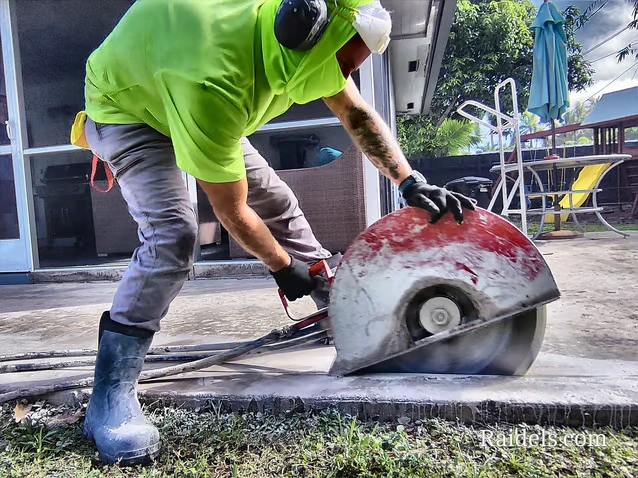
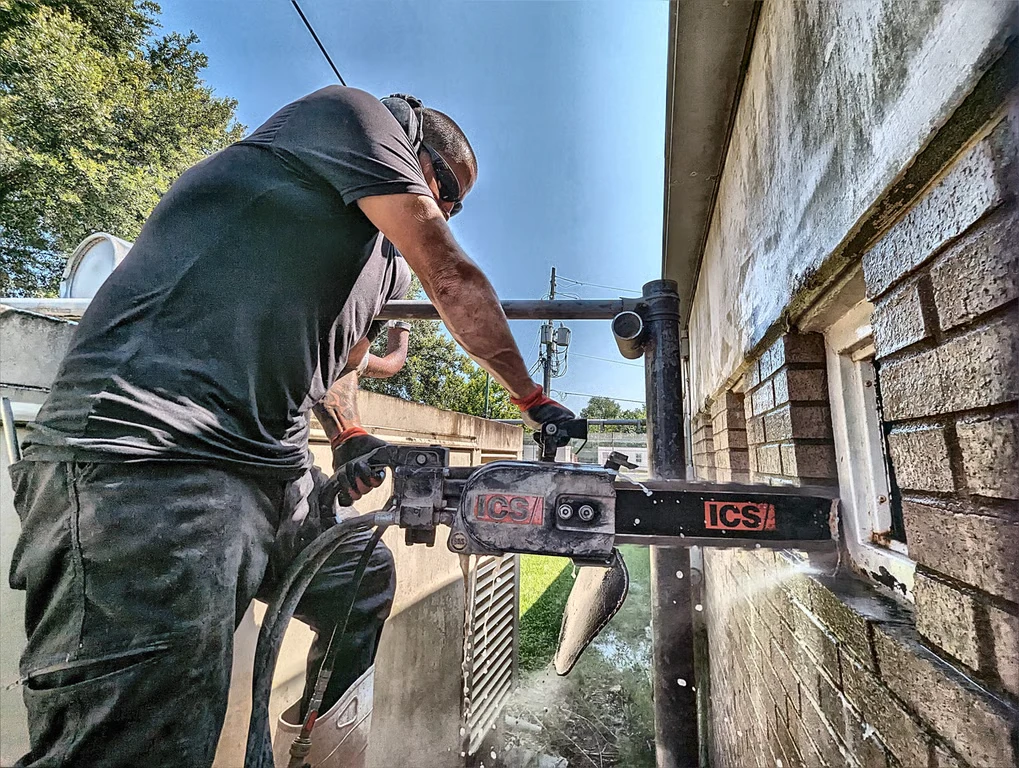
If your project requires a clean, straight cut through a slab — for a new doorway, a utility penetration, a structural opening — a jackhammer will leave a ragged, over-broken edge that requires significant additional labor to clean up, and may compromise the structural integrity of the remaining slab at the cut line. Flat saw cutting or wall sawing delivers a precise kerf that a jackhammer physically cannot replicate. For anyone navigating these decisions on a commercial project, the contractor tips section covers when to call a specialist versus handle demolition in-house.
Similarly, if your slab has post-tensioned cables, a jackhammer is a potentially lethal tool. Post-tensioned concrete contains steel cables under 30,000–45,000 lbs of tension. Striking a cable with a breaker can cause catastrophic, explosive release. Always scan for post-tension systems with GPR (ground-penetrating radar) before any demolition work begins. This is not optional — it’s a life-safety requirement.
Proper Operating Technique to Maximize Rental Efficiency
Most operators make the same mistake: they lean into the breaker with their full body weight, thinking more downforce equals more breaking power. In reality, a pneumatic or electric breaker works most efficiently when the operator applies just enough pressure to maintain bit contact — roughly 20–30 lbs of downforce on a heavy breaker. Excessive downforce actually dampens the piston’s return stroke, reducing BPM (blows per minute) and slowing your production rate.
Work in a systematic grid pattern across the slab. Break a perimeter line first using a flat chisel, then work inward in 12–18 inch sections. This prevents the slab from “bridging” — a condition where the concrete cracks below the surface but remains locked in place by its own geometry, forcing you to break the same area multiple times. For wet cutting and demolition operations that combine saw cutting with jackhammer breaking, pre-cut your grid lines with a flat saw to a depth of 1/3 the slab thickness before bringing in the breaker. This single technique can reduce your total breaking time by 40% on a standard 4-inch slab.
Rotate operators every 20–30 minutes on heavy breakers. Hand-arm vibration syndrome (HAVS) is a real occupational hazard, and beyond the long-term health implications, a fatigued operator loses technique quickly — which means slower production and a higher risk of damaging adjacent structures.
Renting Smart vs. Hiring Right — The Real Cost Calculation
A day’s rental for a heavy pneumatic breaker plus compressor in Miami runs $350–$550 before fuel, bits, hose, and operator labor. For a two-person crew over two days, your all-in cost on a straightforward slab removal job can easily reach $1,800–$2,400. That’s a legitimate approach for a contractor with the crew and experience to execute efficiently. But for complex jobs — post-tensioned slabs, interior demolition with dust control requirements, or precision openings in structural concrete — the gap between rental cost and professional concrete cutting service narrows faster than most project managers expect. Know your numbers before you commit to either path, and make sure your bid reflects the actual scope of work involved.