Why Mixing Up Concrete and Cement Is More Than a Vocabulary Problem
Walk onto almost any residential or commercial job site in Miami and you’ll hear it within the first ten minutes — someone calling a bag of Portland cement “concrete,” or referring to a poured slab as “cement.” In casual conversation, that’s harmless. On an active work site, it’s a different story entirely. Misidentifying these materials can lead to improper PPE selection, incorrect hazard communication, and direct violations of OSHA’s Hazard Communication Standard (29 CFR 1910.1200). As a senior concrete consultant who has worked alongside cutting crews, demolition teams, and general contractors across South Florida for decades, I can tell you with certainty that this terminology gap is not trivial — it’s a liability.
The Technical Distinction Between Cement and Concrete That Every Crew Chief Must Drill Into Their Team
Cement — specifically Portland cement — is a finely ground, kiln-fired powder composed primarily of calcium silicates, aluminates, and ferrites. It is the binding agent, the reactive chemical component, and by itself, it is not a structural material. When cement contacts moisture, it initiates a highly exothermic hydration reaction that produces calcium silicate hydrate (C-S-H) gel and calcium hydroxide. That calcium hydroxide is what makes fresh cement paste caustic, reaching a pH of 12 to 13. Direct skin contact without proper gloves and barrier protection causes alkali burns — sometimes delayed burns that workers don’t notice until hours after exposure.
Concrete, on the other hand, is a composite material. It is a precisely engineered mixture of Portland cement (typically 10–15% by weight), fine aggregates (sand), coarse aggregates (crushed limestone, gravel, or recycled concrete), water, and often chemical admixtures such as fly ash, slag, superplasticizers, or air-entraining agents. Concrete is what gets poured, formed, cured, and ultimately cut. The distinction matters enormously when your crew is selecting the correct Safety Data Sheet (SDS), determining which respiratory protection applies, or deciding how to handle and dispose of material waste under EPA and OSHA regulations.
Crystalline Silica Exposure Risks in Cement vs. Hardened Concrete — They Are Not the Same Threat
Here is where the safety stakes escalate dramatically. Dry Portland cement does contain some crystalline silica, but the primary silica exposure hazard on most job sites comes from cutting, grinding, drilling, or demolishing hardened concrete. When a diamond blade engages a cured slab, it generates respirable crystalline silica (RCS) particles — particles small enough to penetrate deep into the lung tissue and cause silicosis, a progressive and irreversible fibrotic lung disease. OSHA’s Silica Standard for Construction (29 CFR 1926.1153) establishes a Permissible Exposure Limit (PEL) of 50 micrograms per cubic meter of air as an 8-hour time-weighted average.
Workers who don’t understand that hardened concrete is the primary silica vector often underestimate their exposure risk during cutting operations. If your team thinks they’re just “cutting cement,” they may skip the wet-cutting protocol or fail to deploy a HEPA-equipped vacuum system on their angle grinder or core drill. That is a direct OSHA violation and a genuine long-term health catastrophe waiting to happen. For a deep dive into blade selection and cutting protocols that minimize silica generation at the source, review this technical breakdown of effective concrete cutting blade systems.

OSHA Hazard Communication and the SDS Problem Created by Material Misidentification
OSHA’s HazCom Standard requires that every hazardous chemical on a job site have an accessible, current SDS, and that workers receive training specific to the chemicals they handle. Cement has its own SDS. Concrete has its own SDS. They are not interchangeable documents. Cement’s SDS will flag the caustic pH hazard, the sensitization risk (cement can trigger occupational asthma and chromate dermatitis), and the respiratory hazard from dry powder inhalation. Concrete’s SDS will emphasize the silica content of the aggregate fraction and the cutting/grinding hazard profile.
When a foreman points to a pile of bagged Portland cement and calls it “concrete” during a toolbox talk, workers who reference the wrong SDS are operating with incomplete hazard information. That is a citable OSHA violation under 29 CFR 1910.1200(h) — failure to provide adequate employee information and training. For crews operating in Miami-Dade County, where construction activity is intense and OSHA inspections are not uncommon, this is not a theoretical risk. Our job site safety resource library covers the full spectrum of chemical hazard communication requirements for concrete trades.
PPE Selection Differences When Handling Raw Cement Versus Cutting Cured Concrete Slabs
The PPE matrix is not identical for these two materials, and that distinction has direct OSHA compliance implications:
- Handling dry Portland cement: Requires minimum N95 respirator (or P100 in high-dust environments), chemical-resistant gloves rated for high-pH alkaline materials, safety glasses with side shields, and long sleeves to prevent skin contact. Eye wash stations must be accessible within 10 seconds of travel per ANSI Z358.1.
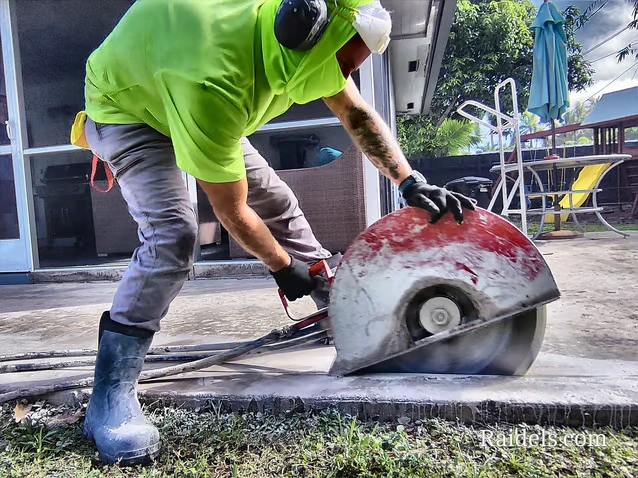
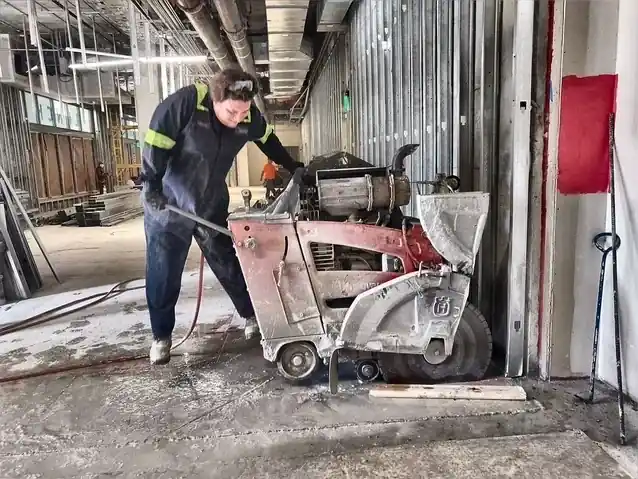
- Cutting or coring hardened concrete: Requires a half-face or full-face respirator with P100 filters rated for silica dust, wet-cutting systems or integrated HEPA vacuum shrouds, hearing protection (concrete saws routinely exceed 100 dB), cut-resistant gloves, steel-toed boots, and high-visibility vests in multi-trade environments.
- Breaking thick concrete slabs by hand or with mechanical means: Adds the requirement for anti-vibration gloves (to address Hand-Arm Vibration Syndrome risk from jackhammers and demolition hammers), hard hats rated for falling debris, and face shields over safety glasses. See our detailed protocol guide on breaking thick concrete slabs while maintaining OSHA safety standards.
Concrete Demolition Scenarios Where the Cement-Concrete Confusion Creates Real Hazard Gaps
Consider a pool removal project — a common job in Miami’s residential market. The pool shell is reinforced concrete, not cement. It contains rebar, aggregate, and a cured cement matrix. When a crew begins saw-cutting the shell for removal, they are generating silica-laden concrete dust, not cement dust. The hazard profile, the required engineering controls (wet cutting, vacuum extraction), and the waste classification under Florida DEP regulations are all governed by the concrete SDS and OSHA’s silica standard — not the cement SDS. Crews who haven’t been educated on this distinction may skip critical controls.
Pool demolition and removal projects in Miami also carry resale value implications that go beyond the safety conversation, but the safety piece must come first. Our team has documented the intersection of proper demolition practices and property value in our analysis of pool removal and Miami home resale value, and we’ve covered the structural considerations in detail in our comprehensive guide to the pros and cons of filling in a pool. In every one of those scenarios, the material being handled is concrete — and the safety protocols must reflect that accurately.
Alkaline Burns from Fresh Concrete — The Delayed Injury That Crews Consistently Underestimate
One of the most clinically underreported injuries in the concrete trades is the delayed alkaline burn. Fresh concrete — while it contains cement as its reactive binder — presents the same high-pH chemical hazard as pure cement paste, but workers often dismiss it because it looks and feels like mud. Concrete finishers who work on their knees without waterproof knee pads and impermeable pants have developed third-degree chemical burns on their knees after extended contact with fresh concrete. The burn mechanism is saponification of skin tissue — a progressive chemical destruction that continues as long as the alkaline material remains in contact with the skin.
OSHA’s General Industry Standard at 29 CFR 1910.138 and the Construction Standard at 29 CFR 1926.28 both require employers to provide and enforce appropriate PPE for chemical hazards. Failing to identify fresh concrete as a high-pH chemical hazard — because the crew thinks “cement” is the dangerous part and “concrete” is just aggregate — creates a direct compliance gap. Employers bear the citation risk, and workers bear the injury risk.
Building a Job Site Safety Culture That Starts With Getting the Language Right
The fix here is not complicated, but it requires deliberate effort from every level of site leadership. Toolbox talks should explicitly address the cement-versus-concrete distinction at least once per project kickoff. SDS binders must be organized by the actual material present on site. Foremen should be trained to correct terminology in real time — not to be pedantic, but because precise language drives precise hazard awareness.
In Miami’s construction environment, where projects range from high-rise core drilling to residential pool demolition to land clearing operations, the material mix on any given site can change day to day. Crews working in Miami Beach and surrounding coastal areas face additional considerations around concrete mix designs (higher cement content for marine exposure resistance), which further reinforces why knowing what material you’re actually handling matters. Explore additional regional safety and land management resources through our Miami Beach land clearing resource hub.
At Concrete Cutting Miami, LLC, our crews operate under a zero-ambiguity safety standard. Every material is identified correctly. Every SDS is matched to the actual substance. Every PPE selection is driven by the real hazard profile of what’s being cut, drilled, broken, or mixed. That’s not bureaucratic box-checking — it’s the baseline of a professional concrete operation that takes its people seriously. The difference between concrete and cement is not just chemistry. On a job site, it’s the difference between a properly controlled work environment and an OSHA citation waiting to happen.