Why Equipment Specs Drive Expansion Joint Quality More Than Operator Skill
Ask any senior concrete contractor what separates a clean, functional expansion joint from a spalled, raveled disaster, and they’ll tell you the same thing — it starts with the machine and the blade, not the person holding the handle. Expansion joints in concrete flatwork, slabs-on-grade, parking structures, and highway panels serve a critical structural function: they control where the slab cracks, channel thermal movement, and prevent random fracture propagation. When those joints are cut with mismatched tooling, undersized saws, or incorrect diamond specifications, the joint itself becomes a liability. This guide breaks down the exact equipment configurations, diamond blade parameters, and saw specifications that produce consistent, industry-standard expansion joint cuts in concrete — from residential flatwork to heavy industrial slabs.
Saw Classification and Horsepower Requirements for Joint Cutting
Expansion joint cutting falls into two distinct operational categories: early-entry sawing performed within 1 to 4 hours of concrete placement, and conventional wet sawing performed after the concrete has achieved sufficient hardness, typically 6 to 24 hours post-pour depending on ambient temperature and mix design. Each category demands a different class of equipment, and confusing the two is one of the most common causes of joint failure in the field.
For early-entry joint cutting, lightweight walk-behind saws in the 5 to 8 horsepower range are the industry standard. Machines like the Soff-Cut series operate with skid plates that prevent raveling in green concrete. The skid plate rides the surface and stabilizes the blade, which is typically 4 to 6 inches in diameter, running at elevated RPM to compensate for the reduced blade mass. Engine speed on these units typically runs between 3,600 and 4,000 RPM at the arbor, and blade tip speed should be maintained between 11,000 and 13,000 surface feet per minute (SFPM) for optimal early-entry performance.
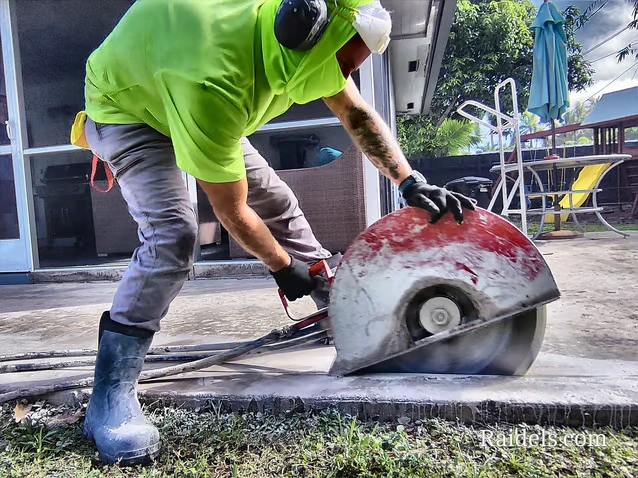
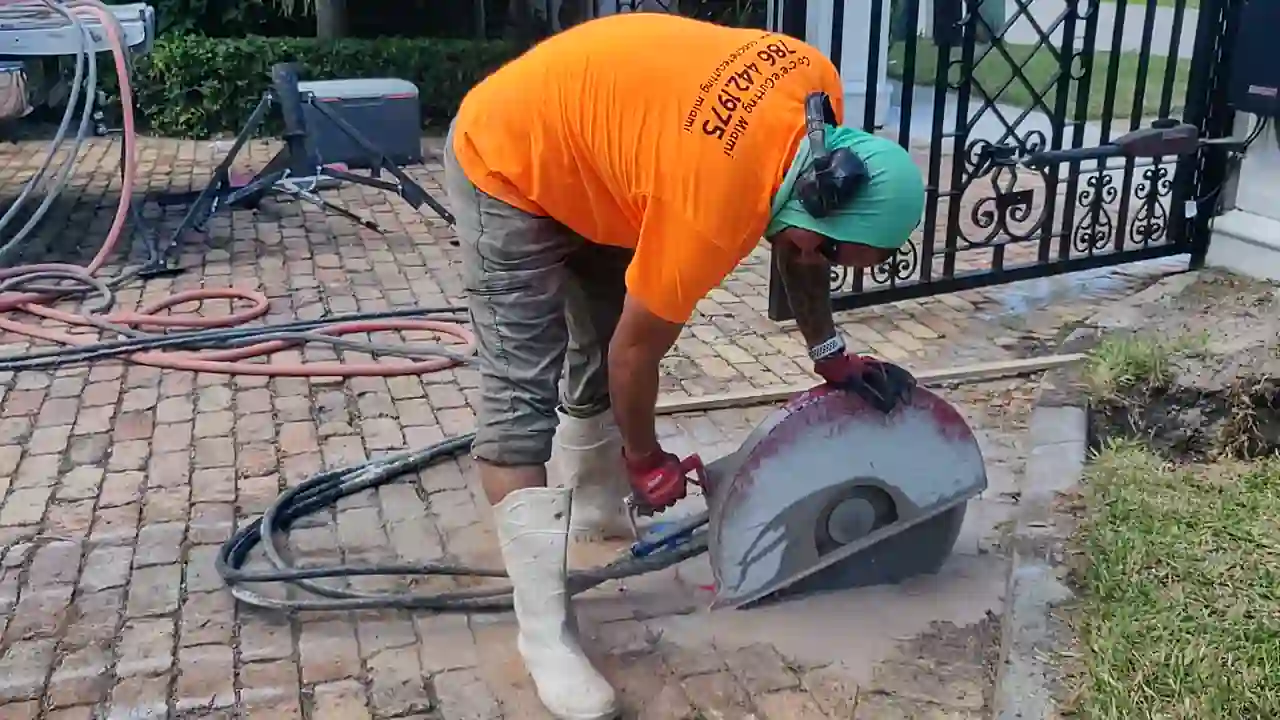
Conventional wet saws used for expansion joint cutting in hardened concrete are a different animal entirely. Walk-behind flat saws for standard slab work typically range from 20 to 65 horsepower, with blade diameters from 12 to 20 inches depending on required joint depth. For expansion joints requiring depths of 1/4 to 1/3 of the slab thickness — the structural minimum per ACI 360R — a 14-inch blade on a 25-horsepower machine is a common configuration for slabs up to 6 inches thick. Deeper cuts in 8- to 12-inch industrial slabs demand 18- to 20-inch blades on saws producing 40 to 65 horsepower. Attempting to run an undersized saw on a deep-cut application causes blade deflection, overheating, and segment loss. For a broader look at the best methods to cut concrete, understanding saw classification is the essential first step.
Diamond Blade Geometry and Segment Configuration for Expansion Joint Cutting
Diamond blades are not interchangeable, and the blade market is littered with general-purpose products that perform adequately in nothing. For expansion joint cutting specifically, blade geometry directly impacts joint width (kerf), edge quality, and segment longevity. Here’s what the spec sheet needs to show before a blade goes on your saw.
Segment Height and Diamond Concentration
Segment height for joint cutting blades typically runs between 10mm and 15mm for standard wet-cut applications. Higher segment profiles (13–15mm) are preferred for abrasive aggregates like flint gravel or recycled concrete, as they provide extended service life before the steel core is exposed. Diamond concentration — expressed as a percentage of diamond volume within the metal bond matrix — should run between 25% and 35% for medium-hard concrete (3,000 to 5,000 PSI compressive strength). Harder concrete above 6,000 PSI requires lower concentration (18–25%) with a softer bond matrix to allow continuous diamond exposure. Running a high-concentration blade in hard concrete causes glazing — the bond matrix hardens faster than it wears, burying the cutting diamonds and killing cut rate.
Bond Hardness and Aggregate Compatibility
The metal bond matrix is the variable most contractors overlook. Bond hardness is rated on a scale from soft (A–D) to hard (L–P), and the selection must be inverse to the hardness of the material being cut. Soft concrete (2,500–3,500 PSI) with hard aggregate like quartzite requires a hard bond (H–K) to resist premature wear. Hard concrete (5,000+ PSI) with soft limestone aggregate demands a soft bond (C–E) to maintain continuous wear and keep fresh diamonds exposed. For expansion joint cutting in South Florida’s typical concrete mixes — which often incorporate oolitic limestone aggregate — a medium-soft bond in the D–F range on a 14-inch blade is the correct specification for most slab-on-grade applications. You can explore more about concrete cutting equipment specifications relevant to local aggregate conditions.
Blade Kerf Width and Joint Specification Compliance
ACI and ACPA joint specifications typically call for joint widths between 1/8 inch (3.2mm) and 3/16 inch (4.8mm) for standard contraction joints. Expansion joints — which must accommodate genuine thermal movement and often receive sealant backer rod — are typically specified at 3/8 inch to 3/4 inch wide, requiring either a single wide-kerf blade or multiple parallel cuts with a standard blade. Purpose-built expansion joint blades are available in kerf widths from 3/8 inch to 1 inch, using a segmented or turbo-segmented rim configuration to maintain cutting stability at wider widths. When using tandem blade setups on a standard flat saw, blade spacing collars must be precision-machined to maintain exact parallel alignment — any lateral deviation greater than 1/32 inch will produce a tapered joint that compromises sealant installation.
Water Flow Rates, Blade RPM, and Feed Speed — The Cutting Triangle
Three variables interact simultaneously during every wet-cut expansion joint operation: water flow rate, blade RPM, and forward feed speed. Mismanaging any one of them degrades blade life, joint quality, or both.
Water flow for blade cooling and slurry evacuation should be maintained at a minimum of 1.5 gallons per minute (GPM) per blade side for blades up to 14 inches. Larger 18- to 20-inch blades require 2.5 to 3.5 GPM to prevent thermal stress cracking in the steel core. Insufficient water flow causes segment overheating, which softens the bond matrix and accelerates segment loss — a failure mode that produces dangerous projectile hazards and destroys the joint edge simultaneously.
Blade RPM must be matched to blade diameter to maintain proper SFPM. A 14-inch blade should run between 2,200 and 2,600 RPM for a tip speed of approximately 8,000 to 9,500 SFPM. A 20-inch blade achieves the same tip speed at 1,500 to 1,800 RPM. Running a large-diameter blade at high RPM exceeds the blade’s maximum operating speed (MOS) — a critical safety and performance parameter printed on every blade’s label that must never be exceeded. Forward feed speed for expansion joint cutting in standard 4,000 PSI concrete with a 14-inch blade typically runs 8 to 15 linear feet per minute. Pushing faster creates undercutting and blade chatter; going too slow overheats the segments and glazes the bond. For current pricing benchmarks on production cutting rates, review the 2025 concrete saw cutting cost per linear foot breakdown.
Early-Entry Blade Specifications and Timing Windows
Early-entry joint cutting demands a completely different blade specification than hardened-concrete wet sawing. Early-entry blades use a vacuum-brazed or electroplated diamond surface rather than a sintered segment, because the green concrete matrix is too soft to generate the abrasive wear needed to expose new diamonds in a sintered segment. Blade diameters of 4 to 6 inches with a 7/8-inch arbor are standard. Diamond grit size for early-entry applications typically runs 30/40 US mesh — coarser grit cuts aggressively in soft material without loading up with paste. The skid plate width must match the blade diameter within ±1/16 inch to prevent surface tearing.
Timing is a blade specification issue as much as a scheduling issue. Cutting too early — before the concrete has developed sufficient tensile strength to resist the cutting forces — causes raveling regardless of blade quality. The maturity method, using embedded temperature sensors and the Nurse-Saul equation, provides the most accurate timing for early-entry cuts, particularly in South Florida’s high-temperature curing environment where concrete can reach cutting maturity in under 90 minutes during summer months. Projects operating under Miami construction conditions need to account for accelerated hydration when setting early-entry cutting schedules.
Blade Mounting, Arbor Fit, and Flange Specifications
Even the highest-specification diamond blade performs poorly when mounted incorrectly. Arbor bore diameter must match the saw spindle exactly — standard sizes are 1 inch, 20mm, and 1-1/4 inch. Using a reduction bushing to adapt an oversized bore introduces runout, which causes lateral blade wobble, widens the joint beyond specification, and accelerates segment fatigue. Flange diameter should be at least 1/3 of the blade diameter — a 14-inch blade requires flanges no smaller than 4.5 inches in diameter. Undersized flanges reduce the blade’s supported area, increasing stress concentration at the core and promoting stress fractures during hard cutting. Flange faces must be clean, flat, and free of concrete slurry buildup before every blade change. For projects involving foundation removal or deep structural cuts where blade integrity is critical, flange inspection is non-negotiable before each cut sequence.
Torque specifications for blade retention nuts vary by manufacturer but typically fall between 25 and 45 foot-pounds for standard flat-saw arbors. Under-torqued blades spin on the arbor during hard cutting, scoring the flange faces and destroying the arbor thread. Over-torqued retention systems strip threads and make emergency blade changes in the field nearly impossible. A calibrated torque wrench is standard equipment on any professional joint cutting operation. For a full breakdown of professional-grade cutting methods used across infrastructure construction services, equipment maintenance protocols are as critical as blade selection itself.
Reading Blade Wear Patterns to Diagnose Cutting Problems
A worn blade tells the story of every cut it made. Segment wear patterns are diagnostic data that experienced operators use to adjust machine settings and blade specifications in real time. Flat-topped segments indicate the bond is too hard for the material — the diamonds are being polished rather than shed. Undercut segments, where the steel core is exposed ahead of the segment body, indicate the bond is too soft and the segment is wearing faster than the core. Cracked or missing segments indicate thermal shock from insufficient water flow or blade speed exceeding MOS. Side wear on segments — visible as a concave profile when viewed from the blade face — indicates excessive lateral force during cutting, usually caused by blade deflection from underpowered equipment or excessive feed speed. Monitoring these patterns and adjusting blade specification accordingly is the mark of a technically proficient concrete cutting operation, and it directly determines whether expansion joints meet the dimensional tolerances that structural engineers specify.