What Concrete Lifespan Actually Means When You Can Barely Get a Saw Into the Space
The textbook answer to how long concrete lasts runs somewhere between 50 and 100 years for well-placed, properly cured structural concrete — longer if the mix design, reinforcement schedule, and environmental exposure were all dialed in at the pour. But here in South Florida, and particularly across dense commercial corridors in Miami, that theoretical number collides hard with a different reality: site logistics, confined space limitations, and access constraints that make the question less about material science and more about operational feasibility. I’ve walked job sites where structurally sound concrete had to come out not because it failed, but because nobody could safely work around it anymore. That’s the conversation most engineers and project managers aren’t having loudly enough.
The Structural Lifespan Formula Nobody Applies to Tight Urban Job Sites
Concrete durability is a function of water-cement ratio, aggregate quality, curing time, rebar cover depth, and long-term exposure to chlorides, carbonation, and freeze-thaw cycles. In Miami’s coastal climate, chloride-induced corrosion of embedded steel is the dominant degradation mechanism — saltwater-saturated air accelerates rebar oxidation, which causes expansive cracking and spalling that can structurally compromise a slab in 30 to 40 years rather than 80. But even that compressed timeline assumes you can get eyes on the structure regularly and perform maintenance cuts, core samples, or partial demolition when deterioration is first detected.
The problem is that many of Miami’s aging parking structures, mechanical rooms, utility tunnels, and below-grade foundations were built in eras when access planning was an afterthought. When those structures begin showing signs of rebar corrosion or carbonation-induced delamination, the cutting and removal work required to assess or remediate them runs directly into confined space regulations, overhead clearance restrictions, and equipment staging nightmares. The concrete’s lifespan, from a practical standpoint, ends not when it fails structurally — but when the cost and complexity of working around access limitations makes continued maintenance economically irrational.
Confined Space Classification and How It Reshapes Every Concrete Cutting Decision
OSHA 29 CFR 1910.146 defines a permit-required confined space as any space large enough for a worker to enter, with limited means of entry or exit, and not designed for continuous occupancy. Parking garage lower decks, elevator pits, mechanical tunnels, and crawl spaces beneath post-tensioned slabs frequently meet all three criteria. When you’re tasked with cutting deteriorated concrete in one of these environments, the job scope expands dramatically before a blade ever touches the surface.
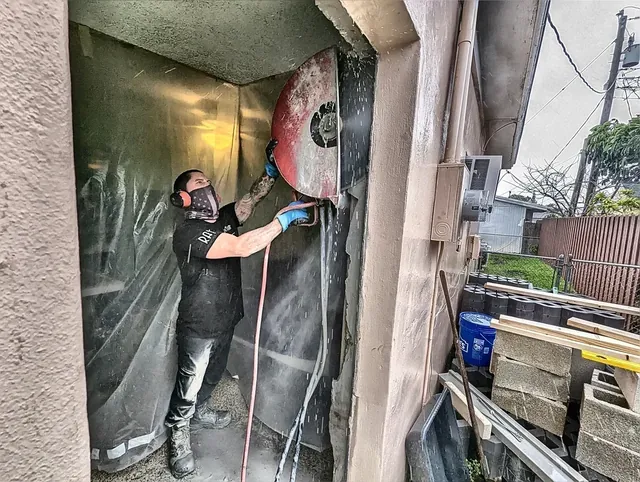
Atmospheric testing for oxygen deficiency, combustible gases, and toxic contaminants becomes mandatory. You need a trained attendant stationed outside the space at all times, a retrieval system rated for the workers inside, and a written permit with emergency rescue procedures documented before entry. For concrete saw cutting operations specifically, this creates a ventilation engineering challenge that most clients don’t anticipate: diamond blade cutting — whether flat saw, wall saw, or handheld — generates silica-laden slurry and airborne particulate that must be continuously exhausted from the confined space. A standard wet-cutting suppression system reduces airborne silica significantly, but in a space with limited air exchange, residual particulate accumulation still requires forced-air ventilation at calculated CFM rates based on the space volume and cutting duration.
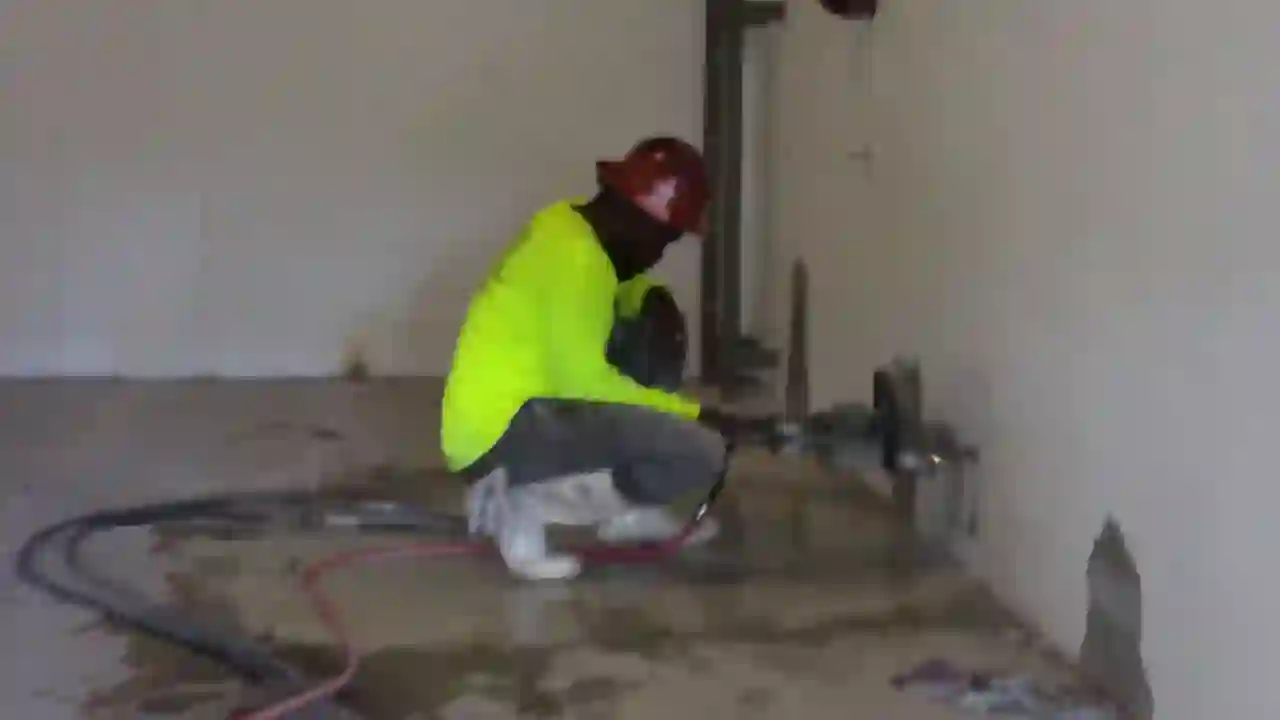
What this means operationally is that confined space concrete cutting jobs require a pre-mobilization site survey that’s as rigorous as the cutting plan itself. For projects in Miami where concrete slab sawing is needed in below-grade or restricted environments, the ventilation design, atmospheric monitoring protocol, and emergency egress plan must be finalized before equipment is ever loaded on a truck.
Overhead Clearance Restrictions That Dictate Equipment Selection Before Anything Else
One of the most common site logistics failures I see on aging concrete remediation projects is equipment selection happening before a thorough clearance survey. A standard flat saw for slab cutting requires approximately 36 to 48 inches of vertical clearance above the blade guard depending on the blade diameter and saw model. Wall saws mounted on track systems need lateral clearance for the drive unit and hydraulic power pack. In a parking garage with 7-foot deck-to-deck clearance and existing MEP systems hanging from the soffit, you may be working in an effective clearance envelope of 5.5 feet or less.
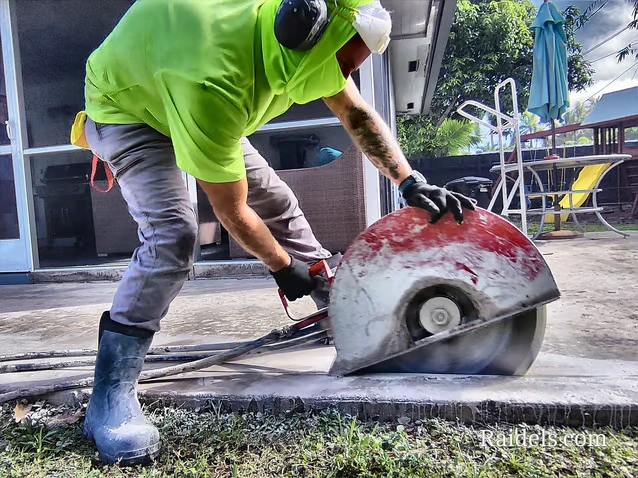
In those conditions, handheld cut-off saws with 14-inch blades become the primary cutting tool — not because they’re the most efficient choice for the volume of concrete being removed, but because they’re the only tool that physically fits. This directly impacts concrete saw cutting cost estimates, because handheld cutting at restricted depths requires more passes, more blade changes, and more labor hours to achieve the same linear footage that a flat saw could accomplish in a fraction of the time. Project managers who budget based on open-site productivity rates and then encounter a confined overhead environment routinely see cost overruns of 40 to 70 percent.
How Staging Logistics Accelerate Effective Concrete Deterioration Timelines
Here’s a dimension of concrete lifespan that rarely appears in engineering literature but shows up constantly in field work: concrete that cannot be properly maintained due to staging limitations deteriorates faster than concrete in accessible locations — even when the mix design and reinforcement are identical. When a parking structure’s lower level requires a complete lane closure, traffic control plan, and structural shoring installation just to get inspection equipment close enough to assess spalling, routine maintenance cycles get skipped. Deferred maintenance on chloride-contaminated concrete in Miami’s environment is not a neutral decision — it’s an accelerant.
This is particularly critical in structures near the coast or in low-lying areas where disaster relief and rapid structural assessment after storm events is required. If the access infrastructure to reach deteriorating concrete doesn’t exist, post-hurricane inspections get delayed, hidden damage goes undetected, and what could have been a targeted cutting and repair operation becomes a full structural replacement. The practical lifespan of concrete in these scenarios compresses not because of material failure but because of logistical failure.
Post-Tensioned Slabs in Confined Environments Demand a Completely Different Risk Protocol
Post-tensioned concrete introduces a cutting hazard that elevates confined space work from difficult to genuinely dangerous if the pre-cut investigation is incomplete. PT tendons under active stress — typically 33,000 to 54,000 pounds per tendon depending on the system — will release that energy catastrophically if a blade contacts an unidentified tendon. In an open environment, the release zone is dangerous but manageable with proper standoff distances. In a confined space, there is no standoff distance. The energy release in an enclosed volume is channeled directly into the space where workers are operating.
Ground-penetrating radar scanning at 1.5 GHz or higher frequency is mandatory before any cutting operation on a suspected PT slab in a confined environment. The scan data must be interpreted by someone with direct experience reading PT tendon signatures — not just rebar patterns — because the tendon profile, spacing, and drape geometry all affect where the blade path can be safely established. This pre-cut investigation phase adds time and cost to every confined space PT cutting project, but it is non-negotiable from both a safety and liability standpoint. For projects where sustainable building practices require selective demolition rather than full replacement, this precision scanning is what makes targeted cutting feasible at all.
When the Honest Answer Is That the Concrete Has Outlived Its Accessible Useful Life
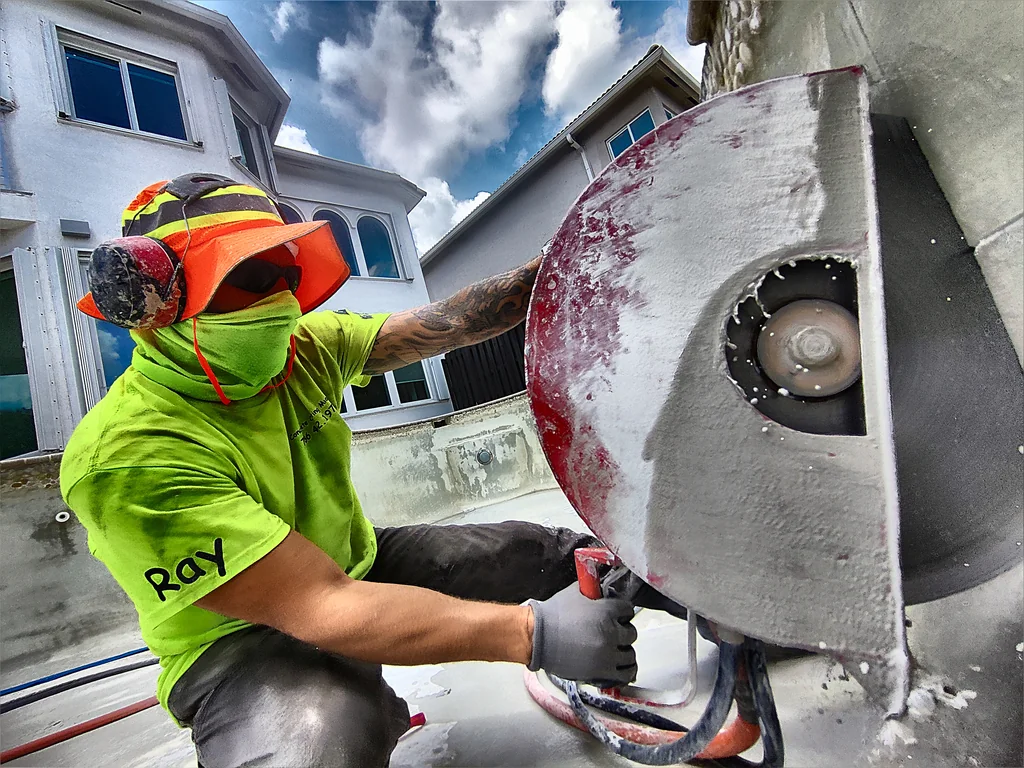
Experienced concrete cutting contractors in Miami have had this conversation with enough structural engineers and property owners to recognize the pattern: a structure that tests well on compressive strength cores, shows manageable chloride penetration depth, and has years of theoretical service life remaining — but sits in a configuration where every maintenance or remediation operation requires confined space permitting, specialized low-clearance equipment, extended staging logistics, and premium labor rates — has reached the end of its practical useful life even if it hasn’t reached the end of its structural useful life.
That’s not a failure of the material. It’s a failure of original design to account for the full lifecycle cost of access. And it’s a problem that’s becoming increasingly common as Miami’s building stock ages and urban density makes equipment staging more constrained than ever. The question of how long concrete lasts, answered honestly, is inseparable from the question of how accessible the concrete is for the work required to keep it performing. When those two answers diverge far enough, the most technically sound decision is often controlled demolition and replacement — executed with the same precision cutting methodology, confined space protocols, and site logistics planning that the maintenance work would have required anyway.
If you’re managing a structure where access limitations are already shaping your maintenance decisions, the time to bring in a specialized concrete cutting contractor for a site assessment is before the deterioration curve forces your hand. The earlier the logistics are mapped, the more options remain on the table.