Why Environmental Compliance Is the First Conversation Every Miami Slab Cutter Should Be Having
Walk onto any active slab cutting job in Miami-Dade County and you’ll notice something the untrained eye often misses — the water. Diamond blade flat sawing and slab cutting operations consume significant volumes of water for blade cooling and dust suppression, and every gallon of that water becomes contaminated the moment it contacts freshly cut concrete. That contaminated water, commonly called slurry, is a regulated waste stream under both federal Clean Water Act provisions and Miami-Dade County’s Department of Environmental Resources Management (DERM) guidelines. Slab cutters who don’t manage it correctly aren’t just creating a mess — they’re exposing their clients to fines, stop-work orders, and potential liability that can dwarf the cost of the original cutting contract. At Concrete Cutting Miami, LLC, environmental compliance isn’t an add-on service. It’s baked into every flat saw mobilization from the moment the blade hits the deck.
The Chemistry of Concrete Slurry and Why It Cannot Enter Storm Drains
Concrete slurry is not simply dirty water. When a diamond blade cuts through a Portland cement slab, it generates a highly alkaline suspension — typically measuring between pH 11 and pH 13 — loaded with fine calcium silicate particles, calcium hydroxide, and trace heavy metals that may be present in aggregate or rebar corrosion byproducts. The U.S. Environmental Protection Agency classifies concrete slurry as a high-pH pollutant capable of killing aquatic life in storm drainage canals and Biscayne Bay tributaries at concentrations that appear visually harmless to an untrained observer.
Miami’s flat, low-elevation topography means that uncontained slurry on a job site moves fast. A single flat saw cut on a parking garage deck or a residential pool deck can generate 15 to 40 gallons of slurry per linear foot depending on slab thickness, blade diameter, and aggregate hardness. On a 200-linear-foot utility trench cut through a 6-inch slab, you’re looking at potentially 3,000 to 8,000 gallons of regulated slurry that must be captured, neutralized, and disposed of through an approved pathway. That’s not a detail — that’s a project management discipline.
DERM Permit Triggers for Slab Cutting Operations in Miami-Dade
Many general contractors in Miami assume that a building permit covers everything happening on their site. It doesn’t. DERM maintains separate jurisdiction over any activity that generates process water with potential to discharge to ground, surface water, or the county storm sewer system. Slab cutting operations that meet any of the following criteria are routinely flagged during DERM inspections:
- Wet-method cutting within 100 feet of a storm drain inlet, swale, or canal — extremely common in Miami’s dense urban and suburban grid
- Slab cutting on impervious surfaces without demonstrated slurry containment — parking lots, driveways, and aprons are primary risk zones
- Cutting operations adjacent to environmentally sensitive areas — mangrove buffers, coastal construction control lines, and wellfield protection zones in western Miami-Dade
- Projects generating more than 500 gallons of process water per day — a threshold easily crossed on commercial slab demolition jobs
Understanding these triggers before mobilizing is part of what separates professional slab cutters from operators who simply own a flat saw. You can learn more about how compliance awareness affects overall project budgeting by reviewing our breakdown of cost-saving strategies for large-scale concrete cutting and demolition projects.

Slurry Containment Systems Used by Professional Slab Cutters in Miami
The physical infrastructure for slurry management on a Miami slab cutting job is not improvised. It is engineered for the specific site geometry, slab area, cut volume, and proximity to sensitive receptors. Here’s how a properly equipped crew approaches containment:
Berming and Perimeter Containment for Flat Saw Operations
Before a flat saw makes its first pass, the cutting area must be isolated using absorbent berms, inflatable drain blockers, or temporary earthen dikes depending on the surface type. On concrete or asphalt surfaces, quick-deploy foam berms are positioned around the cutting corridor and at all storm drain inlets within the slurry migration zone. These berms are rated for pH compatibility — standard sandbags are not appropriate because alkaline slurry can leach through and still reach sensitive receptors.
Vacuum Recovery Systems and Wet-Vac Staging
The most effective slurry management approach for precision slab cutting jobs is continuous vacuum recovery at the blade guard. Industrial wet vacuums with 50 to 100-gallon recovery tanks are staged immediately behind the flat saw, connected to the blade housing via a slurry hose. The operator cuts and the vacuum recovers simultaneously, preventing slurry from spreading beyond a 12-inch radius of the cut line. Recovered slurry is transferred to sealed poly tanks for transport and disposal. This method is particularly critical on high-end residential projects in Coral Gables where site aesthetics and neighbor relations are as important as regulatory compliance.
pH Neutralization Before Disposal
Recovered slurry with pH above 9.0 cannot be legally discharged to the sanitary sewer system in Miami-Dade County without prior neutralization. Professional slab cutting crews carry dry CO2 injection systems or citric acid neutralization agents to bring slurry pH into the acceptable range of 6.0 to 9.0 before any discharge. pH is verified with calibrated meters — not litmus strips — and the readings are logged for compliance documentation. This documentation becomes part of the project file and is available for DERM inspection at any time.
OSHA Silica Exposure Standards and Their Relationship to Wet Cutting Methods
Environmental compliance and worker safety are inseparable in the slab cutting trade. OSHA’s Table 1 under the Respirable Crystalline Silica Standard (29 CFR 1926.1153) mandates wet cutting methods as the primary engineering control for flat saw operations on concrete. Wet cutting suppresses airborne silica dust at the source — which is exactly the same process that generates slurry. This means that the water containment system a crew deploys for DERM compliance is simultaneously the primary silica exposure control required by OSHA standards. The two regulatory frameworks reinforce each other, and a crew that handles one correctly almost always handles the other correctly as well.
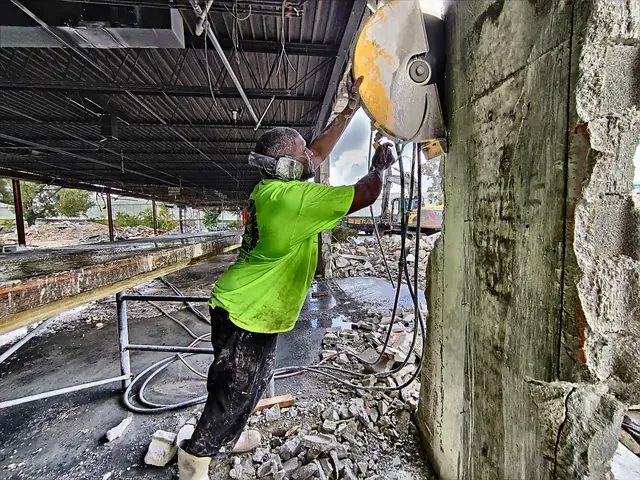
Operators on our slab cutting crews wear half-face respirators with P100/OV combination cartridges as a backup control even during wet cutting, and air monitoring is conducted on projects exceeding 4 hours of continuous cutting time. This isn’t overcaution — it’s the standard that serious concrete cutting contractors in Miami operate at.
Slab Cutting in Proximity to Miami’s Water Table and Karst Geology
South Florida’s geology adds a layer of environmental risk that slab cutters operating in other markets simply don’t face. Miami-Dade sits atop the Biscayne Aquifer, one of the most productive and most vulnerable freshwater aquifers in the United States. The Biscayne Aquifer is a sole-source aquifer designated by the EPA, meaning it is the only viable drinking water source for the region. The karst limestone that underlies most of Miami-Dade means that surface-applied contaminants — including high-pH concrete slurry — can migrate to groundwater through solution holes and fractures far faster than in areas underlain by clay or compacted soils.
This geological reality is why DERM enforces containment requirements that may seem aggressive compared to other Florida counties. Slab cutters who have operated in Broward or Palm Beach and assume Miami-Dade will be similar are often caught off guard by the specificity of local enforcement. Our crews are trained on Miami-Dade-specific protocols, and we document containment measures with time-stamped site photography on every job.
For projects involving wall penetrations or vertical concrete elements alongside slab work, our wall saw services apply the same containment discipline in vertical cutting configurations, where slurry management is even more technically demanding due to gravity-driven flow patterns.
What to Ask Any Slab Cutter Before They Mobilize to Your Miami Job Site
If you’re a general contractor, project manager, or property owner hiring slab cutting services in Miami, the following questions will immediately distinguish compliant professionals from operators who will leave you holding the liability:
- What is your slurry recovery method and what is your disposal pathway? — A legitimate answer names specific equipment and a licensed disposal facility or neutralization process.
- Do you carry DERM compliance documentation templates? — Professional crews should be able to produce site-specific containment plans, not just verbal assurances.
- What is your pH monitoring protocol? — The answer should reference calibrated meters and specific discharge thresholds, not visual inspection.
- How do you handle unexpected groundwater intrusion during slab cutting? — This is a real scenario in Miami’s shallow water table environment and requires a pre-planned response.
- Are your operators current on OSHA silica training? — Compliance with the silica standard and environmental compliance go hand in hand.
Pricing transparency matters here too. Understanding what you’re actually paying for — including the environmental compliance infrastructure — is essential. Our detailed breakdown of what Miami contractors really pay for reinforced concrete core drilling gives you a framework for evaluating bids that include proper compliance costs versus those that externalize that risk onto you.
The Real Cost of Non-Compliance for Miami Slab Cutting Jobs
DERM enforcement actions for improper slurry discharge in Miami-Dade County carry civil penalties starting at $1,000 per day per violation and can escalate to $10,000 per day for repeat or egregious violations. Stop-work orders issued during active construction phases can cost general contractors multiples of the original cutting contract in project delay costs. Beyond the financial exposure, contractors who receive DERM violations may face enhanced scrutiny on future permit applications — a long-term competitive disadvantage in Miami’s active construction market.
The slab cutters who protect your project are the ones who treat environmental compliance as a core technical competency, not a checkbox. At Concrete Cutting Miami, LLC, our flat saw crews arrive with containment systems already staged, pH meters calibrated, and disposal logistics confirmed before the blade spins. That’s what professional slab cutting in Miami actually looks like.