What actually happens when someone cuts into a concrete wall with the wrong tool — and why concrete wall cutting tools are chosen with more care than any other cutting equipment
A concrete wall is the most structurally consequential element in any building, and cutting into it with the wrong tool does not just produce a bad cut — it can compromise the wall’s load-bearing capacity, damage embedded utilities, and create an opening that must be repaired at significant expense before the intended modification can even begin. Concrete wall cutting tools are selected based on a set of considerations that do not apply to any other type of concrete cutting: the wall thickness, whether the wall is structural or non-structural, the rebar density and pattern, the presence of post-tension cables, the cut geometry requirements (is the opening for a door with tight frame tolerances or a utility penetration where the edge quality matters less), access on one or both sides of the wall, and whether the cut must be straight and plumb to within engineering tolerances or can be rougher and trimmed later. Every one of these considerations affects which concrete wall cutting tool is appropriate for the job.
 Concrete Cutting Miami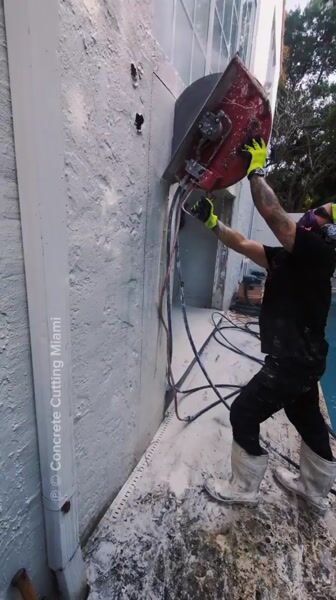
In Miami, concrete wall cutting tools are deployed in a construction environment where concrete walls are the dominant building element — concrete block walls in residential construction, poured-in-place concrete walls in commercial and multi-family buildings, tilt-up concrete panels in industrial and retail construction, and heavily reinforced structural walls in high-rise cores and parking garages. A concrete cutting contractor serving the Miami market must own or have reliable access to the full range of concrete wall cutting tools — from handheld saws for small access cuts to hydraulic track saws for major structural openings to wire saws for the thickest walls. A contractor who only owns a gas cutoff saw cannot cut a professional-quality door opening through a reinforced wall, and a contractor who claims they can is going to produce an opening that causes problems for the door frame installer, the drywall finisher, and ultimately the property owner who has to live with the result.

The primary concrete wall cutting tools and what wall conditions each one is designed for
Hydraulic wall saw with track system
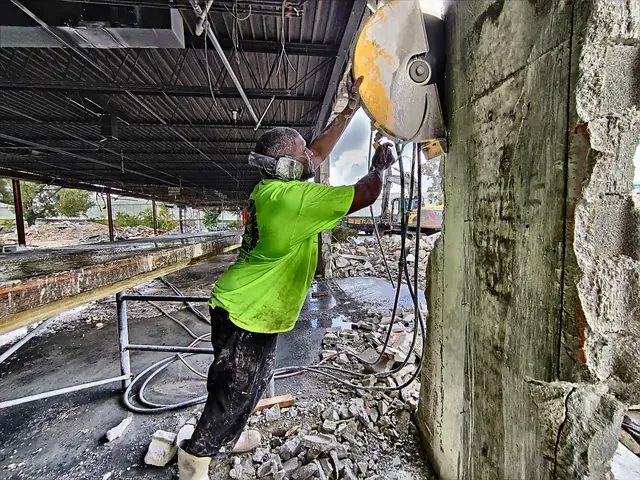
The hydraulic wall saw mounted on a track system is the definitive concrete wall cutting tool — the standard against which all other wall cutting methods are measured. The track is attached to the wall using vacuum anchors or mechanical fasteners. The saw head — carrying a diamond blade that can range from 18 inches to 48 inches or more in diameter — travels along the track on a geared drive. The blade cuts into the wall at a controlled depth per pass, and for walls thicker than the blade’s single-pass maximum, multiple passes with increasing depth complete the cut. The track system provides mechanical guidance that a handheld saw cannot replicate — the cut is straight within a fraction of an inch over the full track length, and the cut face is plumb, perpendicular to the wall surface. This precision is essential when the opening must receive a door frame, window frame, or other element with tight installation tolerances.
The hydraulic wall saw is the concrete wall cutting tool used for creating new door openings through concrete walls, cutting window openings in building facades, making large mechanical penetrations for ductwork and equipment, sectioning walls for selective demolition, and any wall cut where straightness and plumbness are non-negotiable. The saw head is powered by a remote hydraulic power unit — typically diesel or electric — connected by high-pressure hoses. The power unit can be located at a distance from the cutting area, which is advantageous in occupied buildings where exhaust and noise must be managed. Wall sawing with a track system is the service that separates professional concrete cutting contractors from generalists who own a circular saw and a diamond blade.
Wire saw
The wire saw is a specialized concrete wall cutting tool for walls that exceed the practical cutting capacity of circular blade saws. When a wall is 18 inches thick, 24 inches thick, or more, making multiple passes with a wall saw becomes slow and blade consumption becomes expensive. A wire saw cuts through the entire wall thickness in a single continuous operation. A small core hole is drilled through the wall. The diamond wire is threaded through the hole and connected to the drive unit, which tensions the wire and pulls it through the concrete. The wire cuts through the full wall thickness regardless of how thick the wall is — 12 inches, 36 inches, or 60 inches, the wire cuts it all. Wire sawing is the concrete wall cutting tool for massive walls — concrete vaults, thick foundation walls, bridge abutments, and retaining walls where circular blade capacity is exceeded.
Handheld concrete saws for wall cutting
Handheld concrete saws — gas cutoff saws, electric hand saws, and hydraulic hand saws — are concrete wall cutting tools for smaller openings, tight access conditions, and finishing work. A hand saw can cut a small utility penetration through a wall faster than setting up a track system. It can make cuts in confined spaces where a track cannot be mounted. It can finish the corner overcuts left by a circular wall saw blade, squaring the corners of a rectangular opening. Hand sawing is slower per linear foot than a track-mounted saw and produces a cut that is not as straight or plumb — the operator’s hand and eye provide the guidance, not a mechanical track. For non-structural cuts and cuts where the edge quality is less critical, hand sawing is a valid and cost-effective concrete wall cutting method. For structural openings that must meet precise tolerances, the track-mounted wall saw is the correct tool.
Stitch drilling for wall openings
Stitch drilling is a wall cutting method that uses a core drilling rig rather than a saw. A series of overlapping core holes is drilled around the perimeter of the desired opening. The individual cores remove most of the concrete, and the remaining webs between holes are broken out. Stitch drilling produces an opening with rounded corners and a relatively smooth edge, though not as smooth as a wall saw cut. It is used when a track-mounted wall saw cannot be set up due to access constraints — for example, an opening in a corner where the walls meet and there is no flat surface on either side to mount a track. Stitch drilling is slower than wall sawing for large openings, but it works in situations where no other concrete wall cutting tool can reach.

How concrete wall cutting tools are chosen for a specific project
Selecting the right concrete wall cutting tools for a project involves answering a series of questions about the wall and the cut requirements. The answers lead to a tool choice that is appropriate for the specific conditions.
- Wall thickness: Thin walls (4-6 inches) can be cut with handheld saws or small track-mounted saws. Medium walls (6-12 inches) are standard wall saw territory — a track saw with incremental passes handles these efficiently. Thick walls (16 inches and above) may benefit from wire sawing instead of repeated wall saw passes.
- Reinforcement density: Lightly reinforced walls with wire mesh or widely spaced rebar cut faster and with less blade wear. Heavily reinforced walls with #5 or #6 rebar at close spacing require more saw power and blade consumption, which may favor hydraulic equipment over electric or gas.
- Structural status: If the wall is load-bearing or a shear wall, the cutting method must not damage the concrete beyond the cut line. A track-mounted wall saw produces the cleanest, most controlled cut and is the appropriate tool for structural wall modifications.
- Cut geometry: Straight line cuts are standard wall saw work. Openings with corners require corner finishing — either with a smaller hand saw to square the overcuts, or by stitch drilling the corners to the desired radius. Irregular openings may require a combination of methods.
- Access: Track-mounted wall saws require clear wall surface area on at least one side for track mounting. If the wall is obstructed — adjacent walls, ceilings, equipment — a track cannot be mounted and hand sawing or stitch drilling become the methods of choice.
- Finish requirements: An opening that will receive a door frame needs a straight, plumb cut with clean edges. An opening that will be covered by trim or that serves as a utility chase has less demanding finish requirements, which may allow hand sawing where wall sawing would otherwise be specified.
The cost relationship between concrete wall cutting tools and project cost
The concrete wall cutting tools used on a project directly affect the project cost through cutting speed, setup time, and blade consumption. A track-mounted hydraulic wall saw costs more to mobilize than a handheld gas saw — the track system must be mounted and aligned, the power unit must be positioned and connected, and the saw head must be set up on the track. But the wall saw cuts faster per linear foot, produces a cut that requires minimal finishing, and can cut walls that a hand saw cannot cut at all. The higher mobilization cost is offset by higher productivity and superior results on cuts that demand precision. The right concrete wall cutting tool for your project is the one that produces the required cut quality at the lowest total project cost — not the one with the lowest hourly rate or the lowest mobilization charge. Miami wall cutting projects benefit from a contractor who owns the full range of tools and selects the right one based on the wall conditions, not based on which tool is easiest to bring. Contact us to discuss your wall cutting project and receive a recommendation based on the specific wall conditions at your property.