Concrete will crack — the only question is whether the crack follows a line you chose or a line the concrete chooses for itself
Concrete is strong in compression and surprisingly weak in tension — roughly 10% of its compressive strength. When forces pull concrete apart — from shrinkage during curing, from temperature swings, from settlement, from structural loads — it cracks at the weakest point along the stress path. A control joint is a deliberate weak point: a partial-depth cut that creates a vertical plane where cracking is encouraged to occur. When the concrete inevitably shrinks and stresses develop, the crack follows the bottom of the saw cut — neatly, in a straight line, invisible from the surface except as the joint itself. Without control joints, the same shrinkage stress creates a random crack that zigzags across the slab wherever the concrete happens to be weakest. One of those outcomes is aesthetic and functional. The other is a trip hazard, a water intrusion path, and a surface that looks like it is failing even when it is structurally sound. Every cut in a concrete structure exists for a reason — and understanding those reasons is how you tell good concrete work from concrete that was poured without a plan.
Control joints — the most common cut in concrete and the one most frequently done wrong
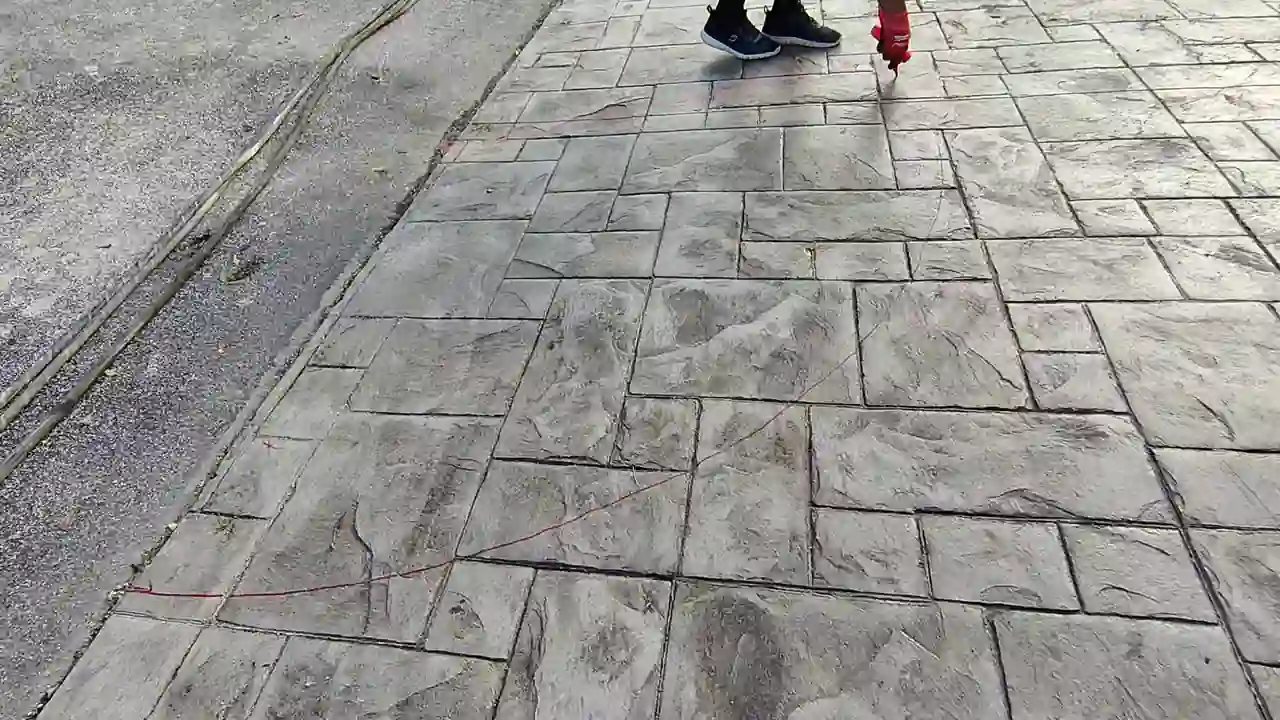
Control joints — also called contraction joints — are the straight lines you see in concrete driveways, sidewalks, patios, and floors. They are cut into the concrete while it is still green, typically 4-12 hours after placement, using an early-entry saw or a conventional flat saw. The joint is cut to a depth of one-quarter to one-third the slab thickness. This creates a reduced cross-section that concentrates shrinkage stress at the bottom of the cut, encouraging the crack to form there rather than randomly on the surface.
The rules that govern control joint layout are straightforward but frequently ignored by contractors trying to save time:
- Joint spacing — The maximum distance between control joints in feet should be roughly 2-3 times the slab thickness in inches. A 4-inch residential slab needs joints every 8-12 feet. A 6-inch commercial slab can go 12-18 feet between joints. Wider spacing guarantees random cracks between the joints.
- Panel shape — The concrete panel between joints should be as close to square as possible. Long, narrow panels (length more than 1.5 times width) are crack-prone because shrinkage stress accumulates along the long axis with no joint to relieve it.
- Inside corners — Any re-entrant corner in a slab — around a column, at an L-shaped section, where a wall protrudes — concentrates stress. A control joint should extend from that corner into the slab to prevent a diagonal crack from forming.
- Timing — Cut too early and the concrete ravels (aggregate pulls out along the cut edges). Cut too late and the crack has already formed somewhere else. The window is typically 4-12 hours after placement in Miami’s climate, but hot weather accelerates curing and may require earlier cutting.
For more on the cutting methods used to create control joints, see our slab sawing services page.
” alt=”Close-up of control joints cut into concrete slab showing crack formation at bottom of saw cut in Miami driveway” style=”max-width:100%;height:auto;”/>
Expansion joints — different from control joints and functionally critical in Miami’s climate
Expansion joints — properly called isolation joints — are full-depth separations between a concrete slab and an adjacent structure: a building wall, a column, another slab, a pool deck, or a sidewalk abutting a foundation. Unlike control joints that encourage controlled cracking within a slab, isolation joints completely separate two concrete elements so they can move independently.
This matters in Miami because of thermal expansion. A 50-foot concrete slab in South Florida can expand by roughly 1/4 to 3/8 of an inch between a cool January morning (50 degrees F) and an August afternoon with the sun beating directly on it (surface temperature 130+ degrees F). If that slab is poured tight against a building foundation without an isolation joint, the expansion pushes against the foundation — and something has to give. Usually it is the slab, which spalls at the interface or cracks. Sometimes it is the building element, especially if it is masonry.
Isolation joints are filled with compressible material — fiberboard, foam backer rod, or elastomeric sealant — that absorbs the expansion movement. The joint material must be flexible enough to compress without transferring load and durable enough to survive Miami’s UV exposure and rain without degrading. A properly designed isolation joint is invisible to the property owner because it is doing its job: the two concrete elements are separated, they move independently, and nothing cracks. Our services page covers how we cut and prepare isolation joints on new and existing slabs.
Demolition cuts — why concrete is cut before it is broken during removal
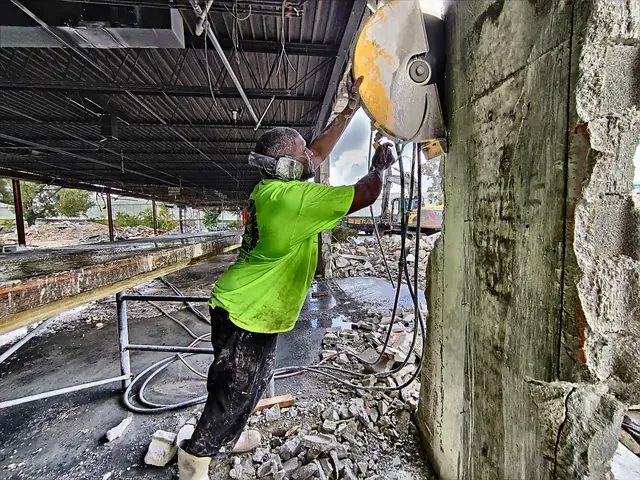
Watch a demolition crew remove a concrete slab and you will notice they cut first, break second. The cutting step — called sectioning — serves multiple purposes that make the entire removal faster, safer, and cleaner:
- Clean separation at the cut line — A full-depth saw cut creates a clean edge where the slab to be removed meets the slab that stays. Without that cut, the breaker’s impact force transmits into the adjacent concrete and causes spalling, cracking, and damage beyond the intended removal area.
- Manageable debris size — A full slab broken randomly produces irregular chunks that are hard to load and inefficient to haul. A slab cut into 4-foot by 4-foot sections before breaking produces rectangular pieces that stack in the truck and maximize the debris weight per load.
- Reinforcement control — Cutting through the rebar at section boundaries allows each section to be removed independently. If the rebar is continuous across sections, breaking one section pulls on the adjacent concrete through the rebar, causing unintended damage.
- Utility protection — Cutting around utility penetrations, drains, and sleeves before breaking allows the breaker to work without risking impact damage to pipes and conduits that need to stay intact.
On projects combining cutting and demolition, see our demolition services page for how these methods work together on concrete removal jobs across Miami-Dade.
Structural cuts — when concrete is cut to change how a building works, not because it is failing
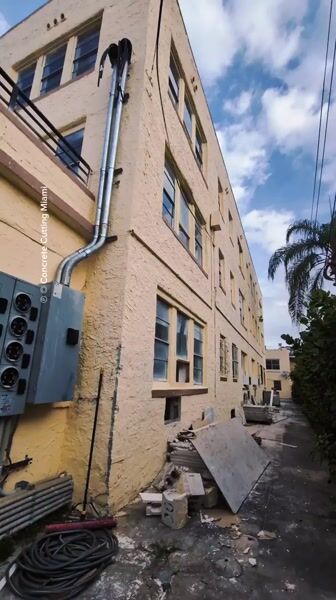
Not every cut in concrete is about cracking control or demolition. Many cuts are functional modifications to an existing structure — creating new openings for doors and windows, adding pipe and duct penetrations, installing new staircases or elevators. These cuts are fundamentally different from control joints and demolition sectioning because they affect how the structure carries load.
Structural cutting requires answers to questions that control joints never raise:
- Is the element load-bearing? Cutting into a column, shear wall, or beam that carries structural load reduces its capacity. The remaining cross-section must be adequate to carry the design loads — including Miami-Dade’s hurricane wind loads — or the structure must be temporarily shored and permanently reinforced.
- Are there post-tension cables in the cut zone? PT cables are under enormous tension. Cutting one releases that tension explosively and compromises the structural integrity of the entire slab or beam. GPR scanning before cutting is mandatory, not optional, on any PT structure.
- What is the load path around the new opening? Creating an opening changes how loads travel through the structure. The load that was carried by the removed concrete must find a new path — through headers, lintels, or redistribution to adjacent elements — or the structure is overloaded.
- Does the cut affect the lateral force-resisting system? In Miami, hurricane wind loads govern structural design. Cutting into a shear wall or diaphragm reduces the building’s capacity to resist lateral forces. Engineering analysis must confirm the modified structure still meets wind load requirements.
For precision cutting methods used on structural modifications, our hydraulic chain saw page and core drilling page cover the equipment and techniques for structural cutting work.
Miami-specific reasons concrete gets cut that do not apply elsewhere
South Florida’s climate and geology create cutting needs that contractors from other regions may not anticipate:
- Drainage retrofits — Miami’s flat terrain and high water table mean drainage problems are common. Cutting trenches in existing slabs for French drains, channel drains, and sump pump installations is a frequent request, especially after wet seasons that reveal ponding issues.
- Hurricane hardening — Building code updates and insurance requirements drive structural modifications: cutting openings for impact-rated windows and doors in existing concrete walls, adding hold-down anchor points for hurricane straps, and installing new shear wall connections.
- Saltwater corrosion repairs — Coastal concrete structures experience rebar corrosion from salt spray and salt-laden groundwater. When spalled concrete is removed for repair, the perimeter is saw-cut to create clean edges for patching — a partial-depth cut that separates the damaged zone from sound concrete.
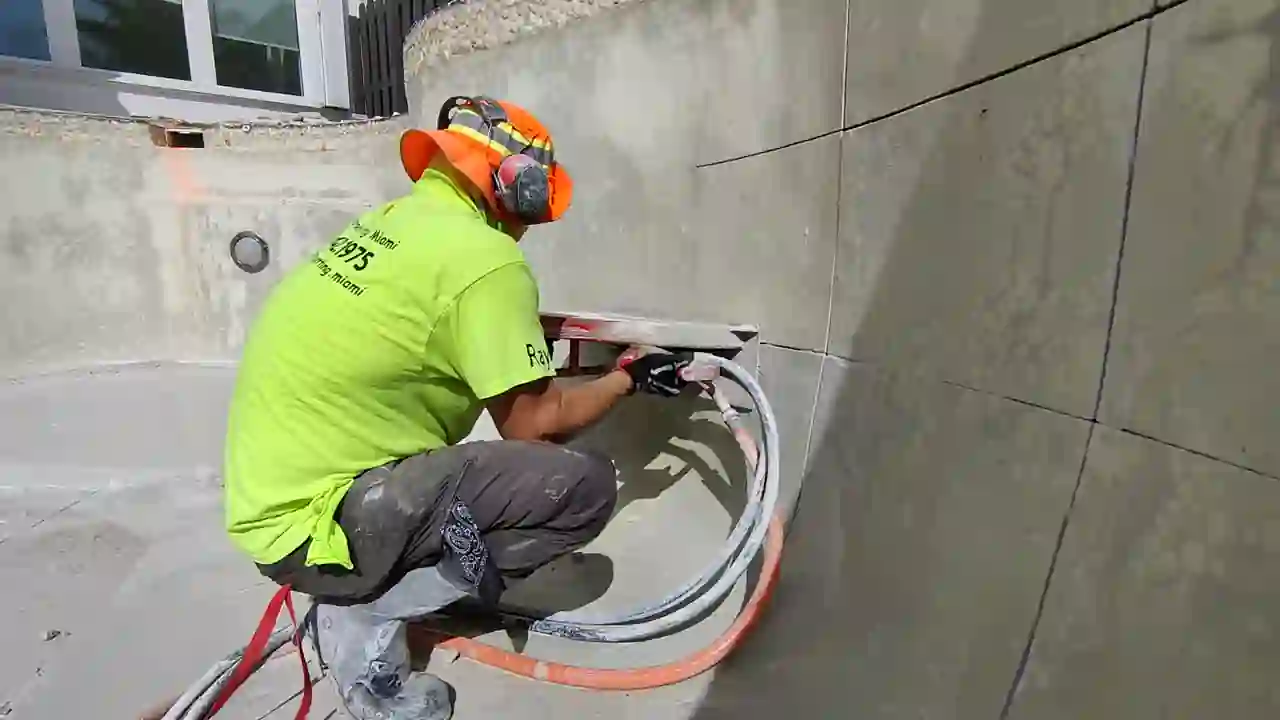
- Pool deck integration — Miami has tens of thousands of in-ground pools, and pool deck concrete moves differently than the pool shell. Cutting isolation joints between deck and coping, and cutting control joints in the deck itself, prevents the cracking that is otherwise inevitable as the deck expands and contracts.
For any concrete cutting need in South Florida, contact us through our contact page with your project details. We cover Miami-Dade, Broward, and the Florida Keys — see our Miami service area and Ft. Lauderdale service area pages for coverage information.
” alt=”Concrete saw cutting demolition section lines in Miami parking lot slab before removal and replacement” style=”max-width:100%;height:auto;”/>