The Chipping Hammer Is Not a Backup Tool — It Is the Primary Tool When Space Runs Out
There is a persistent misconception on job sites that a chipping hammer is what you grab when nothing else is available. That framing gets it completely backwards. In reality, the chipping hammer is a precision instrument deployed deliberately by specific trades in specific site conditions — particularly when access limitations, overhead clearances, confined space classifications, and structural proximity make rotary saws, wall saws, or even angle grinders operationally impossible. Understanding who is most likely to use a chipping hammer means understanding the intersection of trade specialization, site logistics, and the physical geometry of the work environment itself.
Mechanical and Plumbing Contractors Working Below Grade in Miami’s Slab-on-Grade Infrastructure
In South Florida, the dominant residential and light commercial construction method is slab-on-grade. When a plumbing contractor needs to reroute a drain line, add a cleanout, or correct a failed trap configuration, they are almost always working directly against a concrete floor with zero vertical clearance below and active living space or mechanical equipment above. A chipping hammer — typically an SDS-Max rotary hammer set to chisel-only mode, or a dedicated electric demolition hammer in the 10–15 joule impact energy range — is the only tool that allows the plumber to selectively break out a defined trench channel without generating the blade travel distance that a cut-off saw demands.
The access limitation here is not just about physical room. It is about dust containment, vibration transmission to adjacent finishes, and the ability to work in a corridor or bathroom with a footprint of less than 40 square feet. Chipping hammers in this context are used by plumbing crews, mechanical rough-in contractors, and HVAC installers who need to penetrate slabs for condensate drain routing or refrigerant line sleeve placement. These are not demolition specialists — but they are among the most consistent users of chipping hammers on active construction sites in Miami-Dade County.
Confined Space Demolition Teams Facing OSHA Classification Triggers and Atmospheric Monitoring Requirements
The moment a work area meets OSHA’s definition of a permit-required confined space — limited means of entry and exit, not designed for continuous occupancy, and a recognized hazard potential — the entire equipment selection calculus changes. Gas-powered saws introduce carbon monoxide accumulation risk. High-amperage electric tools may require ground fault protection that isn’t available in a utility vault or below-grade mechanical room. Hydraulic systems introduce fluid leak hazards in enclosed atmospheres.
The chipping hammer, particularly a battery-powered demolition hammer or a pneumatic chipper fed by an external compressor, threads this needle cleanly. Confined space demolition specialists — crews who work inside elevator pits, pump stations, wet wells, underground parking structures, and below-grade utility corridors — use chipping hammers as their primary concrete removal tool precisely because the tool’s operational profile is compatible with confined space safety protocols. The operator controls the direction and depth of material removal without needing blade clearance arcs or water slurry management systems that complicate egress and atmospheric conditions.
From a site logistics standpoint, the chipping hammer also allows the crew to stage their work without large equipment mobilization. There is no saw cart, no water supply line, no vacuum shroud system to move through a 30-inch access hatch. The tool goes where the worker goes, and in confined space work, that portability is not a convenience — it is a safety-critical operational requirement. Crews operating in these environments must also be current on job site safety and OSHA compliance standards that govern both the confined space entry procedures and the tool selection criteria that apply inside those spaces.
Structural Repair Specialists Targeting Spalled Cover Concrete Without Disturbing Reinforcement
Concrete repair contractors — particularly those working on parking structures, bridge soffits, seawall caps, and balcony decks — use chipping hammers as their primary removal tool because the work requires selective demolition to a specific depth. The goal is to remove carbonated, chloride-contaminated, or spalled cover concrete down to sound substrate and exposed rebar without cutting, nicking, or otherwise damaging the reinforcing steel beneath.
A diamond blade saw cannot make that distinction. A grinder removes material uniformly without regard to the delamination plane. The chipping hammer, operated by an experienced hand, follows the failure plane in the concrete — the operator feels the change in resistance as the chisel tip transitions from deteriorated material to sound concrete, and adjusts accordingly. This is skilled work, and the practitioners are structural repair specialists, waterproofing contractors, and restoration crews who understand concrete pathology at a level that general demolition crews do not.
In Miami, where chloride-induced corrosion from marine exposure is the dominant concrete degradation mechanism, this type of selective chipping work is extremely common. Seawall restoration, parking garage column repair, and balcony soffit patching all require this level of precision. These contractors also frequently encounter crack repair scenarios where the chipping hammer is used to rout and widen cracks to a consistent geometry before injection or routing-and-sealing repair methods are applied.
Demolition Laborers Performing Secondary Breakout After Primary Saw Cuts in Access-Restricted Interiors
Even when a diamond wall saw or floor saw performs the primary cutting operation, the chipping hammer is almost always the tool that completes the work. Once a saw has defined the perimeter of a knockout or opening, the remaining concrete panel must be broken free from the substrate and removed. In a basement mechanical room, a stairwell landing, or a narrow corridor in an occupied building, a hydraulic breaker or pneumatic jackhammer may be too large, too loud, or too vibration-intensive for the environment.
The chipping hammer fills that secondary breakout role consistently. Demolition laborers on commercial interior renovation projects — office retrofits, hospital mechanical upgrades, hotel renovation projects — use chipping hammers as the final-stage tool that clears the opening after the saw crew has completed their cuts. The site logistics here are driven by noise ordinances, vibration limits imposed by building engineers to protect adjacent occupied spaces, and the physical constraint of working in corridors and rooms where a full-size breaker cannot be maneuvered safely.
This is also where tool selection intersects with environmental compliance. In Miami-Dade County, contractors working on interior demolition in occupied or partially occupied structures must manage silica dust exposure under OSHA’s Table 1 requirements. Understanding cutting charges and environmental compliance in Miami is not optional — and chipping hammer operators must use either water suppression at the chisel tip or a HEPA-equipped vacuum shroud system to maintain compliant silica exposure levels during breakout operations.
Pool Demolition and Removal Crews Dealing With Gunite and Shotcrete Geometry That Defeats Flat Saws
Pool shells present a unique access challenge. The curved geometry of a gunite or shotcrete shell, combined with the varying wall thickness that results from the spray-application process, means that a flat floor saw or wall saw cannot efficiently cut along the shell’s contour. Pool demolition crews — particularly those performing full removals or partial fills that require breaking the shell for drainage compliance — rely heavily on chipping hammers and hydraulic breakers to work around the shell geometry.
In partial-fill scenarios, where the shell must be perforated at the base to allow groundwater drainage before backfill, the chipping hammer is the preferred tool for creating those drainage perforations without over-demolishing the surrounding shell structure. Filled-in pool problems that destroy blades are a real operational hazard, and experienced pool demolition contractors use chipping hammers specifically to avoid the blade damage that occurs when a saw encounters rebar-dense gunite at unpredictable angles.
Pneumatic Versus Electric Chipping Hammers in Confined and Access-Limited Environments
The choice between pneumatic and electric chipping hammers is itself a site logistics decision. Pneumatic chippers require an external compressor, which means the compressor must be positioned outside the confined space or access-restricted area and the air hose routed to the operator. This creates a trip hazard and a potential egress obstruction in confined space scenarios, but it eliminates the electrical hazard and reduces the tool weight the operator carries.
Electric SDS-Max demolition hammers in the 1100–1500 watt range offer 8–12 joules of impact energy — sufficient for most concrete removal work in the 3,000–5,000 PSI range that characterizes residential and light commercial construction in Miami. Battery-powered variants in the 36V or 80V class now approach the performance of corded tools and eliminate both the compressor logistics and the cord management problem entirely. For confined space teams, battery-powered chipping hammers represent a genuine operational improvement that reduces hazard exposure and simplifies the entry and egress procedure.
The Site Geometry Determines the Tool — Not the Other Way Around
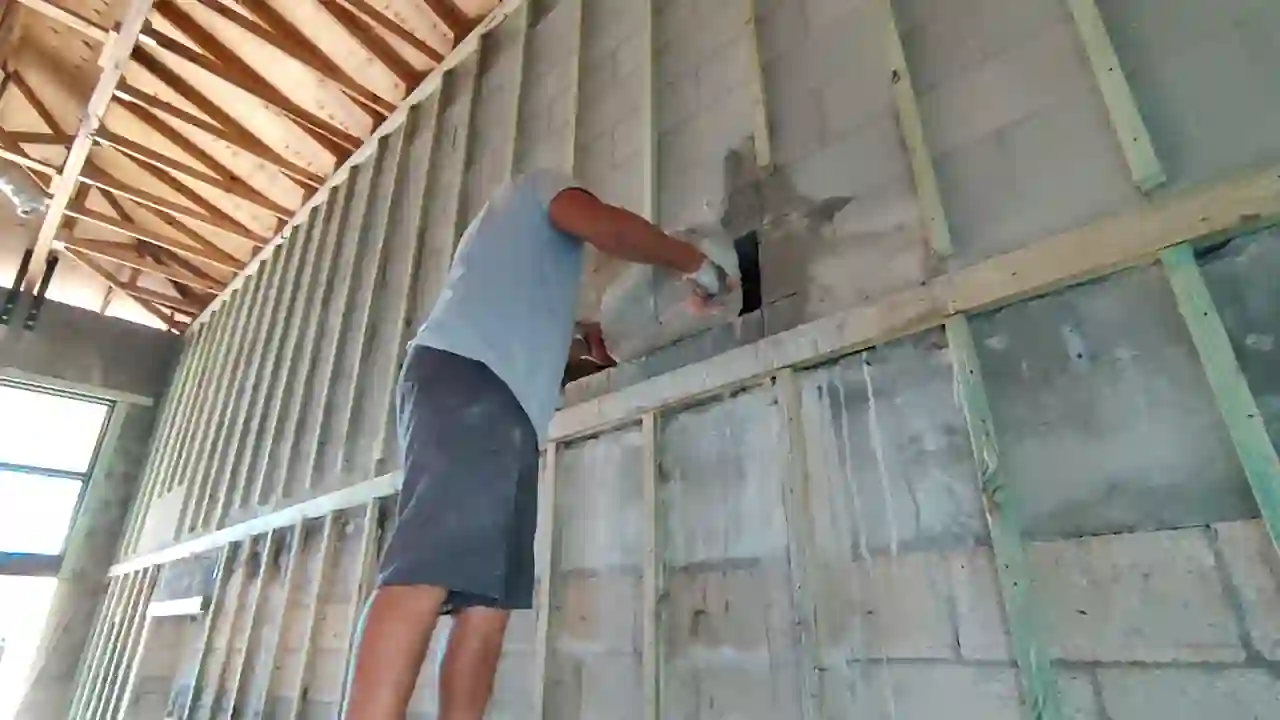
Across all of these use cases — plumbing and mechanical contractors working below grade, confined space demolition specialists, structural repair crews, interior demolition laborers, and pool removal teams — the common thread is that the chipping hammer was selected because the site geometry made every other option impractical. The tool did not define the work. The work defined the tool.
For concrete cutting and demolition contractors operating in Miami, recognizing which site conditions trigger chipping hammer deployment is a core competency. It means faster mobilization decisions, more accurate labor hour estimates, and better safety outcomes in the confined and access-limited environments that are a daily reality in South Florida’s dense urban and suburban construction landscape. When the space gets tight and the clearances disappear, the chipping hammer is not a fallback — it is the answer the site was always going to demand.