Why Equipment Specifications Define Every Concrete Chipping Outcome Before the First Strike
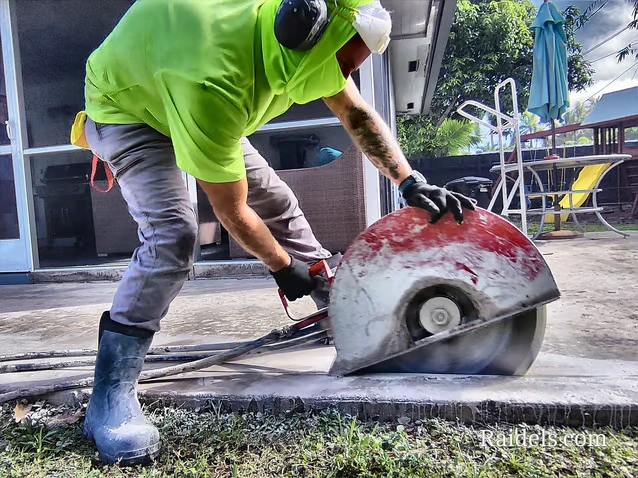
When you type “concrete chipping service near me” into a search bar, you’re not just looking for a body to show up with a hammer. You’re — whether you realize it or not — searching for a calibrated system of mechanical force, tooling metallurgy, and operational precision that either preserves your structure or compromises it permanently. Every concrete chipping project, from surface preparation in a Miami garage to spall repair on a commercial loading dock, lives or dies on three variables: the drive mechanism’s impact energy rating, the geometry of the chisel or bit engaged with the substrate, and the hardness bond of any diamond tooling involved. Get one of those wrong, and you’re looking at micro-fracturing that propagates beyond your removal zone, rebar exposure you didn’t plan for, and substrate delamination that turns a $1,200 repair into a $9,000 structural remediation.
Impact Energy Ratings and What They Mean for Your Specific Slab Specification
Professional concrete chipping equipment is rated in joules of impact energy — not amps, not horsepower, not “commercial grade.” The joule rating tells you how much kinetic force is delivered per blow at the tool face, and matching that rating to your concrete’s compressive strength (measured in PSI) is non-negotiable. Here’s how the tiers break down in actual field application:
- 2–5 joules (light rotary hammers): Appropriate for surface chipping on 2,500–3,000 PSI decorative slabs, tile removal prep work, and shallow spall correction no deeper than 1.5 inches. SDS-Plus bit shanks dominate this range.
- 8–12 joules (mid-range demolition hammers): The workhorse category for residential concrete chipping in Miami. Handles 3,000–4,500 PSI flatwork, driveway edge demolition, and pool deck removal in controlled sections. SDS-Max shank required at this energy level.
- 15–30 joules (heavy demolition hammers and breakers): Reserved for post-tensioned slabs, high-strength industrial floors rated above 5,000 PSI, and any application where depth exceeds 4 inches. Hex shank tooling or spline-drive chisels are mandatory here.
- 30+ joules (hydraulic breakers and electric chipping guns): Commercial and infrastructure-grade applications. Loading dock pit work, bridge deck delamination removal, and mass concrete reduction. This equipment requires operator certification and vibration exposure monitoring per OSHA 1926.302.
The critical mistake contractors make — especially in the South Florida market — is using a 30-joule breaker on a 3,500 PSI residential driveway because “it’s faster.” Faster, yes. Controlled, absolutely not. The transmitted shock wave propagates laterally through the aggregate matrix and fractures the slab 6 to 18 inches beyond the intended removal boundary. If you’re managing a loading dock pit cutting expansion, that energy mismatch can compromise the surrounding floor’s load-bearing integrity entirely.
Chisel Geometry and Point Configuration for Different Concrete Removal Scenarios
The chisel is not a generic component. Every geometry performs a distinct mechanical function inside the concrete matrix, and selecting the wrong profile wastes time, accelerates tooling wear, and risks uncontrolled fracture propagation. Here’s the technical breakdown of the four primary chisel configurations used in professional concrete chipping services:
- Pointed chisel (bull point): Maximum penetration depth with concentrated force. Used for initial fracture initiation in thick slabs. Not appropriate for surface-flush chipping — the point drives force downward and outward, creating cone fractures beneath the surface.
- Flat chisel (scaling chisel): Horizontal force distribution across a wide face. The correct tool for surface prep, delamination removal, and shallow chipping where the goal is to remove a defined layer without disturbing the substrate below. Widths range from 40mm to 100mm depending on application.
- Narrow chisel (trenching chisel): Elongated flat profile for slot cutting and groove work. Commonly used in Miami residential renovation projects where control joints need to be widened or utility trenches opened through existing slabs. See related work at residential renovation Miami.
- Spade chisel (clay spade): Wide, flat, and slightly curved. Designed for surface scaling and paint/coating removal from concrete. Not a structural chipping tool — misuse on structural concrete causes surface tearing rather than clean removal.
Carbide Grade Selection for Chisel Tip Metallurgy
The tungsten carbide grade embedded in the chisel tip determines how many linear feet of concrete the tool survives before losing geometry and requiring replacement. In South Florida, where aggregate often includes coral rock, Miami limestone, and recycled concrete with embedded rebar fragments, standard K10 carbide grade wears prematurely. Professional chipping services operating in this market should be running K20 or K30 carbide grades — coarser grain structures that sacrifice some hardness for dramatically improved toughness and impact resistance. If your contractor can’t tell you the carbide grade of their tooling, that’s a red flag worth acting on before the job starts. For more on how tooling selection affects the entire removal process, review our detailed breakdown at picking the right blades and machines.
Diamond Tooling Specifications When Chipping Transitions to Grinding or Saw-Assisted Removal
Many concrete chipping projects in Miami require hybrid methodology — mechanical chipping to fracture and remove bulk material, followed by diamond grinding or saw cutting to achieve a clean, dimensionally accurate finish surface. This is where diamond tooling bond hardness becomes the defining technical variable.
Diamond segments are held in a metal bond matrix, and that bond’s hardness must be inverse to the concrete’s abrasiveness. The rule is counterintuitive to non-specialists: hard concrete requires a soft bond matrix; soft concrete requires a hard bond matrix. Here’s why this matters in practice:
- Hard concrete (5,000+ PSI, low water-cement ratio) wears the bond matrix slowly. A soft bond releases spent diamonds quickly, continuously exposing fresh cutting diamonds. A hard bond on hard concrete glazes over — the diamonds wear flat and the tool stops cutting.
- Soft concrete (2,500–3,500 PSI, high aggregate content) wears the bond matrix aggressively. A hard bond resists this wear and maintains diamond exposure for the full tool life. A soft bond on soft concrete erodes too fast, destroying the segment geometry prematurely.
Diamond Concentration Ratings for Chipping-Adjacent Grinding Applications
Diamond concentration in a segment is expressed as a number from 25 to 100, representing carats of diamond per cubic centimeter of bond matrix. For surface prep work following chipping operations — particularly in Ft. Lauderdale construction environments with hard aggregate — a concentration of 40–50 is standard for cup wheels and grinding plates. Higher concentrations (60–75) are used when cutting speed matters more than tool longevity, such as in time-sensitive commercial projects. Lower concentrations (25–35) are appropriate for aggressive material removal on softer substrates where each diamond needs more working space.
Segment height also matters. A 10mm segment height on a grinding cup wheel gives you roughly 60–80 hours of operational life under normal Miami field conditions. A 7mm segment on the same tool saves $15 at purchase and costs you a tool replacement mid-project. Professional concrete chipping services running proper maintenance protocols — documented at our maintenance resource hub — track segment wear and replace tooling before geometry loss affects cut quality.
Slurry Management Requirements When Diamond Tooling Enters the Workflow
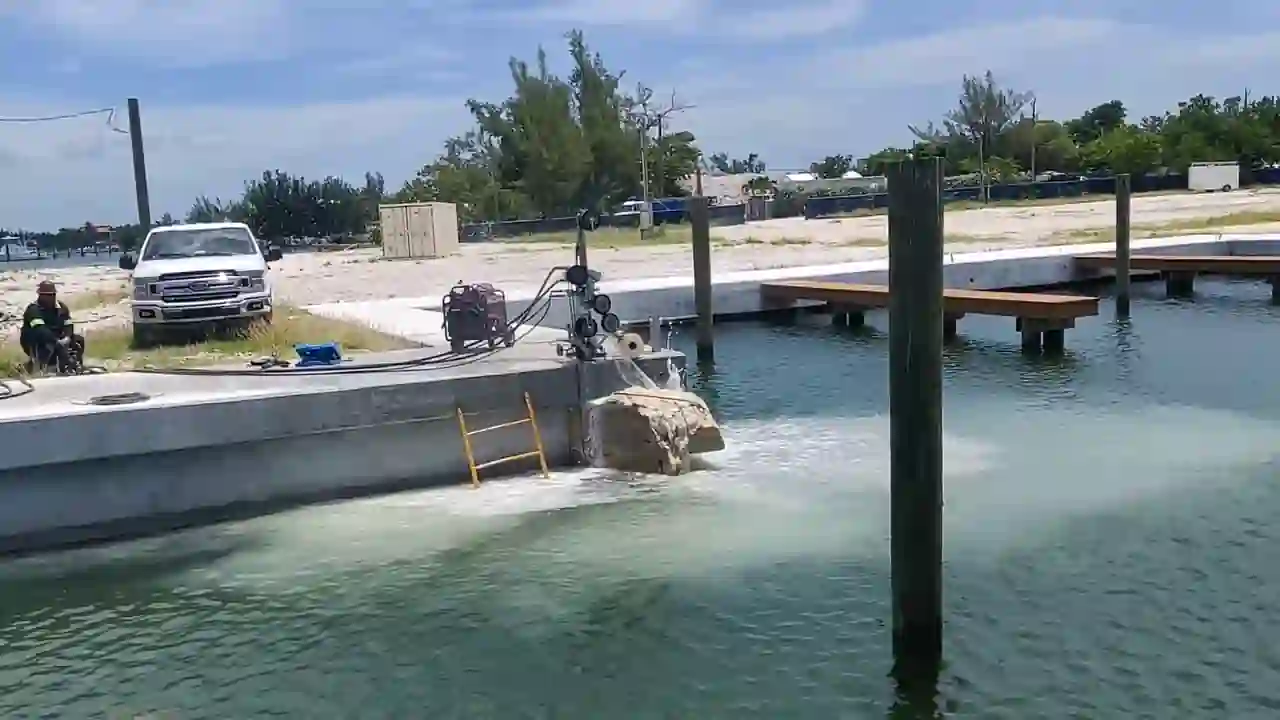
The moment diamond grinding or wet saw cutting enters a concrete chipping project, slurry management becomes an active environmental compliance issue — not a cleanup afterthought. In Miami-Dade County, concrete slurry discharge to storm drains is regulated under the Clean Water Act NPDES permit framework. The pH of fresh concrete slurry typically runs between 11 and 13, which is caustic enough to kill aquatic organisms and violates discharge limits without neutralization. Professional services operating on residential properties understand this from day one, as detailed in our analysis of why residential drainage design in Miami demands slurry control from day one.
Vacuum extraction systems integrated with the chipping and grinding equipment — specifically wet/dry HEPA-rated vacuums rated for continuous slurry recovery — are the field standard. Units pulling 150–200 CFM airflow with a 15-gallon collection capacity are appropriate for residential-scale chipping projects. Larger commercial operations require dedicated slurry management systems with pH neutralization capability built into the recovery tank.
Vibration Exposure Monitoring and Equipment Rotation Protocols
Hand-arm vibration syndrome (HAVS) is a permanent occupational injury caused by prolonged exposure to the vibration transmitted through chipping equipment. EU Directive 2002/44/EC established the 8-hour exposure action value at 2.5 m/s² and the limit value at 5.0 m/s². While U.S. OSHA hasn’t codified equivalent limits, professional concrete chipping contractors operating in Miami’s commercial sector follow these benchmarks as a liability management standard. A 15-joule demolition hammer typically transmits 8–12 m/s² at the handle. At that vibration magnitude, the daily exposure limit is reached in under 30 minutes of continuous operation. This is why crew rotation schedules — not just break schedules — are a technical requirement on any professional chipping operation, not a labor preference.
When you’re evaluating a concrete chipping service near me, the questions worth asking are specific: What’s your equipment’s joule rating for this slab specification? What carbide grade are your chisels? What’s the bond hardness of your diamond tooling relative to our aggregate type? What’s your slurry recovery system? A contractor who can answer those questions on the spot is running a professional operation. A contractor who quotes you a day rate and shows up with whatever’s in the truck is a liability you don’t need on your property.