Why Concrete Saw Cutting Rates in Miami Are Inseparable from Environmental Compliance Costs
When contractors and project managers request quotes for flat saw or wall saw work in South Florida, they’re typically focused on linear footage, blade depth, and mobilization fees. That’s understandable — those are the visible line items. But any experienced operator working in Miami-Dade or Broward County knows that concrete saw cutting rates reflect far more than diamond blade consumption and machine hours. Slurry management, water containment infrastructure, and environmental compliance protocols are embedded costs that legitimate contractors price into every job. When those costs are missing from a quote, they don’t disappear — they show up later as fines, project delays, or remediation expenses that dwarf the original savings. Understanding the full cost architecture of a compliant saw cutting operation is essential for owners, GCs, and project engineers who want to budget accurately and avoid regulatory exposure.
The Chemistry of Concrete Slurry and Why It Cannot Be Ignored
Concrete slurry is not simply dirty water. When a diamond blade engages a concrete substrate — whether you’re cutting a 6-inch slab at 1,800 RPM or making a deep wall penetration through post-tensioned concrete — the cutting action generates a highly alkaline suspension of Portland cement particles, calcium hydroxide, silica fines, and aggregate dust suspended in water. The pH of fresh concrete slurry routinely measures between 11 and 13 on the pH scale, placing it firmly in the category of a caustic hazardous material under EPA guidelines and Florida Department of Environmental Protection (FDEP) regulations.
Discharging that slurry into storm drains, swales, or adjacent soil is not a gray area. Florida Statute 403 and Miami-Dade County Code Chapter 24 both prohibit the discharge of construction-related pollutants into stormwater systems. Violations carry penalties that can exceed $10,000 per incident per day. For contractors operating near Biscayne Bay, the Miami River, or any of the county’s interconnected canal systems — which is nearly everywhere in Miami — enforcement is active and consequences are real. This regulatory reality is precisely why Miami demolition contractors must understand slurry management and environmental compliance before a single blade hits concrete.
Slurry Containment Systems and How They Factor Into Cutting Rates
Professional concrete saw cutting operations deploy layered containment systems that add both time and material cost to every job. These systems are not optional — they are the difference between a compliant operation and a liability event. Here’s what a properly equipped saw cutting crew brings to a Miami job site:
- Perimeter berms and foam dams — Installed around the cutting zone to prevent slurry migration. Foam berm material is single-use and must be disposed of properly after each operation.
- Wet-dry vacuum extraction units — High-capacity industrial vacuums that pull slurry from the cut kerf in real time, reducing surface pooling and runoff risk. These units require operator time to monitor and empty continuously.
- Slurry containment bags and filter systems — Captured slurry is pumped into geo-textile filter bags that separate solids from water. The dewatered solids can then be disposed of as construction debris, while the filtered water must still be pH-adjusted before any discharge.
- pH neutralization agents — Carbon dioxide injection or citric acid treatment brings slurry pH down to an acceptable discharge range (typically 6.5–8.5). This requires testing equipment, neutralizing agents, and trained personnel.
- Vacuum trucks for large-volume operations — On projects generating significant slurry volumes, a dedicated vacuum truck with a licensed waste hauler may be required to transport slurry off-site to an approved disposal facility.
Each of these components carries a direct cost. When you’re reviewing concrete cutting costs in Miami, a quote that omits these line items is not competitive pricing — it’s incomplete pricing that transfers environmental liability to the project owner.
How Cutting Method Affects Slurry Volume and Containment Complexity
Not all saw cutting operations produce equal slurry volumes, and understanding these differences helps project teams anticipate containment requirements before work begins.
Flat Slab Cutting with Walk-Behind Saws
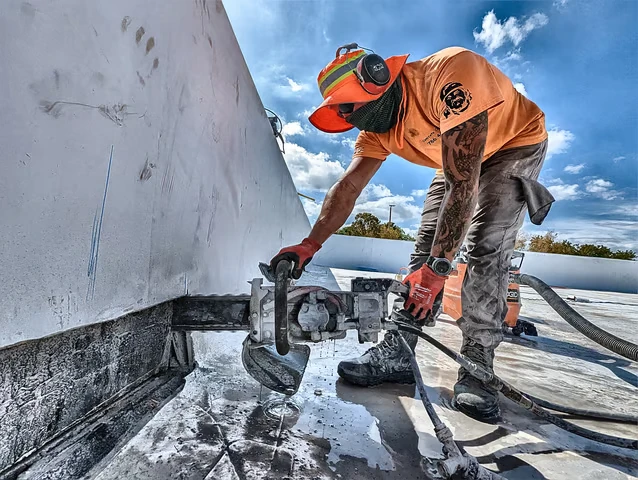
Walk-behind flat saws used for slab-on-grade work, road cutting, or expansion joint installation are among the highest slurry producers per linear foot. A 14-inch blade cutting at full depth through a 6-inch slab with continuous water cooling can generate 2 to 4 gallons of slurry per linear foot of cut. On a 500-linear-foot project, that’s potentially 2,000 gallons of alkaline slurry requiring active management. Containment dams must be repositioned as the saw advances, and vacuum extraction must keep pace with production rates to prevent surface runoff.
Wall Saw Operations on Vertical Surfaces
Track-mounted wall saws present a different containment challenge. Slurry runs vertically down the wall face and pools at the base of the cut. Gravity-fed containment systems — essentially formed channels and collection reservoirs at the base of the wall — are required. The rate of slurry generation is typically lower than flat sawing, but the geometry of containment is more complex and labor-intensive to maintain.
Core Drilling and Its Slurry Profile
Core drilling, while often associated with precise concrete coring work in Miami, generates concentrated slurry volumes at a single point. For horizontal or overhead coring, slurry containment requires purpose-built collection collars and vacuum attachment points integrated with the drill rig. The alkalinity of core drilling slurry is equivalent to flat sawing, but the localized nature of the operation makes containment more manageable when proper equipment is on site.
Jobsite Safety Protocols That Run Parallel to Environmental Controls
Environmental compliance and worker safety are operationally linked in concrete saw cutting. The same slurry that poses an environmental discharge risk also creates immediate safety hazards on the job site. Wet concrete slurry on smooth surfaces creates extreme slip hazards for operators and other trades working in the area. Silica-laden mist generated during wet cutting — even with water suppression — requires respiratory protection under OSHA’s Respirable Crystalline Silica Standard (29 CFR 1926.1153).
Proper PPE protocols for saw cutting operations in Miami must include at minimum: NIOSH-approved N95 or higher respirators, chemical-resistant gloves rated for high-pH exposure, rubber boots with slip-resistant soles, eye protection rated for splash and particle impact, and hearing protection appropriate for the decibel output of the saw in use. These requirements are non-negotiable and their cost is factored into compliant crew rates. For a deeper look at the full safety framework governing these operations, review the concrete demolition safety standards that apply across Miami-Dade project sites.
Breaking Down a Realistic Compliant Saw Cutting Rate Structure
For project managers trying to build accurate budgets, understanding the component structure of a fully compliant concrete saw cutting rate is essential. While actual pricing varies by project specifics, the following cost categories are present in every legitimate quote:
- Blade consumption and machine wear — Typically the largest single variable, driven by aggregate hardness, reinforcement density, and cut depth.
- Water supply and management — Potable water connection fees, water truck costs if no site supply is available, and water recycling system operation.
- Slurry containment materials — Foam dams, filter bags, pH testing strips or meters, and neutralizing agents. These are consumable costs that scale with project volume.
- Vacuum equipment operation — Wet-dry industrial vacuums or vacuum truck time, including operator labor for continuous slurry extraction.
- Waste disposal and manifesting — Licensed hauling of dewatered slurry solids and any liquid waste requiring off-site treatment. In Florida, waste manifesting documentation is required for regulated materials.
- Compliance documentation — Site-specific environmental compliance plans, pre-job inspections, and post-job cleanup verification. Some Miami-Dade projects require photographic documentation of containment setup before cutting begins.
The Real Cost of Cutting Corners on Slurry Management
The pressure to submit competitive concrete saw cutting rates is real, and the temptation to strip out environmental compliance costs is understandable from a purely arithmetic standpoint. But the downstream exposure is severe. A single FDEP Notice of Violation for unpermitted slurry discharge can result in fines that consume the entire profit margin of a project. More significantly, repeat violations can trigger contractor license suspension proceedings and civil liability from downstream property owners or municipalities affected by the discharge.
Beyond regulatory penalties, improperly managed slurry that dries on a job site leaves a white calcium carbonate residue that is extremely difficult to remove from finished surfaces, adjacent structures, and landscaping. Remediation costs for slurry staining on architectural concrete or pavers can easily run into thousands of dollars — costs that typically fall on the contractor responsible for the work.
The bottom line for any project team evaluating concrete saw cutting rates in Miami is straightforward: the cheapest quote is rarely the least expensive outcome. A contractor who has built compliant slurry management, proper containment infrastructure, and trained personnel into their rate structure is delivering a service that protects the project, the owner, and the surrounding environment. That’s not a premium — it’s the baseline standard for professional concrete cutting in South Florida.