Why Slurry Management Is the Most Overlooked Risk for Demolition Contractors in Miami
Most conversations about demolition in South Florida center on equipment, timelines, and structural sequencing. What rarely gets the attention it deserves — until a stop-work order lands on the site — is the environmental liability sitting in every gallon of concrete slurry produced during cutting and demolition operations. Miami-Dade County operates under some of the most stringent stormwater and surface water protection regulations in the southeastern United States, enforced jointly by the Florida Department of Environmental Protection (FDEP) and the Miami-Dade Department of Regulatory and Economic Resources (DERM). For demolition contractors in Miami, failing to manage slurry correctly isn’t just an environmental offense — it’s a direct threat to licensure, bonding eligibility, and project continuity.
The Chemistry Behind Concrete Slurry and Why It’s Classified as a Pollutant
Concrete slurry is not benign gray water. When diamond blades, wire saws, or core drills engage hardened concrete, the resulting effluent is a suspension of Portland cement particles, calcium hydroxide leachate, silica fines, and cutting water. The pH of fresh concrete slurry routinely measures between 11 and 13 — highly alkaline, toxic to aquatic organisms, and capable of destabilizing the biological activity in Miami’s shallow Biscayne Aquifer recharge zones. Even a small discharge into a storm drain connected to Biscayne Bay or the Miami River triggers Clean Water Act Section 402 NPDES violations.
Understanding the chemistry matters because it dictates your containment strategy. High-pH slurry cannot simply be diluted and discharged. It must be pH-adjusted to between 6.5 and 8.5 before any liquid fraction can be legally discharged to a sanitary sewer — and only then with prior approval from Miami-Dade Water and Sewer Department (WASD). The solid fraction, primarily calcium silicate hydrate fines and silica, must be collected, dewatered, and disposed of as solid waste at a licensed facility. For projects near environmentally sensitive areas like Coconut Grove, Coral Gables waterways, or Brickell, DERM may impose even tighter discharge thresholds.
Regulatory Framework Governing Demolition Slurry in Miami-Dade County
Demolition contractors operating in Miami need to be conversant with at least four overlapping regulatory instruments. First, Miami-Dade County Code Chapter 24 governs environmental protection and establishes baseline prohibitions on stormwater contamination. Second, FDEP Rule 62-621 sets the NPDES Generic Permit for Stormwater Discharge from Large and Small Construction Activities — any demolition project disturbing more than one acre requires a Notice of Intent (NOI) filed with FDEP and an active Stormwater Pollution Prevention Plan (SWPPP). Third, the EPA’s Effluent Guidelines for the Construction and Development Point Source Category (40 CFR Part 450) mandate specific best management practices (BMPs) for pH control and turbidity. Fourth, if your project involves any work within 25 feet of a waterbody, Miami-Dade DERM Environmental Resource Permitting requirements kick in, potentially requiring an Environmental Resource Permit (ERP) before demolition begins.
For contractors also working in Broward County, the regulatory picture shifts slightly — visit our Fort Lauderdale concrete cutting resource page for jurisdiction-specific compliance guidance. The underlying chemistry is identical, but permit thresholds and inspection frequencies differ meaningfully.
Slurry Containment Systems That Meet South Florida Field Conditions
Selecting the right containment system for a Miami demolition project requires accounting for the region’s flat topography, high water table, and frequent afternoon rain events. The following systems represent the current industry standard for compliant slurry management in this environment.
Perimeter Berming and Vacuum Recovery for Slab Demolition
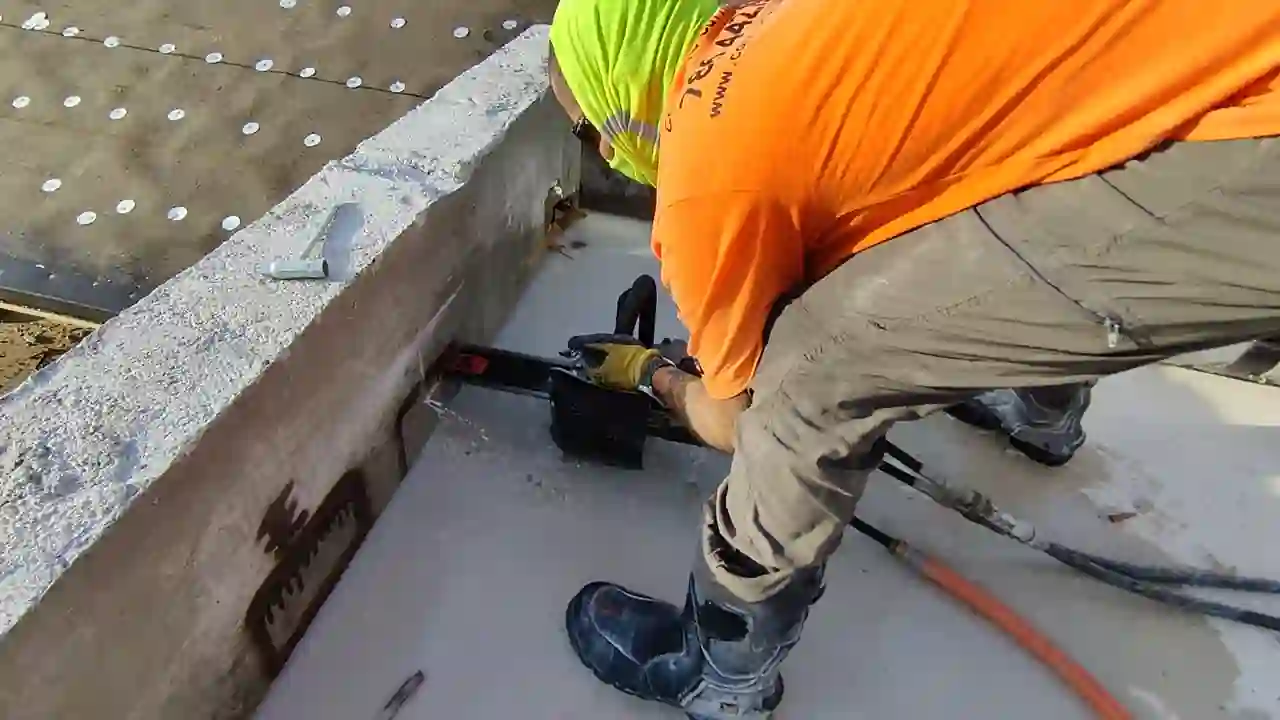
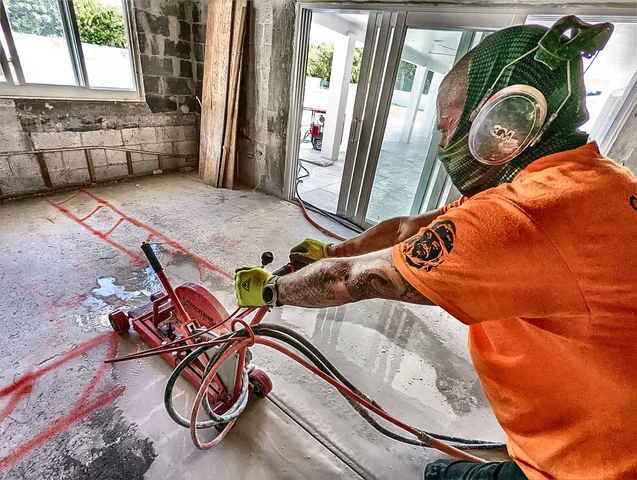
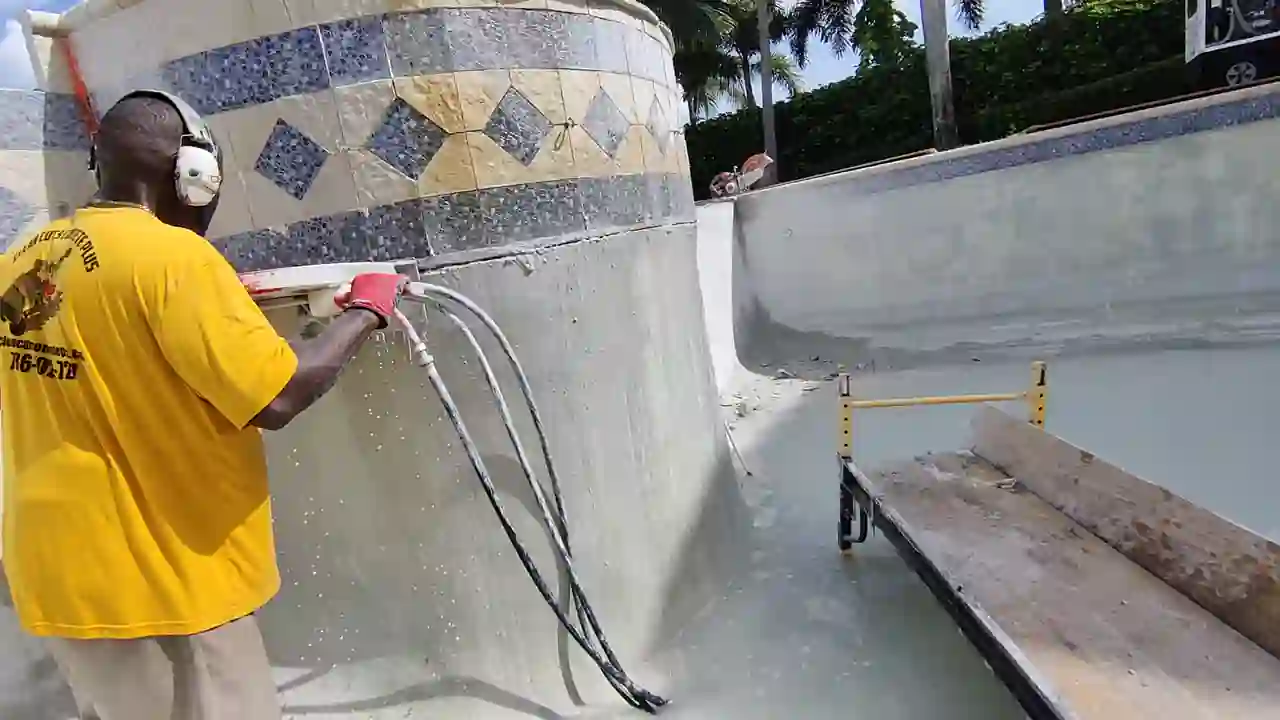
For flatwork demolition — parking decks, warehouse slabs, pool decks — the most effective primary containment strategy combines hydraulic perimeter berms with wet-vacuum recovery units staged at low points. Berms should be constructed from compacted, impermeable material or prefabricated rubber dam systems rated for pH 12+ exposure. Vacuum units with a minimum 500-gallon holding capacity allow continuous cutting operations without interrupting slurry collection. The collected slurry is then transferred to a dewatering tank system where pH adjustment using CO₂ injection or citric acid dosing brings the liquid fraction into discharge compliance range.
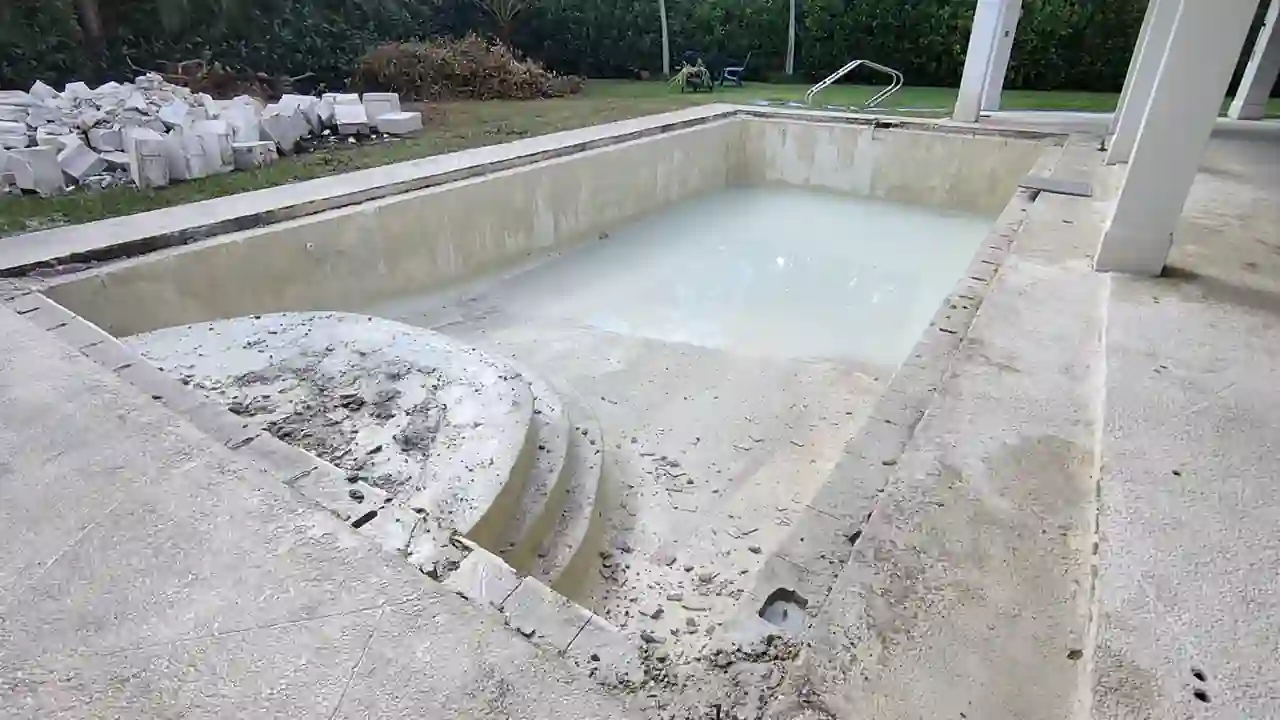
This is particularly critical during pool deck and pool shell demolition projects. The bobcat pool removal process generates substantial slurry volumes as the shell is broken and removed — and in residential Miami neighborhoods, proximity to drainage swales makes uncontained slurry discharge an immediate DERM violation risk. Proper vacuum recovery at the point of cutting is non-negotiable on these jobs.
Diamond Wire Saw Operations and Closed-Loop Water Recycling
Large-scale structural demolition using diamond wire saws — common in bridge column removal, thick retaining wall cutting, and marine structure demolition — demands a closed-loop water recycling system rather than single-pass cooling water discharge. These systems recirculate cutting water through a series of settling tanks, typically a three-stage configuration: primary settlement tank for coarse fines removal, secondary clarifier for suspended solids reduction, and a pH adjustment/filtration stage before water re-enters the cutting circuit. Properly engineered closed-loop systems can reduce fresh water consumption by 85–90% while eliminating discharge entirely during active cutting phases.
For contractors unfamiliar with the hazard profile of high-volume diamond wire operations, our resource on concrete cutting hazards in South Florida covers both operator safety and environmental exposure risks in detail.
Thickness-Dependent Slurry Volume Estimation for Project Planning
One of the most common planning failures we see from demolition contractors is underestimating slurry volume, which leads to inadequate containment capacity and mid-project compliance failures. Slurry volume is directly proportional to the concrete thickness being cut and the linear footage of cuts required. As a practical benchmark, a 6-inch slab cut with a 14-inch diamond blade generates approximately 0.8 to 1.2 gallons of slurry per linear foot of cut, depending on aggregate hardness and water flow rate. A 24-inch wall cut with a wall saw producing continuous cuts can generate 4–6 gallons per linear foot. Understanding minimum concrete thickness parameters for your specific demolition scope allows for accurate pre-job slurry volume calculations and properly sized containment system deployment.
Sustainable Demolition Practices and the Shift Toward Green Site Management
Environmental compliance in demolition isn’t purely about avoiding penalties — it’s increasingly a competitive differentiator in Miami’s commercial construction market. General contractors and property owners are actively selecting demolition subcontractors who can demonstrate documented environmental management systems. Slurry recycling programs, on-site dewatering with certified disposal manifests, and SWPPP documentation packages have moved from optional add-ons to standard bid requirements on most projects over $500,000 in Miami-Dade.
This trend connects directly to broader sustainability initiatives reshaping Miami’s residential landscape. Projects like pool removals that transition toward drought-tolerant landscaping — detailed in our post on swapping pools for sustainable landscaping in Miami backyards — generate demolition waste and slurry that must be managed with the same rigor as commercial projects. The scale is smaller, but the regulatory exposure is identical.

Documentation and Chain of Custody Requirements for Slurry Disposal
DERM and FDEP inspectors increasingly request chain-of-custody documentation for slurry disposal during routine site inspections and complaint-driven investigations. Best practice for compliant demolition contractors in Miami includes maintaining the following records for a minimum of three years post-project completion:
- Daily slurry volume logs with pH readings taken at collection point and post-treatment
- Disposal manifests from licensed Class I or Class III solid waste facilities receiving dewatered filter cake
- WASD approval correspondence for any liquid fraction discharged to sanitary sewer
- Photographic documentation of containment systems at project initiation, during operations, and at demobilization
- SWPPP inspection logs with corrective action records for any BMP failures observed during the project
This documentation package not only protects against regulatory action — it provides the evidentiary foundation needed to defend against third-party environmental liability claims, which are increasingly common in Miami’s dense urban demolition environment where adjacent property owners and environmental advocacy groups monitor active sites closely.
Selecting a Demolition Contractor in Miami Who Takes Environmental Compliance Seriously
When evaluating demolition contractors for projects in Miami-Dade County, the environmental compliance question should be part of your initial qualification screening. Ask specifically about their SWPPP preparation capability, their slurry containment equipment inventory, and their disposal vendor relationships. Request copies of recent DERM inspection reports from comparable projects. A contractor who cannot produce these materials without hesitation is a contractor who is likely managing slurry reactively rather than systematically — and that reactive approach creates liability that flows directly to the project owner.
At Concrete Cutting Miami, LLC, every demolition project begins with a site-specific environmental assessment that identifies discharge pathways, establishes containment system sizing based on actual cut volumes, and produces a pre-job SWPPP that satisfies both FDEP and DERM requirements. Slurry management isn’t a compliance checkbox for our crews — it’s an integrated part of how we plan and execute every job in South Florida.