What Concrete Saws Are Actually Used For Across Commercial and Civil Job Sites
Walk onto any active construction site in Miami-Dade County and you’ll find at least one concrete saw running. These machines are the backbone of structural modification, utility access, pavement rehabilitation, and demolition prep. But the conversation about uses of concrete saws rarely goes deep enough — most discussions stop at “it cuts concrete,” and that’s where the real problems begin. Understanding the full application spectrum of concrete saws is inseparable from understanding the environmental obligations those applications trigger, particularly around water use, slurry containment, and stormwater discharge compliance.
Core Applications Where Concrete Saws Dominate the Trade
Concrete saws operate across a broader range of applications than most project managers account for in their pre-construction planning. Each application carries its own blade specification, depth requirement, and critically — its own slurry profile. Here’s how senior operators categorize the primary uses:
Flat Saw Cutting for Pavement Rehabilitation and Joint Re-Cutting
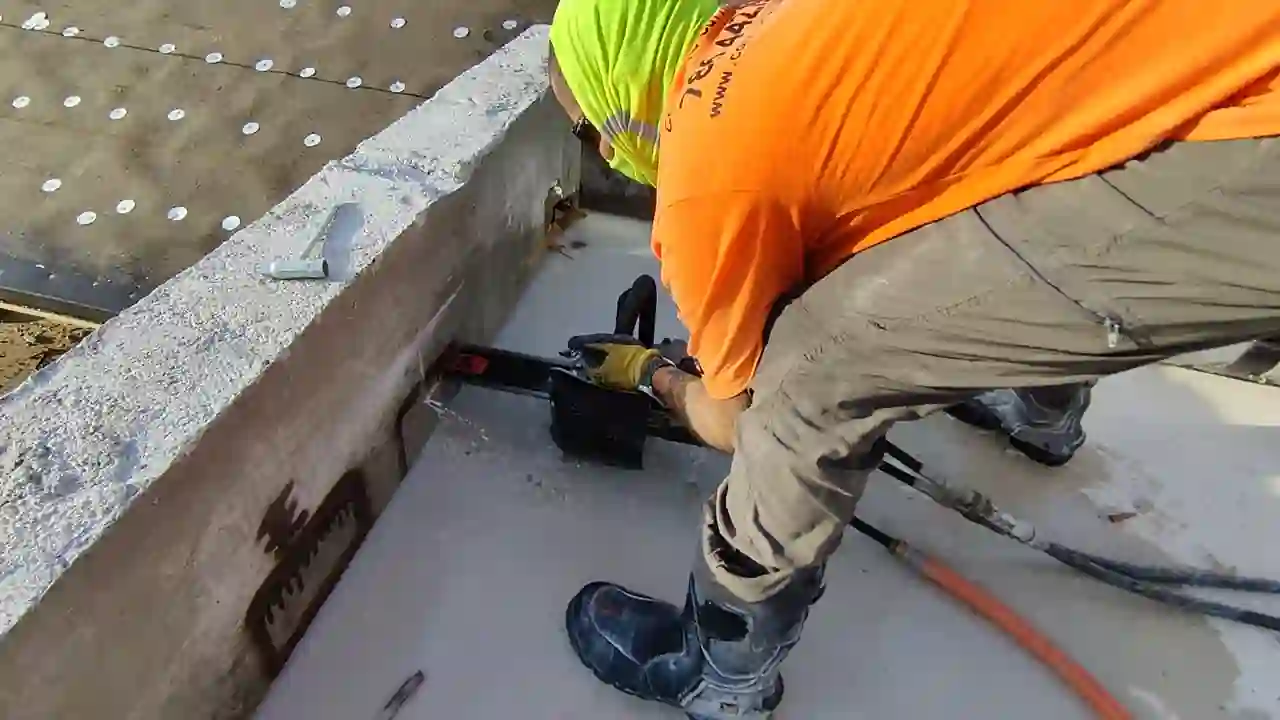
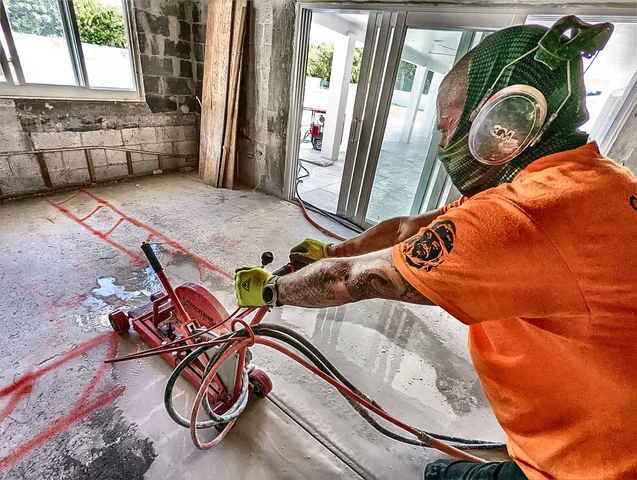
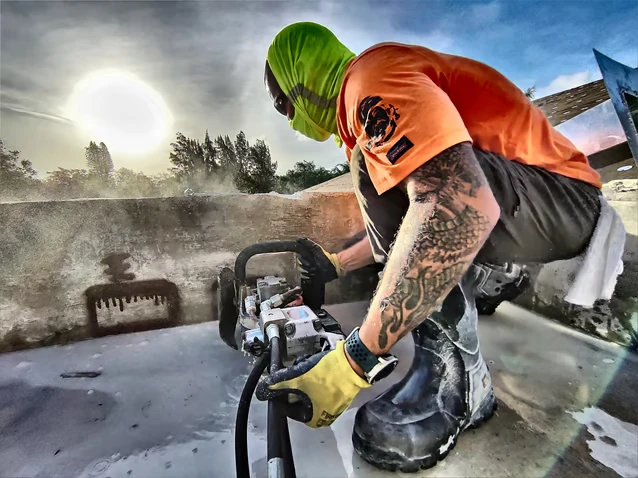
Flat saws, also called road saws or slab saws, are the workhorses of pavement rehabilitation. In Miami’s urban grid, they’re used constantly for re-cutting expansion joints that have deteriorated, removing damaged pavement sections, and creating clean edges before patching crews move in. A flat saw running a 14-inch to 60-inch diamond blade through a 6-inch concrete slab at full depth will consume between 3 and 8 gallons of water per minute during the cut. That water doesn’t disappear — it becomes a cement-laden slurry with a pH that routinely tests between 11 and 13, making it a regulated discharge under the Clean Water Act and Florida’s NPDES stormwater program.
Wall Sawing for Structural Openings and Window Enlargement
Wall saws use a track-mounted system to cut vertical and horizontal openings in reinforced concrete walls. This application is critical in commercial renovation — creating new doorways, HVAC chase openings, and window expansions without compromising structural load paths. Wall sawing generates slurry that runs down vertical surfaces, which makes containment geometrically more complex than horizontal applications. Vacuum shrouds and drip collection trays are non-negotiable on any wall saw setup that’s operating near storm drains or interior floor drains connected to municipal sewer systems.
Core Drilling for Utility Penetrations
Core drilling is one of the most frequent uses of concrete saws in the utility installation sector. Whether it’s conduit penetrations through foundation walls, plumbing rough-ins through post-tension slabs, or anchor bolt holes in parking structures, core drilling produces a concentrated slurry column at the drill point. Because core drilling uses continuous water feed to cool the diamond bit, slurry accumulates rapidly in a small footprint — which is actually an advantage for containment when operators use proper ring dams and wet-vac extraction systems.
Wire Sawing for Large-Section Structural Demolition
Diamond wire saws handle what blade-based systems can’t — massive cross-sections on bridge piers, dam structures, and heavily reinforced industrial foundations. Wire sawing is increasingly specified on Miami infrastructure projects where vibration control is paramount. The water volumes involved in wire sawing are substantial, and the slurry generated carries fine diamond particles in addition to cement fines and aggregate dust. This slurry requires settlement tanks or filter press systems before any water fraction can be considered for recirculation or compliant discharge.
Hand Saw and Angle Grinder Applications in Tight Spaces
For confined spaces, interior work, and precision cuts near existing utilities, hand-held concrete saws and angle grinders with segmented diamond blades are the tools of choice. These tools are discussed in depth in our guide on breaking concrete with hand tools, but from an environmental standpoint, hand sawing in enclosed spaces creates a unique hazard — dry cutting generates respirable crystalline silica at concentrations that exceed OSHA’s permissible exposure limit within seconds. Wet cutting with hand saws in enclosed spaces solves the silica problem but creates a slurry management challenge in areas where floor drains may connect to protected water bodies.
The Environmental Compliance Framework That Governs Every Saw Cut
Here’s what separates professional concrete cutting operations from liability-generating ones: a working knowledge of the regulatory framework that applies the moment water touches a diamond blade. In Florida, and especially in Miami-Dade County with its proximity to Biscayne Bay and the Everglades watershed, the stakes are higher than in most U.S. markets.
NPDES Construction General Permit Requirements for Concrete Saw Operations
The EPA’s National Pollutant Discharge Elimination System (NPDES) Construction General Permit covers sites disturbing one or more acres, but individual concrete cutting operations on smaller sites can still trigger local stormwater ordinances. Miami-Dade County’s stormwater management program explicitly prohibits the discharge of concrete slurry to any storm drain, swale, or surface water body. Violations carry fines starting at $5,000 per incident and can trigger stop-work orders on projects where the general contractor holds the permit — not just the cutting subcontractor.
pH Control and Why Alkaline Slurry Is a Regulated Pollutant
Fresh concrete slurry is caustic. The calcium hydroxide released during cement hydration drives slurry pH into the 11–13 range, which is acutely toxic to aquatic organisms at very low concentrations. A single flat saw cut on a 100-foot joint can produce 40–80 gallons of slurry. If that slurry reaches a storm drain and flows to a canal or bay, the pH spike can kill benthic organisms and trigger regulatory action. pH neutralization using carbon dioxide injection or citric acid treatment brings slurry to the acceptable discharge range of 6.5–8.5 before any liquid fraction is released.
Slurry Containment Systems That Actually Work in Field Conditions
The concrete cutting industry has developed a tiered approach to slurry containment that maps to application type and site conditions:
- Berms and absorbent socks — used for flat saw operations on open pavement to prevent slurry migration to drains
- Vacuum extraction systems — wet-vac units mounted to the saw that pull slurry directly from the cut kerf before it can spread
- Portable settlement tanks — 250 to 500-gallon tanks where slurry is pumped for solids separation and pH testing before discharge
- Filter press dewatering — used on high-volume wire saw and large flat saw operations to produce a dry cake for disposal and a clarified water fraction for recirculation
- Hydro-vacuum excavation integration — on utility corridor projects, slurry from core drilling and flat sawing is combined with hydrovac spoils for unified waste management
Matching the Right Saw to the Right Application Reduces Slurry Volume
One of the most overlooked environmental control strategies is blade and equipment selection. An oversized blade running at incorrect RPM generates more heat, requires more cooling water, and produces finer slurry particles that are harder to settle and filter. Proper diamond bond hardness matched to aggregate type reduces blade glazing, which means less water is needed to maintain cutting efficiency. On a 500-foot utility trench cut, optimizing blade specification can reduce total water consumption — and therefore total slurry volume — by 20 to 35 percent. That’s a material reduction in both disposal cost and environmental risk.
Safe demolition sequencing also plays a role. When concrete saw cuts are integrated into a broader demolition plan, as outlined in our post on breaking apart concrete the right way without getting anyone killed on the job site, the total water and slurry footprint can be minimized by cutting in sequences that allow slurry to be collected in designated low points rather than spreading across the work area.
Solid Waste Disposal for Dried Concrete Slurry and Filter Cake
Once slurry solids have been separated and dewatered, the resulting filter cake or dried slurry must be disposed of properly. In Florida, dried concrete slurry is classified as a non-hazardous solid waste under most circumstances, but it cannot be landfilled in certain coastal protection zones without documentation of pH neutralization. Some contractors are now working with recyclers who incorporate dewatered concrete slurry cake into road base aggregate and manufactured fill products — a legitimate beneficial reuse pathway that eliminates landfill tipping fees and satisfies sustainability documentation requirements on LEED-tracked projects. For contractors working across Miami’s active construction sector, establishing a standing relationship with a slurry recycler is a competitive differentiator, not just an environmental nicety.
Dry Cutting Scenarios and Silica Dust as the Parallel Compliance Challenge
Not every concrete saw application uses water. Interior cutting in occupied buildings, certain decorative scoring operations, and emergency response cuts are sometimes performed dry. In these cases, the slurry management problem disappears — but it’s immediately replaced by a silica dust compliance obligation under OSHA’s Respirable Crystalline Silica Standard (29 CFR 1926.1153). Table 1 of that standard specifies engineering controls for each cutting tool type, including the requirement for integrated water delivery or HEPA vacuum systems on all hand-held grinders and circular saws cutting concrete. The standard also mandates air monitoring under certain trigger conditions, written exposure control plans, and medical surveillance for workers with repeated high-exposure tasks. Choosing between wet and dry cutting is never purely a productivity decision — it’s a compliance decision that requires documented justification either way.
Why Miami’s Proximity to Protected Waterways Raises the Regulatory Bar
Miami-Dade County sits at the edge of one of the most ecologically sensitive regions in North America. Biscayne Bay, the Miami River, and the Everglades system are all connected to the stormwater infrastructure that runs beneath every job site in the metro area. The Florida Department of Environmental Protection enforces water quality standards that are among the strictest in the Southeast, and Miami-Dade’s own stormwater utility has inspection authority on active construction sites. Concrete cutting contractors operating in this market who treat slurry management as an afterthought are not just cutting corners — they’re operating with a liability exposure that can exceed the value of the contracts they’re trying to win. The uses of concrete saws are broad, the technology is mature, and the environmental compliance framework is well-established. The only variable is whether your operation is built around it or hoping to avoid it.