Why the Linear Foot Price on Your Concrete Cutting Quote Rarely Tells the Whole Story
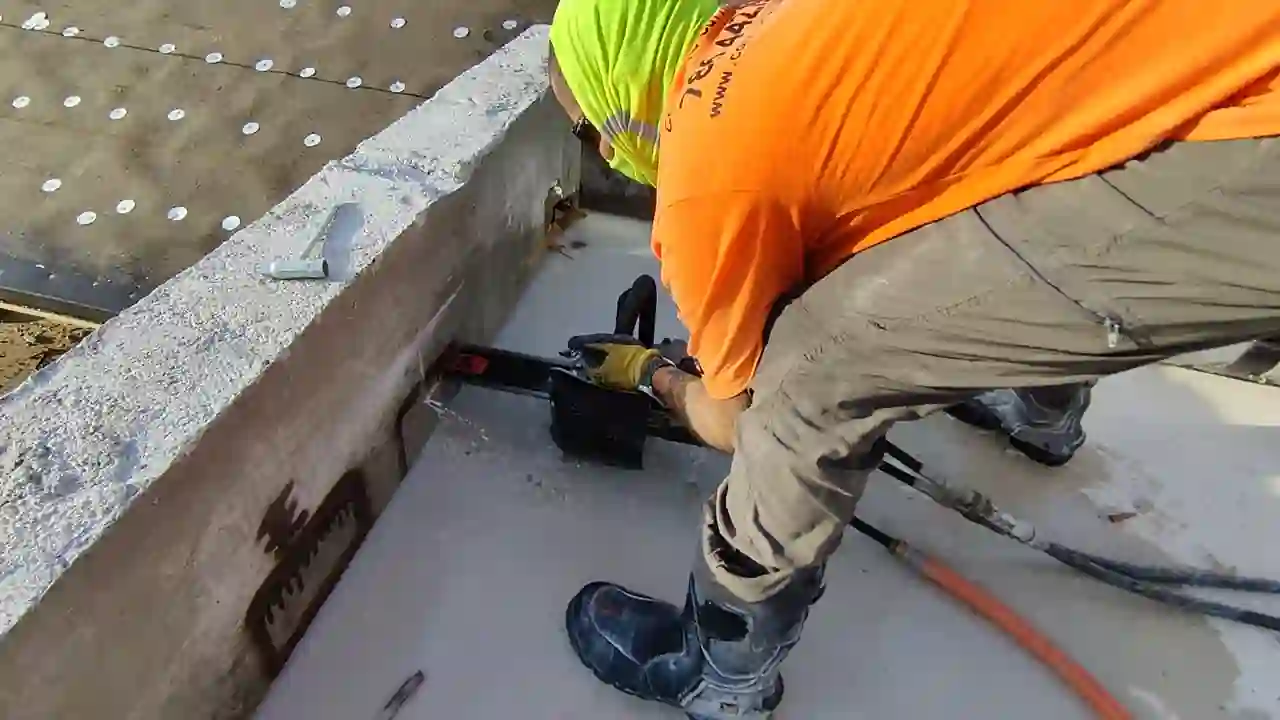
When a general contractor asks for a concrete saw cutting price per linear foot, they’re usually expecting a clean, simple number — something like $3.50 to $8.00 per linear foot for standard slab cutting. And in an open, flat, accessible environment with no overhead restrictions, no slurry management headaches, and a full crew with room to maneuver, that range holds up reasonably well. But the moment site logistics enter the conversation, that number becomes a starting point, not a final answer. In Miami’s dense urban core, where construction happens inside occupied buildings, below-grade parking structures, mechanical rooms, and tight residential footprints, the real cost of concrete saw cutting is almost always a function of access — not just material or blade wear.
Breaking Down the Base Cost Variables Before Site Conditions Even Enter the Equation
To understand how site logistics inflate pricing, you first need a firm grip on what drives the baseline concrete saw cutting cost per linear foot under ideal conditions. The primary cost drivers in a controlled environment include slab thickness, aggregate hardness, reinforcement density, and blade specification. A standard 4-inch unreinforced slab with river rock aggregate in open air will cut efficiently at lower cost per linear foot than a 10-inch post-tensioned deck with hard trap rock aggregate embedded in high-PSI concrete.
Here’s a rough technical breakdown of baseline linear foot pricing by slab category:
- 4-inch unreinforced slab, standard aggregate: $3.00 – $5.00 per linear foot
- 6-inch slab with single mat rebar (#4 or #5): $5.00 – $8.00 per linear foot
- 8-inch double-mat reinforced slab: $8.00 – $13.00 per linear foot
- 10-inch to 12-inch post-tensioned or heavily reinforced deck: $14.00 – $22.00+ per linear foot
- Wall cutting (vertical flat saw or wire saw): $18.00 – $35.00 per linear foot depending on depth and reinforcement
These figures assume adequate water supply for blade cooling, unrestricted equipment staging, and standard slurry vacuum management. The second site conditions deviate from that baseline, every one of those numbers shifts upward. For a deeper look at how bid factors compound in real-world Miami projects, explore the full range of concrete bid factors that experienced estimators track before submitting a number.
Confined Space Premiums and Why They’re Non-Negotiable on Mechanical Room and Below-Grade Cuts
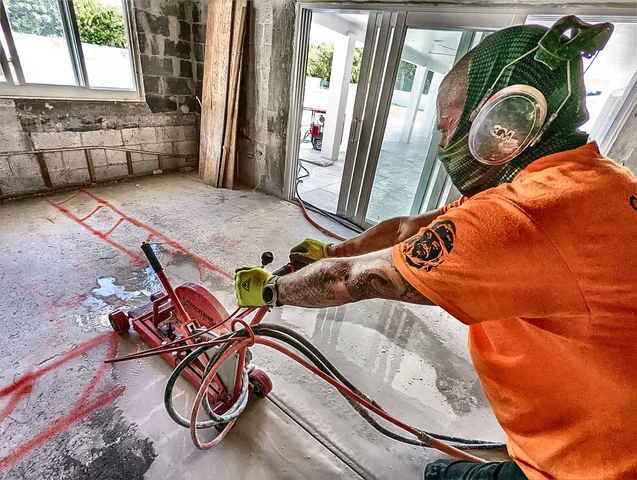
Confined space work is one of the most significant cost multipliers in commercial concrete cutting, and it’s also one of the least understood by project managers who haven’t watched a crew try to maneuver a 65-pound flat saw through a 36-inch doorway into a below-grade mechanical room. OSHA’s confined space entry regulations under 29 CFR 1910.146 require permit-required confined space procedures when atmospheric hazards, engulfment risks, or configuration-based entrapment potential exist — and those conditions are common in below-grade concrete cutting environments.
The operational costs associated with confined space concrete cutting include:
- Atmospheric monitoring equipment and certified gas detection: Adds mobilization cost and requires trained personnel on site throughout the cut
- Forced air ventilation systems: Silica dust and diesel or electric motor exhaust must be actively managed; ducting and blower setup takes time and space
- Reduced equipment size and slower cut rates: Full-size flat saws may be impossible to operate; smaller walk-behind units or hand-held angle grinder setups dramatically reduce linear footage per hour
- Increased crew ratio: Confined space entry typically requires an attendant outside the space plus a rescue-capable standby — that’s labor cost that never touches the blade
- Slurry containment without floor drains: Wet cutting in confined below-grade spaces requires vacuum extraction systems running continuously, adding equipment rental and operator time
In practical terms, confined space premiums typically add 40% to 120% above baseline linear foot pricing. A cut that would run $7.00 per linear foot in open air may land between $12.50 and $15.50 per linear foot once confined space protocols are properly costed. Review the full safety protocols our team applies on confined and restricted-access concrete cutting projects in Miami.
Vertical Access Restrictions, Stairwell Logistics, and Equipment Rigging Costs That Kill Flat-Rate Quotes
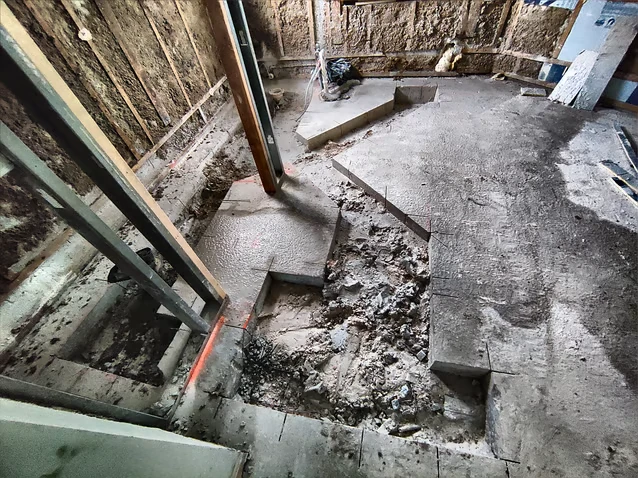
One of the most common scenarios where flat-rate linear foot pricing breaks down is multi-story work where equipment cannot be transported by elevator or standard stairwell access. In parking structures, high-rise residential towers, and commercial buildings with narrow service corridors, getting a flat saw or core drill to the work level isn’t just inconvenient — it’s a billable logistics operation in its own right.
Consider a typical scenario our crews encounter in Miami’s Brickell and downtown corridor: a concrete cutting scope on the 4th floor of an occupied residential building, involving saw cutting around a new MEP penetration through a 7-inch post-tensioned slab. The building elevator has a 2,000-pound capacity with a 36-inch door opening. The flat saw required for this cut weighs 480 pounds and measures 42 inches wide. The stairwell is 38 inches clear. The building management requires work between 9 AM and 4 PM with no core hours disruption.
That scenario triggers the following cost additions before a single inch is cut:
- Equipment disassembly and reassembly: Some flat saws can be partially broken down; others cannot — factor 2 to 4 hours of skilled labor
- Crane or material lift coordination: If exterior hoisting is required, crane scheduling, rigging certification, and building facade protection add significant cost
- Alternate equipment selection: Switching to a smaller, less efficient saw increases cut time and blade consumption, raising the effective cost per linear foot
- Occupied building protection: Dust barriers, floor protection, and noise mitigation in occupied structures require materials and setup time
This is why advanced urban concrete cutting solutions in Miami require contractors who plan logistics as rigorously as they plan the technical cut itself. Equipment selection, staging sequencing, and crew deployment strategy are billable professional services — not overhead absorbed into a per-linear-foot rate.
Water Supply, Slurry Management, and Drainage Constraints That Add Hidden Cost Per Linear Foot
Wet diamond saw cutting requires a continuous, pressurized water supply — typically 3 to 5 gallons per minute for a standard flat saw blade in the 14-inch to 20-inch diameter range. On open exterior slabs near a hose bib, this is trivial. Inside a building three floors up, or in a basement with no floor drains and a building manager who won’t allow slurry to contact the existing drainage system, water management becomes a full operational sub-scope.
Slurry — the mixture of water, fine concrete particulate, and diamond blade swarf — must be captured, contained, and disposed of in compliance with local environmental regulations. In Miami-Dade County, discharging concrete slurry into storm drains violates both county ordinance and EPA Clean Water Act provisions. Proper slurry management on a constrained site involves wet/dry vacuum systems, portable containment berms, slurry solidification agents, and licensed disposal — all of which carry cost that must be distributed across the linear footage of the cut scope.
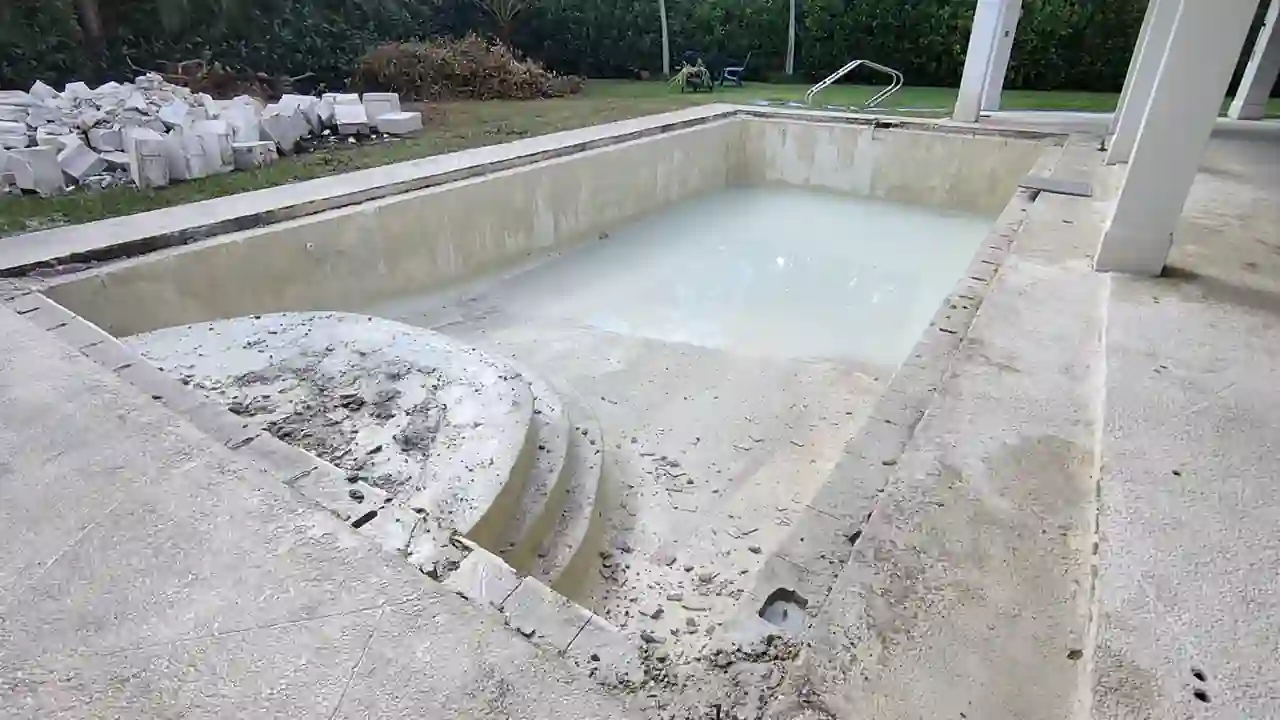
Projects where water supply must be trucked in or where dry cutting methods are required due to drainage constraints will see blade consumption increase by 30% to 60% and cut rates drop proportionally, directly impacting cost per linear foot. For project types like inground pool demolition, slurry management in confined residential backyards follows similar cost logic.
How Experienced Estimators Actually Build a Confined-Access Linear Foot Price
A technically rigorous estimate for confined or access-limited concrete saw cutting starts with a site walk — not a phone call and a plan set. The estimator needs to physically verify ceiling heights (blade guard clearance on a flat saw requires minimum 18 to 24 inches above slab surface), doorway dimensions, elevator capacity, water access points, drainage conditions, and the presence of any existing utilities within the cutting envelope.
From that site walk, the estimate builds upward from a true operational cost model:
- Blade cost per linear foot based on actual concrete hardness and reinforcement density
- Equipment hours calculated from realistic cut rates for the specific saw model in the specific site geometry
- Crew hours including setup, confined space compliance, slurry management, and teardown — not just active cutting time
- Mobilization and logistics cost amortized across total linear footage of the scope
- Site-specific compliance costs including dust suppression, noise mitigation, and occupied building protocols
This is a fundamentally different methodology than multiplying linear feet by a flat rate. It’s also why DIY concrete removal approaches consistently underestimate project cost — the logistics and compliance components are invisible until they become problems. For a visual walkthrough of how our crews handle complex access scenarios, browse our project video library documenting real Miami job sites.
What You Should Actually Ask a Concrete Cutting Contractor Before Accepting a Linear Foot Quote
If you’re managing a project with any site access complexity, the linear foot price on a concrete cutting quote is only meaningful if you understand exactly what conditions it assumes. Before accepting a number, ask the contractor to confirm whether their price includes confined space compliance labor, slurry containment and disposal, equipment rigging or disassembly for access, water supply logistics, and occupied building protection measures. If any of those line items are listed as exclusions or owner-furnished, the true project cost is higher than the quoted linear foot rate suggests.
The most expensive concrete cutting projects in Miami aren’t the ones with the thickest slabs or the most rebar — they’re the ones where access assumptions were wrong and the logistics cost wasn’t built into the estimate from day one. A contractor who walks your site, asks the right questions about water access and equipment staging, and delivers a price that accounts for the real operational environment is worth more than the lowest linear foot number on a competitive bid sheet.