Why Cutting a Concrete Wall for a Doorway Is a Logistics Problem Before It’s a Cutting Problem
Most property owners call us focused on one thing — how fast can you cut the opening? What they don’t realize is that roughly 60% of the planning time on a concrete wall doorway project has nothing to do with the blade, the saw, or even the structural engineering. It has everything to do with how you get equipment into position, how you manage slurry and dust in a space that may be smaller than a walk-in closet, and how you protect adjacent finishes, utilities, and structural members when your working envelope is measured in inches rather than feet. In Miami’s dense urban core — where concrete block construction, tilt-up commercial panels, and poured-in-place residential walls are all common — confined-space logistics can double the cost of a job that looks simple on a blueprint. This post breaks down exactly what we assess before a single diamond blade touches a wall.
Reading the Wall Before You Touch It — Structural and Material Assessment
Before any equipment rolls through the door, a qualified operator needs to understand exactly what they’re cutting. Concrete walls in South Florida range from 6-inch CMU (concrete masonry unit) block filled with grout and rebar, to 8- and 10-inch poured concrete panels, to post-tensioned tilt-up slabs repurposed as interior partitions in industrial conversions. Each material class behaves differently under a wall saw or handheld ring saw, and each carries different structural implications when you remove a section.
The first question is always load-bearing status. A non-load-bearing partition wall can typically be opened with a temporary header installed after cutting. A load-bearing wall requires an engineered temporary shoring plan — often involving acrow props, strongbacks, and a licensed structural engineer’s sign-off — before the saw ever starts. In Miami-Dade County, this is not optional. Unpermitted structural modifications in concrete construction carry serious liability exposure, and our crews will not proceed without the appropriate documentation. If you’re navigating the permit and engineering side of a project like this, the 305 project category on our site covers Miami-Dade-specific compliance considerations in detail.
Rebar location is equally critical. GPR (ground-penetrating radar) scanning tells us bar spacing, depth, and orientation before we mark the cut lines. Hitting unexpected rebar mid-cut with a wall saw doesn’t just damage blades — it can cause blade binding, kickback, and in confined spaces, that energy has nowhere to dissipate safely. For deeper dives into rebar management during structural cuts, see our dedicated rebar handling resources.
Equipment Selection When the Room Won’t Cooperate
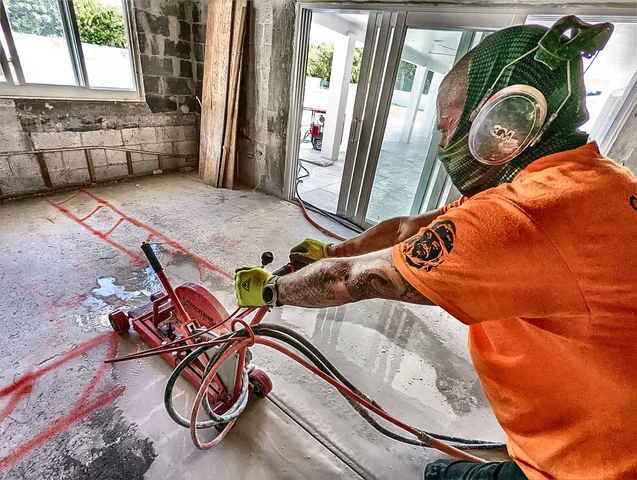
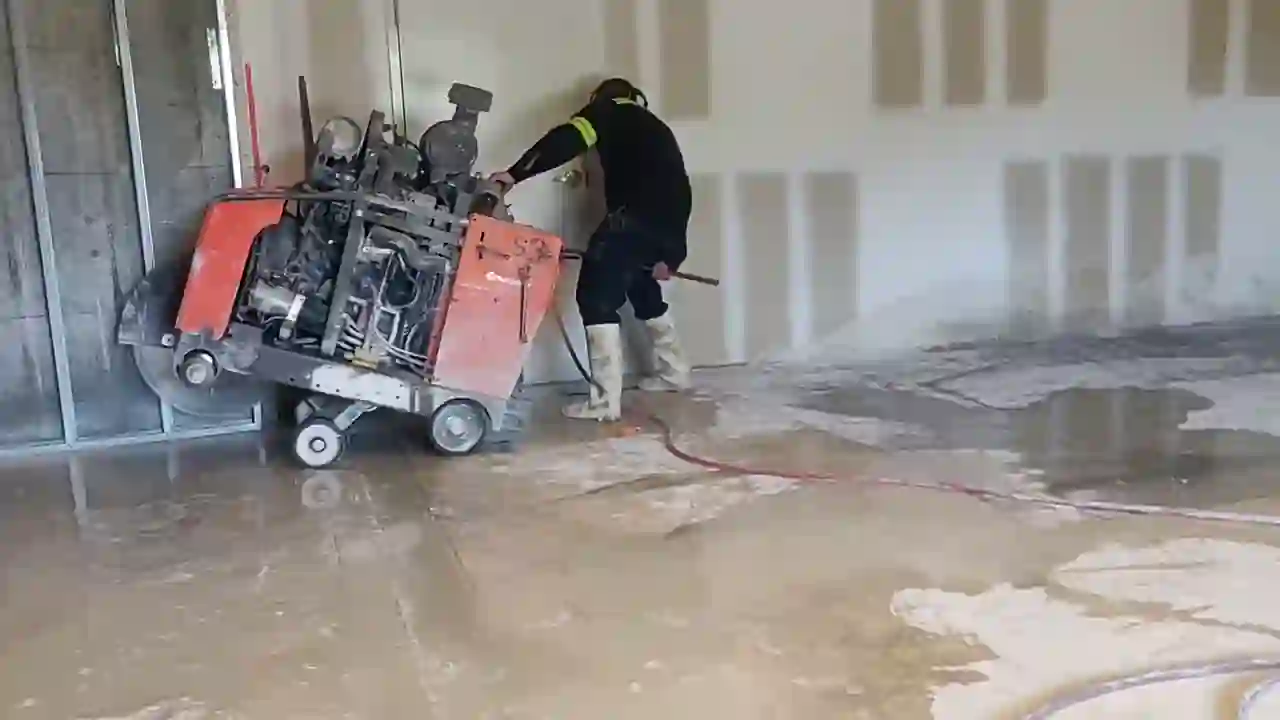
A standard wall saw on a track system is the workhorse for doorway openings in concrete. It delivers straight, controlled cuts with water-cooled diamond blades up to 18 inches in diameter, capable of cutting through walls up to 24 inches thick in a single pass from one side. But a wall saw requires track mounting, which demands a flat, accessible wall face and enough lateral clearance to position the drive unit — typically 18 to 24 inches of side clearance minimum.
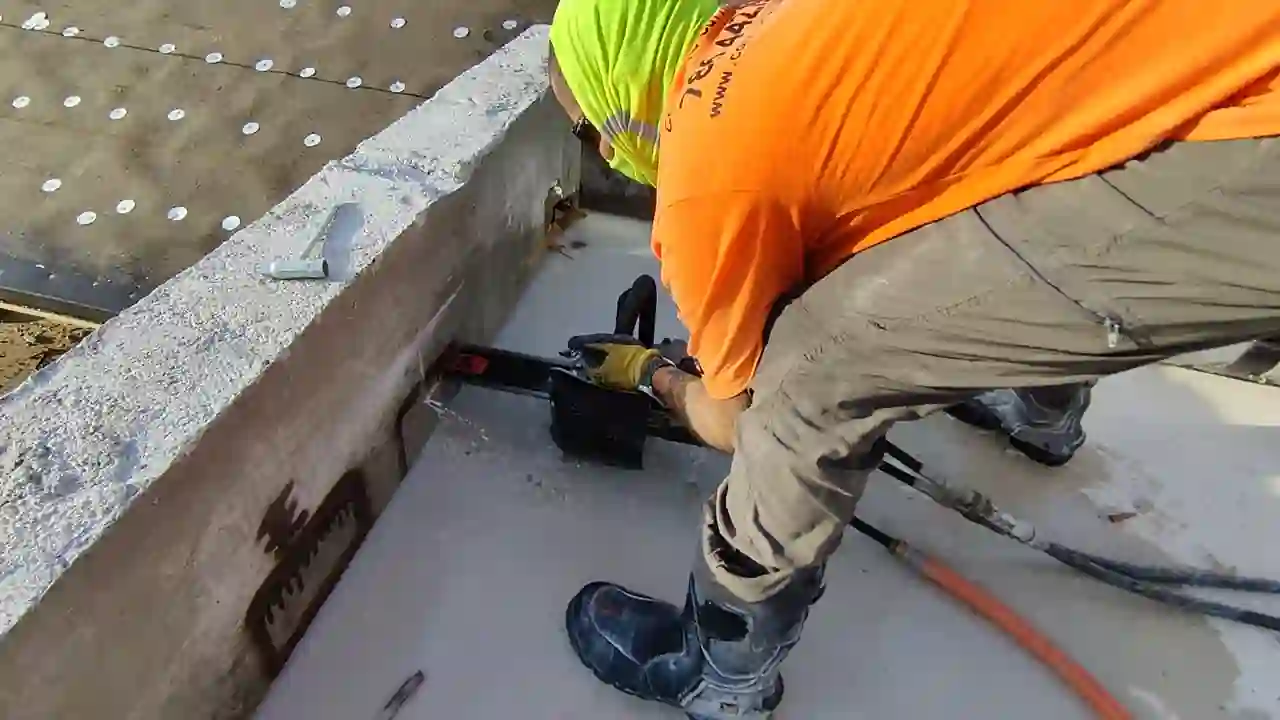
When that clearance doesn’t exist — a corner location, a wall directly adjacent to a structural column, or a mechanical room where equipment is bolted to the wall face — we shift to handheld ring saws or chain saws. Ring saws like the Husqvarna K760 with a 350mm diamond blade give us cutting depths up to 135mm per pass, requiring multiple overlapping passes for thicker walls. Chain saws — hydraulic or electric — handle depths up to 400mm and are particularly effective in CMU block walls where the uniform material allows consistent chain speed. The tradeoff is operator fatigue and vibration exposure in tight spaces, which requires mandatory rotation schedules under OSHA’s hand-arm vibration guidelines.
For extremely confined conditions — think a 36-inch-wide utility corridor or a basement mechanical room — we’ve deployed core drill sequences to define corners, followed by hand-guided ring saw cuts between cores. It’s slower, but it eliminates the need for any equipment footprint beyond the operator’s stance.
Slurry Control and Dust Suppression in Enclosed Environments
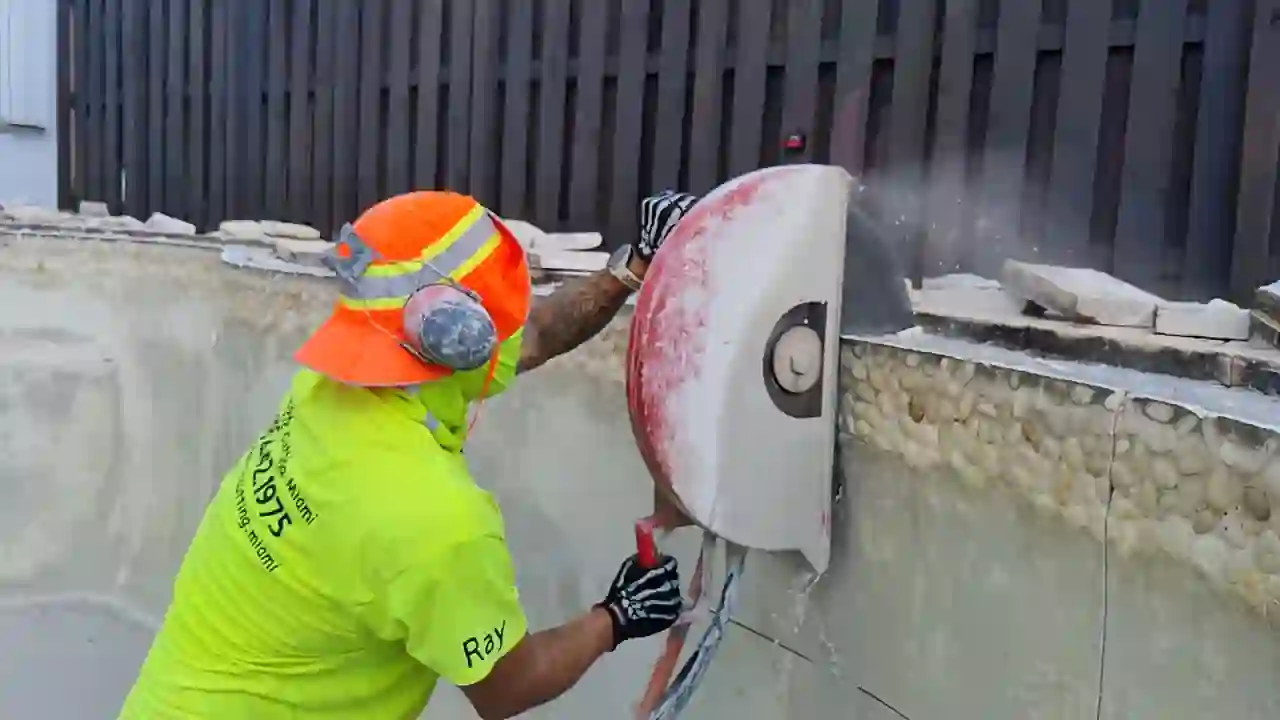
Water-cooled diamond cutting produces slurry — a mixture of water, fine concrete particulate, and in older construction, potentially silica-heavy aggregate. In an open exterior environment, slurry management is straightforward. In a confined interior space, it becomes one of the most operationally complex parts of the job.
OSHA’s silica standard (29 CFR 1926.1153) mandates that wet cutting methods be paired with engineering controls to prevent slurry splash and airborne respirable silica. In a closed room, this means vacuum-assisted blade guards, containment berms around the cut zone, and a wet-vac system running continuously. Our crews use HEPA-filtered industrial vacuums rated for concrete slurry — standard shop vacs are not compliant and will fail rapidly under the particulate load of a wall cut.
Ventilation is the other half of the equation. Even with wet cutting, fine aerosols become airborne in enclosed spaces. We establish forced-air ventilation using ducted fans to create positive pressure exhaust toward an exterior opening, and all operators wear P100 half-face respirators as a minimum. In spaces below grade or with no natural ventilation path, we bring in portable air scrubbers with HEPA filtration rated for the cubic footage of the work area. This is non-negotiable. The demolition techniques tag on our blog covers air quality management across multiple cutting scenarios if you want to go deeper on this topic.
Panel Removal Logistics — The Part That Injures People When It’s Ignored
Cutting a doorway opening in a concrete wall produces a panel of concrete that needs to come out of the wall and out of the building. A 36-inch by 80-inch doorway opening cut through an 8-inch poured concrete wall produces a panel weighing approximately 900 to 1,100 pounds. In a wide-open commercial space, that panel gets rigged, lifted with a mini-crane or telehandler, and walked out. In a confined space, you have none of those options.
The standard approach for confined panel removal is segmented cutting — rather than cutting the full opening as a single panel, we make horizontal and vertical subdivision cuts to break the opening into sections of 150 to 250 pounds each. These segments can be handled with a two-person carry, a panel cart, or a small electric pallet jack depending on floor conditions. Each subdivision cut adds time and blade wear, but it eliminates the rigging requirement and the catastrophic risk of an unsupported panel failing during removal.
Core drill anchor points are sometimes used to rig come-alongs or chain hoists from overhead structure, allowing controlled lowering of larger segments even in confined conditions. This requires overhead structure with verified load capacity — something we confirm with the structural drawings before rigging anything.
Access Routes and Equipment Staging in Urban Miami Job Sites
Miami’s urban residential and commercial density creates staging challenges that suburban markets simply don’t face. Getting a wall saw, vacuum system, water supply, and generator into a second-floor condo unit in Brickell — through a service elevator with a 48-inch door — requires equipment breakdown, component-by-component transport, and reassembly on-site. We account for this in every estimate. If a job requires three hours of equipment staging that wouldn’t exist on a ground-floor commercial site, that cost is real and it belongs in the quote.
Water supply is another access constraint that catches clients off guard. Wall saws require continuous water flow — typically 2 to 4 gallons per minute — for blade cooling. On a job site with no active plumbing, we bring water in IBC totes and pump from a reservoir. On upper-floor jobs, we may need to run supply lines from a lower-floor connection. Either way, it requires planning before the crew arrives. For a broader look at how access and logistics affect project costs across concrete cutting work types, our post on what concrete cutting for plumbing actually costs gives useful cost-per-factor context that applies directly to wall opening work.
When the DIY Option Becomes a Liability
We see the aftermath of DIY concrete wall cutting attempts more often than we’d like. The pattern is consistent — a homeowner or general contractor rents a handheld saw, cuts without scanning for rebar or post-tension cables, and either damages the saw, binds the blade in rebar, or worse, cuts through a post-tension tendon that releases stored energy violently into the work area. Post-tension failures in confined spaces are catastrophically dangerous. They are also expensive to remediate — a severed tendon in a PT slab or wall requires specialized repair that can cost multiples of what the original professional cut would have cost.
Beyond the physical risk, unpermitted structural cuts in Miami-Dade trigger stop-work orders, require after-the-fact engineering assessments, and can affect property insurance coverage and resale title. The DIY construction tag on our blog covers where the line is between manageable DIY scope and work that requires licensed contractors — worth reading before you decide to rent a saw.
What a Professional Site Assessment Actually Covers
When Concrete Cutting Miami, LLC. sends a project manager to assess a wall opening job, we’re documenting the following before we price anything: wall material and thickness, load-bearing status and shoring requirements, rebar and PT cable locations via GPR scan, equipment access route dimensions, water supply availability, ventilation path options, slurry containment feasibility, panel removal method, and permit requirements under Miami-Dade Building Code. That assessment typically takes 45 to 90 minutes on-site and prevents the kind of mid-job surprises that blow schedules and budgets.
Cutting concrete walls for doorways in confined, access-limited environments is genuinely technical work. The cutting itself — once everything else is in place — is often the fastest part of the day. The preparation, logistics, and safety management are where the expertise lives, and where the difference between a clean, compliant opening and a costly failure gets determined.