Why Filled-In Pool Concrete Destroys Standard Diamond Blades Before the Second Pass
Walk onto a job site where a pool has been filled in — even one that was done professionally — and the slab you’re looking at is not a uniform material. It’s a geological layer cake of original gunite shell, grout patches, hydraulic cement fills, compacted base rock, and in many South Florida cases, a cap pour of standard 3,000 PSI concrete on top. Every one of those layers has a different hardness rating, aggregate composition, and bond strength. When you drag a blade through that stack without accounting for those transitions, you’re not cutting concrete — you’re grinding your segment bond into dust. This is the core of every filled-in pool problem that crews run into on Miami-Dade and Broward job sites, and it starts with a fundamental mismatch between blade specification and material hardness.
Understanding the Material Stack in a Filled Pool Slab
Before any blade gets selected, you need a material profile of what you’re cutting. A typical filled-in residential pool in Miami will have the following cross-section from top to bottom:
- Cap slab: 4 to 6 inches of poured concrete, typically 3,000–4,000 PSI, often with #3 or #4 rebar on 12-inch centers
- Fill material: Compacted crushed limestone, sand, or mixed demolition debris — this layer is the wildcard
- Original gunite shell: 3 to 4 inches of pneumatically applied shotcrete, typically 5,000–6,000 PSI with high silica content
- Pool plaster or marcite: A thin, extremely abrasive calcium carbonate and white cement finish coat
That plaster layer is what nobody talks about. Marcite and white plaster are among the most abrasive materials a diamond segment will ever contact. If your blade enters from below — or if you’re cutting through a section where the pool shell is exposed — that calcium-rich layer will open segment pores aggressively and accelerate bond wear at a rate three to five times faster than standard concrete. For crews doing industrial concrete cutting work in South Florida, this is a known variable. For general contractors who bring in a flatsaw without a material briefing, it’s a surprise that costs them a $400 blade in 40 linear feet.
Diamond Blade Specifications for Layered Pool Fill Material
The correct blade for cutting into a filled pool slab is not the correct blade for cutting a standard driveway or warehouse floor. Here’s what the specification sheet needs to look like:
Segment Bond Hardness — Match It to the Hardest Layer
Diamond segment bond is rated on a scale from soft to hard. Soft bonds release diamonds faster, which is ideal for hard, low-abrasion materials like high-PSI concrete or granite. Hard bonds hold diamonds longer, which is correct for soft, highly abrasive materials. Filled pool slabs require a medium-to-hard bond segment — specifically because the gunite shell and plaster layers are simultaneously hard and abrasive. Using a soft bond blade in this material causes catastrophic segment loss within the first 20 feet of cut. Specify a bond hardness in the range of H6 to H8 on a 10-point scale for layered pool fill applications.
Diamond Concentration and Grit Size
For mixed hardness material, you want a medium diamond concentration (30–40 concentration index) with a grit size between 30 and 40 mesh. Coarser grit cuts faster but wears faster through the abrasive plaster. Finer grit holds up better but can glaze over when transitioning into the softer fill layers. The 30–40 mesh range gives you a workable balance across the full depth of cut. Avoid high-concentration blades above 50 index for this application — they’re engineered for consistent, predictable material, not the variable hardness transitions you’ll encounter in a pool fill stack.
Blade Diameter and Arbor Specifications
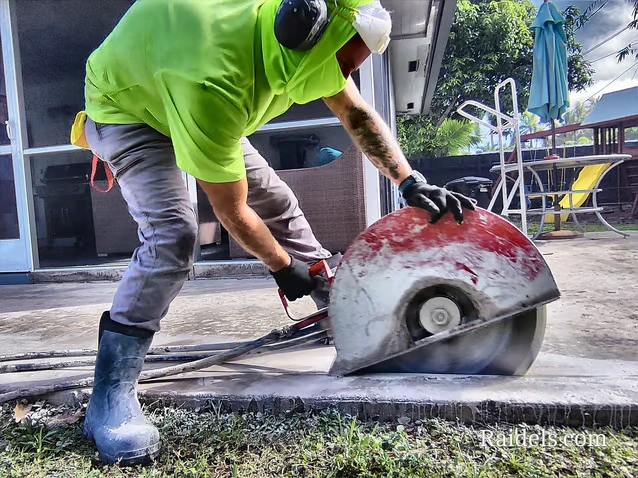
For flatsaw work on filled pool slabs, the standard is a 14-inch to 18-inch diameter blade with a 1-inch arbor bore. Depth of cut requirements on pool fill work typically run 6 to 10 inches to get through the cap slab and into the fill material. A 14-inch blade on a walk-behind flatsaw gives you approximately 4.5 inches of cut depth at full guard exposure — not enough for the full stack. You need either an 18-inch blade for 6.5-inch effective depth or a larger 20-inch blade on a high-horsepower machine if you’re cutting all the way through to the original shell in a single pass.
Equipment Specifications for Filled Pool Cutting Operations
Blade selection is only half the equation. The machine running the blade has to be spec’d for the material load, and filled pool slabs put enormous demand on drive systems and water delivery.
Engine Power and Blade Peripheral Speed
Optimal peripheral speed for diamond blades in hard-abrasive concrete is between 4,500 and 5,500 surface feet per minute (SFPM). For an 18-inch blade, that translates to approximately 950 to 1,150 RPM at the arbor. Most professional walk-behind flatsaws in the 35–65 horsepower range will hit this spec. The issue with filled pool work is that the variable material density causes blade loading — the saw bogs, RPM drops, and you’re suddenly running at 600 RPM through gunite. At that speed, the blade stops cutting and starts rubbing, generating heat that sinters the segment bond and kills the blade. Specify a machine with a minimum of 35 HP and an automatic blade speed governor if available.
Water Flow Rate and Slurry Management
Water cooling is non-negotiable for filled pool cutting. The standard minimum is 3 gallons per minute at the blade, but given the heat generated by the abrasive plaster and gunite layers, experienced crews run 4 to 5 GPM with dual-port blade guards. Insufficient water flow is the single most common cause of segment delamination on this type of job. The slurry produced from pool fill cutting is also chemically distinct from standard concrete slurry — it contains calcium carbonate from the plaster and can have a higher pH. Review Miami’s environmental compliance requirements for slurry disposal before the job starts, because pool-fill slurry often requires containment and off-site disposal.
Blade Tensioning and Flange Specifications
Blade flutter is amplified when cutting through voids and fill transitions in pool slabs. If the fill material was not compacted uniformly — and it rarely is — the blade will encounter sudden drops in resistance that cause lateral deflection. Use diamond blades with a minimum core thickness of 0.130 inches for 18-inch applications, and specify tension-stressed cores (laser-cut expansion slots) to manage heat-induced core distortion. Flanges must be matched to blade diameter: use a minimum 3.5-inch flange diameter for 14-inch blades, and 4.5-inch flanges for 18-inch and larger. Undersized flanges on large blades in variable material are a safety issue, not just a performance issue.
Cutting Sequence Strategy to Extend Blade Life on Pool Fill Jobs
Even with correct blade specification, the sequence of cuts matters. Always make a relief cut at 2 inches depth first to score through the cap slab surface and expose any embedded rebar. This lets you identify rebar spacing before committing to full-depth passes. Rebar in filled pool slabs is frequently irregular — contractors doing quick fill jobs don’t always follow engineered rebar layouts. Hitting unexpected rebar at full depth with a worn segment is how blades crack and cores delaminate.
After the relief cut, proceed in incremental depth passes of 2 to 3 inches, increasing depth per pass rather than cutting to full depth in a single run. This staged approach reduces thermal loading on the segment and allows the operator to identify material transitions — particularly the transition from fill material into the original gunite shell — before the blade is fully committed. For detailed cost modeling on multi-pass cutting operations, the breakdown at concrete saw cutting cost per linear foot in 2025 gives accurate benchmarks for filled pool work specifically.
When Core Drilling Into Pool Fill Requires Different Tooling Entirely
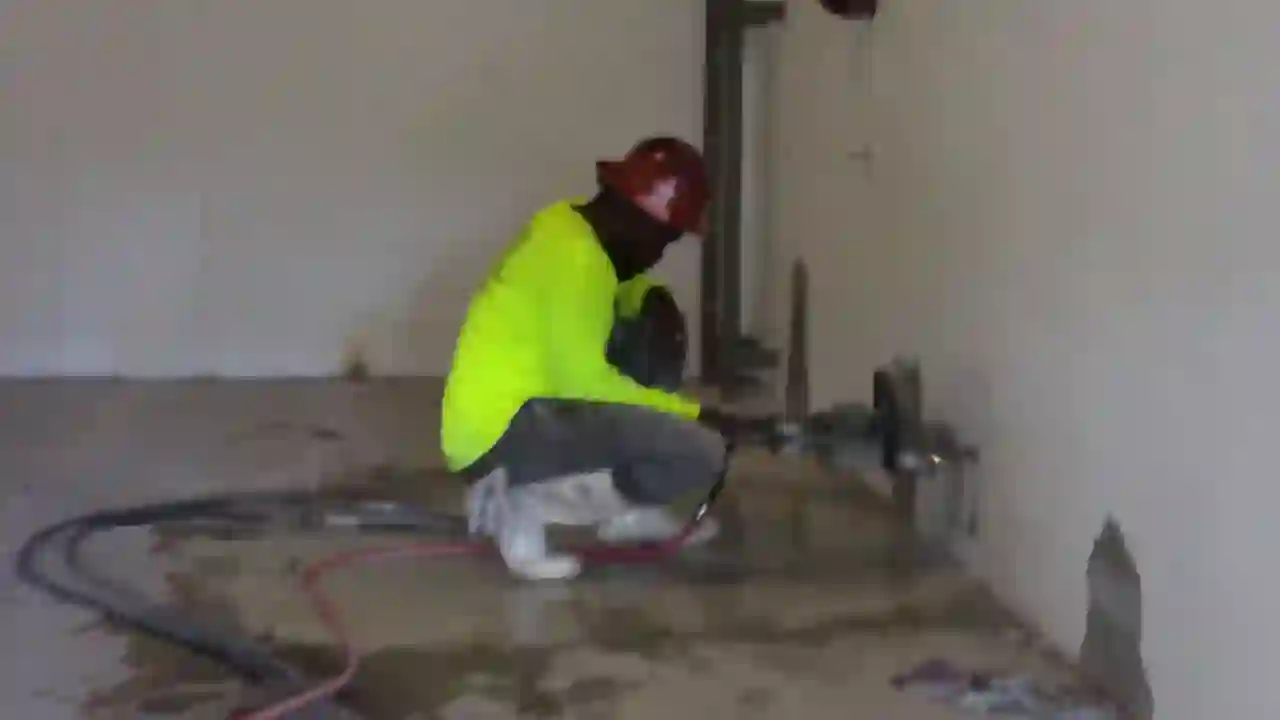
Not all filled-in pool problems involve flatsaw work. When utility penetrations, drainage cores, or structural tie-ins need to go through the filled pool slab, core drilling introduces a separate set of tooling challenges. The variable material hardness that destroys flatsaw blades also destroys core bits — but differently. In core drilling, the problem is bit whip and segment undercutting when the bit transitions from the hard gunite layer into the soft fill material. Specify turbo-segment core bits with a minimum segment height of 15mm for diameters above 4 inches, and use a vacuum-base drill rig rather than a hand-held unit to eliminate lateral movement during material transitions. Refer to construction best practices for South Florida concrete operations for additional guidance on drill rig anchoring in post-fill slab conditions.
For projects where the filled pool is part of a larger site development — new construction over an existing pool footprint, for example — the cutting scope often extends beyond the pool boundary into adjacent slabs and grade beams. Those surrounding elements are typically standard poured concrete and can be cut with conventional tooling. Segment your blade inventory accordingly: don’t run your pool-spec medium-hard bond blade through standard concrete, because it will underperform and glaze. Keep separate blade sets for each material zone on the job. Review the full scope of Florida construction cutting requirements when planning multi-zone demolition work on filled pool sites.
What the Right Tooling Setup Actually Costs You Versus What the Wrong Setup Costs You
A properly specified 18-inch medium-hard bond blade for filled pool work costs between $280 and $420 depending on diamond concentration and manufacturer. A standard general-purpose blade in the same diameter runs $90 to $150. The math that matters is not the purchase price — it’s the linear footage per blade. A correctly specified blade on filled pool material will cut 150 to 250 linear feet before requiring replacement. A mismatched general-purpose blade in the same material will fail at 30 to 60 linear feet, often catastrophically rather than gradually. On a pool fill job with 400 linear feet of required cutting, the wrong blade costs you 6 to 8 blade changes and the associated downtime. The right blade costs you 2. The upfront tooling investment is not the variable that drives job profitability — blade failure rate is.
Filled-in pool problems are solvable problems. They require a disciplined approach to material analysis, blade specification, equipment setup, and cutting sequence. Every element of the tooling chain — bond hardness, grit size, core thickness, flange diameter, water flow rate, and machine horsepower — has to be matched to the specific material stack you’re cutting through. When those variables align, filled pool slabs cut cleanly, on schedule, and within budget. When they don’t, you’re replacing blades on the clock and explaining delays to a GC who doesn’t want to hear about diamond concentration indexes.