Why Golden Beach Demolition Projects Face a Higher Environmental Bar Than Anywhere Else in Miami-Dade
Golden Beach is not a typical Miami-Dade municipality. Sandwiched between the Atlantic Ocean and the Intracoastal Waterway, this 0.3-square-mile enclave operates under overlapping environmental jurisdictions that include Miami-Dade DERM, the Florida Department of Environmental Protection, and the U.S. Army Corps of Engineers when coastal setbacks are involved. When a contractor drills, saws, or demolishes reinforced concrete here, every gallon of process water and every pound of concrete slurry becomes a potential compliance liability. Stormwater drains in Golden Beach discharge directly to tidally influenced canals, meaning a single uncontrolled slurry release can introduce high-pH, silica-laden effluent into a Class III water body within minutes. That is not a theoretical risk — it is the operational reality that every construction project in this corridor must be engineered around from day one.
Understanding Concrete Slurry Chemistry and Why It Threatens Coastal Ecosystems
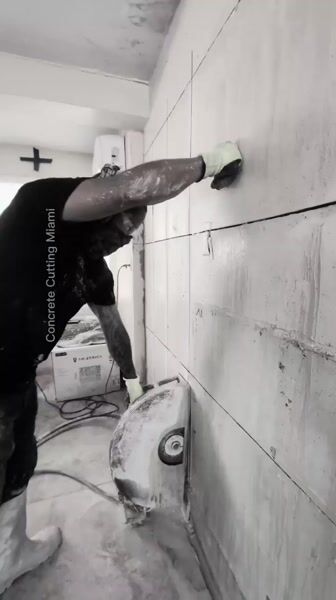
Concrete slurry is the byproduct of wet diamond cutting, core drilling, and grinding operations. It is not simply gray water. Freshly generated slurry carries a pH between 11 and 13 — highly caustic — along with suspended crystalline silica particles, heavy metals leached from rebar corrosion byproducts, and fine calcium hydroxide particulates. When this mixture contacts a marine or estuarine environment, the alkalinity spike alone can kill benthic organisms, disrupt fish gill function, and destabilize the pH buffering capacity of shallow coastal waters. Golden Beach’s proximity to Biscayne Bay’s northern reaches makes this a genuine ecological threat, not a bureaucratic formality. Contractors who treat slurry management as an afterthought routinely face stop-work orders, consent agreements, and remediation costs that dwarf the original project budget.
For environmental compliance in this zone, the baseline requirement is zero uncontrolled discharge. That standard shapes every equipment selection, every crew protocol, and every site layout decision Concrete Cutting Miami makes before a blade ever touches a slab.
Closed-Loop Water Containment Systems for Coastal Demolition Sites
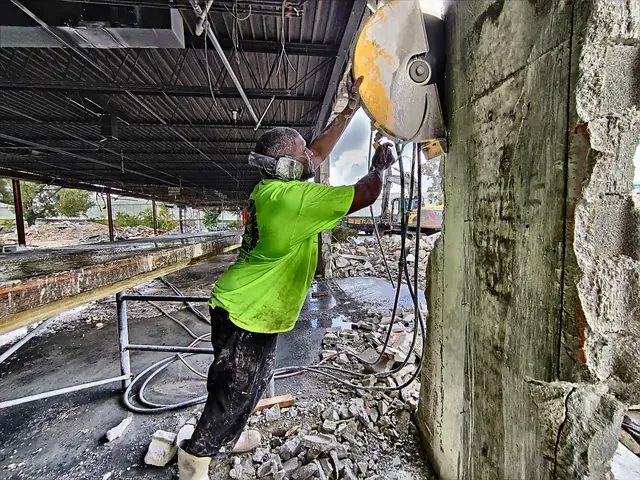
The cornerstone of compliant wet cutting in Golden Beach is a closed-loop water recovery system. Rather than allowing process water to sheet-flow across a slab and into adjacent drains, a closed-loop setup recirculates filtered water back to the cutting head while capturing all slurry in a sealed collection circuit. Here is how the system is configured for a typical Golden Beach slab demolition or core drilling scope:
- Perimeter berming with HDPE sheeting: A minimum 6-inch berm of compacted sand or pre-formed polyethylene channel is installed around the entire work zone before any wet cutting begins. HDPE sheeting with a minimum 20-mil thickness lines the containment field to prevent ground infiltration.
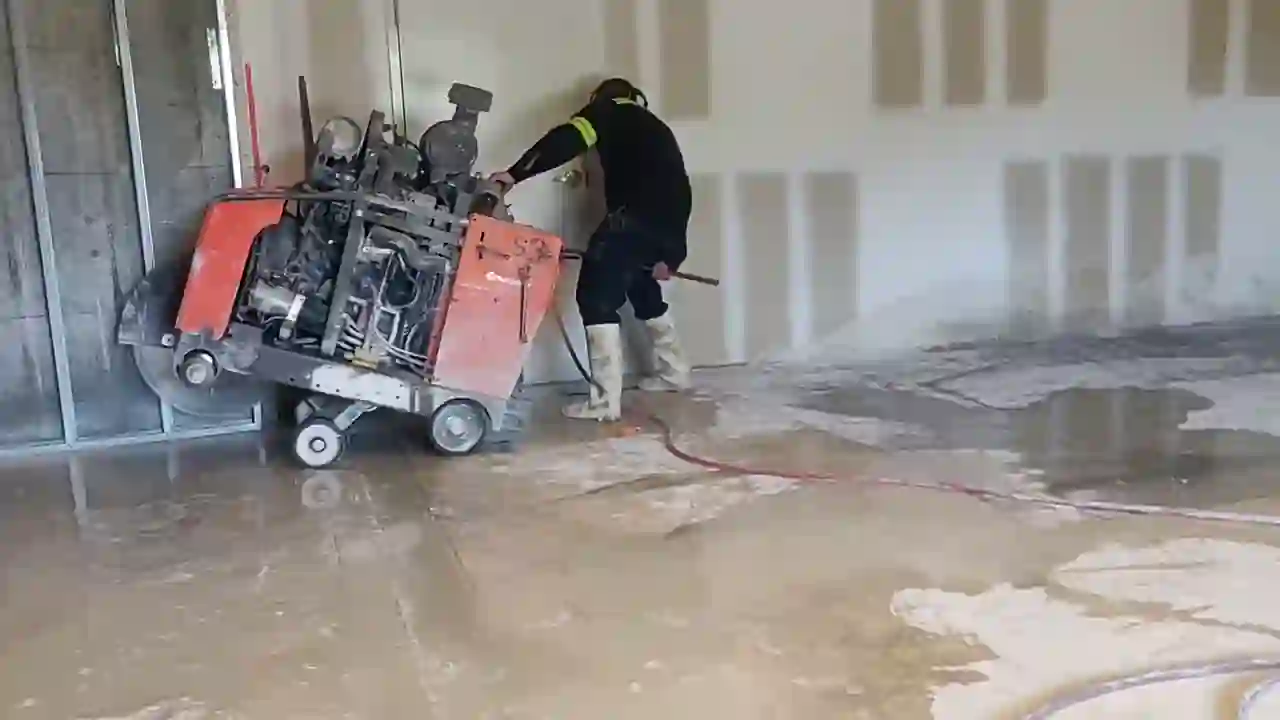
- Vacuum-assisted slurry extraction: Industrial wet-vac units rated at 150 CFM or higher continuously pull slurry from the low points of the containment field. This prevents pooling that could overflow the berm during high-volume cutting operations like wall sawing or concrete core drilling in Miami coastal projects.
- On-site settling tanks: Slurry flows into a two-stage settling tank system. The first stage captures coarse aggregate and rebar scale. The second stage allows fine silica particles to drop out of suspension. Clarified water is tested for pH before any recirculation or disposal decision is made.
- pH neutralization before recirculation: If clarified water reads above pH 9.0, a metered CO₂ injection or citric acid dosing system brings it to the acceptable range of 6.0–9.0 per Miami-Dade DERM discharge standards. Only neutralized water re-enters the cutting head supply line.
- NPDES Construction General Permit coverage: Projects disturbing one acre or more require a Notice of Intent filed with FDEP and a site-specific Stormwater Pollution Prevention Plan (SWPPP) that explicitly addresses concrete cutting and demolition waste.
- Solid waste manifest chain of custody: Dewatered concrete slurry solids must be tracked from generation to disposal at a licensed facility. Golden Beach inspectors have been known to request manifest copies at final inspection as a condition of CO issuance.
- Coastal construction setback verification: For any demolition within 50 feet of mean high water, CCCL (Coastal Construction Control Line) permit coordination with FDEP may be required even for interior slab work if the structure is within the CCCL jurisdiction.
Projects classified under renovation and selective demolition categories often qualify for streamlined permitting, but only when the contractor can demonstrate that no uncontrolled discharge will occur — which circles back to the closed-loop containment systems described above.
Equipment Positioning and Logistics on Golden Beach’s Narrow Coastal Lots
Golden Beach lots are narrow, often 75 feet wide or less, with minimal staging area between the structure and the property line. This constrains where settling tanks, vacuum equipment, and dewatering systems can be positioned. Concrete Cutting Miami uses trailer-mounted closed-loop units that consolidate the settling tank, vacuum pump, pH monitoring panel, and neutralization system into a single towable footprint under 20 feet long. This allows full containment infrastructure to be staged in a standard driveway or side yard without blocking emergency vehicle access — a specific requirement in Golden Beach’s tight street grid.
Crew coordination is equally important. On a site where slurry containment is active, every team member must know the location of the berm perimeter, the emergency shutoff for the water supply, and the overflow protocol if the primary settling tank approaches capacity. These are not informal understandings — they are written into the pre-task plan that Concrete Cutting Miami reviews with every crew before mobilization on a coastal compliance project.
Post-Demolition Site Verification and Regulatory Closeout
Compliance does not end when the last slab section is removed. Golden Beach and Miami-Dade inspectors expect documented evidence that the site was left in a condition that poses no ongoing environmental risk. This means the containment system must remain in place until all residual slurry is extracted and the work zone surface is clean of concrete dust and fine particulates. Final pH readings of any residual surface water must be logged and retained. Waste manifests must be signed by the receiving disposal facility and copies provided to the building department upon request.
Concrete Cutting Miami provides a project closeout package for every Golden Beach demolition engagement that includes dated pH logs, waste manifest copies, and photographic documentation of the containment system at installation and removal. This package has proven invaluable for clients navigating final inspections where environmental compliance is scrutinized as closely as structural completion.
The technical demands of golden beach construction and demolition are substantial, but they are entirely manageable when the contractor brings the right closed-loop systems, properly trained crews, and a rigorous documentation culture to the job. Every compliant project completed in this corridor is evidence that environmental stewardship and aggressive demolition timelines are not mutually exclusive — they simply require the right operational discipline from day one.