Why Concrete Slab Cutting Gets Complicated Before the Blade Ever Touches the Floor
Most project managers think concrete slab cutting is a straightforward line item. You call a crew, they show up with a walk-behind saw, and you’re done by noon. That assumption gets expensive fast. The reality on Miami job sites — especially in occupied buildings, underground structures, and post-tensioned slabs — is that the physical act of cutting is often the simplest part of the entire operation. What actually drives cost, schedule, and safety risk is everything that happens before and around that blade: how you get equipment into the space, how you manage slurry in a room with no drain, how you ventilate a basement level when OSHA confined space protocols kick in, and how you sequence cuts so a 4,000-pound slab panel doesn’t drop on a crew member or a structural beam below.
This post breaks down the logistical and technical layers that define a professional concrete slab cutting operation in constrained environments. If you’re a GC, structural engineer, or facility manager dealing with a slab modification in a space that wasn’t designed for demolition access, this is the operational framework your concrete cutting contractor should already be working from.
Reading the Site Before a Single Measurement Gets Taken
A seasoned concrete cutting crew does a site walk that looks nothing like a standard construction walkthrough. They’re not just checking ceiling height and floor condition. They’re mapping every constraint that will affect equipment staging, slurry management, power supply, and egress. On a typical Miami retrofit or renovation project, this means documenting the following with precision:
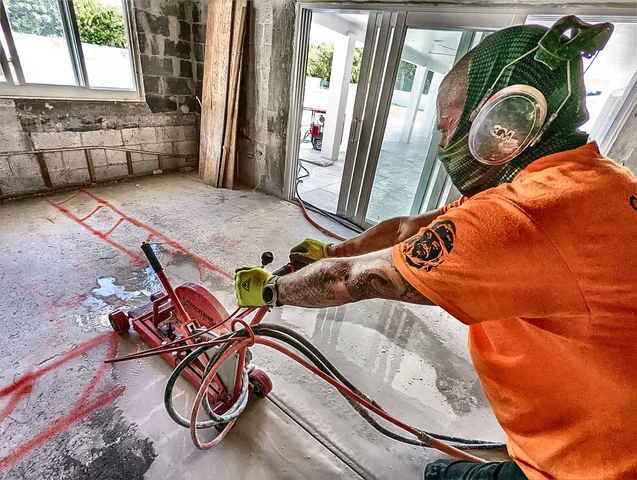
- Doorway and corridor clearances — Can a standard flat saw (which can weigh 800 to 1,200 lbs with the blade assembly) be broken down and reassembled inside, or does it need to be rigged through a window or freight elevator?
- Floor loading capacity — Particularly critical in occupied buildings or parking structures where the slab being cut is also supporting the equipment used to cut it.
- Existing penetrations and utility routing — GPR scanning is non-negotiable before any slab cutting begins, but the scan results have to be interpreted in context of the structural drawings to identify post-tensioning cables, conduit bundles, and embedded pipes.
- Drainage and slurry containment zones — Wet cutting generates significant slurry volume. In a basement or enclosed parking level, there may be no floor drains, which means portable vacuum slurry management systems have to be staged and routed to a legal disposal point.
- Ventilation capacity — Diesel flat saws are prohibited in most enclosed spaces without forced-air ventilation systems. Electric or hydraulic-powered saws are often the only compliant option in underground or occupied environments.
These aren’t checklist items — they’re decision gates. Each one can redirect the entire equipment and methodology selection before a single cut line gets marked.
Confined Space Classification and What It Actually Means for a Slab Cutting Crew
OSHA 29 CFR 1910.146 defines a permit-required confined space as any space large enough for a worker to enter, with limited means of entry or exit, and not designed for continuous occupancy. On Miami job sites, this definition applies more often than most GCs realize — and it directly governs how a concrete slab cutting operation must be structured.
Underground parking garages, mechanical rooms below grade, crawl spaces with limited headroom, and elevator pits all qualify under this standard when ventilation is inadequate and atmospheric hazards exist. The moment a concrete cutting crew introduces a combustion engine — even a high-efficiency propane unit — into one of these spaces, atmospheric oxygen levels and carbon monoxide concentrations become active safety concerns that require continuous monitoring.
A compliant confined space slab cutting operation in Miami requires an entry supervisor, an attendant stationed outside the space at all times, a rescue plan with equipment staged at the entry point, and continuous air monitoring for O2, CO, and combustible gases. This isn’t optional compliance theater — it’s the operational baseline that prevents fatalities. Contractors who skip this protocol aren’t saving money; they’re transferring liability to the GC and owner when something goes wrong.
For projects where confined space protocols apply, electric flat saws or hydraulic-powered units fed from a power pack staged outside the space are the standard solution. Our slab sawing services are specifically configured for these environments, with equipment packages that eliminate combustion inside the work zone entirely.
Slab Panel Weight Calculations and Rigging Logistics for Confined Cuts
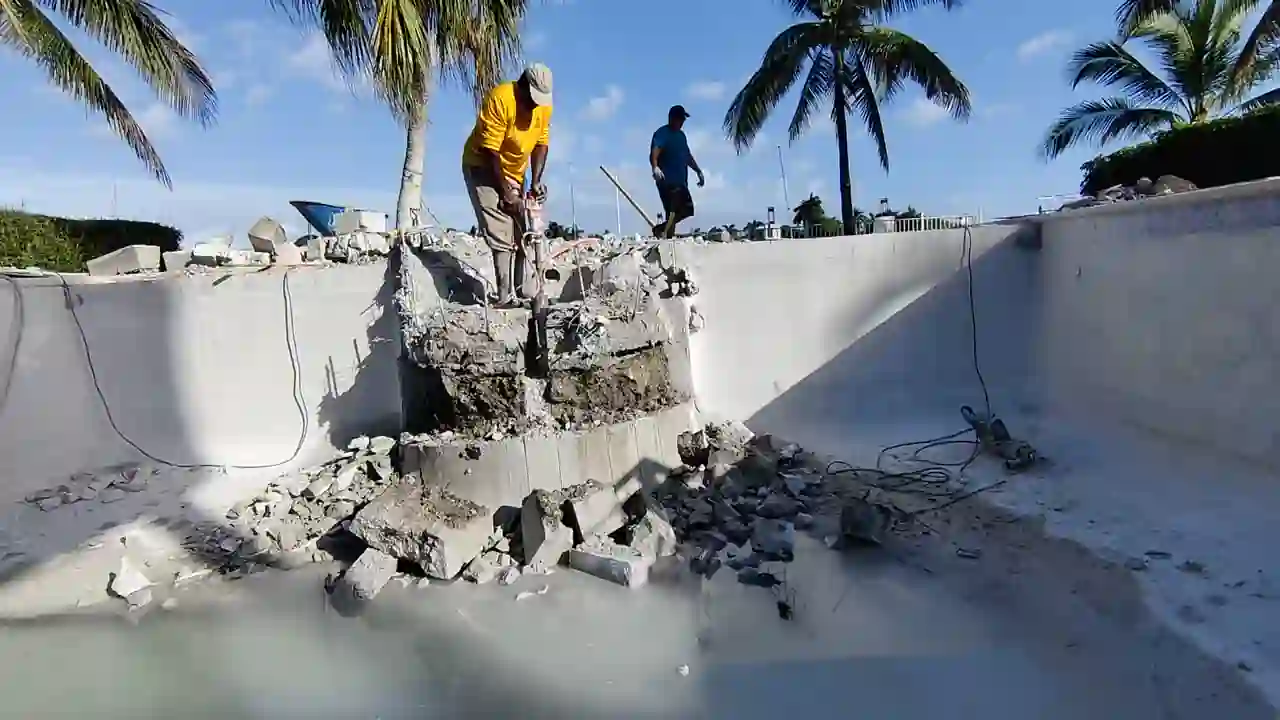
One of the most underestimated technical challenges in confined space slab cutting is what happens after the cut is complete. A 6-inch reinforced concrete slab weighs approximately 75 pounds per square foot. A 10-foot by 10-foot panel cut for a new stairwell opening weighs roughly 7,500 pounds. In an open exterior site, that panel gets lifted by a crane or telehandler. In a basement level with a 9-foot ceiling and no overhead rigging points, that same panel has to be broken into manageable sections, or the cut sequence has to be designed around a mechanical advantage rigging system attached to the existing structure.
This is where the concrete cutting contractor and the structural engineer have to be in direct coordination. The rigging attachment points for panel extraction cannot compromise the structural integrity of the slab section being retained. In post-tensioned slabs — which are extremely common in Miami’s mid-rise and high-rise construction — cutting must be sequenced to avoid releasing tendon tension in an uncontrolled manner, which can cause catastrophic slab movement.
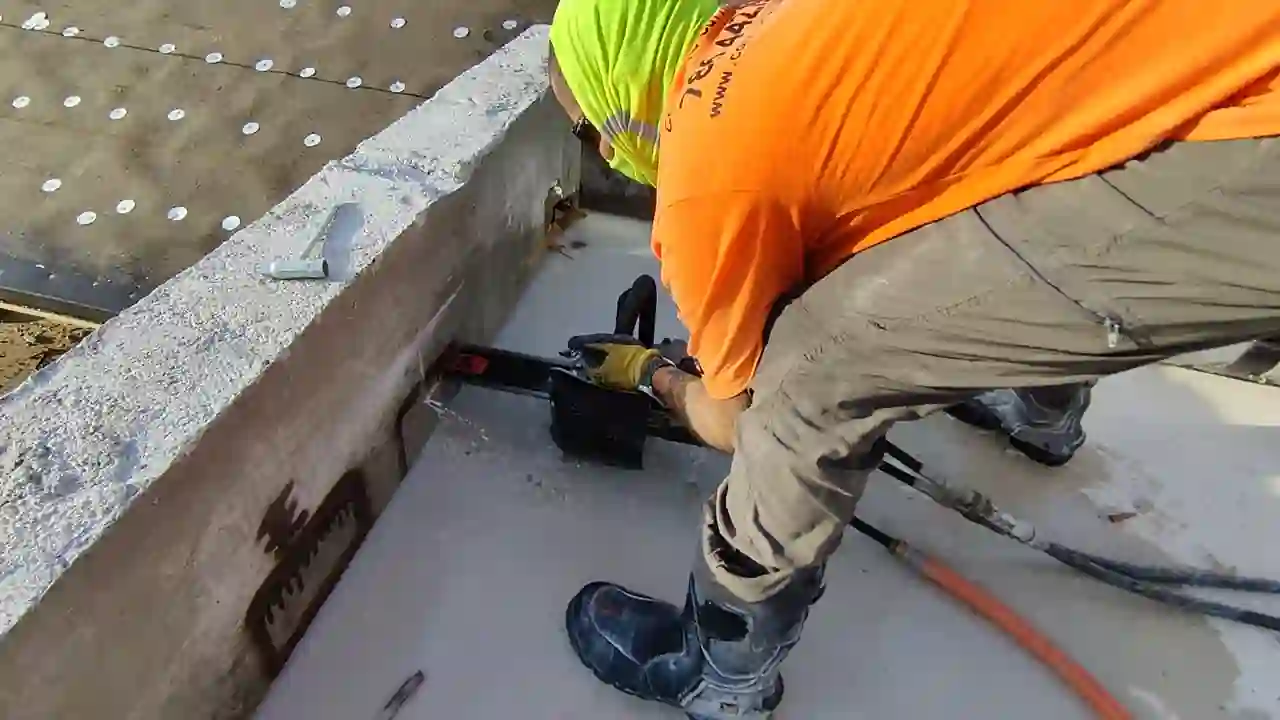
For complex confined cuts involving post-tensioned concrete, demolition chainsaw systems offer a distinct advantage over flat saws in certain configurations. Chain saws can plunge-cut from a vertical face, allowing operators to work from the perimeter of a panel rather than tracking across the full slab surface — which reduces the equipment footprint inside the confined space and gives riggers better access to the panel during extraction.
Slurry Management in Enclosed Environments — the Detail That Kills Schedules
Wet cutting concrete generates slurry at a rate that surprises contractors who’ve only worked on open exterior sites. A single 100-linear-foot cut through a 6-inch slab at standard blade speed produces roughly 30 to 50 gallons of slurry, depending on aggregate composition and water flow rate. In a basement or enclosed floor, that slurry has nowhere to go unless you’ve pre-planned a containment and extraction system.
The standard approach on confined Miami job sites involves a combination of perimeter berms made from hydraulic absorbent material, a wet-dry vacuum with a slurry-rated pump, and a holding tank staged at the nearest accessible drain point or at grade for truck-out disposal. Concrete slurry has a pH typically ranging from 11 to 13, which classifies it as a corrosive material under EPA guidelines — meaning it cannot be discharged to storm drains, and in many Miami-Dade jurisdictions, it requires documentation of proper disposal.
Projects that involve concrete pipe cutting in the same confined environment add another layer of slurry volume and containment complexity, particularly when the pipe cutting intersects with the slab penetration work. Understanding the true cost implications of this kind of multi-scope confined work is something we’ve detailed in our breakdown of what a concrete pipe cutting machine actually costs on a Miami job site.
Equipment Staging Sequences That Prevent Schedule Collapse
In confined slab cutting operations, equipment staging isn’t just a logistics detail — it’s a sequencing discipline that directly controls whether the project finishes on time. The staging sequence must account for the following in order:
- GPR scanning and structural drawing review — Completed and reconciled before any equipment enters the space.
- Ventilation system installation — Forced-air ducting established and tested before cutting equipment is introduced.
- Slurry containment setup — Berms, vacuum systems, and disposal routing confirmed operational.
- Equipment breakdown and reassembly — Large flat saws disassembled at the building entrance and reconstructed inside the space to fit through access constraints.
- Rigging pre-rig — Attachment points for panel extraction confirmed with the structural engineer before the first cut begins.
- Cut sequencing execution — Cuts made in the engineered sequence, not the most convenient sequence for the operator.
- Panel extraction and void protection — Temporary edge protection installed immediately after panel removal before any other trades access the space.
Deviating from this sequence — even on a single step — introduces compounding risk that experienced project managers recognize immediately. The most common schedule failure point is skipping the pre-rig confirmation, which results in a fully cut panel that can’t be safely extracted because the overhead attachment point wasn’t verified for load capacity before cutting began.
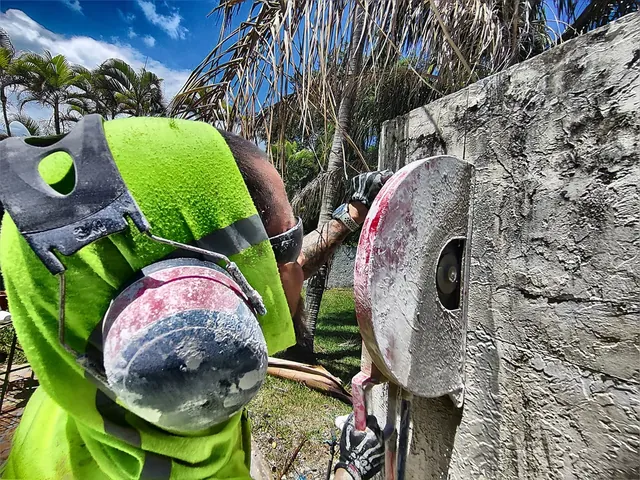
What Separates a Professional Confined Slab Cutting Contractor from a Standard Crew
The difference between a concrete cutting contractor who can handle confined space slab work and one who can’t isn’t just equipment — it’s the depth of pre-job planning, the OSHA compliance infrastructure, and the coordination capacity with structural engineers and GC site supervisors. Any crew can operate a flat saw on an open exterior slab. Executing a precise, compliant, schedule-driven slab cutting operation in a 9-foot-ceiling basement of an occupied Miami office building requires a fundamentally different operational model.
When you’re evaluating contractors for this type of work, the questions that reveal competence are direct: What’s your confined space entry protocol? How do you manage slurry in a space with no floor drain? What’s your equipment breakdown procedure for access through a 36-inch doorway? How do you sequence cuts in a post-tensioned slab? The answers to those questions tell you everything about whether the crew in front of you has actually done this work or is learning on your project.
Concrete slab cutting in constrained Miami environments is a precision discipline that demands technical rigor at every stage — from the initial site walk through the final panel extraction. The logistics aren’t secondary to the cutting. They are the cutting.