Why Slab Thickness Isn’t Just a Structural Calculation Anymore
When contractors and homeowners talk about concrete slab thickness for a house, the conversation almost always defaults to load-bearing capacity, rebar spacing, and compressive strength ratings. Those factors matter — but in South Florida’s regulatory environment, they represent only half the engineering equation. The other half involves what happens when that slab gets cut, cored, or partially demolished. Slurry generation, stormwater contamination, and environmental compliance aren’t afterthoughts. They are embedded into every inch of slab thickness you specify, pour, and eventually work through with a diamond blade. A 4-inch residential slab behaves completely differently from a 6-inch post-tensioned slab when a wet-cut saw runs through it, and the volume of cement-laden slurry produced scales directly with that depth differential. Understanding this relationship before the pour — not after the first renovation call — is what separates technically sound project management from expensive environmental liability.
Standard Residential Slab Thickness Specifications and What They Mean for Cutting Operations
In conventional residential construction across Miami-Dade, Broward, and Collier counties, ground-supported slabs for single-family homes typically range from 4 inches to 6 inches in thickness. The IRC (International Residential Code) sets a minimum of 3.5 inches for unreinforced slabs on grade, but local soil conditions — particularly the expansive fill soils and high water table zones common throughout South Florida — routinely push engineers toward 5-inch or 6-inch designs with #4 rebar on 18-inch centers. Thickened edge beams, often running 12 to 18 inches deep at the perimeter, add another layer of material volume that directly impacts cutting scope.
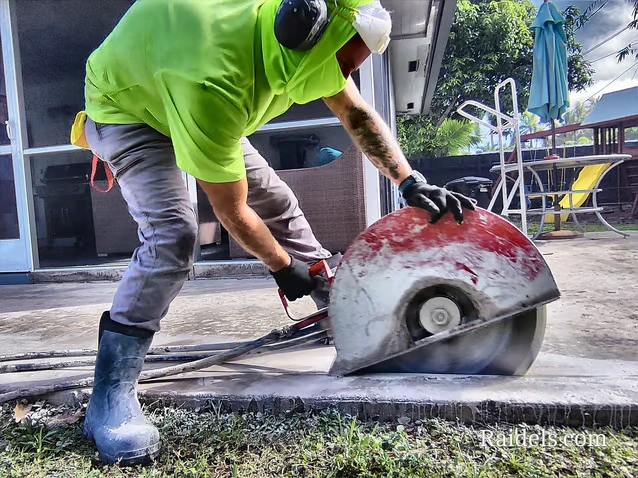
From a cutting contractor’s perspective, every additional inch of slab depth translates to a measurable increase in slurry output per linear foot of cut. A standard 14-inch diamond blade running at wet-cut RPMs through a 4-inch slab produces roughly 0.3 to 0.5 gallons of slurry per linear foot. Scale that to a 6-inch slab and you’re approaching 0.7 to 0.9 gallons per linear foot — nearly double. On a 200-linear-foot utility trench through a residential slab, that difference means the difference between managing 80 gallons of slurry and managing 160 gallons. In a state where cement slurry discharge to stormwater systems is a direct violation of the Clean Water Act and Florida Statute 403, that volume gap carries real legal weight. Explore how concrete slab sawing in Miami handles these volume-specific challenges across different slab configurations.
Slurry Chemistry and Why Alkalinity Levels Scale With Slab Thickness
Concrete slurry is not inert gray water. It is a highly alkaline suspension with a pH typically ranging from 11 to 13 — comparable to household bleach in terms of chemical aggressiveness. The primary driver of that alkalinity is calcium hydroxide (Ca(OH)₂), a byproduct of Portland cement hydration that leaches freely when cement paste is disrupted by cutting. Thicker slabs contain more hydrated cement paste per unit area, which means deeper cuts release proportionally more calcium hydroxide into the slurry stream. A 6-inch slab cut with a wet saw doesn’t just produce more slurry by volume — it produces slurry with elevated alkalinity compared to the same cut through a 4-inch slab, because the blade is contacting a larger cross-section of paste-rich concrete matrix.
This matters enormously for containment planning. Miami-Dade’s stormwater management regulations, enforced under the National Pollutant Discharge Elimination System (NPDES) permit framework, prohibit the discharge of any liquid with a pH above 8.5 to surface waters or stormwater conveyance systems. On residential job sites, where storm drains are often within 20 feet of the work area, a passive containment strategy — a few sandbags and a shop vac — is wholly inadequate for deep slab cuts. Contractors operating under Ft. Lauderdale construction protocols understand that active slurry management systems, including vacuum-assisted wet cutting rigs and pH neutralization equipment, are the only defensible approach on slabs exceeding 5 inches in thickness.
Active Containment Systems Matched to Residential Slab Depth Categories
The industry has moved well beyond passive containment for anything beyond light-duty slab work. Here’s how containment system selection should map to residential slab thickness categories:
- 3.5 to 4 inches (minimum code slabs): Wet cutting with a perimeter berm of absorbent booms, slurry vacuum recovery, and on-site settling tank with pH testing before disposal. Suitable for small-area cuts under 50 linear feet.
- 4 to 5 inches (standard residential): Vacuum-integrated saw systems with continuous slurry recovery. Settling tanks with a minimum 50-gallon capacity. pH neutralization using CO₂ injection or dry acid (sodium bisulfate) before any liquid disposal.
- 5 to 6 inches (engineered residential slabs): Full wet-vac recovery systems, dedicated slurry trailer or drum storage, mandatory pH testing at 30-minute intervals, and documented disposal at an approved facility. No on-site discharge regardless of proximity to drainage.
- Thickened edge beams (12 to 18 inches): Core drilling operations in these zones require dedicated slurry capture collars, vacuum-assisted extraction, and may require a site-specific Environmental Management Plan filed with the local municipality before work begins.
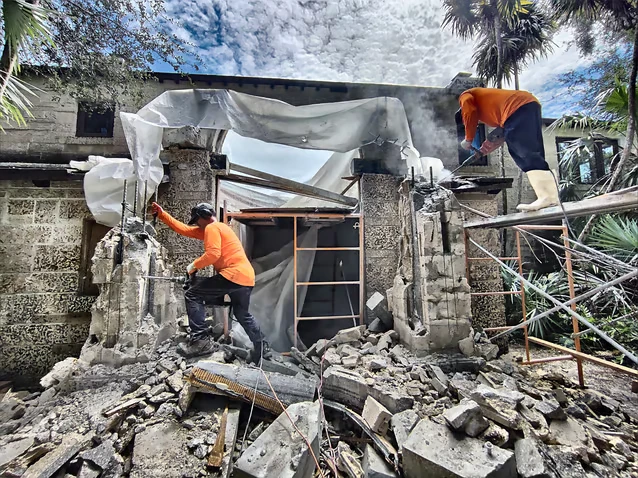
For contractors navigating complex residential demolition scopes, the selective demolition approach — removing only specific slab sections rather than full-slab demolition — significantly reduces total slurry volume and simplifies environmental compliance logistics.
Water Table Proximity and Its Effect on Slurry Containment Beneath the Slab
South Florida’s water table presents a containment challenge that contractors in other regions rarely encounter. In many Miami-Dade neighborhoods, the seasonal high water table sits within 12 to 24 inches of finish grade. When you’re cutting through a 5-inch residential slab with a thickened perimeter beam, your blade is potentially operating within inches of saturated soil. Wet-cut slurry that isn’t immediately vacuumed can migrate laterally through the saw kerf and infiltrate the subgrade, carrying alkaline chemistry directly into groundwater pathways.
This is not a theoretical risk. Florida Department of Environmental Protection (FDEP) enforcement actions have cited residential concrete cutting contractors for groundwater alkalinity impacts traced to inadequate slurry management during slab sawing. The corrective action costs in those cases — soil sampling, groundwater monitoring wells, and remediation reporting — routinely exceeded $15,000 per incident. Understanding the construction and demolition safety protocols required in high-compliance zones like Indian Creek Village illustrates exactly how seriously South Florida municipalities treat these environmental boundaries. The tool selection for these sensitive cuts also matters — review a ranked breakdown of concrete breaking tools to understand which options minimize slurry generation in water-table-sensitive environments.
Rebar and Post-Tension Cables — How Reinforcement Type Alters Slurry Composition
Reinforcement type within the slab adds a metallurgical variable to slurry chemistry. Standard mild steel rebar (ASTM A615 Grade 60) produces iron oxide particles in the slurry when the blade contacts it — visually identifiable as a reddish-brown tint in the slurry stream. Post-tension cables, increasingly common in South Florida residential construction for their crack-resistance benefits on expansive soils, introduce high-carbon steel particles when cut. Both contribute to slurry that requires more aggressive settling time before pH-adjusted disposal, because the metal particulates increase total suspended solids (TSS) beyond what cement paste alone generates.
Contractors working on concrete cutting projects in Naples, FL and across Collier County — where high-end residential construction frequently specifies post-tensioned slabs — need to account for this TSS elevation in their slurry management plans. Settling tanks should be sized at a minimum of 1.5x the calculated slurry volume when post-tension cables are present, and disposal manifests should accurately characterize the waste stream for the receiving facility.
Documenting Compliance on Residential Slab Cutting Jobs
Environmental compliance on residential concrete cutting jobs isn’t just about doing the right thing in the field — it’s about creating a defensible paper trail. Every job involving slab cuts through material exceeding 4 inches should carry the following documentation:
- Pre-job slurry management plan specifying containment method, disposal pathway, and pH neutralization protocol.
- Field pH logs recorded at regular intervals during cutting operations, with readings taken from the slurry collection point — not the blade contact zone.
- Disposal manifests for all slurry transported off-site, identifying the receiving facility and volume disposed.
- Post-job site inspection record confirming no residual slurry discharge to stormwater infrastructure, pervious surfaces, or vegetated areas.
- Photographic documentation of containment setup before work begins and site condition after cleanup.
These records protect the contractor, the homeowner, and the subcontractor chain from FDEP or municipal enforcement actions that can arrive months after a project closes. In Miami-Dade’s increasingly active environmental enforcement climate, documentation is not optional — it is the primary line of defense.
Specifying Slab Thickness With the Full Project Lifecycle in Mind
The most technically sophisticated approach to concrete slab thickness for a house treats the specification not as a one-time structural decision, but as a lifecycle parameter that shapes every future cutting, coring, and demolition event the slab will experience. A 6-inch slab delivers superior load distribution and crack resistance — but it also commits every future contractor who touches it to a higher-tier environmental management protocol. That commitment should be acknowledged in the original project specifications, budgeted into future renovation allowances, and communicated to homeowners who may not understand why a bathroom remodel requires a slurry disposal plan.
Structural engineers, general contractors, and specialty concrete cutting firms who operate at the intersection of technical performance and environmental compliance are the ones delivering projects that close without incident — and without regulatory callbacks. Slab thickness is the foundation of that calculation in every sense of the word.