What Actually Separates the Right Tool from the Wrong One on a Breaking Job
Walk onto any active demolition site in Miami-Dade or Broward County and you’ll see at least three different approaches to breaking concrete happening simultaneously. One crew is running a hydraulic breaker off an excavator. Another is using an electric rotary hammer with a chisel bit. A third is making control cuts with a walk-behind saw before anything gets broken at all. Every one of those choices was made based on slab thickness, reinforcement density, aggregate hardness, and access constraints. None of it was random — and if it was, the crew is bleeding money on broken tooling and rework. This post lays out the full equipment matrix for breaking concrete, with specific attention to diamond tooling specs, blade bond hardness, and the mechanical variables that determine whether your tool selection is going to perform or fail by noon.
Hydraulic Breakers — Carrier Class, Impact Energy, and Blow Rate Specs
Hydraulic breakers are the workhorses of large-scale concrete demolition. They mount to excavators, skid steers, and mini-excavators, and their performance is defined by two numbers: impact energy (measured in foot-pounds or joules) and blow rate (blows per minute, or BPM). A light-class breaker in the 200–500 ft-lb range is appropriate for slabs up to 6 inches unreinforced. Medium-class units running 1,000–3,000 ft-lb are the standard for reinforced flatwork, curbs, and light structural members. Heavy-class breakers exceeding 10,000 ft-lb are reserved for bridge decks, thick walls, and mass concrete foundations.
Tool steel selection on hydraulic breakers matters as much as the breaker itself. Moil-point chisels concentrate force for initial penetration in hard aggregate mixes like Miami’s high-silica limestone concrete. Blunt tools and flat chisels work better for spalling and secondary breaking once the initial fracture plane is established. Always match the tool steel diameter to the breaker’s bushing bore — running undersized tools causes accelerated wear on the retainer pins and front head casting. Hydraulic flow requirements typically range from 15–35 GPM depending on breaker class, and exceeding the carrier’s auxiliary hydraulic output will cause the breaker to cycle erratically and overheat.
Electric and Pneumatic Rotary Hammers — Joule Ratings and Chisel Geometry
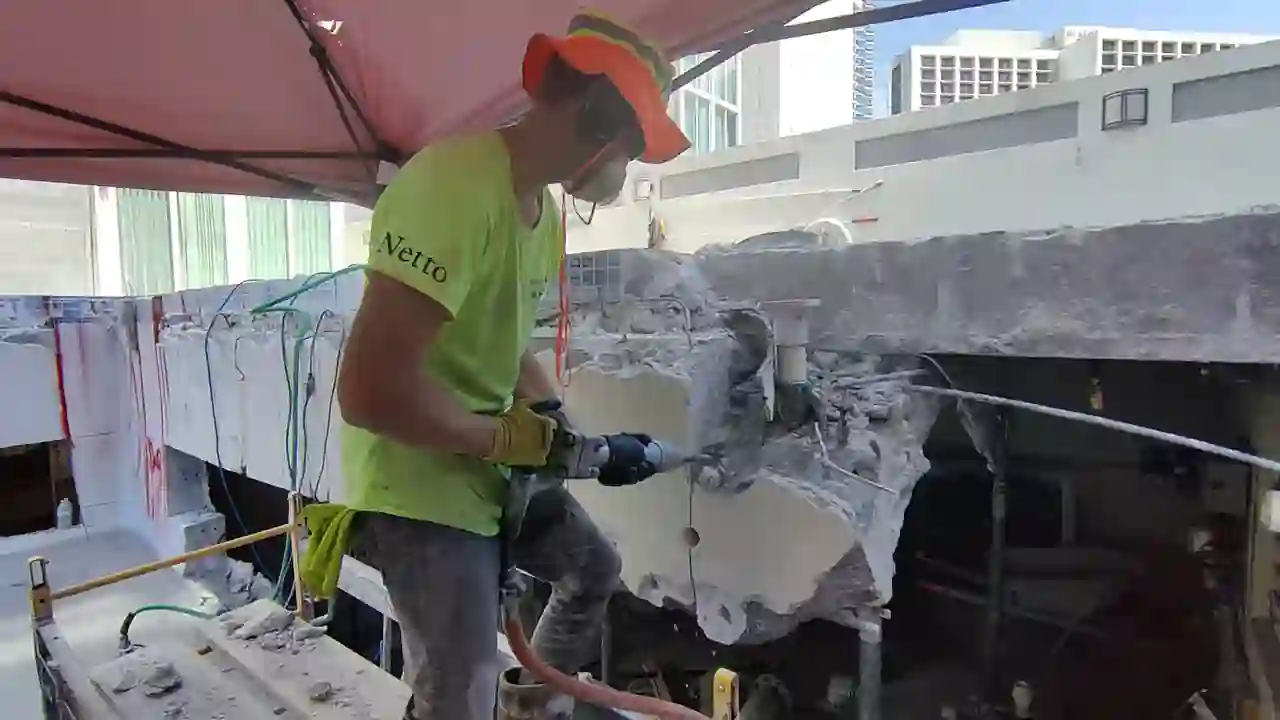
For interior demolition, confined spaces, and precision breaking where an excavator-mounted breaker would cause collateral damage, electric rotary hammers in the 10–30 joule class are the standard. The SDS-Max chuck system is the professional baseline — anything using SDS-Plus is a light-duty tool not suited for sustained concrete breaking on commercial projects. At the high end, 30-joule units like the Hilti TE 3000-AVR or Bosch GSH 27 deliver impact energy approaching small pneumatic breakers, making them viable for 4–6 inch slabs without rebar.
Chisel bit geometry directly controls how energy transfers into the slab. Bull-point chisels are ideal for crack initiation in dense concrete. Wide flat chisels (typically 2–3 inches wide) are used for secondary spalling and surface scaling. Pointed scaling chisels work for removing thin overlays and deteriorated surface concrete without damaging the substrate. Bit shank condition is critical — worn or damaged SDS-Max shanks cause energy loss at the chuck interface and increase vibration transmitted to the operator, which is a direct jobsite safety concern that Miami contractors routinely overlook.
Diamond Blade Specification for Pre-Breaking Control Cuts
Breaking concrete without pre-cutting is brute force. Breaking concrete after establishing control cuts with a diamond blade is engineering. The blade selection process for pre-breaking cuts involves four variables: segment bond hardness, diamond concentration, segment height, and core tensile strength.
Bond hardness must be matched to aggregate hardness. Miami’s local limestone and coral aggregate is classified as soft-to-medium on the Mohs scale. Cutting soft aggregate with a hard-bond blade causes glazing — the diamond crystals become polished and stop cutting before they shed. You need a soft-bond blade that releases worn diamonds quickly to expose fresh cutting edges. Conversely, cutting hard silica aggregate with a soft-bond blade causes premature segment wear. The Mohs hardness of your aggregate should drive every blade purchase decision.
Diamond concentration is expressed as a percentage or a standardized concentration number (typically 25–100). Higher concentration means more diamonds per cubic centimeter of segment matrix. High-concentration blades cut slower but last longer — appropriate for abrasive aggregate. Low-concentration blades cut faster with more aggressive exposed diamonds — appropriate for hard, non-abrasive aggregate where you need the diamonds to work harder before shedding.
Segment height determines blade life. Standard segments run 10–12mm in height. Premium blades for heavy production cutting go up to 15mm. For pre-breaking control cuts where you’re making shallow relief cuts at 1–2 inch depth, segment height is less critical than bond-aggregate match. For full-depth cuts through 6–8 inch reinforced slabs, you want maximum segment height to extend blade life across the full cut depth.
Walk-Behind Flat Saws — Engine Output, Blade Diameter, and Depth Capacity
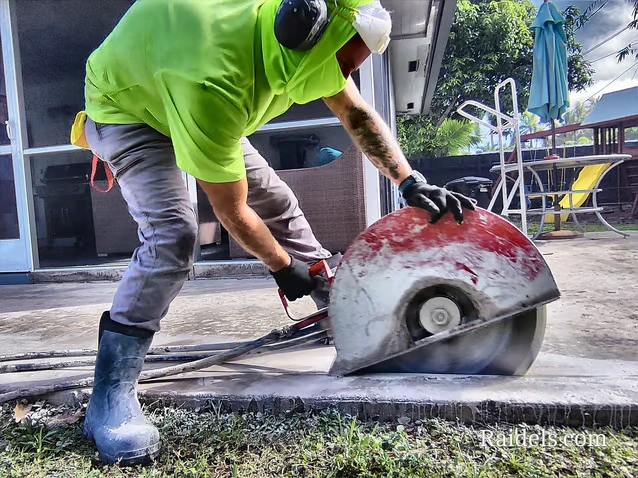
Walk-behind flat saws are the primary tool for making control cuts prior to breaking. Equipment selection starts with blade diameter, which directly determines maximum cut depth. The rule is roughly 1/3 of blade diameter equals maximum cut depth after accounting for blade guards and spindle height. A 14-inch blade gives you approximately 4.5 inches of cut depth. A 20-inch blade gets you to 7 inches. For full-depth cuts through standard 4–6 inch slabs, a 16–18 inch blade is the production standard in Miami.
Engine output on gas-powered flat saws ranges from 13 HP on compact units to 35+ HP on production saws. Underpowered saws bog down on reinforced concrete, causing the blade to pinch and stall — which is both a productivity killer and a blade-damaging event. Electric flat saws are increasingly common on interior jobs and in enclosed parking structures where exhaust ventilation is limited. Match your saw’s spindle RPM to the blade’s recommended operating speed — running a blade below its rated RPM reduces cutting efficiency and increases segment wear per linear foot of cut.
Blade arbor size must match the saw’s spindle exactly. Most production flat saws use a 1-inch arbor. Adapters exist but introduce runout that accelerates segment wear and can cause blade cracking at the core-segment interface. This is especially relevant when cutting door openings in Fort Lauderdale where precision and clean edges are non-negotiable for structural integrity.
Angle Grinders and Hand-Held Cut-Off Saws for Detail Breaking Work
For breaking out small sections, cutting around embedded conduit, or making relief cuts in tight corners where a flat saw can’t reach, angle grinders with 4.5–7 inch diamond cup wheels and cut-off saws with 12–14 inch segmented diamond blades are the go-to tools. The critical spec on angle grinders is arbor speed — most diamond cup wheels are rated for a maximum of 11,000–13,000 RPM. Exceeding rated speed causes segment separation, which is a serious safety hazard. Always verify the tool’s no-load RPM against the blade’s maximum RPM rating before mounting any diamond tooling.
Cut-off saws in the 14-inch class, such as the Husqvarna K 970 or Stihl TS 700, deliver 5+ horsepower and are capable of 5-inch cut depth with the right blade. These tools are frequently used for cutting expansion joints, trimming slab edges, and making plunge cuts in areas where a walk-behind saw cannot be positioned. Blade selection follows the same bond-hardness logic — but on hand-held tools, operator fatigue and vibration also factor into blade choice. Blades with laser-welded segments run smoother and transmit less vibration than sintered segments, which matters significantly on extended cutting operations.
Core Drills for Stress-Relief Holes Before Breaking
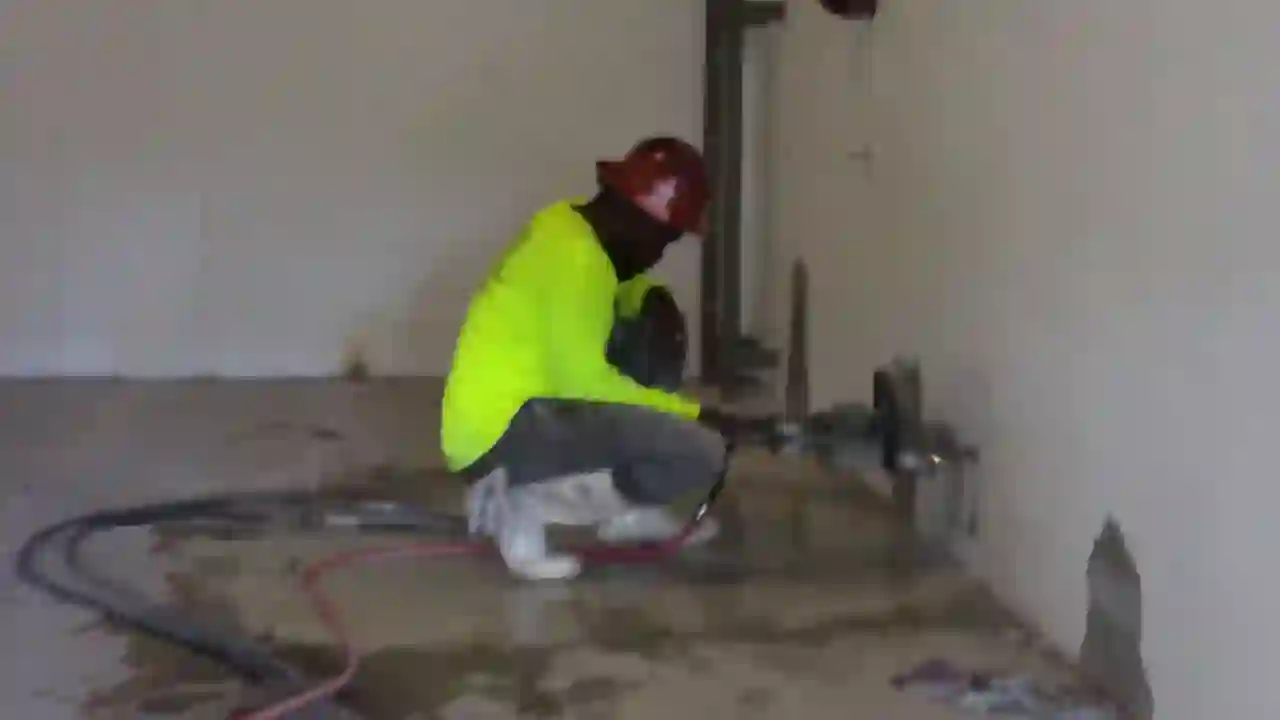
One technique that separates experienced demolition contractors from crews that just swing hammers is the use of core drills to establish stress-relief holes at the corners and termination points of breaking areas. Drilling a 2–4 inch core at each corner of a section to be broken dramatically reduces the force required to complete the break and gives you clean, controlled fracture lines. Core drill motor selection for this application should target 1.5–3 HP with a variable speed range of 300–900 RPM. Core bits for this work should be wet-cutting segmented bits with a soft-to-medium bond for Miami’s limestone aggregate. Proper construction waste management planning should account for the slurry generated by wet core drilling — it cannot be allowed to enter storm drains on any Miami-Dade or Broward County job site.
Estimating Tool Selection Costs Before the Job Starts
Tool selection has direct cost implications that need to be baked into your bid. Diamond blade consumption per linear foot of cut, breaker tool steel replacement intervals, and core bit life expectancy all need to be modeled before you price a breaking job. A 14-inch segmented blade rated for 60 linear feet of reinforced concrete cutting costs roughly $80–$140. If your job requires 500 linear feet of control cuts, you’re budgeting 8–9 blades minimum. Hydraulic breaker tool steel for a medium-class breaker runs $200–$400 per moil point, with replacement intervals of 500–1,500 hours depending on concrete hardness. These numbers belong in your estimate before you ever step on site. Use the project estimating resources available to Miami contractors to build accurate cost models around your specific tool selection.
The Spec Sheet Is the Starting Point, Not the Finish Line
Every tool discussed here has a manufacturer spec sheet that tells you what it can do under ideal conditions. Miami job sites are not ideal conditions. You’re cutting high-silica limestone aggregate with rebar at 6-inch spacing in 95-degree heat with a crew that’s been on site since 6 AM. The spec sheet gets you in the ballpark. Field experience with your specific aggregate type, your specific equipment, and your specific crew is what gets you to accurate productivity rates and blade life projections. Build your tool selection around the specs, validate it in the field, and adjust. That’s how you stop bleeding money on the wrong diamond tooling and start running breaking operations that finish on time and on budget.