Why Cutting Into Concrete Is Never Just About the Saw
Every contractor who has managed a concrete cutting operation in a dense urban environment — a Miami high-rise basement, a Florida Keys seawall corridor, a retrofitted commercial kitchen in a strip mall — knows the same hard truth: the cut itself is rarely the hardest part. What consumes the most planning, the most problem-solving, and the most technical expertise is everything surrounding that cut. Equipment access, debris extraction, ventilation, structural sequencing, utility clearance — these are the variables that determine whether a project runs clean or spirals into costly delays. Understanding how to cut into concrete on a real jobsite means understanding site logistics as deeply as you understand blade selection.
Reading the Site Before a Single Blade Touches the Slab
Before any equipment is mobilized, a senior concrete cutting specialist conducts what the industry calls a pre-cut site assessment. This isn’t a walkthrough — it’s a structured technical audit. You’re identifying doorway widths, ceiling heights, floor load ratings, elevator capacity, stairwell dimensions, and the location of embedded utilities. In South Florida, where construction spans everything from poured-in-place tilt-up warehouses to 1960s-era poured concrete residential blocks, no two sites behave the same way. The type of concrete you’re cutting also dictates blade hardness, water flow rates, and cutting speed — all of which affect how you stage equipment in a confined environment.
The structural drawings, if available, tell you rebar spacing and slab depth. GPR (Ground Penetrating Radar) scanning fills in the gaps when drawings are outdated or nonexistent. You need to know what’s inside that slab before you commit a diamond blade to it. Hitting a post-tension tendon in a parking garage deck without knowing it’s there doesn’t just damage equipment — it can catastrophically release stored energy and injure workers. This is why the pre-cut phase is non-negotiable.
Confined Space Cutting and the Equipment Footprint Problem
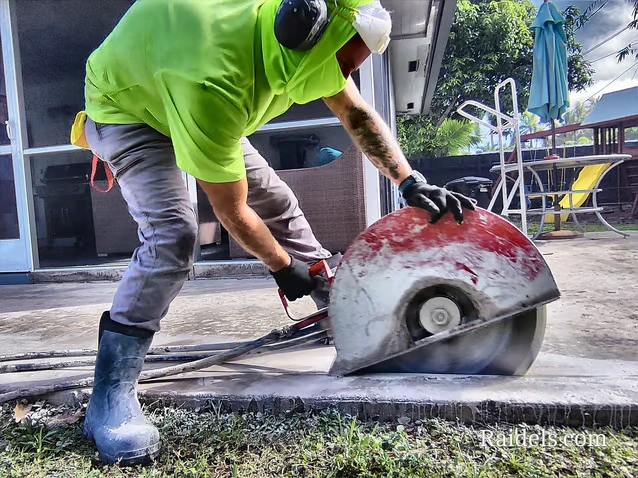
The most common logistical constraint on South Florida jobsites is simple geometry: the equipment you’d ideally use doesn’t fit where you need to use it. A standard walk-behind flat saw with a 30-inch blade has a footprint that becomes completely impractical in a mechanical room, a crawl space, or a narrow utility corridor. This is where equipment selection becomes a direct function of spatial constraints rather than cutting preference.
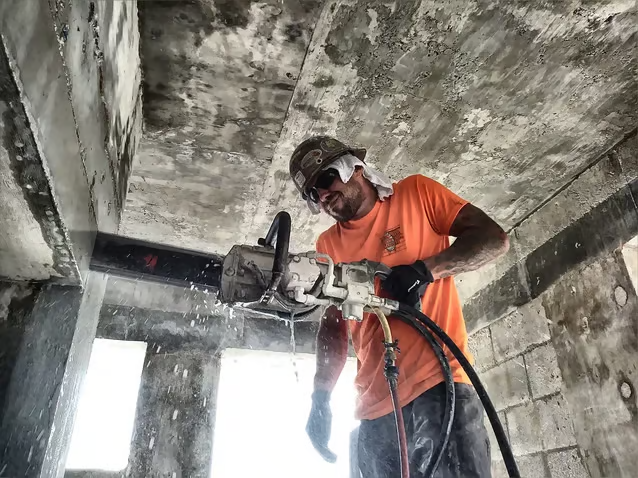
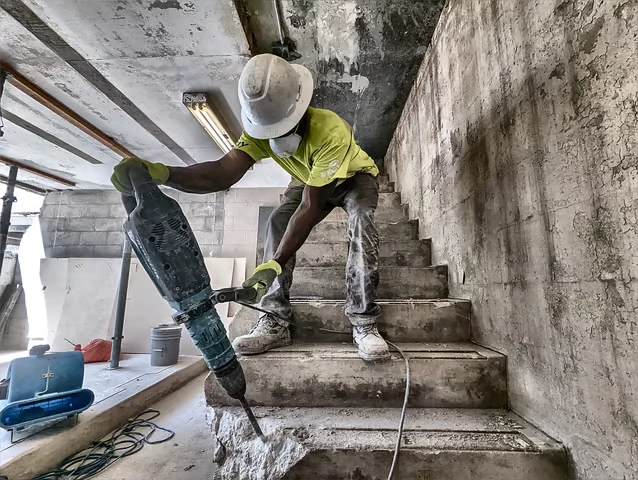
For low-clearance environments — anything under 48 inches of vertical clearance — a hydraulic chain saw becomes one of the most valuable tools in the arsenal. Unlike circular blade saws that require swing clearance, a chain saw operates in a linear cutting plane and can be maneuvered into positions that would be physically impossible with conventional equipment. The hydraulic power unit stays outside the confined space while only the bar and chain enter the work zone, dramatically reducing the operational footprint and improving worker safety.
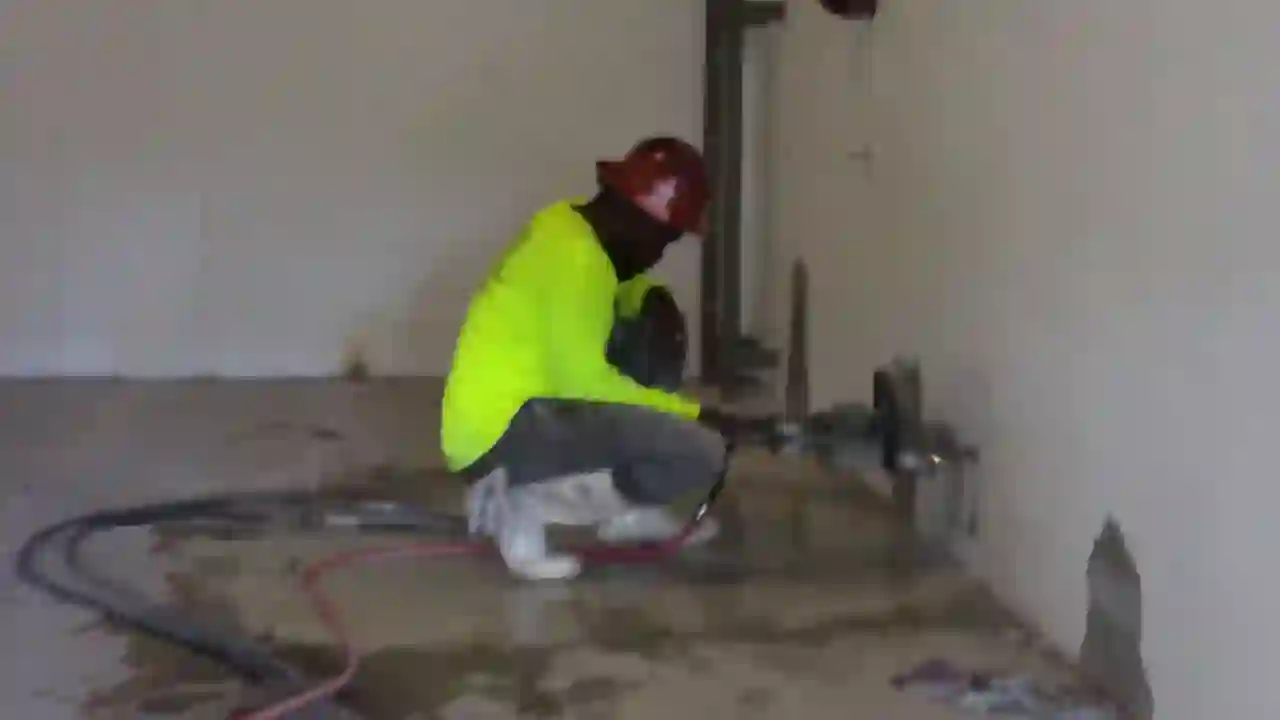
Wall saws mounted on track systems offer a similar advantage for vertical cuts in tight corridors. The motor and drive system are compact enough to operate within a few inches of an adjacent wall, and the track keeps the cut perfectly plumb without requiring the operator to stand directly in line with the blade. For horizontal cuts in basement slabs where a walk-behind flat saw can’t be lowered through the access point, ring saws and handheld core drills become the primary cutting tools — slower, but deployable anywhere a person can physically reach.
Slurry Management in Enclosed and Below-Grade Environments
Wet cutting generates slurry — a mixture of water, concrete dust, and silica particles that must be controlled, contained, and disposed of properly. In an open exterior environment, slurry management is relatively straightforward. In a confined space, it becomes a serious operational challenge. Slurry running unchecked in a basement mechanical room can damage existing equipment, create slip hazards, and migrate into floor drains connected to the municipal sewer system — which is an EPA violation in most jurisdictions.
Professional concrete cutting crews in Miami deploy vacuum extraction systems that run in parallel with the cutting operation. These systems pull slurry directly from the cutting zone into sealed collection tanks before it can spread. For core drilling in overhead or vertical positions, custom containment rings are affixed around the drill point to catch and redirect slurry flow. On projects like concrete removal work in Country Walk, where residential proximity and environmental sensitivity are both factors, slurry containment protocols are treated as seriously as the cut geometry itself.
Ventilation Requirements for Enclosed Concrete Cutting Operations
Cutting concrete generates respirable crystalline silica dust — a Class 1 carcinogen under OSHA standards. In open air, adequate ventilation is typically achievable with proper PPE and positioning. In a confined space, the problem compounds rapidly. Without active ventilation, dust concentrations can exceed permissible exposure limits within minutes of beginning a cut.
OSHA 29 CFR 1926.1153 mandates specific engineering controls for silica exposure in construction, and confined space cutting operations require the most aggressive implementation of those controls. Negative pressure ventilation systems — which exhaust air out of the confined space while drawing fresh air in through a controlled entry point — are standard on professional enclosed-environment cutting jobs. HEPA-filtered vacuum systems attached directly to the cutting tool provide an additional layer of capture at the source. Workers in the space wear full-face respirators rated for silica, and air monitoring equipment runs continuously throughout the operation. The safety protocols around concrete cutting services in enclosed environments are extensive, and any contractor who doesn’t treat them as mandatory is operating outside acceptable industry standards.
Structural Sequencing When Cutting Load-Bearing Elements
One of the most technically demanding scenarios in concrete cutting is working on load-bearing slabs or walls where the structure must remain functional during and after the cut. This is common in retrofit projects — adding a new stairwell opening to an existing floor plate, cutting a doorway through a shear wall, or creating a service penetration through a transfer slab. The cutting itself is often the simplest part of the operation. The structural sequencing around it is where the real expertise lies.
Temporary shoring must be designed and installed before any load-bearing concrete is removed. This typically involves consulting with a structural engineer of record, installing adjustable steel shores or timber cribbing to transfer loads around the cut zone, and verifying that the shoring is rated for the tributary load it will carry. The cutting crew then works within a defined sequence — often cutting in stages rather than completing the full opening in one pass — to ensure that load redistribution happens gradually and predictably. Projects in the Florida Keys, where marine-grade concrete structures have unique reinforcement patterns and corrosion considerations, add another layer of complexity to this sequencing process.
Equipment Rigging and Removal in Restricted-Access Environments
Once a cut is complete, the concrete sections must be extracted from the work zone. In open environments, this is handled with excavators, skid steers, or forklifts. In confined spaces, none of those options exist. Concrete is heavy — a 12-inch-thick slab section measuring 2 feet by 4 feet weighs approximately 800 pounds — and moving that weight through a 36-inch doorway, up a stairwell, or through a ceiling hatch requires careful rigging planning.
Professional crews use electric chain hoists, manual lever blocks, and custom-fabricated steel spreader bars to rig and move cut sections in tight quarters. Cuts are planned to produce sections that are manageable within the constraints of the available rigging points and exit paths. Sometimes this means making more cuts than strictly necessary from a structural standpoint, simply to reduce individual piece weight to something that can be safely handled in the confined space. The planning for extraction happens before the first cut is made — not after.
Understanding how to cut into concrete at a professional level means treating every jobsite as a unique logistical puzzle. The blade is just the tool. The real work is in the planning, the sequencing, the equipment selection, and the safety systems that make the operation viable in the first place.