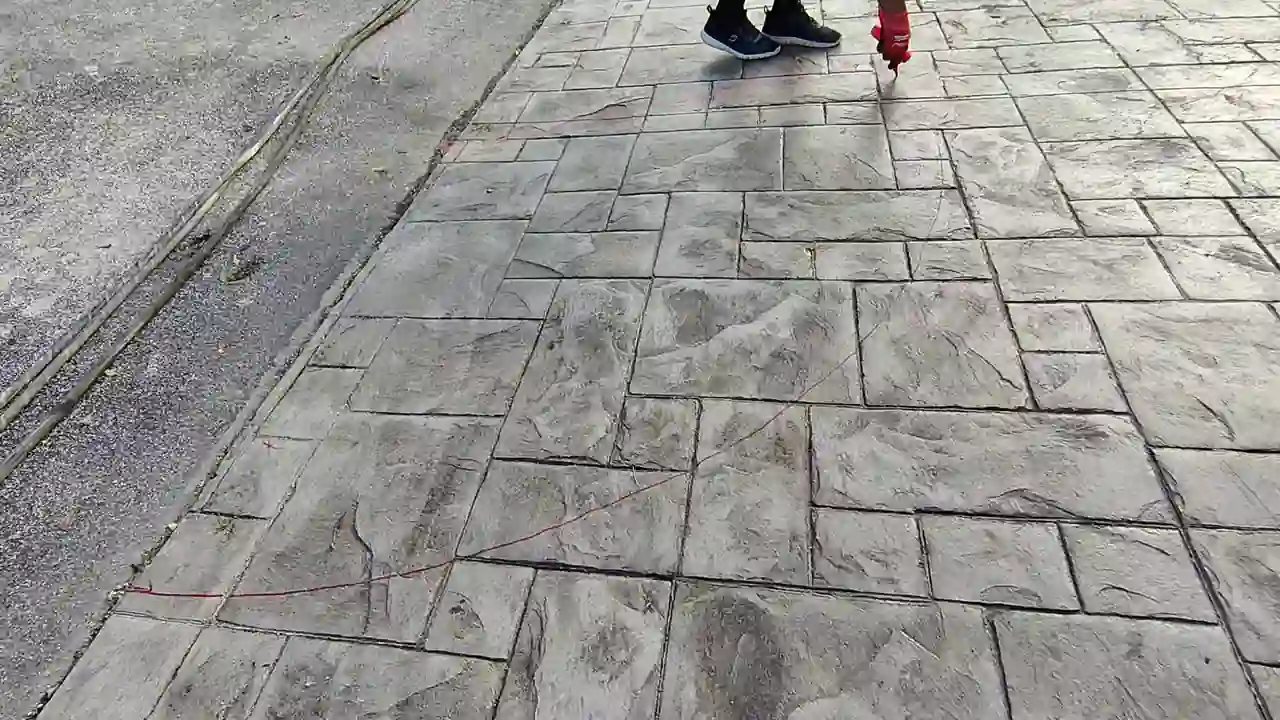
Slab Profiling Before Any Blade Hits Concrete in Country Walk Before a single piece of equipment rolls onto a Country Walk property, the crew needs a clear picture of what they’re cutting. Standard residential slabs in this area typically run between 4 and 6 inches thick, but pool decks — especially those installed in the 1980s and 1990s — can be irregular, with sections ranging from 3.5 inches near the coping to 7 inches where the deck meets a structural beam or footer. Rebar presence varies widely. Some older slabs use 3/8-inch rebar on 18-inch centers; others are fiber-reinforced with no steel at all. That distinction changes your blade spec entirely.
A ground-penetrating radar (GPR) scan, even a basic 1.6 GHz pass, gives the operator enough data to avoid hitting embedded conduit, irrigation sleeves, and post-tension cables — all of which show up in Country Walk properties with alarming regularity. Skipping this step doesn’t save time. It costs blades, equipment, and sometimes the job itself. For detailed sequencing on slab removal prep, the step-by-step methodology we use on pool deck cut-and-remove projects applies directly to most Country Walk slab scenarios.
Diamond Blade Segment Geometry for South Florida Limestone-Aggregate Concrete South Florida concrete is not the same animal as what you’d cut in Atlanta or Chicago. Local ready-mix historically uses oolitic limestone as the primary coarse aggregate. Limestone is softer than granite or trap rock, which sounds like good news until you realize it causes accelerated segment wear and glazing if you’re running a blade spec designed for harder aggregate. The diamond concentration in your segment matrix needs to be calibrated for soft-to-medium abrasive material — typically a concentration rating between 25 and 35 on the standard scale, with a bond hardness in the medium-soft range (J to L on the Mohs-equivalent bond scale).
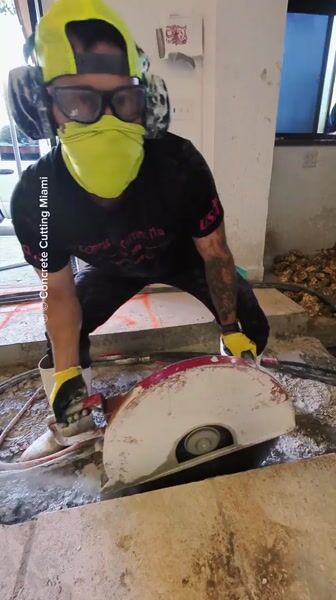
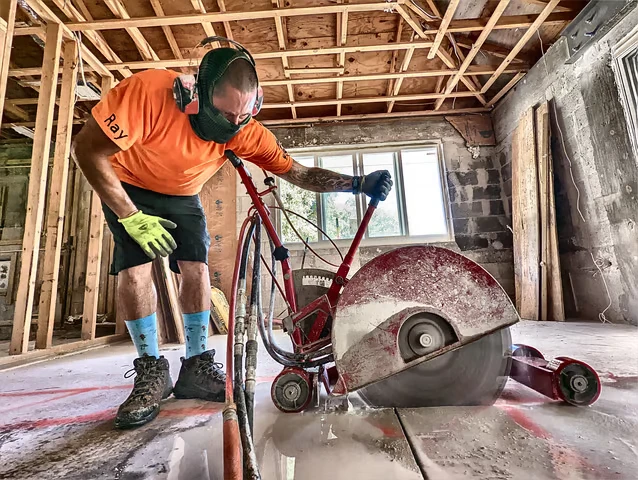
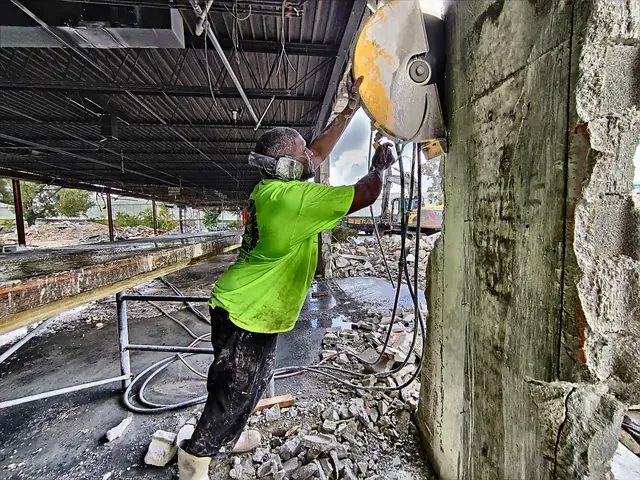
For flat slab removal cuts in Country Walk, a segmented rim blade with a 10mm segment height and a 2.6mm kerf width is a reliable starting point for a 14-inch blade on a walk-behind saw. The segment geometry should be a standard turbo-segment or sandwich-layer design — not a continuous rim, which loads up with slurry and loses cutting speed fast in wet-cut applications. If you’re running a 20-inch or 24-inch blade on a self-propelled flat saw for longer driveway cuts, bump the segment height to 12mm and verify the bond matrix is appropriate for the RPM range your machine produces at full throttle.
RPM Matching Between Blade Diameter and Machine Output This is where a lot of crews lose money without knowing it. A 14-inch diamond blade has a maximum operating speed (MOS) typically rated at 5,500 RPM. A 20-inch blade drops to around 3,800 RPM MOS. If your flat saw’s spindle is producing 4,200 RPM and you mount a 20-inch blade, you’re over-speeding the blade — the segments experience centrifugal stress beyond their design threshold and the bond matrix fails prematurely. Always cross-reference the blade manufacturer’s MOS rating against your machine’s actual spindle output at operating load, not at free spin. Under load, most electric flat saws drop 8–12% from their no-load RPM. Hydraulic saws are more stable but still require verification.
For Country Walk jobs where access restricts equipment to smaller machines, a 65-horsepower hydraulic flat saw with a 20-inch blade running at a verified 3,600 RPM under load is the right configuration for cutting 5-inch reinforced slabs in a single pass. Trying to do the same job with an underpowered electric saw and a 14-inch blade means multiple passes, more blade changes, and significantly more labor time — none of which pencils out on a competitive bid.
Handheld and Walk-Behind Equipment Selection for Tight Residential Access Country Walk lots are not generous. Side yard clearances between a fence and a structure can be as narrow as 28 inches. That eliminates ride-on equipment for a significant portion of residential concrete removal work in this area. The workhorse tool in tight-access scenarios is a 13-horsepower gas-powered cut-off saw or a corded 15-amp electric angle grinder fitted with a 7-inch diamond blade for detail cuts near structures. For the main field cuts, a compact walk-behind saw with a 65-pound cutting head and a 14-inch blade is typically the largest machine that can safely maneuver in confined residential spaces without damaging adjacent landscaping or hardscape.
Hydraulic breakers mounted on mini-excavators in the 1.5 to 3-ton class are the standard removal tool after the perimeter and field cuts are complete. The hydraulic flow requirement for a properly sized breaker in this weight class runs between 8 and 12 gallons per minute at 1,500 to 2,000 PSI. Matching the breaker to the carrier’s auxiliary hydraulic output is non-negotiable — an undersized flow rate produces erratic hammer cycling and accelerated accumulator wear. For projects involving pool deck removal specifically, the pool removal concrete cutting services framework we operate under in Miami-Dade covers these equipment pairings in detail.
Core Drill Specifications for Utility Penetrations During Demolition Prep Before any slab gets broken out, utility penetrations need to be identified and, in many cases, core-drilled to allow for clean disconnection of plumbing, electrical conduit, and drainage lines. In Country Walk, this typically means 3-inch to 6-inch diameter core drill work through the slab at or near the utility entry points. A wet-core diamond bit rated for 3,000 PSI concrete, with a 10-segment crown and a 300mm barrel length, handles this work cleanly. The drill motor should be a two-speed unit with a low-gear torque output of at least 450 ft-lbs to handle any rebar intersections without stalling. Running a single-speed high-RPM drill into a rebar hit is how you strip a bit crown in under 30 seconds.
Slurry Management Equipment Specifications Specific to Country Walk Sites Wet cutting is mandatory for dust suppression under Miami-Dade air quality regulations, and wet cutting produces slurry — a cement-fine and water mixture that cannot be discharged to storm drains, swales, or the street. Country Walk sits within a drainage basin that feeds into protected wetland corridors, which makes slurry management a regulatory priority, not an afterthought. A vacuum slurry recovery system rated for a minimum 27-gallon tank capacity, with a 1.5-inch intake hose and a 110V or 12V pump, is the baseline spec for residential work in this area. The slurry must be collected, allowed to settle, and disposed of as solid waste at an approved facility. The approach we documented for concrete removal in Opa-Locka outlines the slurry-first methodology that applies equally to Country Walk job sites.
For larger slab removal projects — full driveway replacements or pool deck demolitions over 800 square feet — a dedicated slurry vacuum unit with a 55-gallon capacity and a three-stage filtration system is the appropriate spec. This keeps the crew from stopping to empty tanks every 20 minutes and maintains continuous cutting productivity. More on how this integrates into full pool removal scopes is covered in our pool removal Miami project archive .
Blade Wear Indicators and Mid-Job Specification Adjustments A diamond blade doesn’t fail catastrophically in most cases — it glazes, slows, and stops cutting efficiently long before it’s mechanically unsafe. The field indicator for glazing is a noticeable drop in cutting speed with no change in machine RPM or feed pressure. When a blade that was cutting 5-inch concrete at 12 inches per minute drops to 4 inches per minute under identical conditions, the segment surface has polished over and the diamond crystals are no longer exposed. The fix is a dressing pass — running the blade through an abrasive block or a sacrificial piece of soft sandstone for 10 to 15 seconds re-exposes the diamond matrix without replacing the blade.
If dressing doesn’t restore cutting speed, the bond hardness was wrong for the aggregate. In Country Walk’s limestone-dominant concrete, this usually means the bond was too hard — the matrix isn’t releasing worn diamonds fast enough to expose fresh ones. The correction for the next blade order is to drop one bond hardness grade. Keep a job log that records blade model, segment spec, concrete type, and cutting performance. Over three or four Country Walk jobs, that data becomes a reliable spec sheet that eliminates guesswork entirely.
Matching the Full Equipment Package to Country Walk Project Scope The most common mistake on Country Walk concrete removal jobs is treating equipment selection as a one-size solution. A driveway removal, a pool deck demolition, and a patio breakout all have different slab geometries, access constraints, and aggregate profiles — and each one demands a different blade spec, machine configuration, and slurry management approach. The contractors who consistently hit their production targets in this neighborhood are the ones who do the specification work before the job starts, not during it.
Whether you’re evaluating pool filling versus full pool removal options or planning a complete hardscape teardown, the equipment and tooling decisions made in the planning phase determine whether the job runs on schedule and within budget. For broader context on how we approach construction-phase concrete work across Miami-Dade, the Miami construction project category covers the full range of scopes we handle. Country Walk is a technically demanding service area — and the right blade, matched to the right machine, running at the right speed, is what separates a clean job from a costly one.
 Concrete Cutting Miami