Why Hydraulic Sawing in Gainesville Carries Serious Environmental Obligations
Concrete hydraulic sawing in Gainesville operates under a tighter environmental microscope than most contractors expect when they first quote a job. Alachua County and the City of Gainesville enforce stormwater ordinances that align closely with Florida Department of Environmental Protection (FDEP) standards, and those regulations treat concrete slurry — that gray, alkaline soup generated by wet diamond blade cutting — as a regulated discharge. The moment that slurry reaches a storm drain, a drainage swale, or any natural water body, you’re looking at a potential FDEP enforcement action, a stop-work order, and liability that can dwarf the value of the original contract. Understanding the mechanics of hydraulic sawing and the environmental control systems that must accompany it is not optional for any crew operating in this region.
The Hydraulic Sawing Process and Why It Generates So Much Slurry
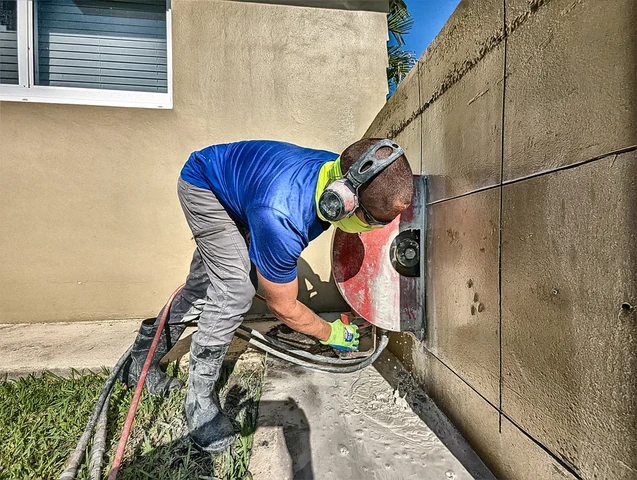
Hydraulic concrete saws are purpose-built for high-production cutting on thick, heavily reinforced concrete. Unlike electric or gas-powered saws, hydraulic units draw power from a dedicated hydraulic power pack, delivering consistent torque even under extreme blade load. This allows operators to run larger diameter blades — commonly 36-inch to 60-inch segmented diamond blades — at controlled RPMs through material that would stall lesser equipment. The tradeoff is volume: hydraulic saws consume significantly more water for blade cooling and dust suppression than smaller electric units.
A standard hydraulic flat saw cutting a 12-inch deep expansion joint through reinforced concrete can consume 3 to 8 gallons of water per minute, depending on blade diameter, aggregate hardness, and feed rate. That water doesn’t evaporate — it combines with pulverized concrete particles, silica dust, and residual curing compounds to form slurry with a pH typically ranging from 11 to 13. That alkalinity makes it chemically hazardous to aquatic ecosystems and corrosive to concrete infrastructure in drainage systems. In Gainesville’s karst geology, where surface water connects rapidly to the Floridan Aquifer through sinkholes and fractures, uncontrolled slurry discharge carries amplified risk.
Slurry Containment Systems Rated for High-Volume Hydraulic Cutting
Effective slurry management on a hydraulic sawing job begins before the blade ever touches concrete. The containment system must be engineered to the specific site geometry, not improvised with sandbags and hope. For Gainesville projects — whether you’re cutting roadway panels on NW 13th Street, sawing utility trenches near the University of Florida campus, or performing structural modifications on a commercial tilt-wall building — the containment approach changes based on slope, proximity to drainage infrastructure, and soil permeability.
Perimeter Berms and Vacuum Recovery Systems
The most reliable field-proven method combines temporary perimeter berms with dedicated slurry vacuum recovery. Foam berm dams or reusable rubber containment strips are deployed around the cutting zone to prevent lateral slurry migration. A wet/dry industrial vacuum unit — ideally a 55-gallon or larger capacity machine rated for slurry recovery — runs continuously alongside the saw, pulling slurry from the cut path before it can spread. High-production hydraulic sawing operations often run a dedicated vacuum operator separate from the saw operator to maintain recovery rates that match the saw’s water output.
Slurry Bags and Dewatering for Disposal
Recovered slurry cannot simply be dumped on-site or discharged to a sanitary sewer without authorization. In Gainesville, GRU (Gainesville Regional Utilities) requires a written discharge authorization for any non-domestic wastewater entering the sanitary system, and concrete slurry typically does not qualify without pH neutralization. The standard field protocol involves pumping recovered slurry into geotextile dewatering bags — commonly called “slurry bags” — which filter out suspended solids while allowing clarified water to discharge at a controlled rate. The dewatered solid cake is then collected, tested if required, and disposed of as solid waste at an approved facility.
pH Neutralization Before Any Discharge
When project timelines or site conditions require on-site discharge of clarified water, pH must be adjusted to the acceptable range of 6.0 to 9.0 before any release. Carbon dioxide injection systems are the cleanest method — CO2 reacts with calcium hydroxide in the slurry to form calcium carbonate, dropping pH without introducing chlorides or sulfates that could cause secondary contamination. Dry ice can serve as a field-expedient alternative for small volumes. Muriatic acid is effective but requires a licensed applicator and creates handling hazards that complicate OSHA compliance on active job sites. For more on maintaining OSHA standards during aggressive concrete work, see our detailed breakdown of breaking thick concrete slabs while maintaining OSHA safety standards.
Site-Specific Planning Requirements for Gainesville Hydraulic Saw Jobs
Florida’s National Pollutant Discharge Elimination System (NPDES) permit framework requires that any construction activity disturbing one acre or more have a Stormwater Pollution Prevention Plan (SWPPP) in place. Even on smaller hydraulic sawing jobs that fall below the acreage threshold, Gainesville’s local MS4 (Municipal Separate Storm Sewer System) permit obligations push contractors toward documented best management practices (BMPs) for concrete cutting operations. This means written slurry management plans, designated slurry disposal staging areas, and documented pH testing logs are not just good practice — they’re defensible documentation if a complaint or inspection occurs.
Pre-job site walks should identify every storm drain inlet within 50 feet of the cutting zone. Those inlets must be protected with inlet protection devices — filter fabric inserts, drain guards, or gravel-filled filter socks — before sawing begins. Gainesville’s flat topography in many commercial corridors means slurry can migrate significant distances along pavement grades before reaching an inlet, so the protection perimeter often needs to extend further than contractors initially estimate.
Equipment Selection and Blade Specification for Compliance-Friendly Cutting
Hydraulic saw selection directly impacts slurry volume and therefore the complexity of your containment operation. Larger blade diameters generate more heat, require more water, and produce finer particle slurry that is harder to filter. When project specifications allow, specifying a blade diameter appropriate to the actual cut depth — rather than defaulting to the largest available blade — reduces water consumption and simplifies slurry management. A 24-inch blade cutting a 9-inch slab produces substantially less slurry than a 48-inch blade on the same cut, even at comparable feed rates.
Diamond blade segment geometry also affects slurry characteristics. Turbo-segmented blades produce a coarser particle distribution that settles faster in dewatering bags, accelerating the filtration process. Standard sandwich segments produce finer particles that can clog filter media prematurely on long cuts. Discussing blade specification with your diamond tool supplier in the context of your slurry management system — not just cutting speed — is a conversation that separates technically sophisticated contractors from the rest. Our broader range of concrete services incorporates this kind of specification-level thinking on every project.

Training and Certification Requirements for Environmental Compliance on Saw Crews
Florida does not currently mandate a specific certification for concrete sawing environmental compliance, but the practical liability exposure makes internal training documentation essential. Saw crews operating in Gainesville should be trained on slurry vacuum operation, berm deployment, pH testing using calibrated meters (not just litmus strips), and the chain of custody for slurry disposal. Crew foremen should be able to produce a site-specific slurry management plan on demand during a city or county inspection.
The Concrete Cutting Miami, LLC operational standard includes pre-job environmental briefings for all hydraulic sawing crews, with documented sign-off before mobilization. This approach has proven valuable not just for regulatory compliance but for client confidence — general contractors and facility managers in Gainesville increasingly require evidence of environmental protocols before awarding subcontracts for any cutting scope involving water use.
Coordinating With Gainesville Utilities and Permitting Offices
For hydraulic sawing work in public rights-of-way, coordination with the City of Gainesville Public Works Department and GRU is mandatory. Right-of-way permits typically include conditions addressing stormwater protection, and inspectors do verify compliance during active cutting operations. Utility locates through Sunshine 811 must be completed and marked before any hydraulic saw is positioned, not just for safety but because cutting into an unmarked utility line in a wet environment creates electrocution hazards that are compounded by the conductive nature of slurry.
Projects involving concrete patio demolition or flatwork removal adjacent to landscaped areas require additional attention — slurry infiltrating soil near tree root zones or planted areas can cause pH-related damage to vegetation, creating secondary liability with property owners. Containment barriers in these zones should include soil protection measures such as plastic sheeting underlayment beneath the berm perimeter.
What Proper Hydraulic Sawing Compliance Actually Costs and Why It’s Worth It
Contractors who price slurry management as an afterthought consistently underbid hydraulic sawing jobs in Gainesville and then either skip the environmental controls — creating violation risk — or absorb the cost and erode their margin. A properly budgeted containment and slurry management system for a mid-scale hydraulic sawing job adds roughly 8 to 15 percent to direct labor and equipment costs. That number sounds significant until you compare it to the cost of an FDEP enforcement action, which can run from $1,000 to $10,000 per day of violation under Florida Statute 403.141, plus remediation costs if aquifer or surface water impact is documented.
The technical discipline required for compliant hydraulic sawing in Gainesville is exactly the kind of work that distinguishes professional concrete cutting contractors from low-bid operators. When the environmental controls are executed correctly — contained slurry, documented pH, proper disposal, protected inlets — the job site tells a story of competence that clients remember when the next project comes up for bid.