Why Slurry Management Is the Most Overlooked Risk in Any Concrete Breaking Service
Most project managers think about structural risk, equipment access, and noise ordinances when they schedule a concrete breaking service. Almost none of them think about what happens to the water. That oversight can turn a straightforward demolition task into an EPA violation, a stormwater citation from Miami-Dade County, or a stop-work order that costs far more than the job itself. Slurry — the grey, alkaline suspension of water, cement fines, and silica particles produced during wet-cutting and hydraulic breaking operations — is a regulated waste stream. Treating it like runoff is not just negligent; it is illegal under federal NPDES permit frameworks and Florida’s stormwater management rules. Every crew we send to a Miami job site operates under a documented slurry containment protocol before a single hydraulic breaker touches a slab.
The Chemistry of Concrete Breaking Slurry and Why pH Control Matters
When a hydraulic breaker fractures a Portland cement slab and wet suppression is applied to control silica dust, the resulting slurry carries a pH typically ranging from 11 to 13. That is highly caustic — comparable to household bleach. Discharging that material into a storm drain, a swale, or onto unprotected soil introduces a chemical load that can kill aquatic organisms, damage root systems, and contaminate shallow groundwater tables. In Miami’s low-elevation, high-water-table environment, this is not a theoretical concern. Biscayne Bay and the Miami River both receive stormwater discharge from urban sites, and enforcement from the Florida Department of Environmental Protection has intensified significantly over the past five years.
A compliant concrete breaking service addresses pH at the point of collection. Our field teams use portable pH meters to test slurry before any transport or disposal decision is made. Material testing above pH 9 is treated as a chemical waste stream, not construction debris. That distinction drives every downstream decision about containment, transport manifesting, and disposal site selection.

Hydraulic Breaker Operations and Primary Containment Setup
The containment strategy for a concrete breaking service depends heavily on the breaking method being deployed. Hydraulic breakers mounted on excavator arms generate high-impact, percussion-driven fracture patterns that produce large aggregate chunks with relatively low fines generation — but wet suppression is still required under OSHA 1926.1153 for any concrete work that may generate respirable crystalline silica. That suppression water must go somewhere controlled.
Our primary containment system for slab-on-grade breaking operations uses a perimeter berm system constructed from compacted bentonite clay or prefabricated water-inflatable tube barriers, depending on site geometry. For interior work — parking decks, mechanical rooms, and basement slabs — we use sealed polyethylene sheeting overlapped at minimum 12 inches and taped at seams, creating a basin that channels slurry toward a central sump point. The sump feeds a vacuum recovery unit rated for high-solids slurry, typically operating at 150 CFM or greater to handle the volume generated by continuous breaking operations.
For contractors managing reinforced slabs, the complexity increases. Rebar exposure during breaking creates irregular surface geometries that defeat simple gravity-drainage containment. Our teams use flexible foam bead barriers that conform to irregular surfaces while maintaining hydraulic seal. You can read more about the challenges of working through reinforced concrete in our detailed guide on cutting through rebar and reinforced slabs in Miami.
Silica Dust Suppression Systems Integrated Into the Breaking Workflow
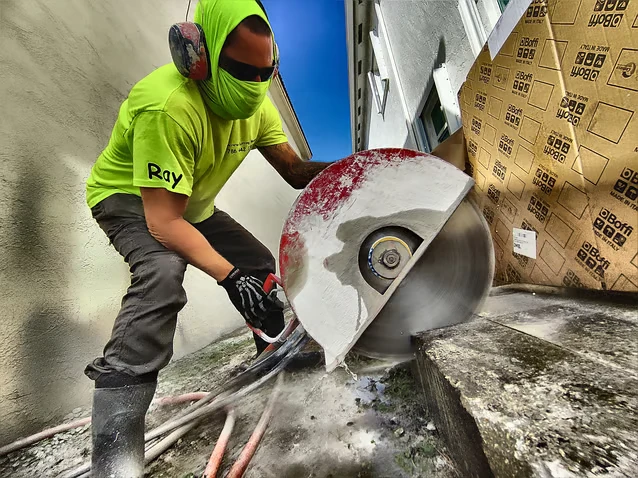
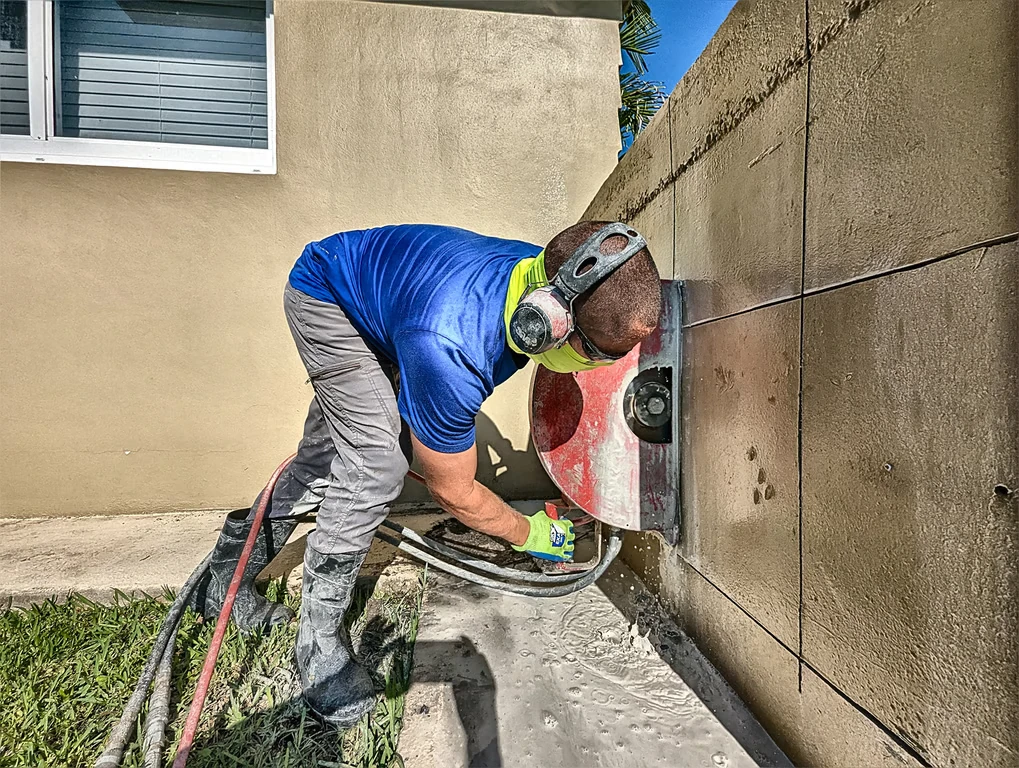
Wet suppression is not simply running a garden hose near the break point. Effective silica control during a concrete breaking service requires continuous water delivery at the tool-material interface, with flow rates calibrated to the breaking frequency and aggregate exposure. Our hydraulic breaker attachments are fitted with integrated water injection ports that deliver suppression water at 0.5 to 1.2 gallons per minute directly to the chisel tip contact zone. This prevents dust generation at the source rather than attempting to knock down airborne particles after they are generated.
The suppression system feeds from a closed-loop tank that recirculates filtered water, reducing total water consumption by up to 40% compared to open-supply systems. Filtered water also reduces mineral scaling on tool surfaces, extending chisel life and maintaining consistent impact energy transfer. The closed-loop design means all process water stays within the containment boundary — there is no overflow risk from a high-pressure supply line disconnection.
Slurry Recovery, Dewatering, and Lawful Disposal in Miami-Dade County
Once slurry is collected, the disposal pathway is strictly regulated. Miami-Dade County’s Water and Sewer Department prohibits discharge of concrete slurry to the sanitary sewer system without a pre-treatment permit. Most job sites do not hold such permits. This means slurry must be dewatered on-site or transported off-site as liquid waste.
Our standard protocol uses a two-stage dewatering process. In stage one, collected slurry is pumped into a portable settling tank where coarse solids drop out under gravity over a 30-to-60-minute dwell time. The clarified supernatant is then pH-adjusted using dry citric acid or carbon dioxide injection to bring the pH below 8.5 — the threshold for compliant discharge to vegetated areas under Florida’s general permit framework. The dewatered solids are loaded into sealed poly-lined containers and manifested for transport to a licensed construction and demolition debris facility. We document every load with a chain-of-custody record that the project owner retains for permit compliance files.
This level of documentation is not bureaucratic overhead. It is the difference between a clean project closeout and a regulatory audit that delays your certificate of occupancy. Our environmental compliance guide for Miami contractors breaks down exactly which permits apply to which project types and how to structure your subcontractor agreements to allocate compliance responsibility correctly.
Heat and Humidity Variables That Affect Slurry Behavior on Miami Job Sites
Miami’s subtropical climate introduces variables that most slurry management protocols written for northern markets do not account for. High ambient temperatures accelerate the hydration chemistry of cement fines in suspension, causing slurry to thicken and set faster than it would in cooler conditions. A slurry batch that remains pumpable for 90 minutes in Chicago may begin setting in under 45 minutes during a Miami summer afternoon. Our crews adjust vacuum recovery schedules accordingly, cycling the sump pump more frequently during peak heat hours to prevent clogging in the collection lines.
Humidity also affects the performance of dry pH-adjustment agents. Citric acid powder absorbs moisture from the air and can cake in dispensing equipment, leading to inconsistent dosing. We store pH adjustment reagents in sealed, moisture-resistant containers and test reagent flowability at the start of each shift. These operational details matter during Miami’s peak construction season, and we cover the broader operational challenges of summer work in our post on conquering concrete cutting under Florida’s summer heat.
Regulatory Framework Every Concrete Breaking Service Contractor Must Understand
Three regulatory layers govern slurry and water management on a concrete breaking service job in Florida:
- Federal NPDES Construction General Permit (CGP): Projects disturbing one or more acres must have a Stormwater Pollution Prevention Plan (SWPPP) that specifically addresses concrete washout and slurry containment. The CGP requires designated concrete washout areas and prohibits discharge of process water with pH outside the 6.5–8.5 range.
- Florida DEP NPDES Permit FLR10: Florida’s state-level construction general permit mirrors federal CGP requirements but adds specific provisions for projects within 500 feet of Outstanding Florida Waters — a classification that applies to several zones in Miami-Dade County near Biscayne Bay.
- Miami-Dade County Code Chapter 24: The county’s Environmental Protection Ordinance imposes additional requirements for projects near wetlands, tidal areas, and wellfield protection zones. Violations carry civil penalties up to $10,000 per day per violation.
Understanding how these three frameworks interact is not optional for a general contractor managing a concrete breaking scope. Our FAQ resource addresses the most common compliance questions we receive from project managers, and our technical guides library provides deeper dives into permit-specific requirements for different project categories.
Selecting a Concrete Breaking Service That Documents Compliance From Day One
The criteria for selecting a concrete breaking subcontractor should extend well beyond equipment capability and day rate. Ask every prospective contractor the following questions before awarding a scope:
- Do you carry a written slurry management plan specific to this project type? Generic plans are a red flag. Site-specific plans demonstrate operational maturity.
- What is your pH testing protocol and documentation frequency? Testing should occur at collection, at dewatering, and at disposal — not just once per shift.
- How do you handle slurry disposal manifesting? Chain-of-custody documentation should be provided to the owner as a standard deliverable, not only upon request.
- Are your suppression systems closed-loop or open-supply? Closed-loop systems reduce regulatory exposure and water consumption simultaneously.
- What is your spill response protocol? Every crew should carry pH neutralization materials and spill containment supplies on the vehicle — not back at the shop.
A concrete breaking service that cannot answer these questions with specificity is a liability on any project subject to environmental permit conditions. In Miami’s regulatory environment, where stormwater enforcement has increased and project timelines are compressed by competitive market pressure, the cost of a single slurry discharge event — in fines, remediation, and schedule delay — will dwarf any savings achieved by selecting a lower-cost, less-compliant subcontractor.
Concrete Cutting Miami, LLC operates under a documented environmental compliance program on every concrete breaking service engagement. Our field supervisors are trained in SWPPP implementation, slurry chemistry, and Miami-Dade County permit requirements. When you need breaking work done right — without the regulatory exposure — contact our team to discuss your project scope and we will provide a compliant, fully documented approach from mobilization through final disposal.