Why Demolition Dust Suppression Fails Before the First Blade Hits Concrete
Most dust suppression failures on demolition sites aren’t equipment failures — they’re planning failures. By the time a crew fires up a diamond blade or a hydraulic breaker and realizes the dust cloud is already migrating toward a neighboring structure or a public walkway, the suppression window has closed. In Miami-Dade and Broward counties, where job sites are compressed against residential buildings, active retail corridors, and coastal air quality monitoring stations, that failure has real consequences. OSHA’s Respirable Crystalline Silica Standard (29 CFR 1926.1153) sets the permissible exposure limit at 50 micrograms per cubic meter of air as an 8-hour time-weighted average — and concrete demolition work can exceed that threshold within minutes without active suppression. This guide lays out the precise, field-tested methods that experienced concrete cutting crews use to manage demolition dust from the moment they pull up to a site.
Understanding the Dust Generation Mechanics in Concrete Demolition
Before you can suppress demolition dust effectively, you need to understand exactly where and how it’s generated. Concrete is a composite material — Portland cement paste, aggregate, and in older South Florida structures, potentially legacy materials like fly ash or slag. When a diamond blade, core drill, or hydraulic hammer fractures that matrix, it produces particles across a wide size spectrum. The particles that matter most for suppression are in the respirable range — below 10 microns in aerodynamic diameter, with the most hazardous silica particles sitting below 4 microns. These particles don’t settle. They stay suspended in the air column for hours, travel laterally with even light coastal breezes, and penetrate standard dust masks that aren’t rated for silica.
The generation rate scales directly with the cutting or breaking method. A dry-cut diamond blade on a 14-inch slab produces substantially more airborne particulate per minute than a wet-cut operation running at the same RPM. Hydraulic breakers generate massive coarse particle clouds but also significant fine particulate through the shockwave fracturing of the cement paste matrix. Understanding this lets you tier your suppression approach rather than applying a one-size-fits-all method that wastes water and still misses the fine fraction.
The Three Suppression Tiers Every Demolition Crew Needs to Know
Effective demolition dust suppression operates on three simultaneous tiers: source suppression, transport interruption, and area containment. Missing any one of these tiers means the other two are working at reduced efficiency. Here’s how each tier functions in a real concrete demolition context:
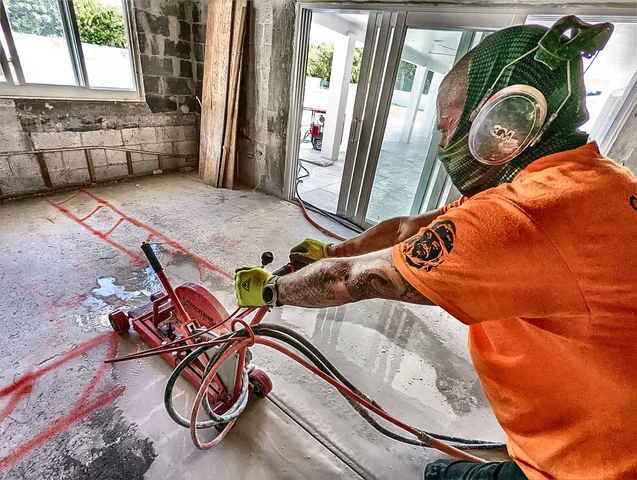
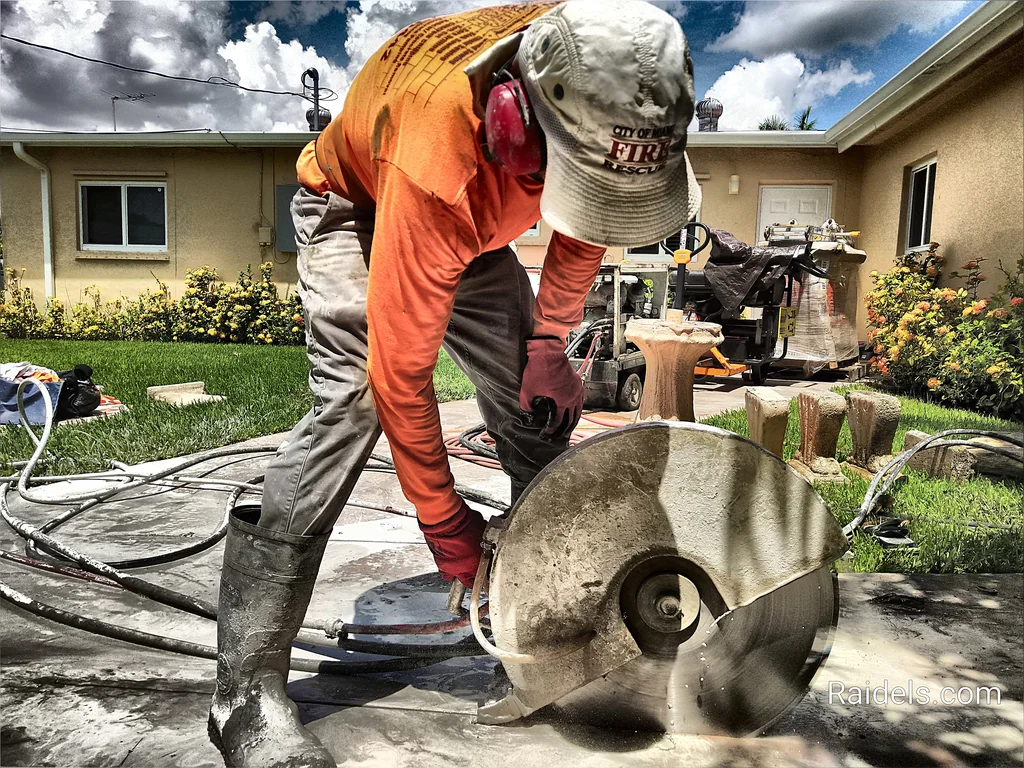
- Tier 1 — Source Suppression: This is water delivery directly at the blade-concrete interface or the point of mechanical fracture. For diamond blade cutting, this means a continuous water feed of at least 0.5 gallons per minute at the blade guard, directed at the entry and exit points of the cut. For core drilling, water must flood the annular space between the core bit and the concrete. For hydraulic breaking, foam-based suppressants or misting rings around the chisel contact zone are used because flooding with water is impractical.
- Tier 2 — Transport Interruption: Dust generated at the source must be captured before it enters the breathing zone or migrates off-site. This is where industrial HEPA vacuum systems attached directly to the tool become critical. A vacuum rated at a minimum of 150 CFM with a HEPA filter capturing 99.97% of particles at 0.3 microns, connected via a shroud or hood to the cutting tool, creates a negative pressure zone at the source that pulls generated dust into the filtration system before it can become airborne.
- Tier 3 — Area Containment: For interior demolition or enclosed work zones, negative air pressure containment using 2,000 CFM negative air machines with HEPA filtration prevents cross-contamination to adjacent spaces. Polyethylene sheeting barriers (minimum 6 mil) create the containment envelope. For exterior work in dense urban areas like Brickell or Downtown Miami, wind-direction-aware misting fences using fine-mist nozzles at 50–100 PSI create a water curtain that intercepts migrating particles.
Wet Cutting Protocols That Actually Work in High-Temperature South Florida Conditions
Wet cutting is the baseline suppression method for diamond blade work, but crews operating in Miami’s climate face a specific challenge — ambient temperatures regularly exceed 90°F, and relative humidity combined with direct sun exposure causes water delivered to the blade to evaporate or flash before it can fully suppress the dust cloud. The fix is not more water volume; it’s water delivery pressure and placement. Water delivered at 20–40 PSI directly at the blade gullets — the spaces between diamond segments — maintains blade cooling and provides enough mass flow to wet the generated particles before they become airborne. A gravity-fed water bottle system producing 0.1 GPM is insufficient for slab work above 4 inches in depth. You need a pressurized supply.
For projects across the Florida Keys and coastal Miami-Dade where job site water access is limited, portable pressurized water tanks (5-gallon minimum, 40 PSI rated) mounted to the saw are the standard solution. Our crews working in the Keys specifically have developed protocols around this — you can review some of that regional context in our Florida Keys construction project coverage. The key metric is maintaining a visible wet slurry at the cut line at all times. If you see dry dust pluming from the blade, your water delivery rate is insufficient regardless of what the flow gauge says.
HEPA Vacuum Integration for Handheld and Track-Mounted Saw Operations
Integrating a HEPA vacuum system with a track-mounted wall saw or a handheld angle grinder requires different shroud geometries, but the principle is identical — create a sealed low-pressure zone around the cutting interface. For wall saws, purpose-built blade guards with integrated vacuum ports are available from most major saw manufacturers. For handheld grinders and cut-off saws, aftermarket dust shrouds with 1.5-inch or 2-inch vacuum ports are the field solution. The vacuum hose connection must be rigid enough to not collapse under the 150+ CFM draw rate, and the filter must be checked and cleaned every 2 hours of operation in heavy demolition conditions.
The combination of wet cutting and HEPA vacuum extraction — what the industry calls a “dual suppression” approach — is required under OSHA Table 1 for several concrete cutting tasks when engineering controls are the chosen compliance method. For crews pricing jobs competitively, understanding the equipment cost differential between single and dual suppression setups matters. Check the current concrete cutting rate benchmarks to see how suppression method selection affects overall project pricing in the South Florida market.
Negative Air Pressure Containment Setup for Interior Demolition
When demolition work moves inside — core drilling through occupied building floors, saw cutting in commercial tenant spaces, or breaking up interior slabs — area containment becomes the primary defense. The setup sequence matters. Establish your polyethylene containment barrier first, seal all HVAC penetrations with temporary covers, then introduce the negative air machine to depressurize the work zone before any cutting begins. The goal is 0.02 to 0.05 inches of water column negative pressure differential relative to the adjacent occupied space. Any air movement through barrier gaps should be inward, toward the work zone, not outward. Verify this with a simple tissue test at all seams before the crew starts cutting.
Negative air machines must exhaust to the exterior of the building — never recirculate into the same structure. In Miami high-rise work, this often means running flexible exhaust ductwork to a window or mechanical chase. The exhaust air, even after HEPA filtration, should discharge away from pedestrian areas and HVAC intakes. For a technical breakdown of how these setups perform across different tool types, our tool reviews section covers real-world performance data on negative air machines and vacuum extraction units used in South Florida conditions.
Foam Suppressant Application for Hydraulic Breaking Operations
Hydraulic breakers and pneumatic chipping hammers present the most challenging dust suppression scenario because the fracture zone is dynamic and water flooding is impractical. Foam suppressant systems address this by generating a high-expansion foam blanket that encapsulates the fracture zone and wets particles at the point of generation. The foam is delivered through a ring nozzle mounted around the chisel, triggered automatically with the breaker’s hydraulic circuit. Expansion ratios of 200:1 to 300:1 provide broad coverage with minimal water volume — critical in areas where slurry runoff management is also a concern.
For large-scale breaking operations, supplemental misting systems positioned upwind of the work zone add a secondary capture layer for any particles that escape the foam envelope. Misting nozzle spacing should be no more than 4 feet apart, operating at 80–100 PSI to produce droplets in the 50–100 micron range — large enough to collide with and capture fine silica particles, small enough to remain airborne long enough to be effective. This is a detail that separates professional suppression setups from improvised garden hose approaches that wet the ground but do nothing for airborne particulate.
Documentation and Compliance Steps That Protect Your Crew and Your Contract
Suppression method selection and implementation must be documented before work begins. OSHA’s Table 1 compliance requires written confirmation of which engineering controls are in use for each task type. For projects in Miami-Dade County, the local Air Quality Management Division may also require dust control plans for demolition permits above certain square footage thresholds. Keep water flow logs, vacuum filter change records, and air monitoring data on-site and accessible. Personal air monitoring using lapel-mounted sampling pumps should be conducted during the first hour of any new task type to verify that your suppression setup is achieving sub-50 µg/m³ exposures.
Concrete Cutting Miami, LLC has documented suppression protocols across dozens of project types in South Florida — from high-rise core drilling to full slab demolition in occupied commercial buildings. Our approach to technical compliance and field execution has been recognized in industry coverage, including our recent press release on advanced cutting and demolition practices. Getting dust suppression right isn’t just a regulatory checkbox — it’s the difference between a project that runs on schedule and one that gets shut down at the worst possible moment.