Why Swimming Pool Removal Demands Purpose-Built Tooling, Not General Demolition Gear
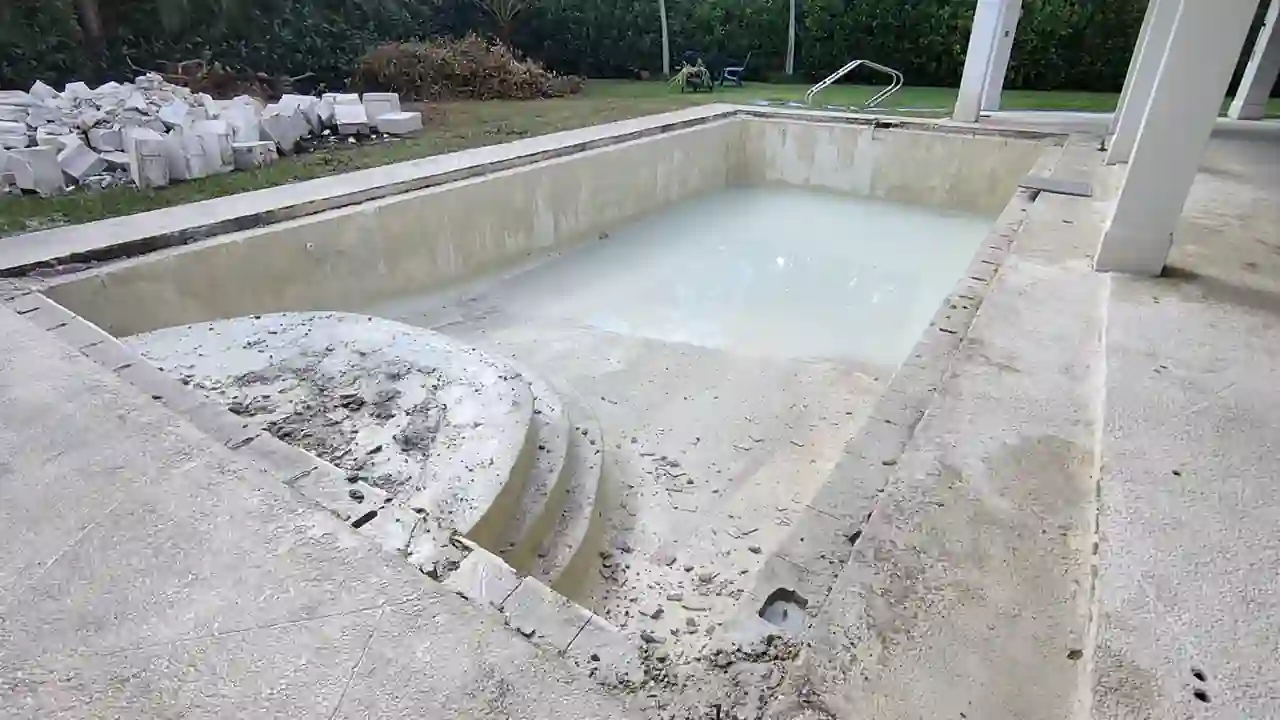
Walk onto a residential swimming pool removal site in Miami and you’ll immediately see why generic demolition equipment fails. Pool shells — whether gunite, shotcrete, or poured concrete — range from 6 to 12 inches thick on the walls and 4 to 8 inches on the floor slab. That variability alone demands a tooling strategy, not just a machine selection. The aggregate composition in South Florida pool shells is notoriously abrasive, typically featuring silica-rich sand and crushed limestone, which eats through underpowered or incorrectly bonded diamond segments faster than almost any other concrete cutting application in the region. Before a single cut is made, the equipment package — saw type, blade diameter, bond hardness, and segment geometry — must be matched to the specific shell construction and site access constraints.
Hydraulic Ring Saw Specifications for Confined Pool Wall Cutting
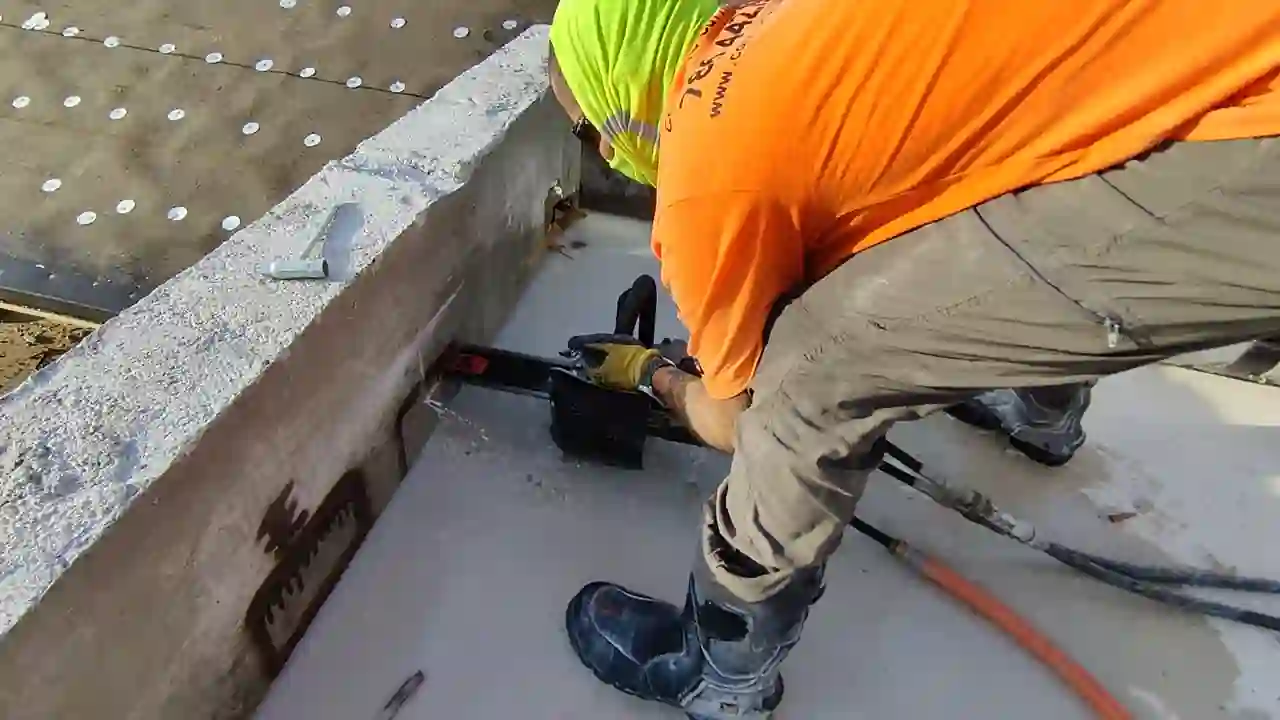
When access to the pool interior is the primary constraint — and it almost always is — the hydraulic ring saw becomes the dominant tool for wall segmentation. Unlike conventional flat saws or angle grinders, ring saws operate with an annular blade that allows cutting depths up to 16 inches with a relatively compact head profile. For swimming pool removal, the Husqvarna K 6500 Ring Saw and the Diamond Products Core Cut CC6500 are the two machines most commonly deployed in South Florida, both operating at hydraulic flow rates between 6 and 8 gallons per minute and generating blade speeds in the 2,800 to 3,200 RPM range.
The critical specification here is cutting depth versus wall thickness ratio. A ring saw with a 16-inch maximum cut depth is not your limiting factor on a standard 8-inch gunite wall — your limiting factor is blade segment exposure and water delivery at depth. Miami pool shells frequently incorporate rebar at #4 and #5 bar sizing on 12-inch centers, and that steel density directly influences blade segment wear rate. For heavily reinforced walls, a ring saw with adjustable hydraulic pressure output — allowing the operator to modulate torque at the blade — prevents segment stripping and premature bond failure.
Hydraulic Power Unit Output Requirements
The hydraulic power unit (HPU) driving the ring saw must deliver consistent flow without pressure spikes. For pool wall demolition, specify an HPU rated at a minimum of 8 GPM at 2,000 PSI. Units with variable displacement pumps — such as the Hilti HPU 6500 or equivalent — provide better torque management when the blade transitions from open concrete into rebar clusters. Pressure relief valves should be set no higher than 2,200 PSI to protect segment bonding on the blade arbor. Proper equipment maintenance protocols for HPU filter service intervals become especially important during extended pool demolition projects where fine concrete slurry contaminates hydraulic fluid rapidly.
Diamond Blade Bond Hardness Selection for Gunite and Shotcrete Pool Shells
This is where most contractors make costly errors. Diamond blade bond hardness must be inversely matched to aggregate hardness — softer bond for harder aggregate, harder bond for softer aggregate. South Florida gunite pool shells are typically mixed with silica sand and local limestone aggregate, producing a medium-to-hard concrete matrix with compressive strengths ranging from 3,500 to 5,500 PSI. That hardness profile calls for a medium-soft to medium bond diamond segment, typically classified as Bond Grade D or E on the manufacturer’s scale.
Using a hard bond blade on Miami pool concrete causes glazing — the diamond crystals become polished rather than fractured and exposed, killing cutting efficiency and generating dangerous heat at the blade core. Using too soft a bond causes rapid segment wear and premature blade retirement. For standard gunite pool wall cuts at depths up to 10 inches, specify blades with the following parameters:
- Diamond concentration: 25 to 30 (medium concentration for balanced wear and cutting speed)
- Segment height: 15mm minimum for walls thicker than 8 inches
- Bond grade: Medium-soft (D/E range) for silica-rich Miami aggregate
- Core thickness: 0.140 to 0.160 inches for ring saw arbor stability
- Laser-welded vs. sintered: Laser-welded segments mandatory for wet cutting at depth; sintered acceptable only for dry shallow cuts on pool decks
Flat Saw Specifications for Pool Deck Demolition and Perimeter Cuts
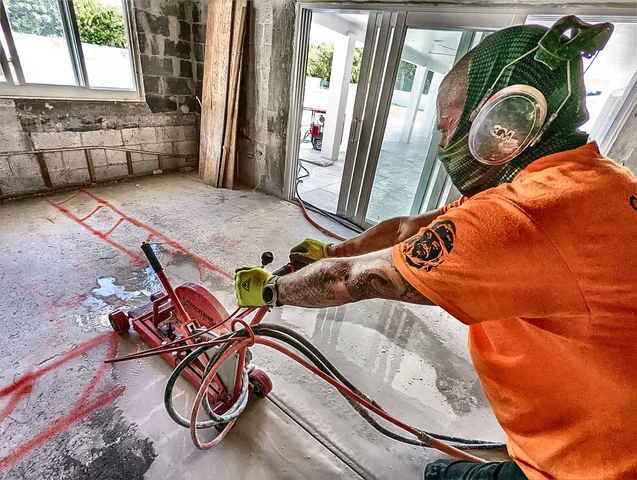
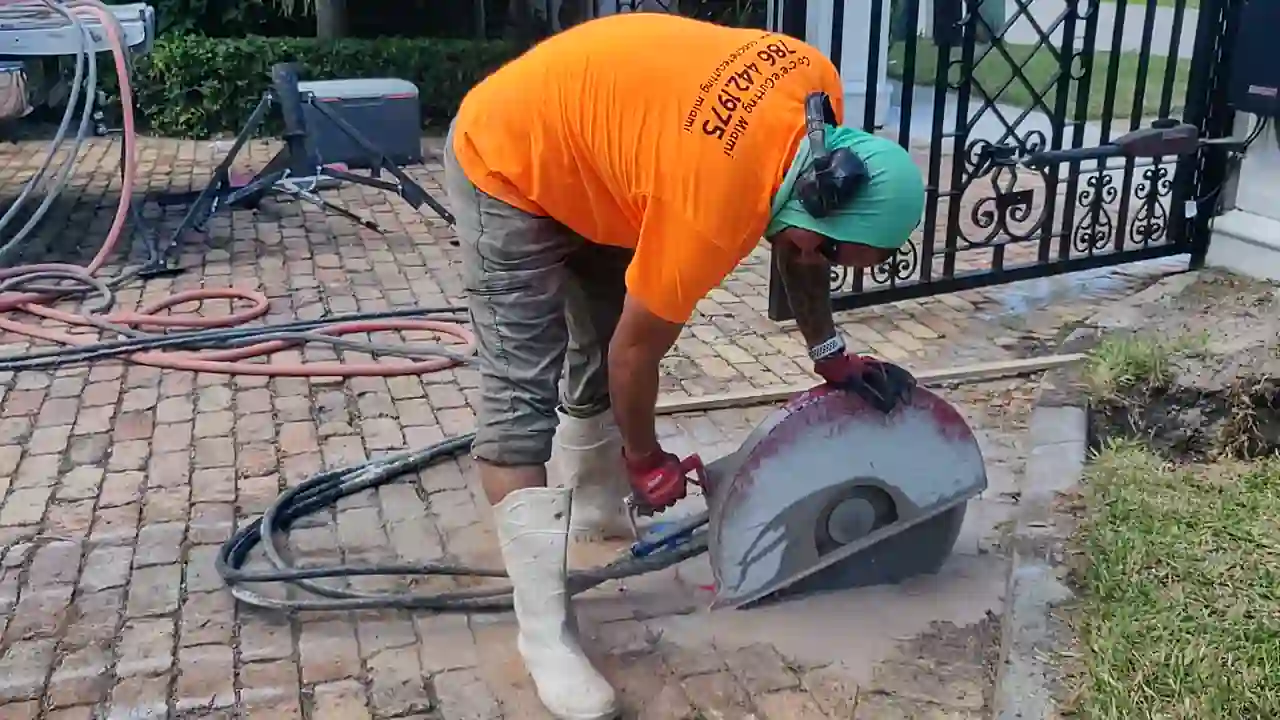
The pool deck removal phase requires a different machine class entirely. Walk-behind flat saws — specifically diesel-powered units in the 25 to 65 horsepower range — handle the horizontal slab work surrounding the pool shell. For typical Miami pool decks at 4 to 6 inches thick with standard wire mesh reinforcement, a 14-inch or 16-inch blade diameter provides adequate depth with controlled kerf width. The Husqvarna FS 5000 D and the Stihl GS 461 class machines are workhorses for this application, but blade selection still governs performance.
Pool decks in Miami frequently feature decorative aggregate finishes, exposed aggregate, or travertine overlays bonded to the structural slab. These surface treatments affect blade entry characteristics significantly. A blade designed purely for standard concrete will micro-chip on travertine overlays, creating surface fractures that extend beyond the intended cut line. For pool deck demolition involving decorative surface materials, specify a turbo-segmented blade with a continuous rim section at the outer 3mm of the segment to control surface chipping on entry.
Blade Diameter to Horsepower Matching for Flat Saw Pool Deck Cuts
Undersizing blade diameter relative to available horsepower wastes machine capacity. Oversizing it stalls the saw and overloads the drive belt. For pool deck work, follow this pairing guideline:
- 14-inch blade: Minimum 20 HP engine; suitable for 4-inch decks with light wire mesh
- 18-inch blade: Minimum 35 HP engine; handles 6-inch decks with #3 rebar
- 24-inch blade: Minimum 50 HP engine; required for thickened edge beams at pool perimeter, often 8 to 10 inches deep
- 30-inch blade: 65+ HP diesel only; used when pool bond beam requires full-depth segmentation before excavation
Blade RPM at the saw arbor must be matched to blade manufacturer’s maximum surface speed (SFPM). Running a 24-inch blade at the same RPM as a 14-inch blade on the same machine will exceed the safe surface speed and risk segment ejection. Always verify the saw’s arbor RPM against the blade’s rated maximum before mounting. This is a non-negotiable safety protocol on every Miami job site.
Wall Saw Setup for Vertical Pool Shell Segmentation Before Excavation
On full pool removal projects — as opposed to partial removals — the shell must be broken into liftable segments before the excavator can remove material. Wall saws mounted on track systems provide the most controlled vertical and angled cuts through pool walls from the exterior. The Husqvarna WS 482 HF and the Diamond Products WS-800 series are the standard track-mounted wall saws used in South Florida pool removal, both capable of cutting depths exceeding 24 inches with appropriate blade sizing.
Track installation on curved pool walls — especially freeform pool designs common in Miami Beach luxury properties — requires flexible track sections and careful anchor bolt placement to maintain blade perpendicularity throughout the cut arc. For Miami Beach pool removal services, where site access is often constrained by adjacent structures and landscaping, the wall saw’s ability to make precise panel cuts without vibration transmission to neighboring foundations is a significant operational advantage over hydraulic breaker demolition.
Segment Geometry for Curved Wall Cuts
Standard flat-profile segments perform adequately on straight wall runs but can bind in curved track applications as the blade enters and exits the concrete arc. For curved pool wall cuts, specify blades with arrow-slot or turbo-arrow segment geometry. The slot pattern increases slurry evacuation from the kerf on curved cuts where water delivery is less direct, reducing heat buildup at the segment-to-core weld. Segment width should not exceed 0.140 inches on wall saw applications to minimize blade deflection on curved runs.
Water Delivery Systems and Slurry Management During Pool Shell Cutting
Cutting a pool shell dry is not an option — not for blade life, not for operator safety, and not for dust compliance under OSHA’s silica standard 1926.1153. Water delivery systems for pool removal must supply a minimum of 1.5 gallons per minute directly at the blade-concrete interface. For ring saw operations inside the pool bowl, portable water tanks with electric pump systems — minimum 12V, 3 GPM rated — are used when municipal water access is unavailable or when the job site requires self-contained operation.
Slurry containment is equally critical. Pool removal generates high-volume concrete slurry that must be contained and vacuumed before it migrates into storm drains. Industrial wet-vac systems with 20-gallon minimum capacity, paired with slurry solidification agents, are standard on compliant Miami job sites. Blade performance degrades measurably when slurry is allowed to re-enter the kerf — always maintain positive slurry evacuation during extended cuts.
Final Tooling Checklist Before Any Swimming Pool Removal Cut Begins
Before the first blade touches concrete on a pool removal project, every equipment parameter must be verified against the specific shell construction. Skipping this step costs time, blades, and machine components. Run through this pre-cut verification on every project:
- Confirm pool shell construction type (gunite, shotcrete, or formed concrete) and design compressive strength if available
- Verify rebar sizing and spacing from original permits or GPR scan results
- Match blade bond hardness to aggregate type — medium-soft for South Florida silica-limestone mix
- Confirm blade diameter-to-horsepower pairing and verify arbor RPM against blade SFPM rating
- Inspect segment welds for pre-existing cracks before mounting — never use a blade with a cracked segment-to-core weld
- Test water delivery flow rate at the blade guard before beginning cuts
- Verify HPU pressure setting does not exceed 2,200 PSI for ring saw applications
- Confirm slurry containment system is operational and vacuum capacity is adequate for cut volume
Swimming pool removal is one of the most technically demanding concrete cutting applications in residential demolition. The combination of variable wall thickness, high rebar density, curved geometries, and site access constraints in Miami’s residential neighborhoods makes tooling selection the single greatest variable in project efficiency and cost control. Match the machine to the material, match the blade to the aggregate, and the work proceeds on schedule. Deviate from those principles and you’ll be changing blades and troubleshooting equipment when you should be loading trucks.