Why Tool Selection Is a Safety Decision Before It’s a Productivity Decision
Every experienced concrete demolition contractor knows the same uncomfortable truth: the most dangerous moment on a job site isn’t when something goes wrong — it’s when everything feels routine. Selecting the best tools to break up concrete is not simply a matter of matching horsepower to material thickness. It is a layered safety decision that involves silica dust exposure, vibration-induced injury, structural load assessment, and strict adherence to OSHA 29 CFR 1926 Subpart Q — the federal standard governing demolition operations. Before a single jackhammer hits a slab, your crew needs a tool plan that is also a hazard control plan. This post walks through the primary concrete breaking tools used in commercial and industrial environments, with hard emphasis on the safety protocols, PPE requirements, and OSHA compliance obligations that must accompany each one.
Hydraulic Breakers and Electric Demolition Hammers — Managing Impact Energy and HAVS Risk
Hydraulic breakers mounted on excavators and standalone electric demolition hammers remain the most widely deployed tools for breaking up concrete slabs, footings, and walls in Miami’s commercial demolition sector. A hydraulic breaker operating at 1,000 to 1,500 foot-pounds of impact energy per blow can fracture a 12-inch reinforced slab efficiently — but that same energy transfers directly into the operator’s body when using handheld variants. Hand-Arm Vibration Syndrome (HAVS) is an irreversible occupational disease caused by prolonged exposure to tool vibration, and OSHA takes it seriously under the General Duty Clause (Section 5(a)(1)).
Crew chiefs must enforce daily vibration exposure limits based on the EU Physical Agents Directive as a best-practice benchmark — an action value of 2.5 m/s² and a limit value of 5 m/s² averaged over an 8-hour shift. Anti-vibration gloves rated to ISO 10819 are mandatory PPE for any operator running a demolition hammer for more than two consecutive hours. Rotate operators every 30 minutes on high-impact work. Log exposure times. This is not optional protocol on a compliant job site — it is a documented liability shield.
For guidance on matching the right equipment specifications to your specific project scope, visit our equipment specifications resource library, which covers impact class ratings, chisel geometry, and hydraulic flow requirements for Miami-area soil and slab conditions.
Concrete Saw Cutting Prior to Breaking — The Controlled Fracture Method
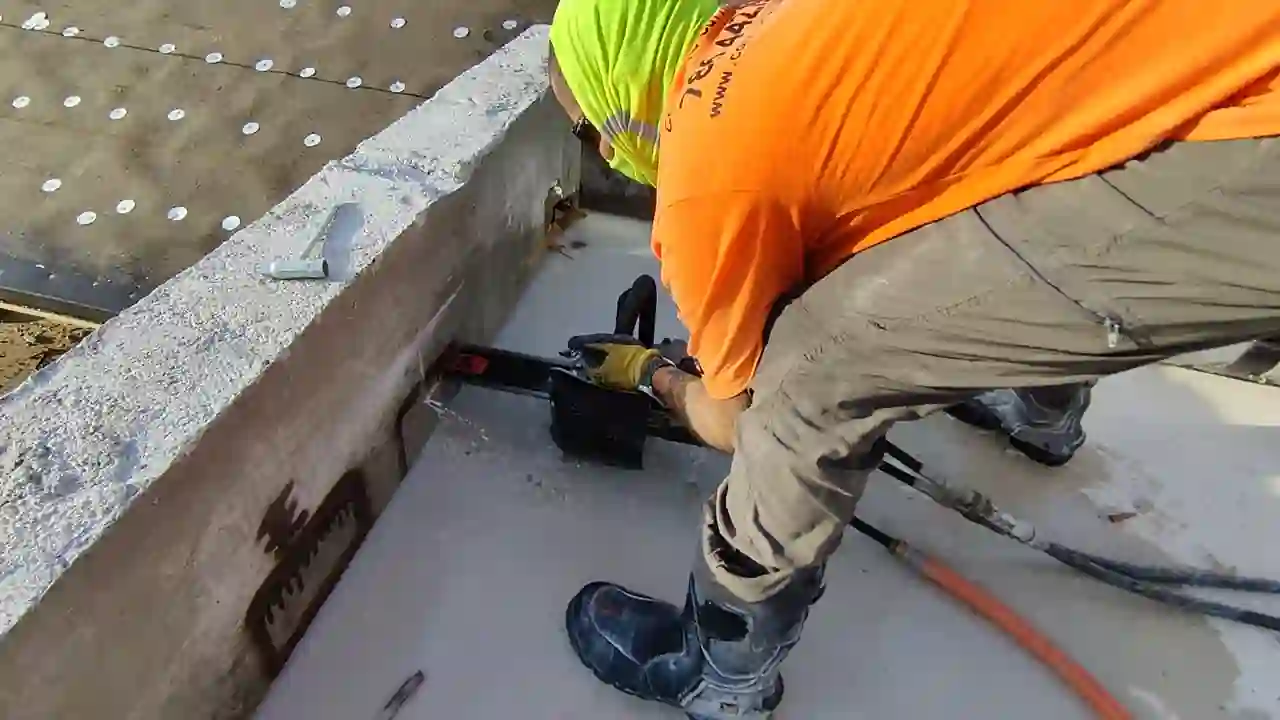
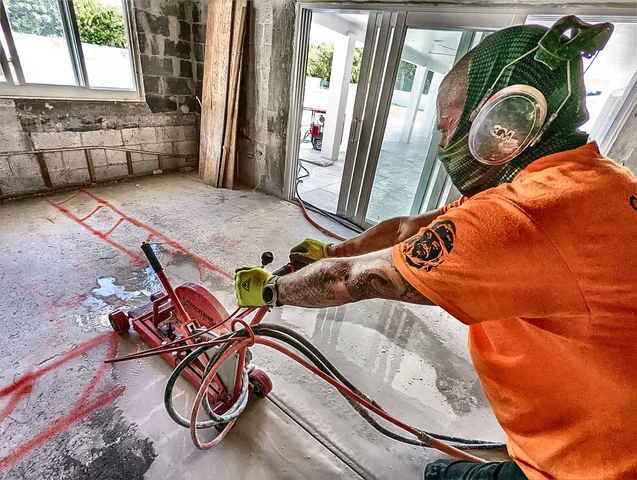
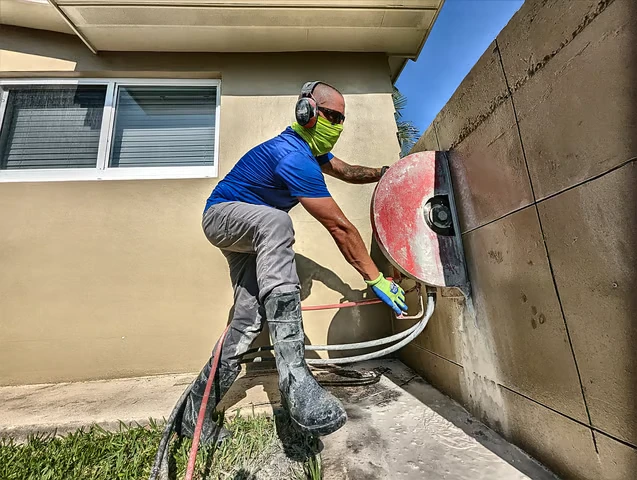
One of the most underutilized safety protocols in concrete demolition is pre-cutting control joints before impact breaking begins. Running a diamond blade walk-behind saw or a hand-held cut-off saw along a defined grid pattern before deploying a breaker dramatically reduces the unpredictability of concrete fracture lines. Uncontrolled fracture propagation is a leading cause of rebar whip injuries, sudden slab collapse, and utility line strikes during demolition. When you define the break path, you control where energy travels.
Saw cutting also reduces the volume of airborne respirable crystalline silica — the primary carcinogen in concrete demolition work. OSHA’s silica standard for construction (29 CFR 1926.1153) mandates engineering controls as the first line of defense. Wet cutting with a continuous water delivery system achieving at least 4 gallons per minute at the blade is the most effective Table 1-compliant method for saw cutting operations. Operators must wear NIOSH-approved N95 respirators at minimum, with P100 half-face respirators required when wet suppression is impractical.
If your team is newer to precision saw work, our detailed breakdown on how to cut concrete like a pro covers blade selection, feed rate, and depth control techniques that apply directly to pre-break scoring operations.

Expansive Chemical Demolition Agents — Zero-Vibration Breaking With Real Chemical Hazards
Expansive demolition grouts, often marketed under trade names like Bristar or Dexpan, represent a non-vibration, non-percussive method for breaking up concrete in confined spaces, near sensitive structures, or in environments where noise ordinances prohibit impact tools. The chemistry is straightforward: a calcium oxide-based slurry is poured into pre-drilled holes, hydrates, and expands at pressures exceeding 18,000 psi over 24 to 48 hours, fracturing the surrounding concrete along a predictable pattern.
The hazard that kills crews who underestimate this tool is blowout. If the grout mixture is too wet, if ambient temperatures exceed the product’s rated range, or if hole diameter and spacing calculations are wrong, the material can violently eject from the bore hole — a phenomenon called “shooting.” Flying grout at high velocity causes severe eye injuries and burns. OSHA’s PPE standard (29 CFR 1926.102) requires chemical splash goggles, full face shields, and chemical-resistant gloves when mixing and pouring expansive agents. A written Job Hazard Analysis (JHA) specific to the chemical demolition task must be completed and reviewed with all crew members before work begins.
Wrecking Balls and Controlled Drop Demolition — When OSHA Subpart Q Takes Full Effect
For large-scale concrete structure demolition — retaining walls, bridge abutments, industrial slabs over 24 inches thick — wrecking ball operations or controlled drop methods may be the most efficient approach. This is where OSHA 29 CFR 1926 Subpart Q becomes non-negotiable in its entirety. An engineering survey of the structure must be completed in writing before any mechanical demolition begins. The survey must identify load-bearing elements, potential for progressive collapse, the location of all utilities (active and abandoned), and the presence of hazardous materials including asbestos-containing materials (ACM) and lead-based paint.
Exclusion zones for wrecking ball operations must extend a minimum of 1.5 times the height of the structure being demolished. All personnel must be cleared from the exclusion zone before each swing cycle. Competent Person designation under OSHA definitions is required for the demolition supervisor — this means documented training, the authority to stop work, and the ability to identify hazards before they become incidents. No exceptions. No shortcuts.
For a comprehensive breakdown of OSHA compliance requirements in industrial concrete demolition environments, including documentation checklists and competent person responsibilities, read our full guide on what every facility manager must know about industrial concrete cutting and OSHA safety.
Pneumatic Chipping Hammers for Precision Removal — Silica Exposure in Tight Spaces
Pneumatic chipping hammers are the go-to tool for selective concrete removal — exposing rebar, removing deteriorated concrete cover, and breaking up sections in areas inaccessible to larger equipment. Their compact form factor makes them indispensable, but that same compactness creates a silica exposure problem: operators work in close proximity to the dust generation point, often in enclosed or semi-enclosed spaces where ventilation is poor.
OSHA Table 1 compliance for handheld and stand-mounted chipping hammers requires either wet methods or a vacuum dust collection system with a HEPA filter operating at the tool. Shrouded chisel attachments paired with an integrated vacuum line are the engineering control of choice for indoor selective demolition. Air monitoring using a calibrated sampling pump and a 37mm PVC filter cassette should be conducted during initial operations to establish baseline silica exposure levels for the specific task and environment. This data supports both OSHA compliance documentation and worker medical surveillance programs.
Selective demolition work demands a level of precision and safety planning that goes beyond standard breaking operations. Explore our tagged resource collection on selective demolition techniques and protocols for project-specific guidance.
Pre-Task Safety Checklist Every Crew Must Complete Before Breaking Concrete
- Utility locates completed and documented — Call 811 and obtain written confirmation of all underground utility locations before any breaking or drilling begins.
- Structural engineering survey on file — Required by OSHA for any demolition operation; must be signed by a licensed engineer for structures over one story or with complex load paths.
- Hazardous materials survey completed — Asbestos, lead, and PCB testing must precede demolition on any structure built before 1980.
- PPE issued and inspected — Hard hats (ANSI Z89.1 Type I or II), safety glasses with side shields, hearing protection (NRR 25+ for impact tools), steel-toed boots, and task-specific respiratory protection.
- Job Hazard Analysis reviewed with crew — Written, signed, and dated before work begins each day.
- Exclusion zones established and marked — Physical barriers, not just cones, for any overhead or heavy mechanical breaking operation.
- Dust control system operational — Water supply confirmed, vacuum systems tested, and wet cutting slurry containment plan in place before cutting begins.
- Emergency response plan posted — Nearest hospital address, emergency contact numbers, and site-specific first aid kit location communicated to all workers.
Building a Culture Where the Right Tool Is Always the Safe Tool
The best tools to break up concrete are not simply the most powerful or the most affordable — they are the tools deployed within a disciplined framework of hazard identification, engineering controls, and OSHA-compliant documentation. Miami’s construction environment presents unique challenges: high ambient temperatures accelerate worker fatigue and heat illness risk during heavy demolition work, coastal groundwater tables complicate saw cutting slurry management, and dense urban job sites demand exceptional exclusion zone discipline. Every one of these variables must be factored into your tool selection and safety planning process.
Senior concrete professionals do not separate equipment decisions from safety decisions. They are the same decision. The hydraulic breaker, the diamond saw, the expansive grout, the pneumatic chisel — each one is a controlled hazard when used correctly, and an uncontrolled liability when used without protocol. Train your crew, document your plans, enforce your controls, and the work gets done safely, efficiently, and in full compliance with the standards that protect everyone on the site.