Why Equipment and Blade Specs Determine Everything on a Slab Removal Job
Walk onto any slab removal site in South Florida and the first question a seasoned concrete cutting contractor asks isn’t “how thick is it?” — it’s “what’s in it, and what am I cutting it with?” The aggregate composition, compressive strength, rebar layout, and slab thickness all feed directly into blade segment geometry, bond matrix hardness, and machine power requirements. Get those variables wrong and you’re not just burning through diamond segments — you’re creating safety hazards, generating excessive silica dust, and leaving your crew fighting equipment that simply isn’t matched to the material. This post breaks down the full technical picture of how to remove a concrete slab from a tooling-first perspective, because that’s where every successful demolition plan actually begins.
Reading the Slab Before You Select a Single Blade
Before any tooling decision is made, a proper site assessment must establish four concrete-specific variables. First, compressive strength — residential slabs in Miami typically run 2,500 to 3,500 PSI, while commercial and industrial pours often reach 4,000 to 6,000 PSI. Higher compressive strength means the concrete matrix is harder and more abrasive to the diamond segments, which directly informs bond hardness selection. Second, aggregate type — South Florida slabs frequently contain Miami oolite limestone, a relatively soft and highly abrasive aggregate that eats soft-bond blades alive. Third, rebar density and diameter — #4 and #5 bar on 12-inch centers is standard for structural slabs, but post-tensioned systems introduce unbonded tendons under 33,000 to 36,000 pounds of tension, requiring an entirely different cutting protocol. Fourth, slab thickness — the depth of cut governs blade diameter selection and directly impacts the power-to-blade-diameter ratio your machine must deliver.
Skipping this assessment is how contractors end up with spalling damage along cut edges or, worse, a blade that glazes over mid-cut because the bond matrix was too hard for the aggregate hardness. For a deeper look at how site conditions and material age interact, see our post on how long concrete lasts when site access and confined spaces change everything.
Flat Saw Specifications for Full-Depth Slab Cutting
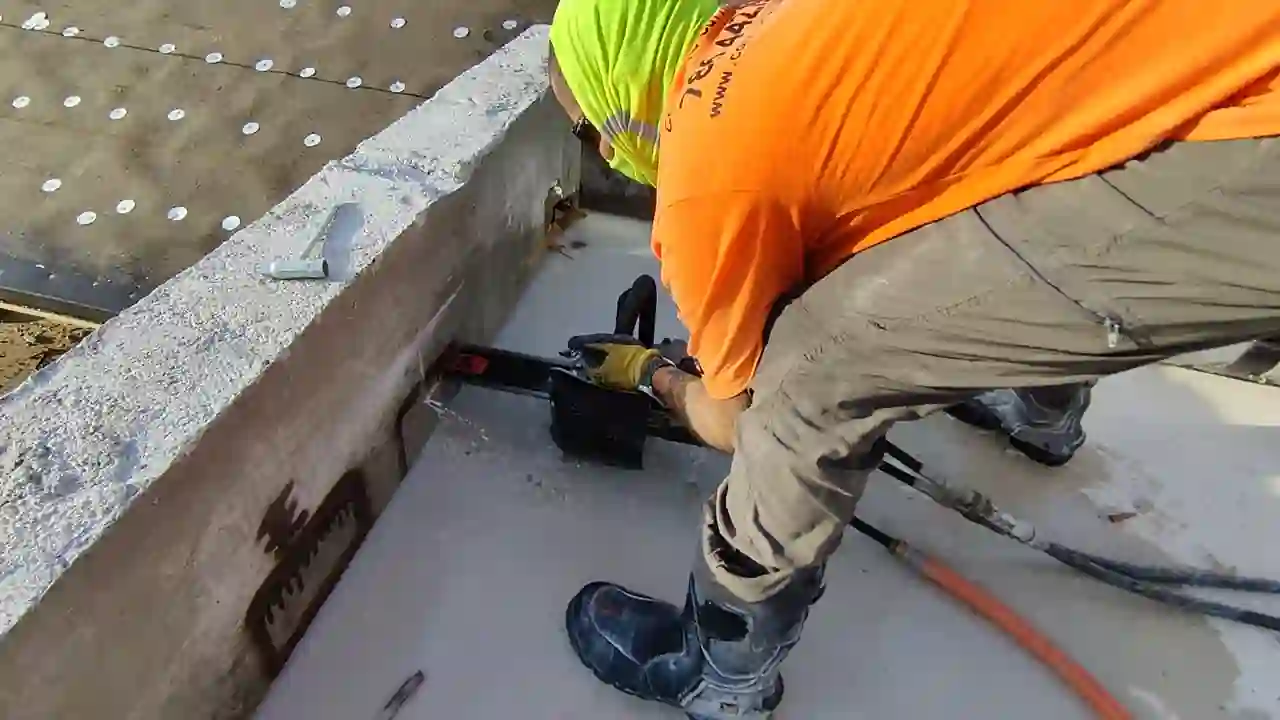
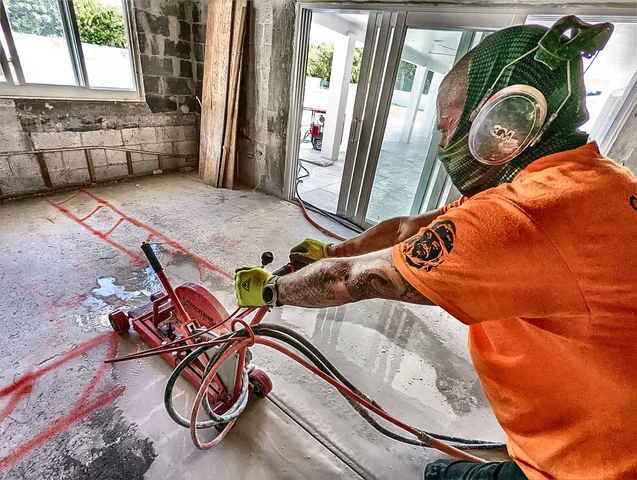
The walk-behind flat saw — also called a road saw or slab saw — is the primary machine for slab removal cuts. Selecting the right unit requires matching engine horsepower to blade diameter with a precise understanding of the power-per-inch-of-blade-diameter rule. The industry standard is a minimum of 3 to 3.5 horsepower per inch of blade diameter for productive cutting. That means a 14-inch blade requires at minimum a 42 to 49 HP machine, and a 20-inch blade demands 60 to 70 HP to maintain adequate rim speed under load.
Blade peripheral speed — measured in surface feet per minute (SFPM) — is the critical operating parameter. Most diamond blades for slab cutting are designed to operate between 9,000 and 12,000 SFPM. Dropping below this range causes the bond matrix to glaze, preventing diamond exposure. Exceeding it generates heat that softens the bond prematurely, causing rapid segment loss. On a 14-inch blade, achieving 9,000 SFPM requires a spindle speed of approximately 2,450 RPM. Always verify your machine’s spindle RPM against the blade manufacturer’s maximum RPM rating — this is a non-negotiable safety specification.
For slab removal depths beyond 6 inches, contractors in Miami increasingly use hydraulic flat saws with variable displacement pumps, which maintain consistent blade speed under varying load conditions far more effectively than belt-driven gasoline units. Hydraulic systems also allow for precise depth-of-cut control, which matters enormously when you’re cutting to a specific depth to preserve a substrate or utility below the slab.
Diamond Blade Segment Geometry and Bond Matrix Selection for Slab Demolition
This is where most contractors — even experienced ones — make costly mistakes. Diamond blade selection for slab removal is a matrix of four interdependent variables: segment height, segment width, diamond concentration, and bond hardness. Each must be matched to the concrete’s abrasiveness and hardness.
For soft, abrasive concrete like the oolite-aggregate mixes common in Miami, you need a hard bond matrix. A hard bond holds the diamonds in place longer against the aggressive abrasion, preventing premature pullout. Conversely, for hard, less abrasive concrete (think high-PSI industrial slabs with granite aggregate), a soft bond matrix is required so the bond wears away at the correct rate to continuously expose fresh diamond crystals. Using a hard bond on hard concrete causes the blade to glaze — the diamonds dull and the bond doesn’t release them. The blade stops cutting and starts burning.
Segment height for slab removal blades typically ranges from 12mm to 15mm for standard demolition work. Taller segments (15mm+) provide longer blade life but require higher machine power to maintain cutting efficiency. Segment width — typically 3.2mm to 4.5mm for 14 to 20-inch blades — affects both cutting speed and kerf width. Wider segments remove more material per pass but demand more horsepower.
Diamond concentration is expressed as a relative scale (low, medium, high) or numerically (25 to 100). For slab removal where cutting speed matters more than blade longevity, medium concentration blades (40 to 60) are the standard choice. High concentration blades are better suited to precision cutting where blade life is prioritized over speed.
Segmented rim blades with gullets — the open spaces between segments — are mandatory for slab removal. The gullets serve two functions: they allow slurry and debris to evacuate from the cut, and they allow the blade to cool. Continuous rim blades have no place in slab demolition work. For jobs involving steel cutting within the slab, such as post-tensioned tendon severance, a dedicated steel-cutting segment profile with a softer, more aggressive bond is required alongside the concrete blade — never attempt to cut steel with a standard concrete demolition blade.
Wet Cutting Versus Dry Cutting Equipment Configurations
Wet cutting is the professional standard for slab removal. Water serves as both a coolant and a dust suppressant, extending blade life significantly and reducing airborne respirable crystalline silica to manageable levels. A minimum water flow rate of 1 to 1.5 gallons per minute directly to the blade arbor is required for effective cooling on blades 14 inches and larger. Flat saws should be equipped with dual-side water delivery systems — single-side water delivery creates uneven thermal loading across the blade, contributing to blade warping and segment stress fractures.
When wet cutting is not feasible — interior slabs near electrical systems, confined spaces with drainage restrictions — dry-cut turbo blades with continuous rim segments and integrated cooling slots are the alternative. These blades are engineered with a segmented turbo profile that creates turbulent airflow around the blade during rotation, providing passive cooling. However, dry cutting generates substantial silica dust, and full respiratory protection with a minimum P100 rating is non-negotiable. Review our resources on silica dust management before operating in any enclosed environment.
Jackhammer and Hydraulic Breaker Tooling After the Saw Cuts Are Complete
Once the perimeter and grid cuts are complete, slab sections must be broken and lifted. Pneumatic jackhammers in the 60 to 90-pound class are standard for residential slab sections up to 4 inches thick. For slabs 5 inches and above, or for reinforced sections, hydraulic breakers mounted on mini-excavators (in the 3 to 6-ton class) deliver significantly higher impact energy — typically 500 to 1,200 foot-pounds per blow — and reduce operator fatigue and injury risk substantially compared to handheld equipment.
Moil point chisels are the correct tool geometry for breaking slab sections after saw cutting. Flat chisels are appropriate for final cleanup along rebar lines. Blunt or worn chisel tips must be replaced immediately — a dull moil point transfers impact energy into the surrounding concrete rather than fracturing along the intended plane, causing uncontrolled cracking and potential damage to adjacent structures or utilities.
For a comprehensive look at how these techniques integrate into larger Miami construction projects, see our overview of the art and science of concrete cutting and demolition in Miami.
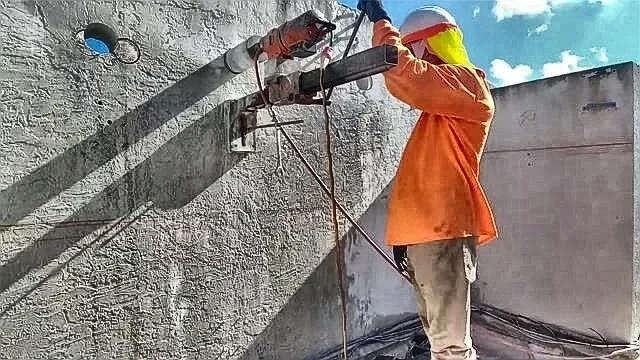
Blade Inspection Protocols That Prevent Catastrophic Failures Mid-Cut
Every blade must be inspected before installation and after every 30 minutes of active cutting. The inspection checklist for slab removal blades includes checking for segment loss or cracking, core warping (place the blade on a flat surface — any rocking indicates core distortion), undercutting of the core steel behind the segments, and gullet cracking. A blade with any of these defects must be removed from service immediately. Segment loss mid-cut is not just a tooling failure — it is a projectile hazard capable of causing fatal injuries.
Torque specifications for blade arbor bolts must be followed precisely per the machine manufacturer’s specs. Under-torquing allows blade slippage; over-torquing can stress the blade core. Always use the correct arbor adapter for the blade’s arbor bore — running a blade on an adapter that allows any lateral movement is a critical safety violation.
Matching the right blade to the right machine, the right concrete, and the right cutting method isn’t a detail — it’s the entire job. Every hour of productive cutting on a slab removal project is built on the five minutes you spend getting the tooling specification right before the first cut is ever made.