Why GPR Scanning Specifications Directly Dictate Diamond Tooling Selection in Miami
Every experienced concrete contractor in South Florida knows the sequence: you don’t pick up a diamond blade until you’ve run a ground-penetrating radar scan and fully interpreted the data. That’s not a liability disclaimer — it’s a hard technical reality. The subsurface profile revealed by a GPR scan — rebar depth, spacing, post-tension cable location, conduit routing, aggregate density — directly determines which blade matrix, bond hardness, and segment geometry will survive the cut. Skipping or under-speccing the scan doesn’t save time. It destroys tooling, damages embedded utilities, and in post-tensioned slabs, creates catastrophic structural failures. In Miami’s hyperactive construction environment, where slabs range from 1950s unreinforced pours to modern high-rise PT decks, concrete scanning is the technical prerequisite for every other decision on the job.
GPR Equipment Specifications for Miami Concrete Scanning Operations
Not all GPR units are equal, and the Miami market demands specific hardware configurations. The two antenna frequency ranges that dominate commercial concrete scanning here are 1.6 GHz and 2.6 GHz systems. The 1.6 GHz antenna — common in units like the GSSI StructureScan Mini XT and Proceq GP8000 — delivers penetration depths up to 18 inches in standard concrete, which covers the majority of Miami’s commercial slabs, parking structures, and concrete pipe infrastructure work. The 2.6 GHz antenna sacrifices depth for resolution, making it the right tool when you need to differentiate closely spaced rebar at shallow depths — think 3-inch cover slabs on elevated decks or thin-shell architectural concrete.
For Miami Beach high-rises and coastal structures, dielectric constant calibration is non-negotiable. Saltwater infiltration into concrete matrix — extremely common in Miami-Dade’s coastal zone — alters the dielectric constant from the standard 6–9 range up to 12 or higher. Running a scan without calibrating for moisture-saturated concrete produces depth readings that are off by as much as 30%, which means your blade depth setting is wrong before the first cut. Field calibration using a known-depth target or a hyperbola-fitting algorithm in the software is mandatory on any oceanside structure. This is especially critical on Miami Beach projects where salt-laden aggregate and decades of tidal moisture have fundamentally altered the concrete’s electromagnetic properties.
Antenna Frequency Selection by Application Type
- 1.6 GHz: Standard commercial slabs, foundations, PT decks over 6 inches thick, slab breaking operations requiring full-depth rebar mapping
- 2.6 GHz: Shallow cover detection, thin architectural slabs, surface-mounted conduit identification, pre-cut verification on overlays
- 900 MHz: Deep structural scanning beyond 24 inches — bridge decks, thick mat foundations, mass concrete pours
- Dual-frequency array systems: High-production environments where a single pass must capture both shallow and deep targets simultaneously
Translating Scan Data into Diamond Blade Matrix Specifications
Once the scan is complete and interpreted, the real technical work begins: matching diamond tooling to what’s actually inside the slab. This is where most contractors make expensive mistakes. The scan tells you aggregate type and estimated hardness, rebar density, and whether the slab is conventionally reinforced or post-tensioned. Each of those variables feeds directly into blade specification decisions.
Miami’s concrete aggregate profile is dominated by oolitic limestone — a relatively soft, high-abrasion aggregate quarried locally from the Miami Formation. This aggregate type demands a hard bond matrix in your diamond segments. A soft bond matrix, appropriate for hard granite aggregate in other markets, will wear away too quickly against oolitic limestone, causing premature diamond exposure and segment loss. Standard specification for Miami limestone aggregate cutting: segment bond hardness in the M-H (Medium-Hard) to H (Hard) range, with a diamond concentration of 25–30 (IDA scale), and a grit size of 30–40 mesh for general slab cutting.
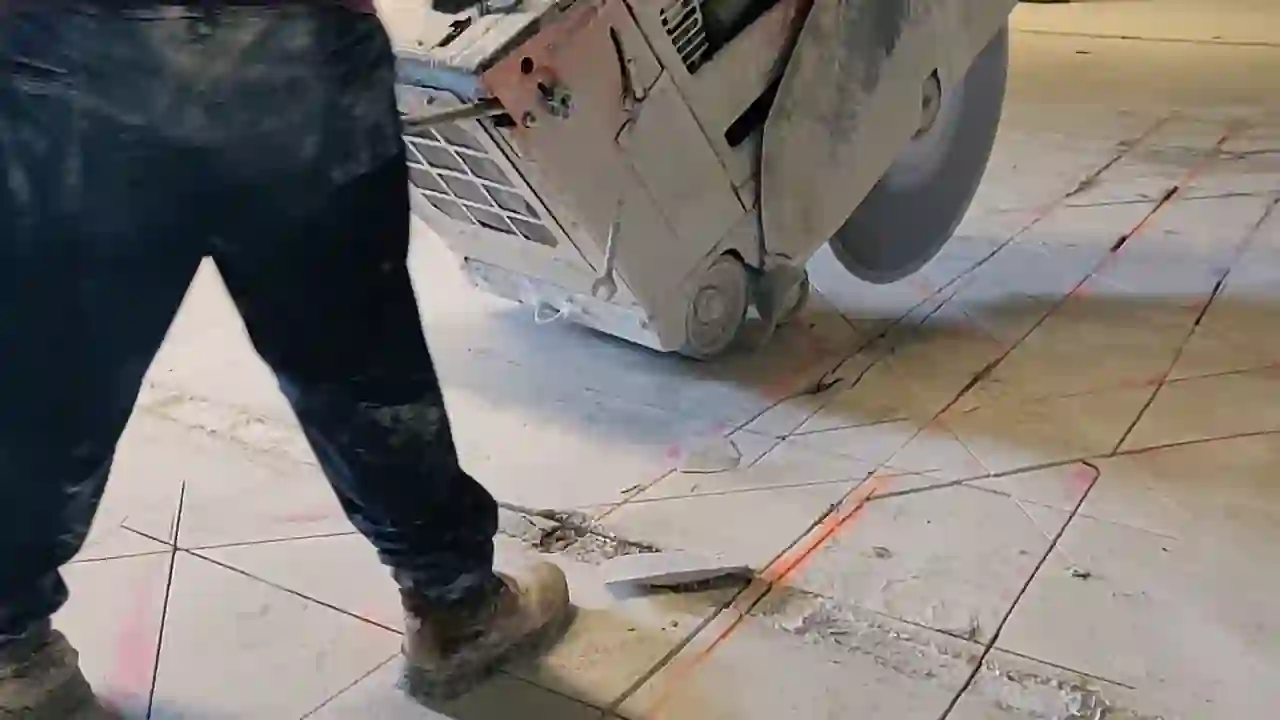
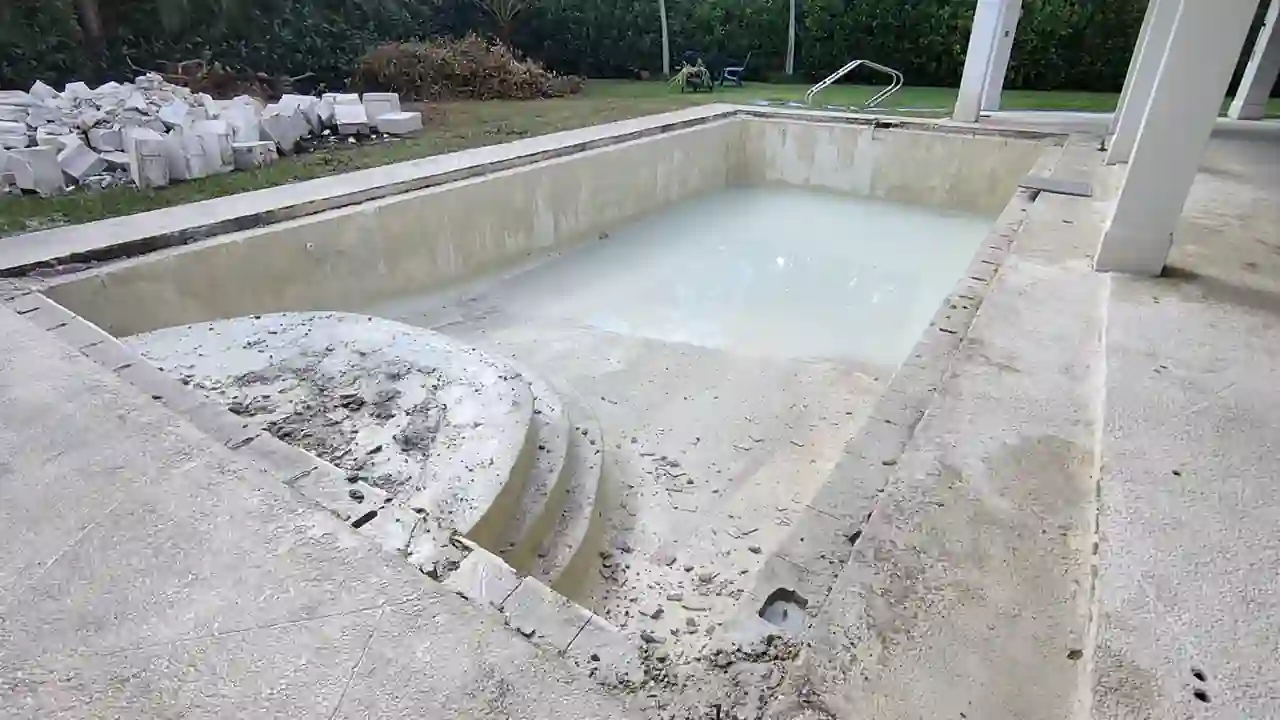
When the GPR scan reveals high rebar density — say, #8 bars at 6-inch centers in both directions — you’re looking at a dramatically different blade spec. High-steel-content cuts require a softer bond matrix to allow continuous diamond exposure as the segment contacts and releases from the rebar. The friction from steel contact accelerates bond wear, so a softer matrix that refreshes diamond exposure is counterintuitively the right call. Pairing a soft-bond segment with Miami limestone aggregate, however, creates a conflict: the aggregate wants a hard bond, the steel wants a soft bond. The resolution is a medium bond with elevated diamond concentration (35+) and a laser-welded segment design that can handle the thermal cycling from mixed-material cutting. This is the exact scenario you encounter on pool deck removal jobs where decades-old slabs have high rebar density and worn, abrasive aggregate surfaces.
Post-Tension Cable Detection and Blade Guard Protocols
Post-tensioned slabs are the highest-stakes scanning scenario in Miami’s market. A GPR scan on a PT slab must identify both the banded tendon zones (typically 2–4 tendons grouped at 48–60 inch intervals) and the distributed single-strand tendons running perpendicular. The scan operator must deliver a marked-up drawing showing no-cut zones extending at least 3 inches on either side of any identified tendon. From a blade specification standpoint, PT slab cutting outside the no-cut zones still requires a modified approach: segmented blades with deep gullets to manage the heat generated by the higher-strength concrete typical in PT construction (6,000–8,000 PSI versus the 3,000–4,000 PSI common in older conventional slabs). Higher PSI concrete is harder on the cutting face and demands a coarser grit (20–25 mesh) with higher diamond concentration to maintain cut rate without overheating segments.
Equipment Power Requirements and Blade RPM Calibration for Miami Job Sites
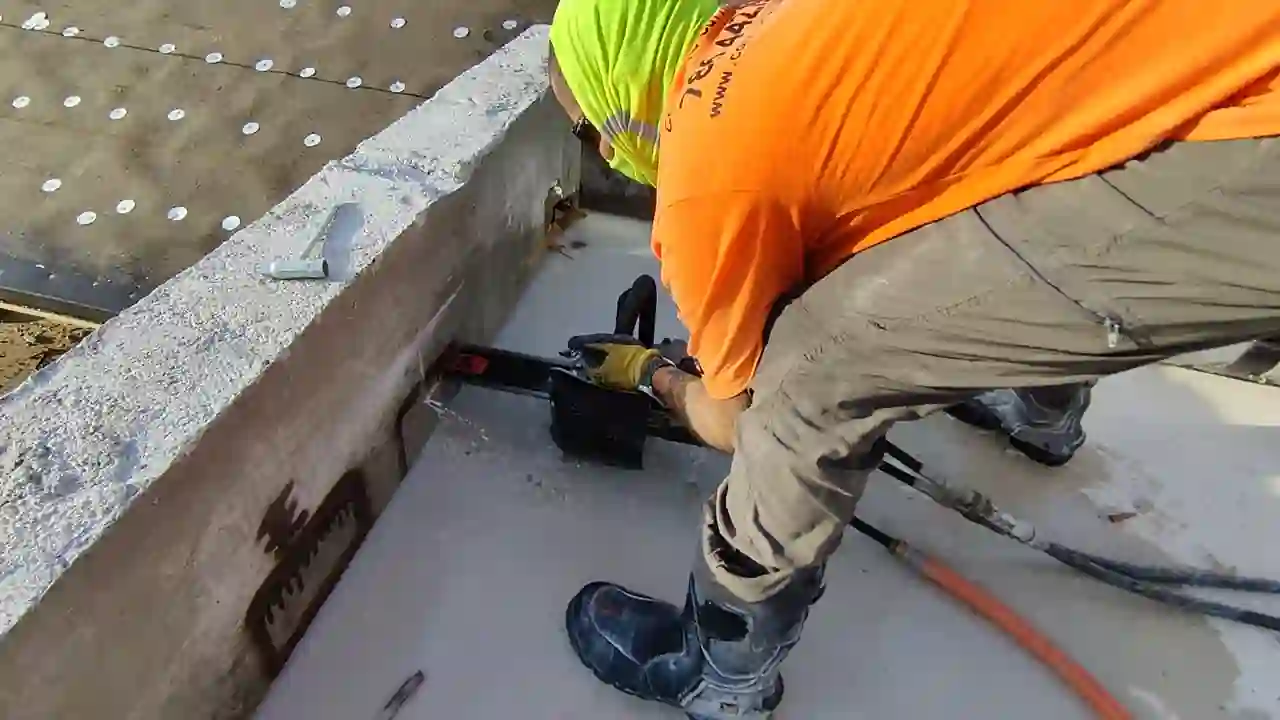
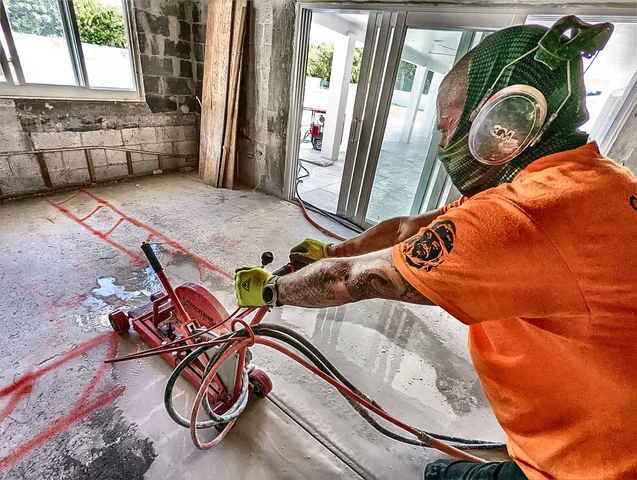
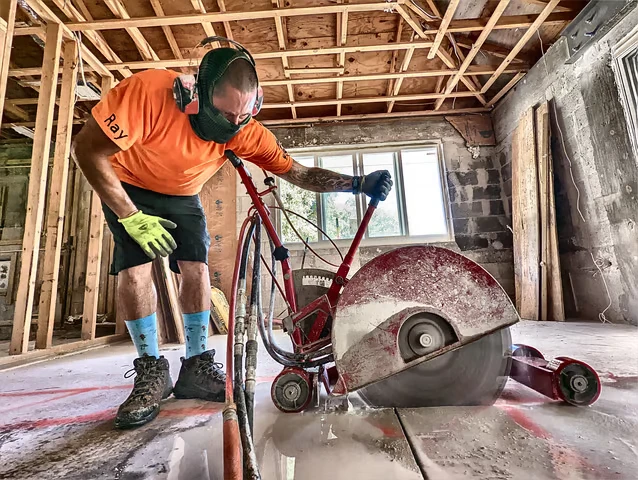
Blade selection is inseparable from the power unit driving it. Miami job sites — particularly renovation work in gravel and aggregate removal scenarios or confined commercial spaces — frequently rely on electric flat saws and wall saws rather than hydraulic systems. Electric flat saws in the 20–30 HP range running on 480V three-phase power are the standard for production slab cutting. The critical specification here is maintaining blade tip speed in the 16,000–18,000 SFPM (surface feet per minute) range. Too slow and the diamond segments polish rather than cut; too fast and segment bond integrity fails from centrifugal stress.
For a 14-inch diameter blade, the target RPM to achieve 17,000 SFPM is approximately 4,900 RPM. For a 20-inch blade, that drops to roughly 3,250 RPM. When operators push production by running larger blades at the same RPM as smaller blades, they’re operating outside the blade’s engineered tip speed range — a primary cause of segment cracking and core fatigue that GPR scan data alone won’t prevent. This is why equipment calibration and blade spec matching are treated as a single technical discipline at Concrete Cutting Miami, LLC, not two separate concerns.
Wire Saw Tensioning for Deep-Section Cuts Identified by Scanning
When GPR scanning reveals that a cut profile requires depths exceeding the capacity of a flat saw — common in thick mat foundations or heavily reinforced grade beams — wire saw systems take over. Diamond wire specifications for Miami conditions call for a 6.3mm to 7.3mm wire diameter with sintered bead spacing of 35–40 beads per meter. Wire tension must be maintained between 1,800 and 2,200 Newtons throughout the cut; tension loss causes wire whip, uneven bead wear, and potential wire failure. The scan data informs wire saw setup by identifying any metallic obstructions that could snag the wire mid-cut — a potentially violent equipment failure if not anticipated. Projects involving concrete slab breaking on thick sections benefit enormously from pre-cut wire saw planning informed by a thorough GPR pass.
Core Bit Selection Driven by Subsurface Scan Profiles
Core drilling decisions follow the same scan-driven logic. A GPR scan showing 3/4-inch aggregate in a 4,000 PSI slab calls for a standard segmented core bit with 8–10mm segment height and medium bond. A scan revealing 1.5-inch crushed limestone aggregate in a 7,000 PSI engineered slab demands a premium bit with 12–14mm high segments, hard bond matrix, and a water delivery system capable of maintaining coolant flow at 2–3 gallons per minute at the cutting face. Trying to run a standard production bit through high-strength, coarse-aggregate concrete identified by scanning is how operators burn through $400 core bits in a single 4-inch diameter hole.
For any project touching concrete pipe infrastructure — utility penetrations, drain line cores, sleeve installations — the scan must also confirm pipe wall thickness and any internal steel lining before core bit diameter and segment spec are finalized. Pipe wall cutting presents unique challenges because the curved geometry causes intermittent blade contact, requiring a softer bond to prevent glazing during the non-contact arc of each rotation.
Building a Scan-to-Cut Specification Workflow That Eliminates Guesswork
The most technically disciplined contractors in Miami treat GPR scanning and tooling specification as a single integrated workflow. The scan report doesn’t just go to the safety officer — it goes directly to the blade procurement decision. Aggregate type, rebar density, slab thickness, concrete compressive strength (estimated from scan velocity data), and post-tension status all feed into a specification matrix that determines blade bond hardness, diamond concentration, grit size, segment geometry, and core bit grade before a single tool hits the slab. Whether the job is a pool deck removal in Coral Gables, a utility penetration on a Miami Beach high-rise, or a gravel and aggregate clearing operation in Doral, the scan-to-spec workflow is what separates contractors who hit production targets from contractors who burn through tooling budgets and miss deadlines. Concrete scanning in Miami isn’t overhead — it’s the most cost-effective investment on any cutting project.