Why Lauderhill Concrete Fence Projects Carry Serious Occupational Hazard Exposure
Lauderhill sits in the heart of Broward County, a dense urban grid where residential lots butt up against commercial corridors, utility easements cross every block, and aging concrete fence structures — some dating back to the 1970s — line property boundaries throughout the city. When a concrete fence needs to be cut, cored, or fully demolished in this environment, the hazard profile is not trivial. Crystalline silica, structural instability, overhead and underground utilities, vibration-induced collapse, and bystander exposure all converge on a single job site. Every operator, laborer, and site supervisor must understand the regulatory framework and the physical risks before a single diamond blade makes contact with masonry or cast concrete.
The regulatory backbone for this work is OSHA 29 CFR 1926, the construction industry standard, with specific attention to Subpart Q (concrete and masonry construction) and the 2017 silica rule under 29 CFR 1926.1153. These are not optional guidelines — they are enforceable federal standards with penalty exposure that can shut a contractor down. In Lauderhill, where residential proximity is nearly universal on fence jobs, compliance is not just a legal obligation. It is the difference between a clean project closeout and a multi-agency investigation.
Pre-Job Hazard Assessment Protocols Before Any Blade Contacts a Lauderhill Concrete Fence
A thorough pre-job hazard assessment is the single most important document a crew generates before work begins. On a lauderhill concrete fence project, this assessment must address structural condition, material composition, site geometry, and third-party exposure — all before equipment is unloaded.
Structural Condition Evaluation and Load-Path Analysis
Concrete fence panels in Lauderhill are commonly post-tensioned or reinforced with rebar grids, and many older installations used block-and-pillar construction with no engineered drawings on file. Before cutting begins, a senior technician must physically inspect the fence for visible cracking, spalling, efflorescence, and differential settlement. Any section showing signs of compromised post tension or rebar corrosion is a collapse risk the moment a saw introduces vibration or removes a load-bearing section. The assessment must document panel dimensions, estimated reinforcement layout, and the presence of any attached structures — gates, lighting conduit, irrigation lines — that could shift load distribution during cutting.
Underground Utility Verification and the 811 Call Requirement
Florida law requires a Sunshine 811 call at least two full business days before any excavation or ground-penetrating work. On a concrete fence project, this applies to any core drilling that penetrates the footing and enters soil, and to any saw cutting that approaches grade level where buried utilities may run parallel to the fence line. In Lauderhill, FPL distribution lines, AT&T conduit, and Broward County water mains frequently run within inches of property-line fence footings. The 811 call triggers utility locates, but those locates are advisory — the crew must treat every marked line as a confirmed hazard and maintain the required horizontal clearance buffers during all cutting operations.
OSHA 29 CFR 1926.1153 Silica Compliance on Concrete Fence Cutting Operations
The 2017 OSHA silica rule is the most technically demanding compliance obligation on any concrete cutting job site, and lauderhill concrete fence work is no exception. Respirable crystalline silica generated during dry cutting of concrete masonry units, poured panels, or cinder block can reach action level (25 µg/m³ as an 8-hour TWA) within seconds of blade contact. The permissible exposure limit (PEL) is 50 µg/m³, and exceeding it without documented engineering controls is a willful violation.
Table 1 Engineering Controls for Walk-Behind and Handheld Saw Operations
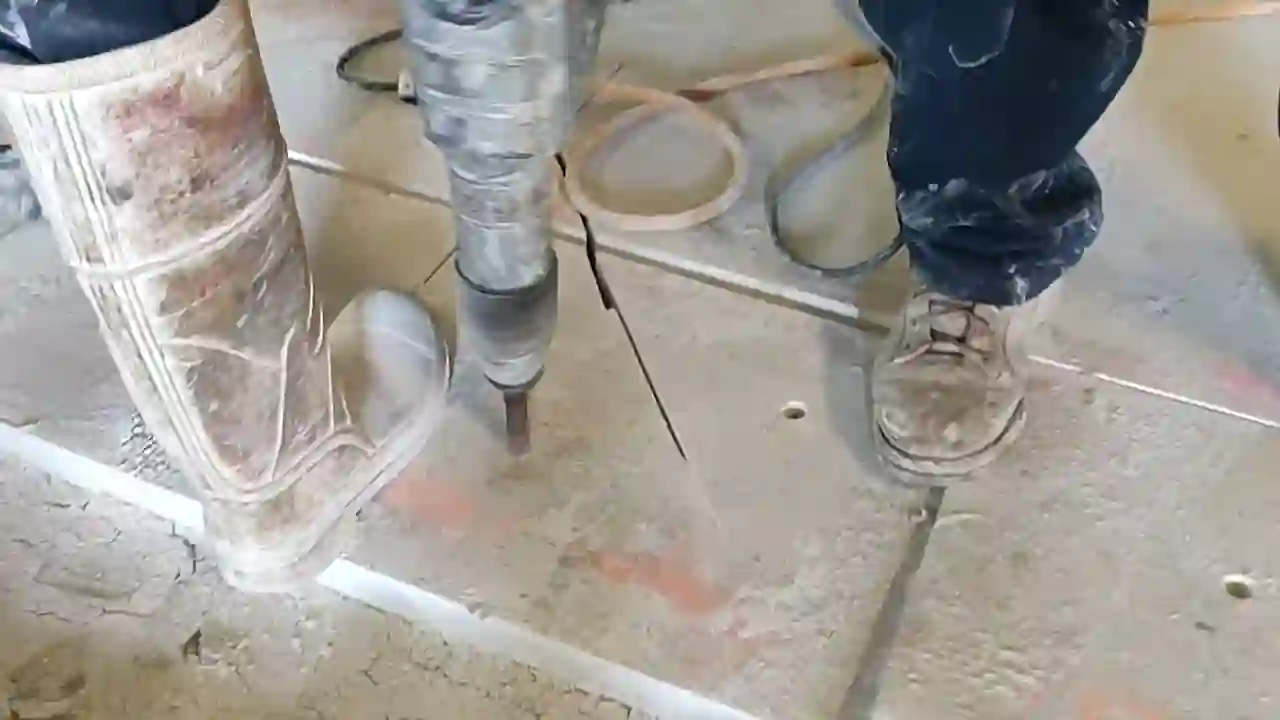
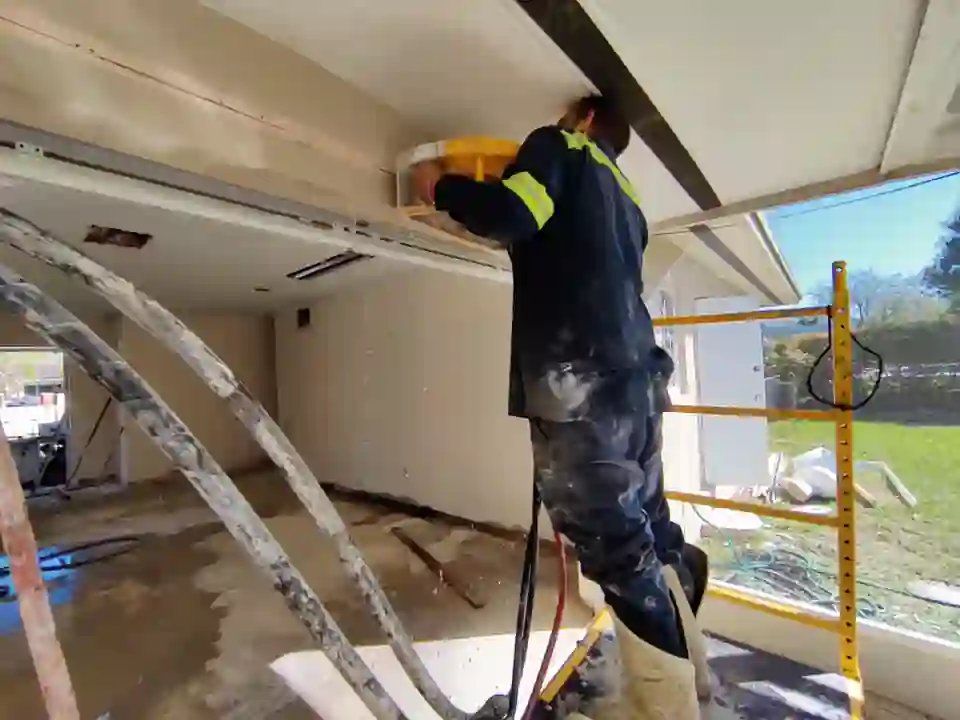
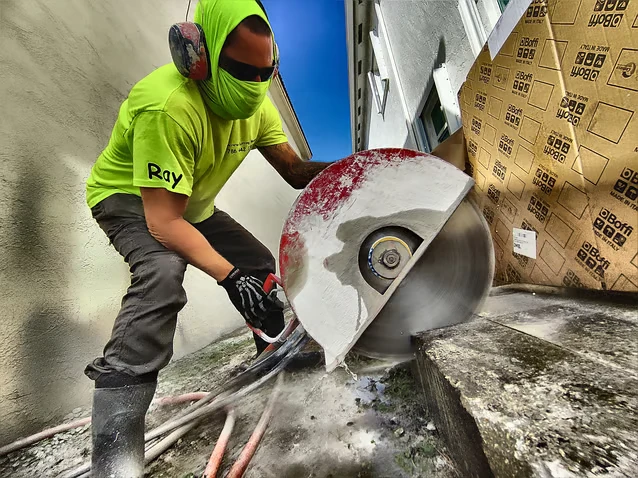
OSHA’s Table 1 specifies the required engineering controls by tool type. For walk-behind saws used on concrete fence demolition, the standard requires either a blade-mounted water delivery system supplying a continuous flow of at least 0.5 gallons per minute to the blade contact zone, or a blade-mounted vacuum shroud connected to an HEPA-filtered dust collection unit rated at a minimum of 99.97% filtration efficiency at 0.3 microns. Wet cutting is the dominant method on Lauderhill fence jobs because it is faster to set up and more effective on the thick cross-sections typical of older decorative concrete fence panels. However, wet cutting introduces its own hazard — silica-laden slurry runoff that must be contained and disposed of as a regulated waste material under Broward County environmental ordinances.
Respiratory Protection Requirements When Engineering Controls Are Insufficient
When Table 1 controls are not feasible for a specific task — for example, hand-held angle grinding of rebar tie-points on a concrete fence pillar — OSHA requires a written exposure control plan, air monitoring, and mandatory respiratory protection at or above a half-face APF-10 respirator standard. On most lauderhill concrete fence projects, this means a NIOSH-approved N95 at minimum, and a P100 half-face respirator for tasks generating visible dust plumes. Disposable dust masks are not compliant. Medical evaluation and fit testing are required before any employee uses a tight-fitting respirator under 29 CFR 1910.134.
Establishing a Controlled Work Zone Around a Residential Concrete Fence in Lauderhill
Urban fence projects in Lauderhill are almost always adjacent to pedestrian traffic, parked vehicles, and neighboring structures. OSHA Subpart Q requires physical barricading of the work zone, and the practical standard for concrete cutting operations extends that requirement significantly. A minimum 10-foot exclusion zone around all active cutting must be established using hard barricades — not cones, not tape alone. On sidewalk-adjacent fence lines, a Type III barricade with reflective sheeting and signage meeting MUTCD standards is required if any pedestrian rerouting is necessary.
Overhead hazard assessment is equally critical. Many Lauderhill concrete fence lines run beneath FPL distribution spans, and saw dust, debris, and water spray from cutting operations can contact energized conductors. The minimum approach distance for unqualified workers near overhead lines up to 50kV is 10 feet under OSHA 29 CFR 1926.1408. If the fence line runs closer than 10 feet to an overhead conductor, the crew must either contact FPL for a temporary de-energization or erect an insulating barrier system before work begins.
Projects like Faena House and SkyRise Miami have demonstrated how high-density urban concrete work demands layered safety systems — the same discipline applies at the residential scale in Lauderhill.
Tool-Specific Safety Requirements for Diamond Blade Fence Cutting
Blade Speed Ratings, Guard Integrity, and Wet-Dry Compatibility
Every diamond blade used on a lauderhill concrete fence project must carry a visible MAX RPM rating that equals or exceeds the no-load RPM of the power unit. Using an under-rated blade on a high-RPM saw is a segment ejection hazard capable of producing a projectile at over 200 mph. Blade guards must cover a minimum of 180 degrees of the blade circumference and must not be removed or modified. Wet-rated blades must be used for wet cutting operations — dry-rated blades used with water can delaminate the core, and the failure mode is catastrophic.
For deeper cuts through reinforced fence panels, the same diamond tooling selection principles that govern pool removal diamond tooling and blade selection apply directly — bond hardness matched to aggregate type, segment height matched to rebar frequency, and core diameter matched to the hydraulic output of the power unit.
Vibration Exposure Limits and Hand-Arm Vibration Syndrome Prevention
Extended use of handheld concrete saws and core drills on fence demolition projects creates cumulative hand-arm vibration (HAV) exposure. The EU Directive 2002/44/EC action value of 2.5 m/s² and limit value of 5 m/s² are the most widely referenced benchmarks, and while OSHA has not yet codified a specific HAV PEL for U.S. construction, the General Duty Clause creates liability exposure for employers who ignore documented vibration hazards. On Lauderhill fence projects lasting more than one day, a vibration exposure log should be maintained and tool rotation schedules implemented to keep individual daily exposure below the action value.
Waste Stream Management and Environmental Compliance on Lauderhill Fence Demolition Sites
Concrete debris from fence demolition is classified as construction and demolition (C&D) waste under Florida Statute 403.7046. In Broward County, C&D waste must be transported to a licensed facility and cannot be stockpiled on residential lots without a Broward County Environmental Protection and Growth Management Department permit. Silica slurry from wet cutting must be collected in lined containment — not discharged to stormwater inlets or adjacent landscaping. Projects near rain gardens or bioretention features require additional protection to prevent silica-laden runoff from compromising infiltration media.
For projects that include full fence footing removal — a scope that overlaps with pool removal methodology — the excavated material must be tested for lead-based paint if the fence was constructed before 1978 and shows evidence of painted surface coatings. Lauderhill’s older residential neighborhoods have a significant inventory of pre-1978 concrete fence structures, and lead hazard assessment is a regulatory requirement under EPA’s RRP Rule (40 CFR Part 745) when residential occupants are present.
Post-Cut Inspection and Documentation Requirements Every Crew Must Complete
When the last cut is made on a lauderhill concrete fence project, the safety obligation does not end. OSHA requires that any remaining structural sections be evaluated for stability before the work zone is released. Partially cut panels and isolated pillars with severed footings are fall hazards that must be either braced, shored, or immediately demolished to grade. A post-cut inspection checklist — documenting blade condition, slurry containment status, utility clearance verification, and barricade removal — should be signed by the site supervisor and retained in the project file for a minimum of three years under OSHA recordkeeping requirements.
Air monitoring results, exposure control plan documentation, and equipment inspection records all belong in the same file. If OSHA conducts a programmed or complaint-driven inspection, the ability to produce this documentation within minutes is the difference between a citation and a clean inspection record. In Lauderhill’s competitive concrete cutting market, that documentation discipline is also a differentiator — clients who understand compliance risk will always choose the contractor who can prove it on paper.