Why Miami’s Architectural Complexity Makes Concrete Cutting One of the Most Hazardous Trades in South Florida
Miami’s built environment is unlike anything else in the United States. Post-tension slabs cantilevered over Biscayne Bay, reinforced tilt-up panels in Wynwood warehouses converted into mixed-use developments, coral rock foundations beneath Art Deco structures in South Beach — the architectural diversity here isn’t just visually striking, it’s operationally brutal for concrete cutting crews. Every structural variation introduces a new set of hazards, and the contractors who survive long-term in this market are the ones who treat OSHA compliance not as a checkbox but as a load-bearing element of every project plan. If your team isn’t approaching Miami architecture jobs with a formalized safety protocol, you’re not cutting concrete — you’re cutting corners on lives.
Pre-Cut Structural Assessment Protocols for High-Rise and Mixed-Use Miami Buildings
Before a diamond blade touches a slab in any Miami architectural project, a pre-cut structural assessment is non-negotiable. Miami’s building stock spans nearly a century of construction codes, and what looks like a standard 6-inch slab on a set of drawings may conceal post-tension tendons running at unpredictable angles, embedded conduit from three renovation cycles, or deteriorated rebar from decades of salt air exposure. Cutting into an undetected post-tension tendon releases stored energy equivalent to a high-velocity projectile — a documented cause of fatalities on South Florida job sites.
OSHA 29 CFR 1926 Subpart Q governs demolition operations, and it explicitly requires engineering surveys before any structural element is disturbed. For Miami architecture projects, this means ground-penetrating radar (GPR) scanning of every cut zone, review of as-built drawings when available, and consultation with a licensed structural engineer on any load-bearing wall or slab that intersects with planned openings. Skipping this step to save a half-day of schedule is how crews end up on the wrong side of an OSHA citation — or worse. Learn more about how Miami demolition companies must approach worker safety from the ground up.
Crystalline Silica Exposure Controls When Cutting Through Miami’s Architectural Concrete Mixes
OSHA’s Silica Standard for Construction (29 CFR 1926.1153) established a permissible exposure limit (PEL) of 50 micrograms per cubic meter of air as an 8-hour time-weighted average — half the previous limit. Miami’s architectural concrete often contains high-silica aggregate blends and older poured mixes from the 1970s and 1980s that generate particularly fine respirable dust when cut. Wet cutting with continuous water suppression at the blade is the primary engineering control, but it must be paired with local exhaust ventilation (LEV) on enclosed or partially enclosed job sites like parking garages, elevator shafts, and interior renovation spaces common in Miami’s commercial architecture sector.
Operators must wear NIOSH-approved half-face respirators rated at minimum N95, but P100 respirators with OV cartridges are the standard on enclosed Miami job sites where both silica and chemical off-gassing from coatings or adhesives are present. Designated competent persons must conduct air monitoring at the breathing zone when new tasks begin or when work conditions change — this is not optional under the standard. Wet slurry generated from water-suppressed cutting must be managed as a hazardous waste stream and cannot be discharged into storm drains, which in Miami flows directly to coastal waters under strict EPA and DERM oversight.
Overhead Hazard Management on Miami Waterfront and High-Rise Architecture Sites
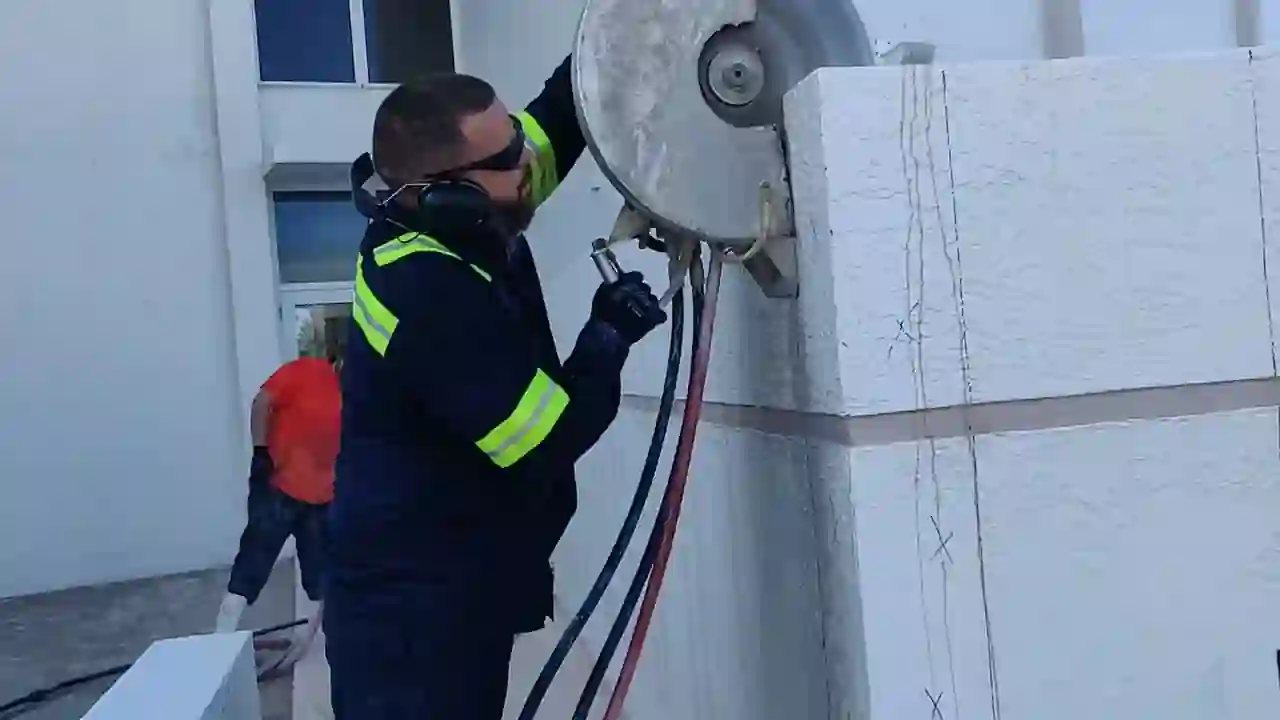
Miami’s waterfront architecture — from Edgewater luxury towers to Coconut Grove marina-adjacent mixed-use — creates a specific class of overhead hazard that inland construction crews rarely encounter. Concrete cutting operations on elevated slabs or balconies generate falling debris, water slurry, and blade fragment risk for workers and public pedestrians below. OSHA 29 CFR 1926.502 requires fall protection at six feet above a lower level in construction, but the debris exclusion zone requirements extend well beyond the immediate work platform.
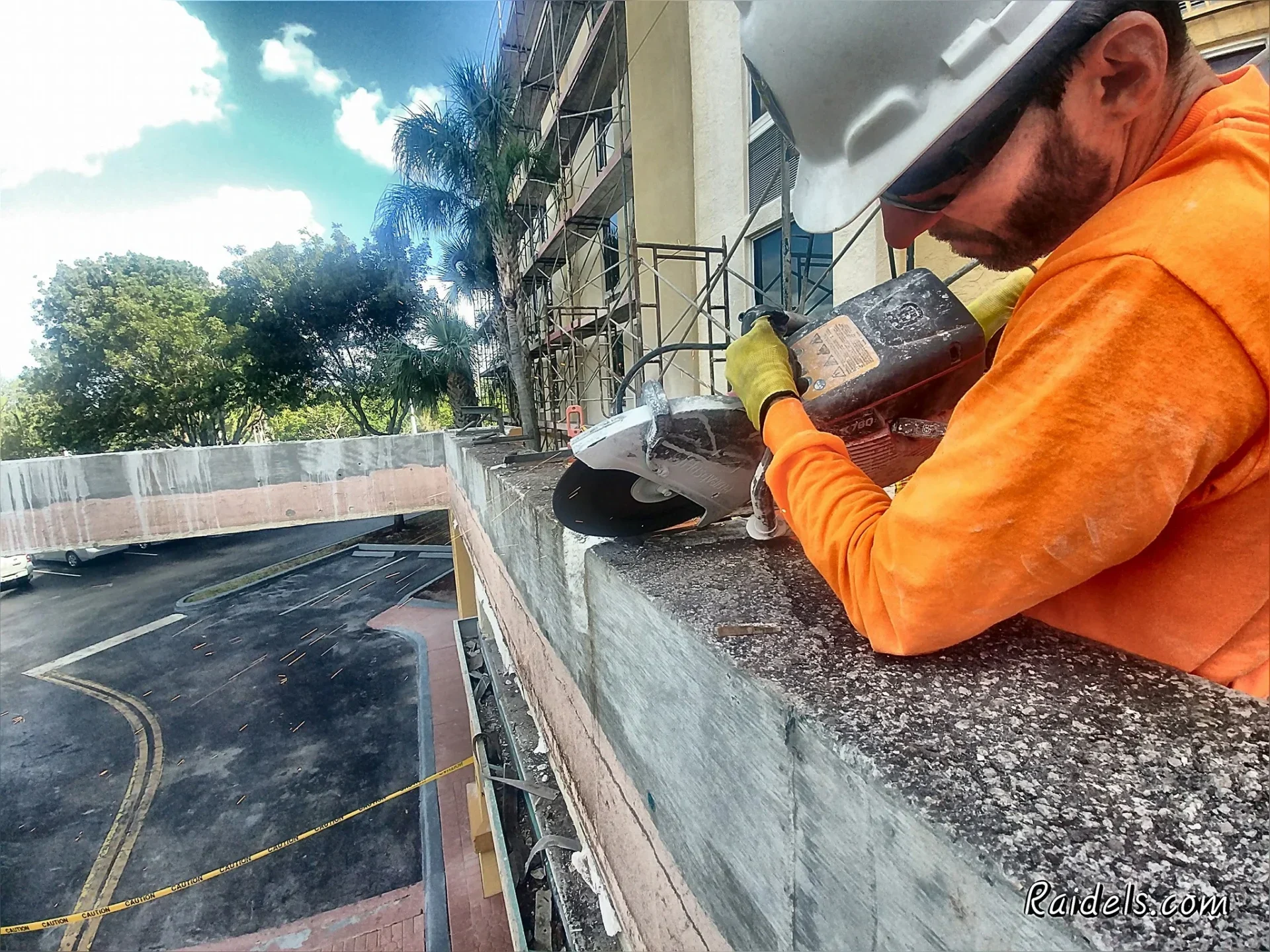
Engineered debris nets rated for the calculated fragment weight must be installed below any elevated concrete cutting operation. On Miami’s high-rise architectural projects, this often means coordinating with the general contractor to establish a dedicated rigging plan for net installation before cutting commences. Blade guards must be fully intact and properly torqued — an inspection item that gets skipped during rushed schedule pushes but represents one of the highest-frequency OSHA violations in the concrete cutting trade. For ground-level work near public rights-of-way, such as sidewalk trip hazard grinding in Miami, physical barricades and signage meeting MUTCD standards are required whenever work encroaches on pedestrian paths.
Electrical and Utility Isolation Procedures Specific to Miami’s Dense Urban Architecture
Miami’s urban core — Brickell, Downtown, Midtown, the Design District — features some of the most congested subsurface utility infrastructure in the Southeast. Electrical conduit, fiber optic runs, chilled water lines, and natural gas service often share the same concrete slab or wall cavity in mixed-use architectural projects. OSHA’s lockout/tagout standard (29 CFR 1910.147, applied to construction via 1926.417) requires full de-energization and verification of all electrical circuits within the cutting zone before work begins. This means physical lockout devices on breakers, not just verbal confirmation from a foreman.
Florida 811 (Call Before You Dig) notification is legally required 48 business hours before any cutting that may contact buried utilities, but in Miami’s architectural renovation market, the real risk is embedded utilities that were never mapped. GPR scanning serves double duty here — identifying both structural steel and hidden conduit. Crews working on seawall repair and marine structure projects face the additional hazard of energized cathodic protection systems embedded in concrete, which must be isolated by a licensed electrician before any cutting or coring begins.
Tool-Specific Hazard Controls for Diamond Blade and Core Drill Operations in Architectural Settings
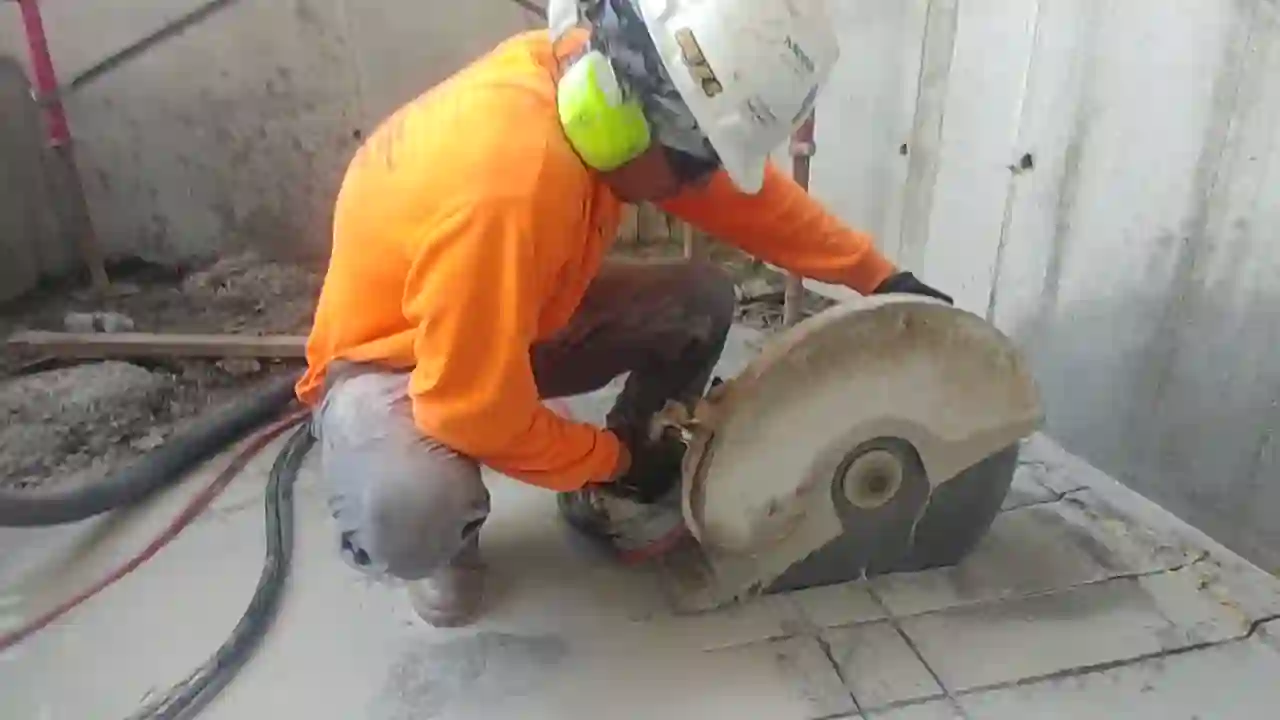
The diamond blades and core drills used in Miami’s architectural concrete cutting environment operate at rotational speeds that generate significant kinetic energy. A 14-inch segmented diamond blade spinning at 5,000 RPM carries enough energy to cause fatal lacerations if it contacts rebar at an unexpected angle and shatters. OSHA 29 CFR 1926.303 governs abrasive wheel machinery in construction and requires machine guarding, proper RPM rating matching between blade and tool, and pre-use inspection of every blade for cracks, missing segments, or delamination.
Operators must be trained and documented as competent persons for each specific tool type — a wall saw operator is not automatically qualified to operate a ring saw in a confined space. Hand tool operations, including chipping hammers and angle grinders used in detail work on Miami’s architectural finishes, carry their own vibration exposure risks governed under NIOSH hand-arm vibration syndrome (HAVS) guidelines. Rotation schedules limiting continuous vibrating tool exposure to 30-minute intervals with equivalent rest periods are now standard practice among compliant Miami contractors. For more on concrete repair hand tools and their safe application, consult manufacturer specifications alongside OSHA guidance.
Confined Space Entry During Core Drilling in Miami’s Architectural Mechanical and Utility Spaces
Miami’s architectural mechanical rooms, parking garage columns, elevator pits, and utility tunnels frequently qualify as permit-required confined spaces under OSHA 29 CFR 1926.1201-1213. Concrete cutting in these environments introduces atmospheric hazards — carbon monoxide from gas-powered equipment, oxygen displacement from wet cutting steam, and accumulation of silica-laden air — that transform a routine coring job into a life-safety operation. Entry without a written permit, atmospheric testing with a calibrated 4-gas monitor, an attendant stationed outside, and a rescue plan in place is a serious violation and a genuine fatality risk.
Miami’s humidity compounds confined space atmospheric hazards. High ambient moisture accelerates CO accumulation from combustion equipment and reduces the effectiveness of passive ventilation. Electric-powered cutting equipment is strongly preferred in confined architectural spaces, and forced-air ventilation calculated at a minimum of 20 air changes per hour must be maintained continuously during cutting operations. Budget planning for these additional safety measures is essential — teams that underbid confined space work and then cut safety corners to preserve margin are the ones generating fatalities and OSHA fatality investigation reports. Review budget planning resources to properly scope safety costs into project bids.
Post-Cut Site Stabilization and Debris Management on Miami Architectural Projects
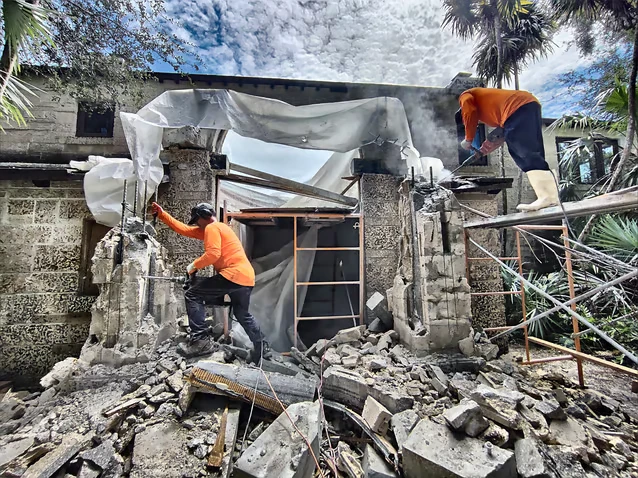
Once cutting is complete, the job-site hazard profile doesn’t reset to zero. Freshly cut concrete edges are razor-sharp and create laceration hazards for all subsequent trades. OSHA requires that all cut edges in pedestrian or worker pathways be clearly marked, guarded, or covered with rated load-bearing covers. Concrete debris and slurry must be staged in designated containment areas — not scattered across the slab where it creates trip hazards for ironworkers, MEP crews, and inspectors moving through the structure.
In Miami’s architectural market, where multiple subcontractors share tight floor plates simultaneously, debris management is a coordination issue as much as a safety issue. The concrete cutting contractor must communicate cut completion status and debris staging locations to the general contractor’s superintendent before demobilizing equipment. Projects in areas like concrete removal in Country Walk and similar residential architectural zones require additional attention to dust and debris containment given proximity to occupied structures. A written site-specific safety plan, reviewed and signed by all cutting crew members before mobilization, is the document that holds everything together — and the document that OSHA will ask for first if an inspector arrives on site.