Why Miami Demolition Companies Operate in One of the Most Hazardous Construction Environments in the Country
Miami’s construction landscape is unlike anywhere else in the United States. You’re dealing with aging concrete structures built before modern seismic and wind-load codes, a coastal environment that accelerates rebar corrosion and concrete spalling, extreme heat that degrades worker performance and equipment tolerances, and an urban density that places active demolition sites within feet of occupied buildings, live utility corridors, and public pedestrian zones. For miami demolition companies, these compounding factors don’t just raise the difficulty level — they raise the body count when safety systems fail. OSHA’s 29 CFR 1926 Subpart T governs demolition operations on federal and state-regulated job sites, and it is not optional reading. It is the legal floor. The professional standard demands you build far above it.
The Engineering Survey Requirement That Most Contractors Underestimate
Before a single tool touches a Miami structure slated for demolition, OSHA 1926.850(a) mandates a competent person conduct a thorough engineering survey of the structure. This isn’t a visual walkthrough with a clipboard. A legitimate pre-demolition engineering survey for South Florida structures must evaluate post-tensioned slab systems, which are extremely common in Miami-Dade County construction from the 1970s onward. Cutting into a post-tensioned slab without identifying and properly relieving or isolating tendons can cause catastrophic, explosive slab failure. The survey must also document the location of all utilities — gas, electrical, water, sewer, and telecom — with as-built drawings cross-referenced against current utility locates. In Miami Beach and waterfront zones, underground infrastructure is frequently undocumented or shifted due to decades of flooding mitigation work. Projects in these areas require additional due diligence, and our team has extensive experience navigating these conditions across Miami Beach job sites where subsurface surprises are the norm, not the exception.
Structural Load Path Analysis Before Selective Demolition Begins
Selective demolition — removing specific walls, slabs, or columns while leaving adjacent structure intact — is one of the most dangerous categories of work performed by demolition companies in Miami. The failure mode here is progressive collapse. When a load-bearing element is removed without temporary shoring installed along the affected load path, the redistribution of dead and live loads can trigger a cascading structural failure within seconds. A competent structural engineer must produce a shoring and bracing plan specific to the sequence of demolition. This plan must be on-site, accessible to the crew, and reviewed during the pre-task safety briefing every single day that selective demolition is active.

Silica Dust Control as a Non-Negotiable OSHA Compliance Requirement
OSHA’s Respirable Crystalline Silica Standard, 29 CFR 1926.1153, became fully enforceable for construction in 2017 and remains one of the most frequently cited violations against demolition contractors in Florida. When concrete is cut, cored, ground, or broken, it releases respirable crystalline silica particles — particles small enough to penetrate deep into lung tissue and cause silicosis, lung cancer, and COPD. The permissible exposure limit (PEL) is 50 micrograms per cubic meter of air as an 8-hour time-weighted average. In Miami’s open-air demolition environments, wind dispersion can create a false sense of safety. It doesn’t. Workers in the immediate cutting zone are still exposed to dangerous concentrations without proper controls.
Compliant silica control for concrete demolition operations requires one or more of the following engineered controls depending on the task type listed in OSHA Table 1 of 1926.1153: integrated water delivery systems that continuously wet the cutting surface during saw operations, local exhaust ventilation (LEV) attached directly to the cutting tool and rated for the dust volume generated, and respiratory protection at minimum N95 filtering facepiece respirators when engineering controls alone cannot reduce exposure below the action level of 25 µg/m³. All workers performing silica-generating tasks must be enrolled in a medical surveillance program if they are regularly exposed above the action level for 30 or more days per year. For more on how we implement concrete safety measures across our South Florida projects, our field documentation standards are available on request.
Wet Cutting Protocols for Slab and Wall Demolition in Confined Urban Sites
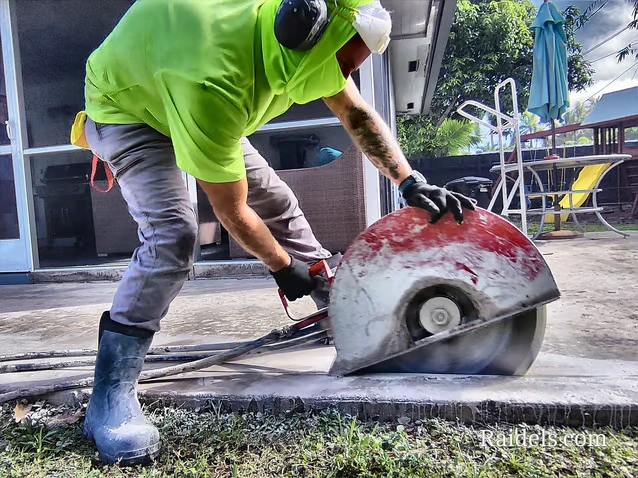
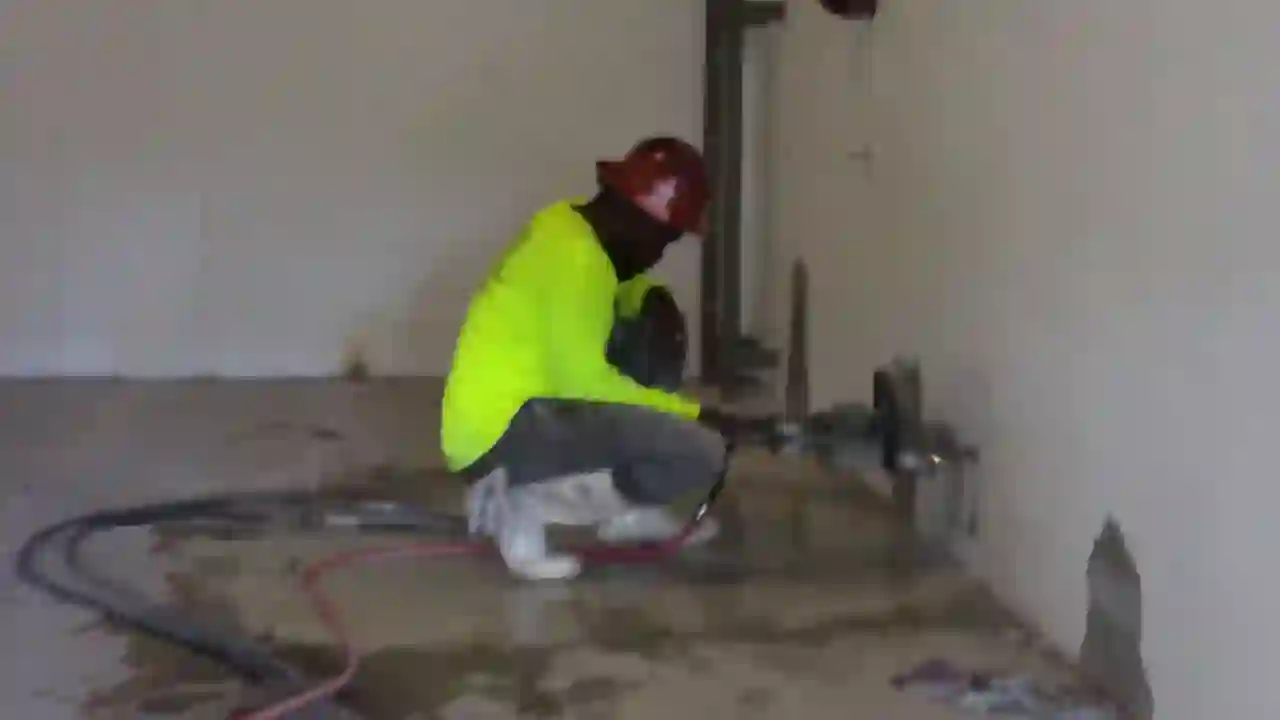
In dense Miami urban environments, wet cutting is the preferred first-line silica control for flat saw, wall saw, and core drill operations. Water flow rates must be sufficient to suppress dust at the blade-concrete interface — typically a minimum of 0.5 gallons per minute for handheld angle grinders up to 3+ GPM for large-diameter flat saws. The water supply must be continuous, not intermittent. Operators must verify water flow is active before the blade engages concrete. Slurry generated by wet cutting is a secondary hazard — it must be contained, not allowed to run into storm drains, and disposed of in compliance with Miami-Dade County environmental regulations, which prohibit concrete slurry discharge into the municipal storm system.
Fall Protection and Elevated Work Platforms During Structural Demolition
Demolition work frequently creates or exposes floor openings, leading edges, and elevated work surfaces that trigger OSHA’s fall protection requirements under 29 CFR 1926.502. Any working surface with an unprotected edge six feet or more above a lower level requires fall protection — guardrail systems, personal fall arrest systems (PFAS), or safety net systems. In Miami’s waterfront and marine demolition environments, this requirement extends to work over or adjacent to water. Drowning is a recognized secondary hazard in these settings, and workers operating near open water must have approved personal flotation devices (PFDs) accessible within the work zone. Our waterfront demolition and cutting operations follow a dual-hazard protocol addressing both fall-to-surface and fall-to-water scenarios simultaneously.
For boat dock modification projects specifically, the combination of deteriorated concrete substrates, tidal movement, and working over open water creates a uniquely hazardous fall environment. Temporary work platforms must be engineered for the load, anchored to stable structure, and inspected before each shift. No improvised scaffolding using dock cleats, railing posts, or vessel gunwales as anchor points — these are not rated structural anchorages and have caused fatal falls in South Florida marine construction projects.
Utility Isolation and Lockout/Tagout Procedures Before Demolition Cuts
Energized utility strikes during demolition are among the leading causes of fatalities on South Florida construction sites. OSHA 1926.850(b) requires that all electric, gas, water, steam, sewer, and other service lines be shut off, capped, or otherwise controlled before demolition work begins. “Before demolition work begins” means before the first cut, the first core, and the first impact — not before the structure comes down. In practice, this requires coordination with FPL, TECO, Miami-Dade Water and Sewer, and AT&T/Comcast utility representatives to physically disconnect and verify isolation of all services. A signed utility isolation confirmation from each utility provider must be on file at the job site. For projects in the Fort Lauderdale metro area, utility coordination protocols differ slightly due to Broward County jurisdiction — our Fort Lauderdale operations team maintains active relationships with all relevant utility authorities having jurisdiction (AHJs) in that market.
Lockout/Tagout for Mechanical and Electrical Systems Within Structures Being Demolished
Beyond utility service lines, structures being demolished frequently contain active mechanical systems — HVAC, hydraulic elevators, fire suppression, and electrical distribution panels — that must be de-energized and locked out before workers enter or begin cutting adjacent structure. OSHA’s Lockout/Tagout standard, 29 CFR 1910.147, applies to these systems in demolition contexts. Every energy isolation point must receive a physical lock from the authorized employee performing the work, and a tag documenting the hazard and the responsible party. Multi-lock hasp devices are required when more than one crew is working in the affected zone. This is not paperwork formality — it is the physical barrier between a worker and electrocution, crush injury, or chemical exposure from pressurized systems.
Driveway and Residential Slab Demolition Safety Protocols in Active Neighborhoods
Residential demolition work — including driveway removal and slab breaking in occupied Miami neighborhoods — carries its own specific hazard profile. Flying concrete debris from jackhammer operations can travel 30 to 50 feet from the impact point. All bystanders, including homeowners, neighbors, and pedestrians, must be kept outside this exclusion zone. Physical barriers — not just cones or tape — must define the perimeter. Workers must wear ANSI Z87.1-rated eye protection, hard hats rated for lateral impact, steel-toed boots, and cut-resistant gloves as minimum PPE for all hand-breaking and saw-cutting operations. Noise levels from demolition equipment routinely exceed 100 dBA at the operator position, triggering OSHA’s Hearing Conservation Standard under 29 CFR 1926.52 and requiring hearing protection rated to reduce exposure below 90 dBA as an 8-hour TWA.
Building a Safety Culture That Outlasts Any Single Job Site
The most technically sophisticated safety plan on paper means nothing if the crew on the ground doesn’t own it. Miami demolition companies that consistently operate without fatalities and without OSHA citations share a common trait — they treat safety briefings as technical training, not compliance theater. Every pre-task analysis (PTA) should be specific to that day’s scope, that day’s hazards, and that day’s crew composition. New workers, subcontractors, and visitors receive site-specific hazard orientation before they step inside the exclusion zone. Near-misses are documented and reviewed without punitive consequences so that hazard patterns can be identified and corrected before they produce injuries. The companies that build this culture don’t just protect their workers — they protect their licenses, their bonding capacity, their insurance ratings, and their ability to bid public work in Miami-Dade and Broward Counties where safety records are a scored evaluation criterion. In this market, safety compliance is not overhead. It is competitive advantage.