Why Glenvar Heights Concrete Removal Is a Logistics Problem Before It’s Ever a Demolition Problem
Most property owners in Glenvar Heights call us expecting a conversation about equipment and timelines. What they get instead is a 20-minute site assessment focused almost entirely on access. That’s not an accident — it’s the right starting point. Glenvar Heights sits in an unincorporated pocket of Miami-Dade County where residential lots are dense, driveways are narrow, mature landscaping crowds every approach, and older construction methods left behind slabs, footings, and walls that weren’t designed with future removal in mind. Before a single saw blade spins, a competent crew has to answer a set of logistical questions that will determine every tool selection, crew size, and debris removal strategy for the entire job. Skipping that step is how projects stall, properties get damaged, and budgets collapse.
Reading the Site Before Any Equipment Is Staged
A thorough pre-demolition site walk in Glenvar Heights covers far more ground than most clients expect. We’re looking at gate widths — not just whether a skid steer can enter, but whether it can turn once inside. We’re measuring overhead clearance on covered patios and carports where slab removal is often requested. We’re identifying utility stub-outs, irrigation lines running under target slabs, and any signs of post-tension reinforcement that would change our cutting sequence entirely. We’re also noting the soil condition around the perimeter of the work zone, because in South Florida’s wet season, ground that looks solid in the morning can become a traction problem for tracked equipment by early afternoon.
Glenvar Heights properties frequently feature rear additions and enclosed patios added decades ago without permits, which means structural drawings rarely exist. That forces our team to perform field verification of slab thickness, rebar spacing, and aggregate composition before selecting blade diameter and bond hardness. Cutting a 6-inch post-tension slab with a blade spec’d for a 4-inch residential pour isn’t just inefficient — it’s dangerous. Our full range of construction services is built around exactly this kind of pre-work verification.
Gate Width, Turning Radius, and the Equipment Substitution Chain
Standard residential gate openings in Glenvar Heights run between 36 and 48 inches. A full-size skid steer with a hydraulic breaker attachment needs a minimum 60-inch clear opening to operate safely. That gap triggers what we call the equipment substitution chain — a pre-planned sequence of alternative tools that can accomplish the same demolition objective within tighter dimensional constraints. In practice, this often means swapping a skid steer for a mini excavator with a compact breaker head, or abandoning mechanical breaking entirely in favor of diamond blade slab sawing combined with manual extraction using pry bars and hand trucks.
The substitution chain has cost implications, and clients deserve to understand them upfront. Manual extraction of broken concrete sections is labor-intensive. A 400-square-foot rear patio slab that a skid steer could clear in two hours might require a four-person crew and six hours of hand work when access is restricted. That’s not a failure of planning — it’s honest logistics. Understanding how concrete cutting costs are calculated helps clients contextualize why confined-space premiums exist and why they’re justified.
Confined Space Slab Sawing Techniques Used in Tight Glenvar Heights Conditions
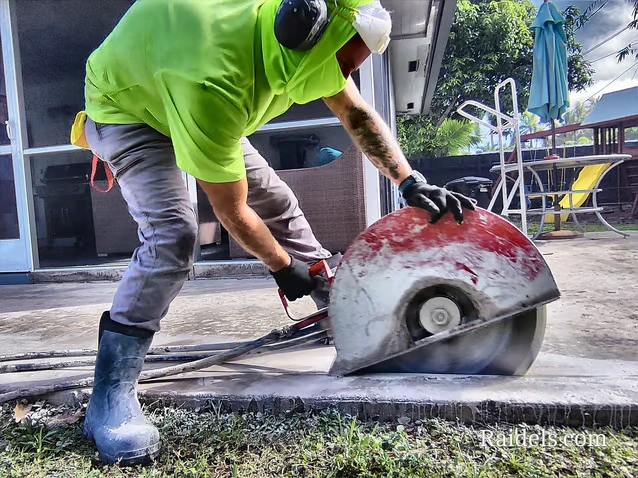
When mechanical demolition equipment can’t reach a target slab, diamond blade flat sawing becomes the primary removal method. In confined conditions, we use walk-behind flat saws with blade diameters ranging from 14 to 18 inches, which allows us to cut panel sections of manageable weight — typically between 150 and 300 pounds per piece — that a two-person crew can extract manually using lifting handles and rubber-wheeled dollies. The panel sizing is calculated based on the extraction path, not just the slab itself. If the only exit route is a 36-inch side gate with a 90-degree turn, panel dimensions have to account for that geometry.
Water management is a secondary challenge in enclosed spaces. Flat sawing requires continuous water flow for blade cooling and dust suppression. In an enclosed patio or interior space, that water has to go somewhere, and uncontrolled slurry runoff into adjacent landscaping or interior flooring is unacceptable. We use wet/dry vacuum slurry management systems on confined jobs to capture and contain the cutting water as it’s generated, which adds setup time but eliminates damage claims and keeps the work zone compliant with Miami-Dade stormwater ordinances.
Hydraulic Hand Tools for Sub-Grade Footing Removal in Restricted Zones
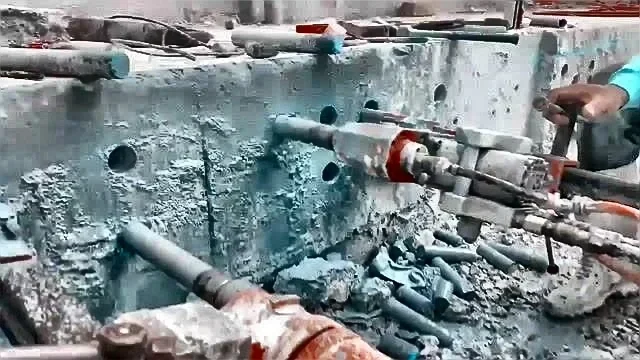
Below-grade work in Glenvar Heights adds another layer of complexity. Footings for older additions often extend 18 to 36 inches below finished grade, and accessing them with conventional excavation equipment is impossible in tight spaces. We deploy hydraulic hand-held breakers — compact units in the 30 to 45 lb class — that can be operated in excavated trenches as narrow as 24 inches. These tools deliver sufficient impact energy to fracture standard 3,000 PSI residential footings, though reinforced footings with #4 or #5 rebar require supplemental cutting with a reciprocating saw or angle grinder to sever the steel before sections can be extracted.
The depth of the footing also determines how we handle spoil management. Excavated soil and broken concrete can’t accumulate in a 24-inch trench without creating a cave-in hazard. We stage removal in lifts, clearing broken material to the surface before advancing deeper. It’s methodical, it’s slower than open-site work, and it’s the only way to do it safely. Our demolition service protocols are built around this kind of staged, safety-first sequencing regardless of how simple a job might look from the surface.
Debris Staging and Extraction Logistics When Dumpster Access Is Blocked
Getting a roll-off dumpster to the curb in front of a Glenvar Heights property is usually straightforward. Getting broken concrete from a rear yard confined space to that dumpster is not. On jobs where the extraction path runs more than 60 feet from the work zone to the dumpster, we pre-position a staging area at the midpoint — typically a 4×8 sheet of plywood laid over the lawn — where crew members can deposit hand-truck loads before a second crew member relays material to the container. This relay system reduces fatigue, maintains a consistent work pace, and prevents the kind of rushing that causes dropped loads and foot injuries.
Concrete debris weight accumulates fast. A single cubic yard of broken concrete slab weighs approximately 2,000 pounds. A 400-square-foot, 4-inch slab generates roughly 5 cubic yards of debris — 10,000 pounds that has to travel from the work zone to the container by human power when equipment can’t reach it. Proper planning for concrete debris removal and disposal after demolition isn’t an afterthought — it’s a core component of the project plan that affects crew sizing, timeline, and total cost.
Protecting Adjacent Structures and Landscaping During Extraction
Glenvar Heights lots frequently have mature ficus hedges, concrete block privacy walls, and decorative pavers immediately adjacent to demolition zones. Protecting these features during concrete extraction requires physical barriers — typically plywood sheets laid on pavers and foam padding strapped to block wall corners — installed before the first saw cut is made. We also use rubber-tired dollies rather than steel-wheeled equipment wherever pavers or decorative concrete flatwork must be crossed, and we designate a single extraction path that gets protected and maintained throughout the job rather than allowing crew members to improvise routes that damage surrounding surfaces.
Vibration management is equally important when working near older block construction. Hydraulic breaker operation transmits ground vibration that can crack mortar joints in adjacent walls, particularly in structures built before modern seismic detailing requirements. On jobs within 10 feet of existing block walls, we limit breaker use and prioritize saw-and-extract methods that generate significantly less ground-transmitted vibration. This protects the client’s property and keeps our work within the scope of what’s covered under standard liability frameworks. Proper maintenance of adjacent structures during demolition is a professional obligation, not an optional courtesy.
What a Properly Scoped Glenvar Heights Concrete Removal Project Actually Looks Like
A properly scoped project starts with a written site assessment that documents gate dimensions, overhead clearances, extraction path distances, slab thickness and reinforcement type, proximity to adjacent structures, and utility locations. From that assessment comes a tool and crew plan, a debris management strategy, and a realistic timeline that accounts for confined-space premiums. Clients who receive this level of pre-project documentation before signing a contract are clients who don’t get surprised by change orders halfway through the job.
Glenvar Heights concrete removal isn’t harder than other Miami-Dade locations because the concrete itself is different. It’s harder because the sites demand a higher level of pre-planning, more specialized equipment configurations, and crews experienced enough to execute manual extraction work efficiently without cutting corners on safety. If you’re evaluating contractors for a confined-space removal project in Glenvar Heights, the first question to ask isn’t about price — it’s about whether they’ve walked the site and can explain exactly how they plan to get the broken material out. The answer to that question tells you everything you need to know about whether they’re actually equipped to do the job.