Why Equipment Specification Is the Deciding Factor in Control Joint Performance
Every slab cracks. The only question is whether it cracks where you planned or where the concrete decided on its own. Cutting control joints in concrete is the industry’s primary method of directing that inevitable shrinkage cracking into a predictable, manageable location — but the results live and die on the equipment you put on the job. Walk onto a South Florida pour with the wrong saw, an undersized blade, or a diamond segment engineered for the wrong aggregate, and you’ll either rip the slab surface, blow out joint edges, or miss the critical timing window entirely. This post breaks down the machinery, the diamond tooling geometry, and the blade selection logic that separates a clean, functional control joint from a liability.
Walk-Behind Slab Saws Versus Early-Entry Saws — Matching the Machine to the Pour Schedule
The first equipment decision isn’t which blade to run — it’s which saw platform is appropriate for the timing window you’re working in. Two primary machine categories dominate control joint work: conventional walk-behind slab saws and early-entry dry-cut saws. Each has a specific performance envelope, and confusing them is one of the most expensive mistakes a crew can make.
Conventional Walk-Behind Slab Saws for Standard Timing Windows
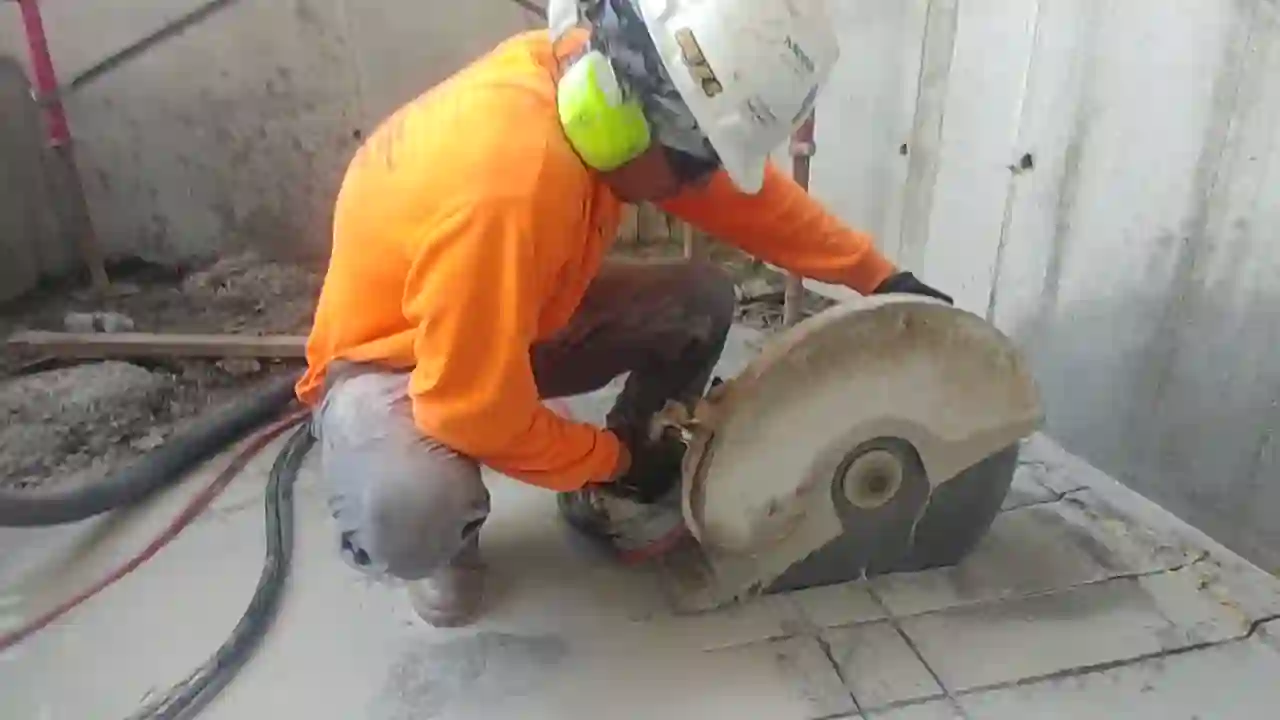
Walk-behind slab saws in the 25–65 horsepower range are the workhorses of control joint cutting when the concrete has achieved sufficient surface hardness — typically 4 to 12 hours after the finishing operation, depending on ambient temperature, humidity, and mix water content. In Miami’s subtropical climate, that window compresses dramatically during summer pours. These saws operate at blade shaft speeds between 1,450 and 2,800 RPM depending on the model, and they accept blade diameters from 10 inches up to 20 inches for standard slab work. The higher-horsepower units — think the Husqvarna FS 7000 D or the Multiquip SawMaster series — deliver the torque needed to run larger-diameter blades through high-PSI mixes without the motor bogging under load, which is critical for maintaining consistent cutting depth on long joint runs.
Early-Entry Saws and the Green Concrete Timing Advantage
Early-entry saws like the Soff-Cut series or the Husqvarna Soff-Cut X4000 operate with a skid plate system that allows cutting to begin as early as one to four hours after finishing — before raveling becomes a risk. These machines run smaller-diameter blades (typically 6 to 14 inches) at higher RPM ranges and are specifically engineered to produce a narrow kerf without undercutting aggregate at the joint face. The skid plate prevents blade deflection and surface raveling by distributing the machine weight around the blade entry point. For Miami contractors dealing with accelerated set times driven by heat and humidity, early-entry equipment often represents the only viable path to hitting the timing window before random cracking initiates. For context on how environmental conditions interact with concrete work in this region, the technical notes at our concrete cutting and slurry management guide address similar climate-driven complications.

Diamond Blade Geometry and Segment Specification for Control Joint Cutting
The blade is where physics meets metallurgy, and the specifications matter at a granular level. A diamond blade engineered for cutting control joints in concrete is not the same tool as a general-purpose demolition blade, even if both carry diamond segments. The differences in bond hardness, diamond concentration, segment height, and kerf width directly determine joint quality, blade life, and the risk of surface damage.
Bond Hardness Matched to Aggregate and Mix Design
Diamond blades are classified by bond hardness — the metal matrix that holds the diamond crystals in place. The fundamental rule is counterintuitive to most people new to the trade: hard aggregate requires a soft bond; soft aggregate requires a hard bond. In South Florida, you’re frequently cutting mixes that incorporate Miami oolite limestone as coarse aggregate. Oolite is a relatively soft, porous material that wears the bond matrix quickly. Running a soft-bond blade on oolite-aggregate concrete will prematurely expose and lose diamonds before they’ve done useful work. For oolite-heavy mixes, a medium-to-hard bond segment in the 30–45 Rockwell C range gives the blade the wear resistance to stay in service through a full joint layout. Conversely, hard silica gravel or trap rock aggregate — common in imported fills and structural slabs — demands a softer bond so the matrix wears away at a rate that continuously exposes fresh diamond cutting points.
Diamond Concentration and Grit Size for Joint Face Quality
Diamond concentration in a segment is expressed as a percentage by weight of diamond to total segment volume. Standard concentrations for control joint blades run between 25 and 40 percent. Higher concentration doesn’t automatically mean better performance — it means more cutting points in contact simultaneously, which increases load on the saw motor and generates more heat. For control joint work where joint face integrity matters (especially in industrial floors that will see hard-wheeled traffic), a medium concentration (30–35%) with a medium grit size in the 40–60 US mesh range produces the cleanest cut face with minimal microfracturing at the joint edges. Coarser grit cuts faster but leaves a rougher face; finer grit extends blade life and improves surface finish at the cost of cutting speed.
Segment Height, Kerf Width, and Depth-to-Thickness Ratios
Segment height on a control joint blade typically runs 10–15mm for standard slab work. Taller segments extend blade life by providing more diamond-bearing material before the blade core is exposed, but they also increase the lateral surface area in contact with the cut walls, raising friction and heat. Kerf width — the actual cut width — should be matched to your joint sealant specification. Most control joint sealant systems require a minimum kerf of 1/8 inch (3.2mm) to allow proper sealant tooling and bonding. Standard turbo or segmented blades for this application produce kerfs in the 0.125–0.145 inch range. The depth specification is non-negotiable from a structural standpoint: control joints must be cut to a minimum of one-quarter the slab thickness. On a 6-inch slab, that’s 1.5 inches minimum. Shallow cuts don’t create the stress concentration needed to direct cracking, and the joint fails its primary function entirely.
Wet Versus Dry Cutting Equipment Configurations and Slurry Management
Wet cutting with continuous water flow to the blade is the standard approach for walk-behind slab saws on hardened concrete. Water serves three functions simultaneously — it cools the blade to prevent segment glazing, it suppresses respirable silica dust, and it flushes cuttings from the kerf to prevent recutting. A minimum flow rate of 1.0–1.5 gallons per minute to the blade is required to maintain adequate cooling. Insufficient water flow is the leading cause of premature blade failure in the field, and it’s a documented hazard prevention issue that affects both equipment longevity and worker safety on the job site.
Early-entry saws are inherently dry-cut systems — introducing water to green concrete creates surface defects and interferes with the hydration process. These machines rely on the skid plate and blade geometry to manage heat, and they require HEPA-filtered vacuum systems for dust collection to remain compliant with OSHA’s Table 1 silica standard. Any crew running early-entry equipment without integrated dust collection is operating outside regulatory compliance.
Blade Selection Quick-Reference for Common Miami Slab Scenarios
- Standard residential slab (3,000–4,000 PSI, oolite aggregate, wet cut): Medium-hard bond, 30% diamond concentration, 14-inch diameter, 0.130-inch kerf, continuous rim or segmented profile.
- Industrial warehouse slab (5,000+ PSI, silica aggregate, wet cut): Soft bond, 35% concentration, 16–18-inch diameter, turbo segment profile for aggressive material removal.
- Early-entry green concrete (any mix, dry cut): Proprietary early-entry blade with integral skid plate compatibility, typically 10–14-inch diameter, hard bond to compensate for abrasive unhydrated cement paste.
- Post-storm repair and re-cutting deteriorated joints: Medium bond, aggressive segment profile to handle contaminated or partially deteriorated concrete. See our resources on storm cleanup concrete work for additional context on degraded slab conditions.
- Decorative or exposed aggregate slabs: Fine-grit, high-concentration blade to minimize surface chipping adjacent to the joint line. Consider pairing with chiseling techniques for joint prep on ornamental work.
Saw Speed, Feed Rate, and the Physics of Blade Loading
Running a blade at the correct peripheral speed — measured in surface feet per minute (SFPM) — is as important as blade selection itself. Most diamond blades for slab cutting are rated for operation between 9,000 and 12,000 SFPM. At a given RPM, peripheral speed is a direct function of blade diameter. A 14-inch blade running at 2,800 RPM generates approximately 10,267 SFPM — well within the optimal range. Drop to a 10-inch blade at the same RPM and you’re at 7,330 SFPM, which is below the threshold for efficient diamond exposure and cutting action.
Feed rate — how fast you push the saw along the joint line — controls the load on each diamond segment. Too fast, and you’re overloading the segments, generating heat, and risking segment loss. Too slow, and the blade glazes because the bond matrix isn’t wearing fast enough to expose fresh diamonds. For standard 4,000 PSI concrete with a 14-inch blade, a feed rate of 8–15 feet per minute on a wet-cut walk-behind saw is the practical working range. Increase that feed rate on softer mixes; reduce it on high-PSI structural pours. The saw motor’s load indicator — whether amperage draw on electric units or RPM drop on gas/diesel units — is your real-time feedback mechanism for dialing in the correct feed rate on any given pour.
Blade Mounting, Arbor Fit, and Pre-Cut Inspection Protocols
A technically perfect blade selection is worthless if the blade isn’t properly mounted. Arbor fit must be exact — a blade with a 1-inch arbor bore running on a 1-inch shaft should have zero lateral play. Any wobble at the arbor translates to kerf width variation, joint face chipping, and accelerated bearing wear on the saw. Always inspect the blade flanges for flatness before mounting; a warped flange induces runout that destroys joint quality and can cause catastrophic blade failure. Torque the arbor nut to the manufacturer’s specification — typically 35–50 ft-lbs for standard slab saw configurations — and verify blade tracking in a free-spin test before entering the cut. These pre-cut protocols aren’t optional formalities; they’re the last line of defense between a productive joint run and a blade separation event.
Cutting control joints in concrete at a professional level means treating blade selection and equipment specification as engineering decisions, not purchasing decisions. The right diamond tooling for your mix design, your saw platform, and your timing window is the difference between a slab that performs for decades and one that requires remediation before the building is even occupied. When the specifications matter — and in Miami’s demanding construction environment, they always do — the equipment choices made before the first cut determines everything that follows.